

Why America Needs To Rethink Its China Strategy - Zhengyu Huang
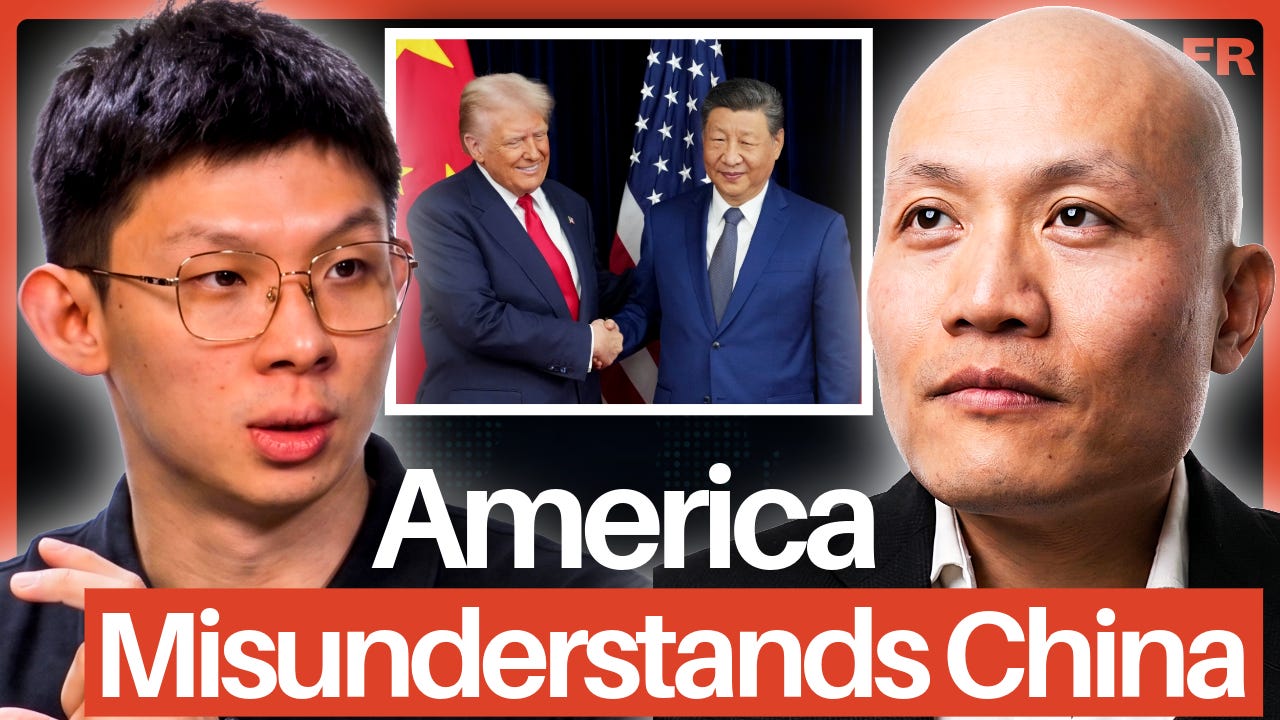
Zheng Yu Huang is a technology executive, entrepreneur, policy adviser, and author whose career spans Silicon Valley, the Obama White House, and the US-China policy arena.
He is the author of Rethinking China: Challenging Our Economic Assumptions and Opportunities for Lasting Prosperity, as well as Lifelong Learning: Six Classes After Harvard Graduation, published in Chinese.
Huang holds a BS in Industrial Engineering, a BA in Economics, and an MS in Computer Science from Stanford University, and an MBA from Harvard Business School.
After Stanford, Huang joined Intel Corporation, rising to Managing Director — one of the youngest to hold that title.
He subsequently served as a White House Fellow under President Obama, becoming the first person of mainland Chinese origin to hold that distinction, as well as a Special Assistant to the Administrator of the US Agency for International Development.
During his fellowship, he led an interagency task force to restore Haiti's telecommunications infrastructure following the 2010 earthquake.
After leaving government, Huang founded a financial services data firm that grew to 300 staff across seven offices, reaching a valuation of $100 million.
He later served for four years as President of the Committee of 100, the prominent Chinese American organisation co-founded by IM Pei and Yo-Yo Ma.
In this conversation, Huang draws on that breadth of experience to challenge what he argues are dangerously flawed assumptions underlying current US policy and the pivots US administrations need to consider.
TIMESTAMPS:
00:00 Trailer
00:55 A Drive-By Shooting on My First Month in America
5:29 Why America Is Still the Land of Opportunity
9:24 Negotiating IP With Beijing at Intel
16:27 What the White House Fellowship Taught Me About Power
23:49 When US-China Relations Broke
27:49 The Consequences of Getting Your Assumptions Wrong
33:14 Why Southeast Asia Is America's Blind Spot
34:41 The Real Reason the US Pivoted to Securitisation
35:43 The China Shock Was Never Really About China
41:15 The $600 Billion Number That Isn't Real
46:26 How the China Initiative Destroyed Innocent Lives
52:59 Compete or Cooperate? The AI Question
58:03 What History Tells Us About US-China-Taiwan
1:00:57 What China Gets Wrong About America
1:06:10 Focus on Results: A New China Strategy
1:08:32 America's Real Domestic Challenges
1:11:59 One Final Piece of Advice
This is the 81st episode Of The Front Row Podcast
Keith 00:00:55
You were a migrant who came from Shanghai and moved to the US, navigating a dual identity — first as an ethnic Chinese immigrant, and subsequently as an American citizen. I'd like for you to unpack a little more about your experience growing up in the US.
Zhengyu 00:01:17
I arrived not speaking a word of English. About a month into the move, my dad was studying during the day and working at night as a motel manager. My mom and I would bring him soup — this was downtown LA.
I remember one night, walking to his workplace around 10 or 11 PM. The streets were deserted. We walked past a hotel, and out came a gallantly dressed couple who had clearly just been to a party. They were maybe four or five paces ahead of us, and we thought, great — some company for the walk.
Then I heard a car screech by. As it turned the corner, I heard what I thought were firecrackers — growing up in China, you play with firecrackers, especially at Chinese New Year. Then the woman was lying in a pool of blood, and the man was screaming for help. That was my first drive-by shooting.
My mom and I ran as hard as we could. When our bodies finally gave out and we stopped to catch our breath, I thought to myself: this is a brave new world. So different from everything in my first ten years. I must really understand it.
I think I've carried that perspective ever since. I've been to about 92 countries, and every time I go somewhere, I try not to assume what that place is about — I try to figure it out. That stems from being an immigrant. I had to understand and make a life in this brave new world, make a home for myself. And that is, I think, the story of so many immigrants who came to America and, in that process, contributed to its growth and success.
Keith 00:03:49
I'd like you to elaborate a little more on what kept you in the US — what made America appealing enough that you decided to call it home. Earlier you mentioned the drive-by shooting. Why didn't that push you away?
Zhengyu 00:04:06
I've been to over 90 countries and lived in five. And I must confess: America still seems like the place where, regardless of where you're from, if you work hard and pursue your dreams and passions, you have a chance to make it. This is why Elon Musk didn't found his companies in South Africa, where he's from. This is why Eric Yuan started Zoom in Silicon Valley. The list goes on.
Even though for many people the American dream may be fading, I saw it — I bear witness to it. And the second thing is a genuine sense of helping each other. America is known as individualistic, very much out for oneself — but I can look back on everything I've accomplished and think of all the people who helped me along the way. None of them asked for anything in return. They helped because they could, and they were willing to take a risk on a young man. I'm very grateful for that. In many senses, America is still that land of opportunity.
Keith 00:05:29
You went to Stanford and rose to become one of the youngest managing directors at Intel. One of the early milestones in your career was negotiating an IP transfer with the Chinese government. I'd like you to pull back the curtain a little. What was that experience like? Because I think it sets up the frame for understanding technology transfer to China in the earlier years of the US opening up.
Zhengyu 00:06:06
We were negotiating with multiple agencies within the Chinese government — the lead agency being the Ministry of Information and Technology — at the vice minister level, which is where the real work gets done.
In one meeting, I had with me a senior vice president visiting from the United States. He spoke at length. The first thing the Chinese officials said was: "You Americans don't understand what's going on in China. You don't understand us."
After he finished, I said: "You're right." And I explained that Intel has never charged intellectual property fees on any technology. We produce enormous amounts of IP — in microprocessing, in wireless — but we've never charged for it, because we believe technology should be global, shared, and that its benefits should go to consumers wherever they are. And we believe that China also wants to be a technology leader. In 3G alone, China paid over $100 billion in IP fees — a number slated to grow significantly in 4G.
I had prepared this response because I had heard the same complaints many times. After I finished, the government official paused, then turned and said: "You're Chinese. You understand what I'm talking about."
The fact is, I was representing an American company. All I had done was articulate that I understood the Chinese perspective — not that I agreed with it, but that I understood it, and that our intentions took their concerns into account. That was probably the biggest lesson: at some point, you don't have to agree with somebody, but showing that you understand makes an enormous difference in bridging the divide.
Keith 00:08:55
That was really about going to the table, understanding their interests, and finding a win-win solution.
Zhengyu 00:09:07
Exactly.
Keith 00:09:08
You were also a White House Fellow.
Zhengyu 00:09:10
Yes.
Keith 00:09:11
For those of us in Southeast Asia and Singapore, we might not be entirely familiar with the programme. Could you explain what the White House Fellowship is, and what your experience was like serving under President Obama?
Zhengyu 00:09:24
The programme was started by Lyndon B. Johnson during the Vietnam War era, when many young people were protesting against the government. Johnson's idea was: what if we invited perhaps ten of the most promising young leaders in America to spend a year in the White House, with full access to the most senior people in American government, and then send them back into all parts of American society? By understanding government, whatever they chose to do later, they would be better equipped to engage with it. Every year, roughly ten to twelve people — usually in their mid-thirties — are selected.
I was fortunate to be selected in what I believe was the second year of President Obama's term. One story I can share: we had multiple meetings with the president, and in one of the first, we sat in the Roosevelt Room. It's a long table; the president sits at the head, and the back of each cabinet secretary's chair bears their name — because when a secretary retires, that chair is typically given to them as a token of appreciation.
I asked President Obama a question: "Mr President, what has been your biggest realisation since taking office?"
He paused for perhaps twenty or thirty seconds — which feels like a very long time — and I worried I had offended him. But when he spoke, he said: "The people around this table — the Secretary of Energy, Steven Chu, has a Nobel Prize; the Secretary of Defense, Bob Gates, served perhaps thirty or forty years in various capacities in Washington; the Secretary of State, Hillary Clinton, was First Lady. Everyone at this table is probably smarter than me in their respective area."
"But the second thing I know," he continued, "is that every issue that comes to my table is genuinely unsolvable — because if it were solvable, one of these very smart people would have already solved it. So my role as president is to gather all the wisdom around me and make a decision on something that seems intractable, in a way I believe is correct, in order to push the matter forward."
That stayed with me. So many of the challenges America grapples with today — racial inequality, wealth inequality — have been around for decades. They come to every president. The best any president can do is gather the wisest counsel available, make a decision they believe is right, and advance the agenda a little further.
Keith 00:13:29
Were there other crucial lessons from your year in the White House?
Zhengyu 00:13:35
When the Haitian earthquake happened — around January 2010 — roughly 250,000 people died. Because of the longstanding relationship between Haiti and the US, the American government was invited to assist with search and rescue. Because of my background at Intel in telecommunications, I was put in charge of an interagency task force to restore the telecommunications network. This was critical: many people were still trapped in the rubble with mobile phones, and that network was the primary way to communicate with survivors and direct the delivery of food, water, and essential supplies.
The task force brought together about ten different agencies, including the FCC and FEMA, and I had a one-star general seconded to the group. I was working until three or four in the morning every night.
One night, leaving around 3 AM, I stepped outside into the bitter Washington cold. The sky was pitch dark, but clear enough to see the stars. And it struck me: public service means something. In DC, people say "thank you for your service" — not just for your leadership, but for your service. That night it hit me. The best we can do for the world is to be of some service to others.
And the US government — it's like a giant elephant. Generally it doesn't move much. If a fly lands on it, the elephant swats its tail. But if you get it truly moving, it becomes a formidable force.
Keith 00:15:55
You have been quite critical of some of the core assumptions underlying US policy towards China — arguing that they are not merely flawed, but actively harmful. When did you first start recognising that this was a serious problem, and that the US-China relationship had fundamentally fractured?
Zhengyu 00:16:24
I became president of the Committee of 100 just a couple of days after the start of COVID. By way of brief background: the Committee of 100 is a nonprofit organisation founded about thirty years ago by prominent Chinese Americans such as IM Pei, the noted architect, and Yo-Yo Ma, the celebrated cellist, among others. The story goes that IM Pei was good friends with Henry Kissinger, and over dinner in New York one night, Kissinger said: "US-China relations are on the up. Chinese Americans — you have the cultural background and linguistic skills to play a critical role." And so the Committee of 100 was formed with two purposes: to advance Chinese American inclusion, and to foster a more productive US-China relationship.
It is a member-based organisation of roughly a hundred people — you might know Gary Locke, former ambassador to China, or Jerry Yang, the founder of Yahoo, among others. I served as president for about four years.
In one of my early meetings at the State Department, a senior official said to me: "Mr Wang, you have to understand — the relationship between the US and China has fundamentally changed. And you as Chinese Americans must take a stand." That statement made clear to me that after roughly forty years of engagement, the US strategy towards China had shifted from engagement to competition and confrontation. And unfortunately, Chinese Americans were the only people in America who looked Chinese. In many ways, we found ourselves caught between a rock and a hard place.
Keith 00:18:43
You are right to frame this as a shift from competition to confrontation — and I think that distinction matters enormously. You can compete without entering an escalatory spiral of confrontation. One of the core intellectual arguments in your work is that the assumptions driving US policy towards China are not just incorrect, but harmful. Why, in your view, does the Yellow Peril trope remain so persistent — and why has anti-China sentiment become, in some respects, almost unanimously bipartisan?
Zhengyu 00:19:36
Let me answer in two parts. The first is that this pivot in US strategy happened about ten years ago, and my book was written precisely because, after a decade, the results are in. I spoke to more than 300 leading experts on US-China relations in the United States and Europe, and I examined the data and evidence to assess whether this pivot has made American businesses more competitive, made America more secure, and advanced American interests and values around the world — three goals on which virtually all Americans agree.
And the truth is, all the data and evidence suggest otherwise. The strategies pursued over the last ten years have not yielded the results intended. Which then leads to the question: why not? And this brings me to a principle I learned at Harvard Business School — GIGO: garbage in, garbage out. If your assumptions are wrong, no matter how much resource or talent you apply, you will still get bad output.
One of those underlying assumptions — unspoken but persistent — is the trope of the Yellow Peril. What is the Yellow Peril? It dates back more than a hundred years: the belief that a yellow horde from Asia is coming to take over America, destroy Western civilisation, and destroy the American way of life. Consciously or unconsciously, this persists today — and it clouds judgement. It underpins fear-based policy. And as we know, human beings almost never make good decisions when they are afraid.
Keith 00:22:48
I spoke with Michael O'Hanlon from the Brookings Institution about America's involvement in wars, and he made the point that America often continues to be a great power in spite of itself — that many of its military involvements, from Vietnam to Iraq, were ultimately mistakes. We are seeing something similar play out now with the assumptions underlying US involvement in Iran. I'd like to use that as a frame. What do you think are the assumptions that are currently wrong in US policy towards the Middle East — and what does that tell us about how America understands powers that seek to challenge its dominance?
Zhengyu 00:23:50
Let me give you clear examples from the past. We entered Vietnam on the false assumption that if South Vietnam fell, the rest of Southeast Asia would follow — the so-called domino effect. South Vietnam did fall. Southeast Asia did not. We entered Iraq on the assumption that there were weapons of mass destruction. There weren't. We went into Afghanistan on the false assumption that defeating Al-Qaeda required defeating the Taliban, which proved not to be the case. And in Iran, the intervention proceeded on the assumption that the regime was imminently developing a nuclear bomb — which, according to virtually all experts, was not true.
These are the kinds of assumptions that, when wrong, provide a disastrous foundation for any military expedition.
How does this apply to China? Today, we are already at war with China — a tech war, a trade war, a currency war, a media war. Every form of conflict, in fact, except a kinetic one: a direct military confrontation between the two largest economies on earth, each with nuclear weapons capable of devastating the other. And we are dangerously close.
Most people do not fully appreciate what a Taiwan contingency would actually involve. Unlike Ukraine, Taiwan has no capacity to defend itself without the active military participation of the United States. To put this in context: Taiwan has a population smaller than the city of Shanghai. Its GDP is smaller than Shanghai's. It has no realistic prospect of defending itself against China — all it could do is prolong the time before the United States intervenes.
And yet most discussions stop there, without asking what happens in the actual conflict. I went and found the answers. Many war games have been conducted, most classified, but some public. The ones in which America wins the first engagement — and it does not always win — project losses in the first two to three weeks of perhaps two aircraft carriers, a dozen warships, hundreds of aircraft, and thousands of service members. Roughly half the total American losses over ten years in Iraq. In two to three weeks.
And then I always ask: what happens after the first battle? No expert believes China would simply concede after a single engagement. The conversation then turns to escalation: does the United States strike the Chinese mainland — where most missile batteries, naval bases, and weapons production are located? And if it does, does China then strike American military bases or the American mainland? At that point, how quickly does this approach nuclear exchange?
I have to tell you — when I pressed experts on those scenarios, they literally stopped talking. The scenarios are too frightening to contemplate.
For me, the conclusion is clear: if we fully understand not just the possibility but the potential consequences of war, then we must ask very precisely what we are fighting for. If there is a real risk of this going nuclear, then what, exactly, justifies that? And I have not yet heard a compelling answer.
Some say we must defend Taiwan because it is a democracy. But the United States did not intervene militarily in Ukraine, which is also a democracy. Others say we must fight for Taiwan's semiconductor dominance. I worked in semiconductors for seven years. That argument is nonsensical — if the US wanted to deny China those assets, it could simply destroy the fabrication plants. The idea that we must go to war to protect them makes no sense.
The most coherent argument I've heard is that if the United States fails to defend Taiwan, it may lose the trust of Southeast Asia. That may be true. But if that is the concern, then the answer is to deepen our engagement with Southeast Asia now, before any conflict — not to prepare for a kinetic confrontation. And instead of deepening that engagement, the United States has largely pulled away. China and Southeast Asia are each other's largest trading partners. The US is falling far behind on economic and broader engagement with the region.
What troubles me most is that the American media discusses this potential conflict constantly, without helping Americans truly understand its consequences — and without asking whether, given those consequences, the underlying justifications hold up.
Keith 00:31:51
When you talked about Taiwan, one thing I've observed is a profound asymmetry in commitment. When I speak to friends on the mainland, Taiwan is almost an existential red line — it touches something at the core of Chinese identity, and the emotion around it is intense. When I speak to American friends, the issue is often framed as a tool for constraining China, and when you press them, many are not deeply committed to it at all.
Given that asymmetry, and given your point that the US needs to deepen its engagement in Southeast Asia — what would that actually look like in practice? What policy recommendations would you make to a Washington decision-maker?
Zhengyu 00:33:13
Southeast Asia is on track to become one of the world's four largest economic blocs over the coming decades, with one of the largest, most dynamic, and best-educated young populations globally. Even today, you are seeing a remarkable supply chain forming across the region, serving not just the United States but advanced economies worldwide.
If the United States were to identify the key regions it must engage beyond the usual interlocutors — the EU, China, India — Southeast Asia is the obvious answer. It is, frankly, a no-brainer.
And here is what I find important: every person I have spoken to in Southeast Asia understands that China is here. China is not going anywhere. China has 1.4 billion people, the world's second-largest economy, and is every Southeast Asian country's largest trading partner. But every person I've spoken to also wants the United States to have a meaningful role — both because America has genuinely extraordinary things to offer in terms of innovation, market access, and institutional capacity, and because an American presence provides a useful counterbalance to China.
The United States has an open invitation to deepen its engagement across the region — economic, cultural, educational, diplomatic. What I see instead is a strategy almost entirely focused on military deterrence, carried out without the attendant integration across all other domains. That is an unfortunate imbalance, and a costly one.
Keith 00:35:43
Why do you think there has been this persistent shift towards securitisation? What caused it?
Zhengyu 00:35:59
The United States is going through profound internal change — trying to make sense of how the promises that generations of Americans believed in can be renegotiated in a world transformed by AI, by globalisation, by rapid technological disruption. And in that process, as throughout American history, it is always tempting to blame a foreign group. Whether it's Mexicans, Chinese, or Indians — fear is an effective way to mobilise voters, and externalising a domestic problem is politically convenient for people on both sides of the aisle. It doesn't solve the problem, but it works as a short-term strategy.
My book examines China's entry into the WTO and what became known as the China shock. I spoke to the economists who authored that research, and to pretty much all the scholars who have studied its effects on US employment. They found that yes, perhaps a million manufacturing jobs were lost as a result of China joining the WTO. But the part almost nobody discusses is that roughly the same number of jobs — perhaps more — were created in its wake. The difference is that those jobs were created largely in coastal, high-skill, high-mobility regions of America. The people most hurt were those who were less mobile, less educated, and concentrated in specific geographies — the middle of the country, the south.
The China shock, properly understood, is not a story about what China did to America. It is a story about the concentrated costs and distributed benefits of globalisation. And without addressing that directly — without real, concerted strategies to help the people most affected — even if you removed China from the equation entirely, you would still face fierce competition from India, Malaysia, Indonesia, and others. The US economy has shifted from manufacturing to services. If you call a service centre today, you're speaking to someone based in India, the Philippines, or Malaysia — not China — because that part of the economy has moved.
Without honestly confronting the effects of globalisation, this problem will persist. Politicians find it easy to say: here is the villain, if we block them, your problems go away. Tariffs and bans are simple answers. But the right answer is harder — investing in helping American workers migrate to better opportunities, building resilience against the structural effects of globalisation. That work is unglamorous, and it takes time. But done well, it would actually help people.
Keith 00:40:17
I've read the research as well, and I think one thing often missed is that the outsourcing of manufacturing and the emergence of global value chains — which Singapore benefited from enormously — were already underway two decades before China entered the WTO. Perhaps it was the sheer scale of China that brought the trend into sharper relief, but the underlying dynamic was already there. So when people draw the wrong conclusions from the data, as you say, it tends to cause more harm than good.
This brings me to the specific issue of the $600 billion IP theft figure. You have been quite direct in arguing that this number is not merely wrong but actively harmful. Help me understand: where did it come from?
Zhengyu 00:41:39
I heard politicians — including presidents and presidential candidates — use that figure constantly: $600 billion stolen annually by the Chinese from the United States. Being an engineer by training, I was genuinely curious about where that number came from. It is an enormous figure. I asked every expert I could find. Almost nobody could answer. I got blank stares — as if asking the question was somehow impertinent.
I finally tracked down someone who explained it. The number originates with the OECD, and it is a rough estimation: typically about two to three per cent of national GDP is estimated to be lost to IP loss globally. The US economy at the relevant time was about $20 trillion. Three per cent of $20 trillion is $600 billion. But IP loss has many categories — the largest being counterfeit goods: fake Nikes, fake watches, and so on. All of that rough global estimate was attributed to China. That is how you arrive at $600 billion.
When I dug further, I found some rigorous, credible think tanks that had actually analysed how much is genuinely stolen from the United States by Chinese actors. Their estimate: roughly $30 to $40 billion. Now, $30 to $40 billion is still a significant number. But it is 96 per cent smaller. The magnitude matters enormously.
Here is why. If you believe the $600 billion figure, then there must be a vast spy network — countless operatives inside the United States stealing at that scale. And on the basis of that assumption, the Department of Justice launched the China Initiative in 2018 — the first law enforcement programme ever targeted at a single country. The FBI director at the time said they were opening one new China case every ten hours.
So then you ask: who do you actually target? There were not that many spies. But the most visible and accessible targets were Chinese American academics, who for four decades had been actively encouraged by their universities to engage with Chinese counterparts — precisely because of their language skills and cultural knowledge. Everything they did was public, posted on the web, and it instantly became suspect.
The China Initiative ensnared thousands of Chinese American scientists. The MIT Technology Review conducted a comprehensive analysis of all the cases brought under the initiative. They found that none of those cases — essentially zero — involved economic espionage. The cases fell apart on shoddy evidence. But in the meantime, thousands of people's careers and lives were destroyed. Many Chinese American scientists left the United States. Some went elsewhere in the world. A significant number went back to China.
Consider the context: there is a great deal of talk in the United States about winning the AI competition with China, because AI is genuinely transformational. I agree. But transformational technological leadership — in quantum computing, nuclear fusion, nanotechnology, genetic engineering, space technology, as well as AI — depends above all on talent. China today produces six times as many STEM graduates as the United States, and fifty per cent more STEM PhD students. The United States can only compete by attracting the world's best talent, including from China. Instead, it has driven away some of that talent. That is, quite simply, shooting ourselves in the foot.
Keith 00:47:24
I was struck by the human costs you described in the book following the launch of the China Initiative — people whose lives were genuinely shattered, who went through extremely dark periods. It is easy to discuss geopolitics and economics in the abstract. The real and tangible harm to individual lives is something we cannot afford to overlook.
Zhengyu 00:48:01
In my role at the Committee of 100, I had the opportunity to meet many of these scientists, and their stories are heartbreaking. Most academics are not wealthy. When they were arrested by the FBI, their universities — fearful of the reputational and legal implications — often fired them immediately. The cost of mounting a legal defence against the federal government is staggering. Many of these people lost their jobs, were publicly branded as suspected spies, had to sell their homes, and borrowed money to cover legal fees. And even those who won — who had their charges dropped — often struggled to find work afterwards. Careers, and lives, were destroyed. It is deeply sad.
One example I include in the book is Sherry Chen. She worked for the US government and had won multiple awards. She was arrested after a trip to China, accused of being a spy. When the case was examined, there was plainly no substance to it, and it was dropped. But instead of retreating into private life — as most people in her position would understandably do — she kept fighting. She wanted justice and restitution.
I met with her and asked why she was putting herself through it. She said: "I'm not doing it for myself. I'm doing it for everyone else. Justice needs to be served — not for me, but for all of us."
Because she persisted, a subpoena uncovered something remarkable: a rogue group within the Commerce Department had been systematically surveilling Asian American employees on the assumption that there was a vast Chinese spy ring operating inside the government. This was directly traceable to the $600 billion figure — if you believe that number, a massive internal operation to identify and stop spies follows almost inevitably.
That rogue surveillance operation was exposed as a result of her fight. And she ultimately became one of the first people to receive not just an apology from the Commerce Secretary, but approximately $1.4 million in restitution for the pain and suffering she endured.
She walked a very long road. But speaking to people like her makes me believe that courage is real, and that ordinary people can do extraordinary things.
Keith 00:52:06
Her story goes right back to the GIGO principle you mentioned earlier. Catastrophise the number — $600 billion — and extreme responses become not just justified but necessary. The same logic, incidentally, operates in other historical contexts: inflate the scale of a threat, and you create the conditions to treat the other side as an enemy that must be eliminated at all costs. That kind of thinking is dangerous.
The other question I wanted to raise is this: when you talk about the tech war, is it actually a war in the sense people imagine? From where I sit in Singapore, the US and Chinese approaches to AI look genuinely divergent. China's model appears to be oriented around integration and open source — make it affordable, make it accessible, embed it everywhere. The US model is about frontier capability — pushing the envelope as hard as possible. That divergence shapes the startups being formed, the investments being made, the innovation ecosystems on each side. So is this really an existential contest, or do we need to re-examine the assumptions underneath that framing?
Zhengyu 00:54:06
We do have to compete — there is no question about that. But consider the framing more carefully. From an American perspective, China is a genuine threat. The question is not whether China poses challenges, but what kind — and of what magnitude. To borrow from meteorology: if it is a Category Five hurricane, you evacuate. If it is Category One, you close your windows and stay home. The problem today is that, because of the hysteria surrounding China, everything is treated as Category Five. And the responses become unmeasured and disproportionate — often hurting America's own interests and values.
When people say this is an AI war, when they say it is existential, they are, once again, playing to fear. And so the responses become disproportionate.
My view is this: the US and China will compete in many of these domains — and must. But in many of these same domains, they must also find ways to cooperate. You have to do both simultaneously. Why? Because AI, for all its promise in terms of productivity, also carries real risks of harm — particularly if you take seriously the possibility, as Jensen Huang does, that AGI is already here or imminent. The United States and China working together to govern the most consequential effects of AI would be critical. Because ultimately, we are the same human species.
The same applies to climate change, to nuclear proliferation, to a range of challenges that will require active collaboration between the two largest powers on earth. None of that precludes competition. Competition is fine — even healthy. The question is whether competition devolves into conflict. As you noted at the outset, those are different things. The goal must be to compete without allowing the competition to become something that destroys both sides.
Keith 00:56:53
There was a period when the US and Chinese economies were deeply integrated. If you speak to the first generation of Chinese tech entrepreneurs, many of them hold Americans — especially in business and innovation — in very high regard. And the first wave of foreign capital that underwrote Chinese technology companies was largely American. A great deal of Chinese technological growth was, at its foundation, underwritten by American capital. That seems to be almost entirely forgotten today — not just in the US, but in China as well. Some of my friends there, as they become more nationalist, have developed a sense that America is simply out to get them. I tell them: many of your biggest tech companies were funded or given their public market liquidity by American investors. It was a genuinely win-win relationship. Things were not always as they are today.
Zhengyu 00:58:03
History is endlessly fascinating. You can see something similar with Taiwan. For a long time, China's largest source of foreign direct investment was not the United States or Europe — it was Taiwan and Hong Kong. At the height, Taiwanese companies operating in China accounted for about fourteen per cent of all tax receipts. Foxconn was China's largest private-sector employer. Today, there are still over a million Taiwanese business people living and working in China.
A number of serious scholars — and I engage with some of them in the book — have argued that China's economic rise would not have been possible without the active participation of Taiwan. And as you noted, even before manufacturing migrated to China, it first went to Taiwan. I remember flying to Taiwan regularly because all the ODMs — the manufacturers of computers and mobile phones — were headquartered there. It was Taiwanese companies that then built out facilities on the mainland.
There is simply so much interaction and interdependence across the US-China-Taiwan triangle that people have chosen to forget — because they have convinced themselves that this is a zero-sum contest, a you-or-me situation, rather than recognising that throughout history, working together has produced better outcomes for everyone. In the fifty years since US-China normalisation in 1972, we have seen unprecedented prosperity on all sides — and unprecedented peace. Before 1972, there were actual Taiwan Strait crises involving live ammunition and real fighting. Since 1972, nothing of the kind.
We would do well to remember what history offers. It does not repeat itself exactly — but, as someone astute once noted, it does rhyme.
Keith 01:00:16
Given your perspective as someone who has moved between both worlds and understands China deeply — let me flip the question. What do you think the average Chinese citizen most misunderstands about America today?
Zhengyu 01:00:57
I have come to agree with several senior DC policymakers who say: all policy is ultimately domestic. In China, there is a tendency to interpret American actions as deliberate attempts to contain or undermine China — without fully appreciating that many of those policies are primarily driven by domestic political pressures and concerns. The same is true in reverse: Americans often attribute expansionist or malicious intent to Chinese policy without recognising how much of it is driven by internal imperatives.
If you look beneath the surface, both countries share remarkably similar underlying challenges. Ageing populations. Youth unemployment. Income and wealth inequality. The disruptions of rapid technological change. The list goes on. And I think it is those commonalities — not just cultural similarities, but shared problems — that could form the basis for a more honest relationship, rather than one defined by projected fears and assumed intentions.
Keith 01:02:52
So Chinese counterparts would benefit from extending some of the same empathy and interpretive generosity to American policy that you're advocating Americans extend to China.
Zhengyu 01:03:02
Absolutely. And this connects to something I explored in the book — a study by Harvard professors on the question of intentions. A great deal of geopolitical thinking is premised on assumptions about what the other side intends. Some American policymakers believe China intends to surpass and replace America as the dominant power. Many in China believe America intends to contain and ultimately bring down China.
The Harvard research — which aligns with my own experience, and I suspect with yours — is that human beings are genuinely terrible at accurately reading other people's intentions. We almost always assume the worst in others and the best in ourselves. And in reality, most of the time, people do what they do because of their own circumstances and pressures. If something they do happens to benefit you, it is probably incidental. If something harms you, it is probably not targeted. We are just not very good at recognising that.
This is also why I argue in the book that we should construct policy that protects and advances our interests regardless of what we believe the other side's intentions to be — rather than calibrating our entire strategic posture around an assumed, and likely inaccurate, reading of those intentions.
Nobody actually knows what President Xi truly thinks. And for that matter, nobody truly knows what President Trump thinks — despite him having been in the public eye for decades, Americans remain almost evenly split on the question. If that is true of someone so extensively documented, imagine how unreliable our assessments of a leader operating in a very different system must be. The answer is to have well-constructed policy that protects our interests in any scenario — whether the other side turns out to be friend or adversary — and to stop making grand assumptions about intent.
Keith 01:06:10
If you were advising Washington policymakers today on a rethink of China strategy, what would you advocate?
Zhengyu 01:06:21
That is, incidentally, the title of my book — Rethinking China: Challenging Our Economic Assumptions and Opportunities for Lasting Prosperity. It is available now, and for those who want to go deeper, you can visit RethinkingChina.us, where you can download the first chapter for free and sign up for updates.
If I were to distil the recommendation into a single phrase: focus on results. Ultimately, results are what matter. Rhetoric and intentions, however sincere, are secondary. In DC, I believe that virtually everyone I met genuinely wants America to succeed. But we know the old saying: the road to ruin is paved with good intentions.
After ten years, let us stop debating intentions and rhetoric. Let us look at the results. Have the policies made America more economically competitive? Have they made America more secure? Have they advanced American values in the world? The data suggests the answer across all three is no. That should be enough to prompt a genuine rethink. If the results are not there, we need to be open to adjusting course. If they are, double down. But intellectual honesty requires looking at what has actually happened.
Keith 01:08:13
You alluded earlier to the importance of getting domestic conditions right. As a technologist and bridge-builder, what do you see as the most pressing challenges within the United States itself that policymakers should be addressing?
Zhengyu 01:08:32
The world is changing so rapidly, across so many domains, that America's systems may need to be updated to keep pace. The primary system, for example, structurally rewards extreme positions — if you are a moderate, you tend not to survive a primary. You end up with an increasingly bifurcated political field. Can that system be reformed? Yes — smart people are actively working on it, including through innovations like ranked-choice voting. This is one of the reasons I remain cautiously optimistic about America: it retains the capacity to reinvent itself. Simply calling yourself a democracy is not enough. You have to continuously innovate the democratic machinery itself.
The other issue is the role of money. Running for Congress today costs perhaps five to ten million dollars. A Senate race in a large state can exceed a hundred million. Presidential elections routinely cost billions. When you are constantly fundraising, you are constantly making commitments — and that shapes what you are able to do once in office. Campaign finance reform is not a simple problem, and I know many very intelligent people are grappling with it.
But again, these are internal issues. No external actor is going to solve them for America. That work has to be done by Americans. And I believe, if done well, it will come out stronger for having done it.
Keith 01:11:36
My final question: drawing on everything you have experienced — your time as a managing director at Intel, your White House Fellowship, your work running your own firm and building bridges — what is the single piece of advice you would give to a new graduate entering the working world today?
Zhengyu 01:11:59
Time moves extraordinarily fast. I have spoken to people far more accomplished than I am, and even they say the same thing: it went by in an instant. We each have one life. However long it is — seventy, eighty, ninety, a hundred years — it will feel like it passed in a moment.
The promise I have made to myself, and try to live by, is this: I want to reach the end with no regrets. I may not be able to control every outcome — some things are simply beyond my reach. But I can control whether I pursue the things that truly matter to me.
My advice to a younger person is: have no regrets. If there is something you genuinely want to do, ask yourself — if I don't do this, will I regret it in ten, twenty, fifty years? If the answer is yes, then you have to do it. You cannot live with regret. And at the end, there is nothing we can take with us. The only thing we can say at that last breath is: I lived without regret.
Keith 01:13:34
On that aspirational note — Z thank you so much for coming on.
Zhengyu 01:13:38
Thank you.