Why We Are Entering A Multipolar World - George Yeo
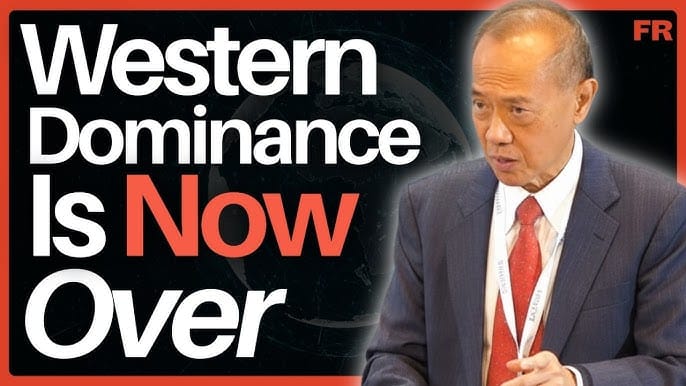
George Yeo is a Singaporean statesman, former Brigadier-General, and distinguished scholar. He served in Singapore's Cabinet for 23 years (1988–2011), holding key ministerial positions including Foreign Affairs, Trade & Industry, Health, and Information & the Arts.
I consider him to be one of Singapore's greatest public intellectual in the 21st century and find it my great privilege to call him a friend and mentor. I hope you will learn from this short address as much as I did.
This is the 61st episode Of The Front Row Podcast
(Yes, even this mini-episode counts. Thank you Mr Yeo for giving us great access to your insights)
This keynote was given at The Danube Institute earlier this year.
The Danube Institute was established by the Batthyány Lajos Foundation in 2013 in Budapest, with the aim of encouraging the transmission of ideas and people within the countries of Central Europe and between Central Europe, other parts of Europe, and the English-speaking world.
President Trump is the first US president to recognize that America operates within a multipolar world. It is by far the biggest pole, primus inter pares, and its foreign policy represents quite a dramatic change from US thinking after the end of the Cold War, when many Americans thought that the US was the new Rome.
It is not the new Rome, but it remains the most formidable superpower. It dislikes the rise of China, but increasingly has to accept it. We're in a great transition to a new world crystallising. It's not clear what its shape will be, but we can discern its rough shape.
Organizations like the Shanghai Cooperation Organization, like BRICS, like the Belt and Road Federation—they are indications of a world which is becoming more multipolar. And in that world, the West will no longer dominate the way it used to and has to accept that. It will continue to play a very important role, but it must accept others with different systems, different histories and traditions as equals. And that's uncomfortable because emotionally it's not easy to accept.
When at the end of last month at the SCO meeting in Xinjiang, Putin, Xi Jinping, and Modi held hands, smiling warmly to one another, it was a powerful image which played and replayed around the world, creating a certain discomfort among Americans and Europeans. Many were hoping that India would join them in their alliance against China and Russia.
India is a skilful player and played with that to get advantages from both America and Europe. But when the Ukraine war broke out and America expected India to take its side against Russia, that was not possible. For India, Russia has been a strategic partner over decades. And when in the short air war between India and Pakistan, India wanted America to take its side against Pakistan, America would not. In fact, Trump had the army chief over to the White House for lunch, who reciprocated the hospitality by nominating Trump for the Nobel Prize.
Then on September the 3rd, we all witnessed a spectacle in Beijing commemorating the 80th anniversary of the end of the war, what the Chinese call the anti-Japanese, anti-fascist war. I attended that same event 10 years ago when I was helping the Hong Kong government. The parade was not too different, only grander and perhaps more interesting.
At the appointed time, Xi Jinping marched out on one side, Putin on the other side, Kim Jong-un, and one person further, Jokowi from Indonesia and Tokayev from Kazakhstan. For the Chinese, symbolisms are a way to organise a huge population, and that was carefully choreographed. Why Jokowi? Why Tokayev? Because in 2013 when Xi Jinping announced the Belt and Road Initiative in August, he broke it first in Astana, then a little more than a month later in Jakarta.
The parade itself was very Chinese. When you watch the marching, it was perfect. I was from the army and air force before. I trained with the US Army for three months at Fort Gordon as a signals officer. When I was head of Air Force planning, I visited Israel many times. The Americans and the Israelis are not famous for marching, but that says nothing about their fighting ability.
So the ability to conduct grand parades is no indication that the Chinese army can fight. But a careful parade of military equipment, and some new ones—to impress whom? To impress the Americans and the Europeans and the Indians and others. At the Pentagon there was a report that pizza orders went up fourfold because they were all in the office watching the parade. Who were there? Who said what? Who stood behind the other and the military equipment?
Why did the Chinese display new equipment? It's a poker game. I don't want you to miscalculate, so I show you some cards, but of course for every card I show you I have other stronger cards which I don't show you. But enough to influence your behaviour.
They feel they are growing, and therefore peace is on their side, and they'd rather have peace over Taiwan, South China Sea, and elsewhere for as long as possible.
For the Chinese and for the Indians, the Middle East and Ukraine are distant conflicts. Yes, they are not troublemakers. They'll be peacemakers, and they will say the right things and they will triangulate carefully, but it's not really core to them.
But from the European perspective, the world has changed. The leaders of the SCO represent more than half the world's population, and the half which is growing much more rapidly. So if we project the world 10 years from now and the correlation of forces at that point in time, and ask ourselves how will this affect Ukraine? How will this affect the Middle East? How will this affect the pattern of migration? Those forces will have changed.
The Europeans and Americans know if China were not supporting Russia economically—and it's careful to do so only economically and not militarily, with controls on dual-use equipment—then Russia cannot sustain this struggle with Europe. But why should the Chinese help the West bring down Russia? Because if they do that, then they face the combined West alone.
But they do not want to be with the West against Russia entirely, because their principles involve respect for territorial integrity.
In the Middle East, Israel needs American support. But America's relative strength in the world will not be the same 10 years from now. And young Americans have a different view from older Americans. So I tell my Israeli friends, do not calculate just month by month, year by year, but think in terms of a longer-term perspective, because the frame will change. And the frame will change because of the rise of Asia.
It will present enormous challenges to Western countries. There is too much sloganeering—the Thucydides Trap—as if those in Asia are familiar with the Peloponnesian War. For us in Asia, the reference points are very different.
In Asia, neither in China nor in Europe, nor in India or Southeast Asia, do we have the constant warring amongst tribal nations as we see on the European continent. And increasingly I hear "autocracy versus democracy" as if that were the single most important explicator of human history.
To me, if a democracy is captured by vested interests, by elite structures, is it not a new form of oligarchy? If a country is authoritarian like Singapore under Lee Kuan Yew, does it mean it was not a democracy? I was a popular foreign minister, but I was defeated in an election in 2011. And when the Americans say Singapore is not a democracy and would not invite us for democracy conferences, I say, well, how then was I defeated?
So it's important to avoid excessive simplifications but to think through the complexities of a multipolar world. And in the end, big ideas and big structures cannot solve deep problems.
Trump and Putin agreed that there will be no ceasefire. They'll go straight to a peace agreement. When I read that, I thought, how could this be possible? When you have war, you generate poison. It gets into the soil, into the water, and it'll take years, decades for that poison to be taken out.
So to have peace, it takes time, and you've got to granulate it from the bottom little by little. Let the hurt, the hatred gradually subside and be dissolved by trade and interaction. Then people begin to forget. The children will hear it only as stories and they begin to know one another as a new generation. And then you can begin to think about win-win outcomes for the future.
And I think this is an important lesson for those of us who are political leaders or ex-political leaders, that big ideas are important, structures and agreements are important, but in the end we've got to work also at the bottom.
I'm a Roman Catholic. There is a moral principle—subsidiarity—which was a founding principle but long forgotten in the European Union. It is a struggle. Do I take your freedom? I should not take it lightly in the name of a higher good. And if I do, the moment it is no longer needed, I must recede it back to you, because you are a unique act of creation.
And it goes back to what we talked about earlier, the importance of respecting the individual, of families, of tribes, of communities, because that's how we are created. And if we forget that, then the big ideas lead to evil.
And subsidiarity has as a corollary the respect for differences, because if I'm autonomous and you are autonomous, we're naturally different. We have four children. They're all different. And parents have to accept that each has its own nature and must fulfil its own nature.
As an intellectual exercise, I ask myself—and it's within a short period when human beings begin to colonise Mars—the Chinese will be there, the Americans will be there, I think Europeans will be there, Indians will be there. How do we govern ourselves? Do we carry weapons? If we carry weapons, is it against Martians or against one another? And will we have a European system, will we have an American system, a Chinese system, a BRICS system on Mars?
This is an important intellectual exercise, because it is within the lifetime of our children that this will happen. Christopher Columbus landed in the Americas in 1492. Within a few decades, European powers were fighting each other, killing one another.
Thank you.