How Singapore Navigates A Complex World - Amb. Tommy Koh
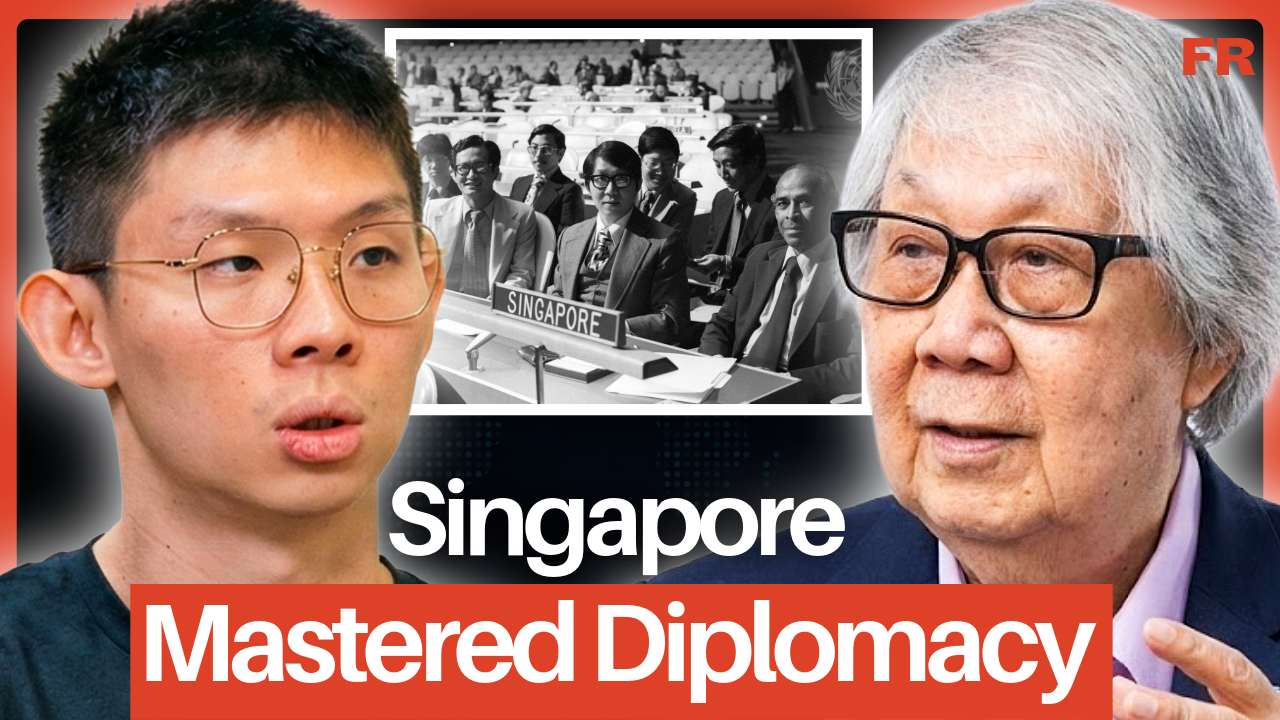
Prof Koh is Singapore's Ambassador-at-Large at the Ministry of Foreign Affairs, a position he has held since 1990, and Professor of Law at the National University of Singapore. He is a veteran diplomat and negotiator recognised globally for his contributions to international law and diplomacy.
Koh's distinguished career spans international law, diplomacy and education. He served as Singapore's Permanent Representative to the United Nations in New York (1968–71; 1974–84) and Ambassador to the United States (1984–90).
His most notable international contribution was serving as President of the Third United Nations Conference on the Law of the Sea, where he successfully steered 119 countries to sign the convention in 1982—creating what he called "a constitution for the world's oceans." He was also a member and second chairman of the High-Level Task Force that drafted the ASEAN Charter, providing the institutional and legal framework for the organisation.
Koh has represented Singapore in major legal disputes, including serving as chief negotiator in the reclamation works dispute with Malaysia over Tuas and Pulau Tekong (resolved in 2005), and as part of Singapore's legal team in the Pedra Branca cases before the International Court of Justice (2003 and 2017).
At NUS, Koh was the founding Rector of Tembusu College and currently serves as Chairman of the International Advisory Board of the Asia Research Institute and Special Adviser to the Institute of Policy Studies.
TIMESTAMPS:
0:00 Trailer
0:42 Introduction
1:18 Living Through Decolonisation
6:27 Becoming The Youngest UN Ambassador
12:13 Why International Law Cannot Protect Small States
17:21 Condemning America in 1983
19:04 Creating the UN Constitution for the Oceans
28:20 ASEAN's Peace Miracle
29:51 Why LKY Was America's Friend
37:51 What Singapore Should Not Import from America
41:35 The Downside of CEO Worship
52:08 Understanding China
56:17 China's Return To A Tang Dynasty Vision?
1:02:42 How to Engage an Assertive China
1:07:14 Insights From Five Generations of Singapore's PM
1:18:07 Tommy Koh's Hopes for Singapore
1:21:48 Tommy Koh's Advice For Young Singaporeans
This is the 70th episode Of The Front Row Podcast
Keith 00:01:20
Thank you for coming on, Ambassador. I want to start with this quote I read in your memoirs. You said, "When I went to study at Harvard, I traveled on a British passport. After Singapore joined Malaysia, I traded in my British passport for a Malaysian passport. When Singapore became independent in August 1965, I traded in my Malaysian passport for a Singaporean passport." You traded many passports. I have to ask you, you represent a person from a different era, a person who's lived through decolonization. What was that process like for you?
Tommy 00:01:55
I'm 88 years old. I was born in 1937, so I was born as part of the British Empire. Then the British lost the war to the Japanese and I became part of the Japanese Empire. Then the Japanese were defeated and the British came back.
Then the process of decolonization—there was a big debate in Singapore about our future. The PAP was convinced that an independent Singapore would not succeed and brought us into merger. Merger did not work. We became independent. In my life journey, I've gone through many historical phases of Singapore's journey.
Keith 00:02:41
If you were to play back that time of merger—and you've said in a previous interview with my friend Joel that you were against it, you were against the idea of merger—you believed that a small state like Singapore could succeed. What convinced you that this was the case for Singapore?
Tommy 00:02:54
In 1961, if I'm not wrong, the Prime Minister of Malaysia, Tunku Abdul Rahman, spoke to the Press Club in Singapore. It was during that speech that he mooted the idea of Malaya, Singapore, Sabah, Sarawak, and Brunei merging to form the Federation of Malaysia. Lee Kuan Yew liked the idea immediately, endorsed it, and campaigned both at home and in the region to bring this to fruition.
The PAP narrative at the time was that an independent Singapore would not survive, that we were too small. I argued the contrary case. I said look at Switzerland, a small country with a population of fewer than 10 million people—it's survived and is a very prosperous country. Look at the Scandinavian countries. There are many examples in the world of small countries that have succeeded.
I was not satisfied with the PAP argument on merger. The PAP leaders' commitment to merger was an article of faith. When something is an article of faith, your mind is closed. You're not open to argument.
I argued with the PAP leaders that merger would not work because there are four fundamental differences of values between us. We are a republic, Malaysia is a monarchy.
We are a secular country, Malaysia is an Islamic country. We are a meritocracy, Malaysia has special privileges. English is the lingua franca in Singapore, Bahasa Melayu is the lingua franca in Malaysia. I said there are these fundamental contradictions between us, and this marriage will not work.
I was not popular, as you can imagine.
Keith 00:05:06
At that point in time, was it purely just because they really couldn't see an alternative?
Tommy 00:05:12
You have to understand the context. When the British ruled both Malaya and Singapore, our students studied together—they were all in London. In London, the Malaysian students and the Singapore students formed a forum, the Malaya-Singapore Political Forum, and people like Lee Kuan Yew, Goh Keng Swee, Toh Chin Chye met with and became friends with people like Razak, Ismail, and others.
They were fellow students in England. They were united in their cause to get rid of the British and to achieve independence. The Singapore leaders were bonded with the Malayan leaders. For the PAP leaders, their belief in merger was beyond rational—it became an article of faith. The current Director of IPS, Janadas Devan, said in a podcast about the recent exhibition "Albatross" that the PAP's belief in merger was an article of faith. They were not open to any contrary arguments.
Keith 00:06:34
I remember reading that even other opposition parties were against it. They believed that it was not beneficial to Singapore, and you said that you were unpopular. That begs the question—after that you went into academia, you became a trained lawyer, you went to Cambridge, you went to Harvard, and you could have been a lawyer and they could have maybe left you alone. But then there came a fateful knock on your door. They asked you to be an ambassador to the UN—not only that, the youngest ambassador to the UN ever.
Tommy 00:07:07
Our country was new. Because the PAP did not believe in independence, we had not prepared for independence. When independence came, we had no foreign service. Out of the blue, overnight, we had to set up a Ministry of Foreign Affairs. You needed people to represent Singapore abroad.
The government looked around Singapore to see who they could persuade to serve Singapore abroad. They picked some businesspeople in Malaysia—the High Commissioner was a businessman, Koh Teck Kin, and George Lee. But they asked a bunch of us from NUS, University of Malaya at that time. Professor Koh Eng Pang went to Japan, Professor Winsemius went to Washington, Professor Maurice Baker went to India, and I was asked to go to the UN. I was the youngest.
At first I said no—I'm just too young, inexperienced. How can I be ambassador? I'm only 30 years old. They said, "Well, nobody else, and at least you have been an intern at the UN in 1964, so at least you know something about the UN."
It was Minister Rajaratnam that actually approached you to do it. And you were newly married then. How did that conversation go?
The PAP leaders knew me because I was very active on campus. I helped to organize forums, I was a leader of the Socialist Club. On top of that—a bit of trivia—in 1962 I was one of the founders of the Singapore Institute of International Affairs. I was a very young lawyer, but I felt that Singapore would always be part of a bigger world and we should be knowledgeable about the world. I asked the British Institute of International Affairs at Chatham House to help me set up a Singapore institute. I organized lectures and so on.
The PAP knew that I was interested in world affairs, that I had friends in other countries. Maybe that's one of the reasons they picked me.
Keith 00:09:28
But you were disagreeable with them on something so fundamental. Why would they say let's go and pick this person?
Tommy 00:09:34
But I was proven right. I was proven right. Since I believed in an independent Singapore, they probably said, "Why don't we send this young fellow to represent us at the UN?"
Keith 00:09:48
On a more personal note, how did it feel to be 30 and on the world stage? I'm 30 this year, so I can't imagine myself being thrust into the UN where you're really in the jungle world of diplomacy and geopolitics.
Tommy 00:10:09
I still remember clearly—August 1968, before I left Singapore, I asked the Ministry of Foreign Affairs to brief me. They said they couldn't brief me because they weren't knowledgeable about the UN. "Why don't you go and find out what's going on there and then inform HQ on the issues in debate, propose our positions, and vote accordingly?"
It was exhilarating but also frightening because I was so young and innocent. I had to think not just about myself but about the country—what the country's interests are, how should we speak on each topic.
The month I arrived in New York in August 1968, nobody told me in Singapore that we were the chairman of the Asian group that month. As soon as I arrived, I chaired a meeting of the Asian group. I think I looked like a kid. Some of the more senior ambassadors tried to take advantage of my innocence and said, "Mr. Chairman, can you endorse our candidature for some post?"
I knew I shouldn't do that. I said, "Why don't you make the announcement and let's see whether there are any competing candidates?" Sure enough, when the representative of Pakistan put forward the candidate for a post, the Indian had a competing candidate. I learned very quickly.
But it was also a traumatic entry to the world because that month, August 1968, the Soviet Union and the Warsaw Pact allies invaded Czechoslovakia. I learned firsthand that international law cannot protect you if a great power decides to use force to impose its will on you.
Keith 00:12:18
Even when you were writing in your memoirs, you wrote about when you were at the UN—you were very cognizant of the fact that you had to prepare for an evil day where Singapore would have to maybe leverage or use the UN to protect us in the case where we were defenseless, and we were indeed defenseless at that point in time.
Tommy 00:12:36
Happily, that period is gone. But in those early days of independence, there were threats from time to time by our Malaysian friends to stop supplying us with water. It would be a life and death issue. If that were to happen, then we would of course ask the UN for help. I needed to learn how to make the Security Council work for us.
One of my jobs at the UN was quick learning on how to use the UN system in case we faced an evil day when our existence was threatened.
Keith 00:13:10
What were the lessons you learned about how you could actually use the UN Security Council to help advance Singapore's interests in that case?
Tommy 00:13:23
Some of the lessons were actually not helpful because I found out that the Security Council will not help you unless the great powers have an interest in you, and provided no great power is against you. As you know, the five great powers—the victors of World War II—enjoy a permanent seat and veto power. If one of the great powers is against you, nothing will be done. The Council will be blocked.
At the end of the day, the Council cannot help you, cannot protect you, unless all the great powers are in your favor. That requires all the stars to line up perfectly for you.
Keith 00:14:08
There's this interesting paradox that you pointed out. You said that international law can't really protect you, but at the same time, you're such a huge advocate of international law. You're the person that when people think of UNCLOS, you're the person that people think of. How do we explain this paradox?
Tommy 00:14:25
It's not a paradox. Look at history. Before 1945, we lived in a world in which big countries, powerful countries could do what they wanted and small countries had no recourse but to suffer.
In 1945, the UN was founded and the UN Charter brought about a new world order in which countries big and small have a right to independence, sovereignty, and territorial integrity, where the use of force is forbidden except in self-defense, where countries are obliged to settle their disputes peacefully. The UN brought about a new world order.
The UN Charter, the UN international law, do not give us full protection, but they give us some protection. I ask you, what's the alternative? Do you want to go back to the world before 1945, the world where there are no rules, where the big country can do what they want and you have to suffer? We don't want that world.
We must continue to defend the UN Charter, the international law, and the rule of law. We must have the courage to stand up and oppose actions by great powers that violate the Charter.
Keith 00:16:01
Recently when the US went into Venezuela, it reminds me of the episodes in Singapore's own diplomatic history, like our involvement with Cambodia, for example. In this case, what should Singapore's position be?
Tommy 00:16:18
The Ministry of Foreign Affairs issued a very carefully crafted statement yesterday. It began by saying Singapore views with deep concern the US intervention in Venezuela. Then it reiterated that Singapore has always supported the UN Charter, international law, and the rule of law. We've always opposed the unilateral use of force, including military force, that violates the independence and territorial integrity of other states.
We have a track record. I was at the UN in 1978 when we condemned the Vietnamese for invading Cambodia. I was at the UN in 1979 when we condemned the Soviet Union for invading Afghanistan. I was at the UN in 1983 when we had the courage to condemn the United States for invading Grenada. We have taken a principled stand.
Keith 00:17:26
I remember in your 1983 speech you had to say that this was something you had to do even to a friend, and that you could not on the principle of convenience, or only because they're your ideological ally or adversary, make a different position, which I think some of the other countries there were doing, especially in the case of the US.
Tommy 00:17:47
Of course. In reality, in pursuing a country's foreign policy, you are always balancing values versus interests. You believe in some values, you stand by some values, but you also have national interests. Sometimes your national interest is so powerful that you're willing to sacrifice your values and principles.
But to Singapore, a small country, the right of countries to independence and territorial integrity is fundamental. When transgressions take place, we must speak up.
Keith 00:18:33
To drive home the point of the work you've done in international law, I wanted to quote this because I think it remains underrated. When you were the president of UNCLOS, you said—and this was your reflection on the convention, the ratification of the convention—"On 10th December 1982, we created a new record in legal history. Never in the annals of international law had a convention been signed by 119 countries on the very first day which it was open for signature." How should we understand the significance of this constitution for the oceans?
Tommy 00:19:04
70% of the earth's surface is water. The oceans are not only a source of food but also the highway of the world. Most of international trade is maritime trade. Shipping, freedom of navigation, are fundamental to the world's interests, not just Singapore's interests.
The old law of the sea began to break down after the Second World War. Many new countries, many developing countries, felt that the old law was antiquated and no longer served their interests. They wanted to change the law. We went through a period of chaos when the old law was breaking down and there was no new law.
The UN convened the Third UN Conference on the Law of the Sea. We had a very big ambition—our ambition was to write a new law of the sea for the world. Because we were so ambitious and the agenda was so extensive, it took us 10 years to get it done. Many people thought it would never be done. When I became president, I was determined to bring it to an end.
Keith 00:20:23
It's hard to imagine that you could actually get this passed, that you could persist, and in 10 years' time, in a decade's time, you could actually create a law or constitution that, although non-binding in a certain sense where you cannot really enforce through military action if a country chooses to contravene the law, is accepted by all countries, including countries like the United States which is not a party, as an authoritative statement of the law of the sea. My dream in 1982 that the Law of the Sea Convention would become a constitution for the world's oceans has come to pass.
Keith 00:21:10
One of the lessons I took from that essay and in particular your work in UNCLOS was that you really had to get buy-in from all kinds of countries—landlocked countries, maritime countries. Everyone had to agree that this was a good piece of legislation and was mutually beneficial. How were you able to not only persist but actually get the buy-in at the end of the day?
Tommy 00:21:35
The art of negotiation, the art of compromise, and creative thinking to find solutions that accommodate the competing interests of all stakeholders. In the beginning in the conference, there was a lot of heated debate but there were no texts. We needed a text.
In 1976, I made a proposal to the conference. I said, "We are floundering. We're going around in circles. What we need is a single negotiating text." I proposed to the conference that we ask the chairmen of the three committees to submit to us a draft single negotiating text. To my happy surprise, the conference adopted my proposal.
Beginning the next year, 1977, we had a single negotiating text. You need a text to work with. Once you have a text, then countries look at the text, identify their interests, and groups of countries begin to form around their common interests. Coastal states have a group, landlocked states have another group, countries with broad continental shelves have a group, countries which are long-distance fishermen have a group, countries that depend on coastal fishing have a group.
Once the interest groups are identified, it makes negotiation possible because then you convene all the stakeholders. You try to understand each country or each group's interests and you try to find ways to accommodate these competing interests in a compromise text. It took time, but it also took leadership.
Because the conference took so long, over time there emerged in the conference a group of leaders. They represented different interests, but they shared a common vision to complete the conference successfully and to adopt a new law of the sea treaty.
Keith 00:23:58
You were the chairman but you were also from a small state, from a small country like Singapore. You said earlier that in those days some of them might take advantage of your juniority or the fact that you're from Singapore, a small country. Once you're elected chairman, how did that change?
Tommy 00:24:17
Once you become chairman, your position doesn't depend on the size of your country. Being a chairman gives you inherent power. You're the convener, you're the chair, you lead the negotiation. You have great influence over the outcome of a negotiation.
Once you become chair, you transcend the size and limitations of your country. But with the advantage comes huge burden, because the whole conference depends on you. You're their leader. They depend on you to bring the conference to a successful conclusion.
Keith 00:25:07
There's this idea that nowadays international law is receding, that we're entering maybe a new—some call it multipolar—era where great powers are able to exert more forcefully on their spheres of influence. Would you agree or disagree with that assessment, and where does the role of international law play into this?
Tommy 00:25:32
I've come to the sad conclusion that we will never have a world without war. There will always be conflicts and war. It seems to be inherent in the nature of men. But at the same time, the majority of us in the world want to live at peace.
I would say of the three big goals of the UN—peace, development, human rights—peace is the most important. Without peace, there would be no development. Without peace, there will be no human rights. Therefore, we must support peace. We must support the instruments that promote peace—the UN Charter, international law, the courts. We must have the courage to stand up and say no to powerful countries when they take the law into their own hands and use force to assert their will, whether in Moscow or elsewhere.
We will always have transgressions, we will always have countries that violate law and use force. We will always have countries that say, "I'm not interested in settling my disputes with my neighbor by peaceful means. I will use my superior force to assert my rights." But these are the minority.
The great majority of countries in the world want peace. They want to live under the rule of law rather than the rule of force. If you ask me what kind of world do we live in today, I would say most of the world still lives in peace. But there are areas in the world where we are witnessing war and conflict. But we must never give up our quest for peace and world order. We must continue to work for a world ruled by law and not by force.
Keith 00:27:35
This is a similar takeaway I had when I read Professor Kishore's book on the ASEAN miracle. Part of it was him articulating the fact that ASEAN has created, for a large part of our history, a time of great peace that enabled development.
Tommy 00:27:53
Absolutely. Kishore is right that if the Nobel Peace Prize Committee gave the Peace Prize to the EU, they should consider giving it to ASEAN too. ASEAN has brought about a long period of peace in Southeast Asia. Of course there are still conflicts like the current one between Cambodia and Thailand, but these are minor. There are no big wars in our region.
Keith 00:28:20
The challenge is that sometimes we cannot imagine the counterfactuals. For example, we see what's happening with Thailand and Cambodia, but we don't think actually this could have been much worse.
Tommy 00:28:37
It could have escalated out of control and become a full-scale war. But because they are members of ASEAN, ASEAN has a restraining influence on them. They were at a summit in Kuala Lumpur. Prime Minister Anwar put pressure on them, China put pressure on them, the United States put pressure on them, all their ASEAN colleagues put pressure on them. Collectively the pressure worked, at least temporarily. They stopped fighting.
Then they started fighting again. Again, the foreign ministers of ASEAN had an emergency meeting and ASEAN pressure again forced them to stop fighting. ASEAN has an influence—it can't stop war completely, but it can help to de-escalate, to encourage talks. That's a useful function.
Keith 00:29:31
As Singaporeans, especially being a small state here, we should appreciate and even champion the value of ASEAN.
Tommy 00:29:37
Absolutely.
Keith 00:29:42
I want to move on to another part of your career which I found very interesting, which is your time as our ambassador in the US. I want to revisit your time where you started an initiative in 1985. You decided to launch an initiative where you would try to obtain an invitation from the US Senate and the House of Representatives for PM Lee to address the joint session of Congress. When I was reading that, it seemed like a throwaway line and then you went into how you got that to happen. My initial question was, why did you think this was a good initiative to start working on?
Tommy 00:30:19
I felt that Mr. Lee Kuan Yew had been a good friend of the United States for so long and he was coming toward the end of his premiership. I felt that it would be a good thing for Singapore if I could succeed in persuading the two houses of US Congress to invite him to address a joint session. This was my initiative. It didn't come from Singapore.
I wrote to my Foreign Minister, Mr. Dhanabalan, who was very supportive. He said, "You'll probably fail, but I won't stop you." Then I wrote to Prime Minister Lee. He was very modest. He said, "I don't deserve the honor." I said, "Let the Americans judge whether you deserve the honor, but let me try." Surprisingly, I succeeded.
Keith 00:31:19
The thing you said earlier struck me. You said that he was a very strong friend of the Americans throughout his premiership. Can you elaborate a little bit more on that? How was he a strong friend? Because one could imagine or remember times when he was critical.
Tommy 00:31:39
Lee Kuan Yew's value to America is that he was not an ally. Singapore is not an ally of the United States. We are a friend, a partner, but not an ally. Because he's not an ally, he's not beholden to them. He can speak with a certain independence which an ally cannot.
Secondly, he was very knowledgeable about our region. American leaders wanted to pick his brain. Every time he visited Washington, they wanted to pick his brain about what's going on in our region, what's going on in China. He would give them objective advice which they appreciated very much.
What was frustrating for us is that when we gave Mr. Lee a list of our requests—that we wanted ABC from the Americans—he refused to use our list. We asked him why. He said, "No. My value to America is that I'm not a supplicant. I did not come to Washington to ask for things. I come to Washington as your friend, as your adviser, but not as a supplicant."
This was his wisdom. Americans respected him because this was an unusual Third World leader who came to Washington, never asked for anything, but who gave his advice freely and objectively. This was his value to America.
Keith 00:33:07
In turn, what did that get Singapore?
Tommy 00:33:14
Preferential access. When I was ambassador in Washington, I was given access to the Secretary of State George Shultz, to President George H.W. Bush, that most ambassadors don't get. Lee Kuan Yew's friendship and goodwill percolated down. I enjoyed that.
Keith 00:33:43
The common thread seems to be—I previously had Professor Lim Hong on. He said the same thing as you. He said that Lee Kuan Yew taught him that when you go to other countries, especially the big powers, you look at them in the face and you see them as equals. You make sure they treat you as an equal and that we never ask. We always have their interests in mind and we start from that as a basis of a working relationship.
Tommy 00:34:06
One of the wisdoms of our founding fathers—and it was a tough call—was that in 1965 we were poor with high unemployment and rather bleak prospects, and yet they took the courageous decision that we will not solicit foreign aid. This is so that we don't want to be beholden to rich countries. We also want to teach our own people that the world doesn't owe us a living. We have to work hard, make our own way in the world.
Because we don't solicit and don't accept foreign aid, it gives us a certain dignity and standing that many developing countries don't have. We are in a position to—in 1983, if we were an American ally, we would not have the agency to say, "Sorry, you cannot invade Grenada."
Keith 00:35:08
In that sense, it's useful for Singaporeans to appreciate this ability to be independent even as a small country.
You were also one of the most prescient observers of America. I referenced earlier a 1986 essay that you wrote—prepared remarks that you gave at Harvard—and in it, what I found surprisingly timely was that in 2026, the problems that you diagnosed close to 40 years ago remain true today. You talked about the influence of media, you talked about the influence of lobbying in America and the influence of money in America. Help me understand some of the unique dynamics within America that we as Singaporeans should understand if we want to make our way in the world.
Tommy 00:36:03
First, the American democracy is a unique democracy. There's no other democracy in the world like the American democracy. What do I mean by that?
It is a system of checks and balances. The founders of the Constitution did not want concentration of power either in the president or in Congress or in the courts. They check each other. Power is dispersed. Power is broadly dispersed, not only between different departments of the government but also between the government and Congress, between government, Congress, and the private sector.
The private sector has an influence in America that no private sector in any country has. I'll give you an example. When I was negotiating the Free Trade Agreement with the United States, I received no calls on my mobile phone from any of our private sector leaders. But my American counterpart, Ralph Ives, was constantly answering questions on his mobile phone from business leaders who were asking him about the state of the negotiation, whether he was protecting their interests, and so on.
This is a unique aspect of America. But on the negative side, there's too much power given to big money and it's gotten worse. You now see so many plutocrats and the influence they enjoy in Washington is not good for America.
Keith 00:37:52
You made the point of Hollywood and Madison Avenue, and today you could even argue that it's Silicon Valley that influences the culture.
Tommy 00:37:58
Actually, the role of media changed. With the new media, alternative media, mainstream media lost influence. But now you've got so much social media, and political leaders now are very skillful in using social media. The media picture has changed, but media as an industry, as a factor, remains very powerful.
Keith 00:38:27
One of the things that I found to be true today was that when you talked about the role of the entertainment industry, you said that in America there was this idea that everything had to be captured in a soundbite. You made this point about a Congressman who said that he could not articulate a proper response on gun control within two minutes. But if you look at social media today, it's interesting that even in the US, there seems to be a move towards meme communication—you need short and snappy, but at the same time more long-form as well. In that sense, I found it prescient that the culture of only being able to communicate in short snippets remains true today.
Tommy 00:39:10
It's a negative development. I'm sorry that fewer and fewer young people read newspapers. Fewer and fewer people have the attention span to read a long think piece. They want the info online in soundbites, in short quotes. This is a pity. It's not good for the world.
Keith 00:39:38
The reason I asked that question is also because in Singapore we're extremely open to the US—not just in terms of our FDI, with the US obviously being the largest source of FDI in Singapore, but in our exposure to American culture and influence in our politics as well. It affects our politics. What are some of the amber lights that you're seeing that you think we as Singaporeans should be cautious of, of not importing wholesale from America?
Tommy 00:40:06
American culture tends to emphasize the individual. It's a "me" culture. PM Lawrence Wong has said recently that we should not have a "me" culture, we should have a "we" culture. We should think of the collective and not just of the individual. This is one of the weaknesses of American culture—an overemphasis on the individual to the neglect of the collective.
Of course, you don't go the other way either where you overemphasize the rights of the collective to the neglect of the individual. You need a balance between the rights of the individual and the rights of the collective.
I think we are moving in many ways towards American popular culture where we become a consumer society. Young people no longer are as thrifty as older people. We have become—if we look at private debt, private debt in Singapore is quite high. These are not good things.
Keith 00:41:21
One of the poor traits that we've imported from the US was also that we've had this obsession with the worship of the CEO. You made the case that actually we should look at the Gini coefficient within the company as well—that the CEO should not be earning 39 multiples higher, for example, than the lowest paid, or a thousand times.
Tommy 00:41:42
I agree. I think we moved the wrong way. We moved towards the American model of capitalism rather than the Asian model or European model. I was very unhappy. I was on the board of two big companies in Singapore.
I still remember one occasion—the director of human resources came to the board and made a presentation to say, "We propose paying our CEO this package"—I can't remember the exact number, but this was many years ago, something like $6 million, which in those days was a lot of money. Then he ended by saying, "I wonder whether it's enough."
I asked him, "What's the Gini coefficient in our company?" He said he'd never heard of the term. To him, the American model was the correct model—we should pay CEOs American salaries, London and New York salaries. But if you go to Japan, go to Korea, they don't pay the CEOs in the same way. The culture in Japan and Korea is more egalitarian. The CEO of a major company is not paid 100 times or a thousand times the average worker in the company. I'm not convinced that we should follow the American model.
I spoke up once and I think I caused some offense to people. I said, "The average bus driver in Singapore earned $3,000 a month. The CEO of one bus company was paid a million dollars a year. The CEO of the other company was paid $3 million a year. How can you justify this?"
Keith 00:43:43
It really goes back to the idea of rethinking for ourselves what are the values that we hold here as a country.
Tommy 00:43:50
We should go back to our original inspiration. Post-independence, our inspiration was growth with equity. We've forgotten that—growth with equity.
In the old days, in my father's day, most Singapore companies had a system of profit sharing. At the end of the year, if the company made a lot of money, they would share the profit with the workers. We've lost that. Now it's working for shareholders, working for senior management. I say, what about the rest of the employees? Don't they matter? Don't their children matter? Shouldn't you also think of the suppliers? You can't just squeeze them. Don't you think you should also think of your customers and think of society at large?
Keith 00:44:52
If you were the management, one could argue that to make a more just society, we should always leave some money on the table for the rest of the folks.
Tommy 00:45:04
I wouldn't say it's charity—it's actually good practice. I'll give you an example. A friend of mine has a restaurant, a successful one. Then she opened several more branches. I asked her, "Many restaurants in Singapore have trouble recruiting and retaining staff. How are you able to do it?"
She said, "I pay above market price, and I have a system of profit sharing." If you pay people well, if you share the prosperity of the company with your staff, I think you will have better prospects attracting and retaining people. But most of our companies don't do that.
I regret to say there are very few good bosses in Singapore. Most of our bosses are not good bosses.
Keith 00:46:07
What would a good boss look like to you?
Tommy 00:46:13
First, you must respect your colleagues. Don't just look up but also appreciate people who work below you. Second, help to develop them, empower them. Don't just exploit them and take advantage of their work as yours. And be a good team player.
One of the reasons I chose the title of my memoir, "The Extraordinary Life of an Ordinary Man," is to make the point that you may be successful, but the success is not due to your own ability alone. It's also due to the contribution of your team, due to opportunity, and due to good luck.
Keith 00:47:06
Was that something that you'd seen? Because when I was reading your book, one of the strong themes throughout is that you really had good bosses that believed in you. For example, when they chose you to go to the UN, I was like, wow, that's actually a huge bet on a 30-year-old young lawyer. We're thankful it paid off and you did more than represent Singapore well—you did a great deal of good for the international community. Is your idea or perception of what a good boss or good leader is very much influenced by your own personal career or journey through the foreign service?
Tommy 00:47:50
Probably influenced by my scouting days. I was a scout leader. From those early days, I learned to be a good leader—take care of the people in my troop, in my patrol, treat everybody with respect, appreciate the contribution of all members of your team, not just the top, but also people in the middle, people at the bottom.
Keith 00:48:20
I wanted to hear from your point of view as well—what do you think American culture did right for Singapore? What did we learn right from the Americans that we should continue doing?
Tommy 00:48:25
The belief in upward mobility. The American Dream. The American Dream was no matter who you are, where you start from, if you work hard with ability and luck, you can get to the top.
In Singapore, at least up till now, no matter who you are, where your starting point is, with ability and hard work, opportunities will be given to you to study, to work, and excel. That's very American and I think that's an important lesson.
The other lesson we can learn from America is not only to do research but to apply research with innovation and creativity. If you look at the world today, high technology is dominated by the United States and China. In American high technology, it's being led by the so-called seven magnificent companies. Why are there no equivalents in Europe? Because America has this unique culture of supporting innovation and not stigmatizing you if you fail.
In America, if you fail and it's an honest failure, it doesn't matter. Pick yourself up and try again. Try and try until you succeed. We should learn from America. There's no shame in failure if it's an honest failure. We must have a system that supports innovation and creativity.
Keith 00:50:17
I speak to my American friends and compare ourselves to them sometimes. We share a similar belief in meritocracy—that if you can prove yourself to be competent, you deserve the fruits of your labor. Sometimes we take it to the extreme, as we've talked about earlier. But they are much more willing to venture, which is something that I think is a critique of the Singapore system or Singaporeans in general—we are becoming increasingly risk-averse. Do you agree with that assessment?
Tommy 00:50:51
I think we're becoming less risk-averse. I think we're becoming a very important hub for startups. The ecosystem is changing. I think we are trying to promote young people to be brave, to start their own companies, to take a leap. I think we're changing, but we should change faster. Here we should look to America for inspiration. We cannot replicate Silicon Valley, but we can replicate the values of Silicon Valley.
Keith 00:51:30
That's food for thought. As we speak about America, we cannot not talk about China. I found something really interesting when I was reading your memoirs, which was that you were actually the person in charge of organizing the first trips to China for three key leaders because you were at the UN and back then we didn't have official relationships with China. You had to find your counterpart in the UN from China and you had to organize these three trips for Dr. Goh, for Prime Minister Lee, and Mr. Rajaratnam. How was that like?
Tommy 00:52:11
In 1974, the government persuaded me to leave the law school again and to go back to the UN because they wanted me to be the leader of our delegation to the Law of the Sea Conference. I agreed reluctantly because I loved my academic career.
But the government also told me that I had a second job, which was to contact the Chinese ambassador to the UN, a wonderful man called Huang Hua, and to begin a dialogue with China through him. For two years, I was the contact point between Singapore and China.
In 1974, a very good friend who's passed away, Lee Khoon Choy, and I took some risk and decided we would organize a working dinner between our Foreign Minister, Mr. Rajaratnam, and the leader of the Chinese delegation. We were worried whether or not they would hit it off, that the dinner would go well, but it went very well.
At the end of the dinner, the Chinese side said they would like to invite Mr. Rajaratnam, Dr. Goh Keng Swee, and Mr. Lee to visit China. I had the great pleasure of organizing those three trips. But after 1976, the contact point was passed from New York to Kuala Lumpur, so I ceased to be the contact point.
Keith 00:53:49
But later on you also negotiated our official relationship, establishing the relations with China, which would make you someone that had a relatively up-close and personal look at the evolution of China's foreign policy or foreign engagement with the world. How have they changed since your first early days at the UN to now? What are the big changes?
Tommy 00:54:10
China has enjoyed a true economic miracle. In 1974, China was poor and weak. Everything changed with Deng Xiaoping. The Chinese leader who changed the fortune of China.
After Deng Xiaoping visited Thailand, Malaysia, and Singapore, on his return to China, he decided China was going down the wrong path, that the command economy doesn't work. Although he was already in his 70s, he had the great courage to say, "Let's change. Let's open up China gradually, starting with the coastal region. Let's open up China to foreign investment."
That decision by Deng Xiaoping changed China. Over the years, China was growing by 10% per annum for 30 years. I don't think the Chinese could have foreseen that today China is a superpower, that it has the second most powerful economy and military in the world, and that unless there's some great disaster or war, China would become a peer superpower to the United States. This is a miracle.
Keith 00:55:57
One of the concerns that someone like Bilahari talked about—he had this short book about how China is trying to change your mind or trying to influence the way you think—and his view is that Singapore, being a majority Chinese population, is very susceptible to being more pro-China than is in our national interest.
Tommy 00:56:22
I would put it differently. I would say our relations with China can be divided into three historical phases: the Mao era, the Deng Xiaoping era, and the current phase.
During the Mao era, our relations were very bad because China wanted to export revolution to the region, supporting the communist insurgency. But Deng put a stop to that.
During the Deng era, there was a charm offensive by China to do away with the Mao legacy and to start a new chapter in China's relations with Singapore and ASEAN. China succeeded. During the Deng era, relations got better and better.
I would say from maybe the Beijing Olympic Games in 2008, the Deng era ended. China has now arrived. China feels that we have become a global power, we have a right to recover territory we lost when we were weak, we have a right to assert ourselves with our neighbors.
In the current phase of China's history, the Chinese are no longer engaged in a charm offensive. China is now, I would say, more assertive of her rights or her perceived rights.
Keith 00:58:13
You had an essay where you talked about your hopes for China in the way it seeks to engage with its neighbors. Can you briefly articulate what your hopes are for China?
Tommy 00:58:29
That was, by the way, a very remarkable experience. Out of the blue, I received an invitation from one of the national institutions of China, the CPPCC—China's People's Political Consultative Committee—which is a sister institution of the National People's Congress. It's a very wealthy institution. They invited us to attend a conference and for me to contribute an essay to a book on the future of China.
It gave me a chance to really think about China's past, China's present, and China's future. I was right in predicting that China will continue to grow and no country, not America, can contain China's rise, that China will become a superpower.
Then I said I hope when China becomes a superpower, it will behave like China during the Tang Dynasty. Many of my Chinese friends were very puzzled. They said, "Why do you talk about the Tang Dynasty? This was so long ago." I said the message I'm making is that the Tang Dynasty was a very good period for China. It was a great civilization that lived at peace with the world. China welcomed people of other cultures and nationalities to be in Chang'an or Luoyang.
The Tang Dynasty was a very peaceful and open and inclusive period of Chinese history. That's my hope.
Keith 00:1:00:29
You know, the funny thing is that I actually interviewed Senior Colonel Zhou Bo and he said this exact same thing.
Tommy 00:1:00:34
Is it?
Keith 00:1:00:34
He said that I asked him what a positive vision of China would look like, because there were views that China has a largely negative vision of itself as a victim in the past 100 years because of the century of humiliation. He said a similar thing. He said that the positive vision that Chinese people should see themselves as today is that we want to have a reincarnation of the Tang Dynasty in its spirit.
Tommy 00:1:01:05
I'm glad to say that, by the way, I'm a friend of Zhou Bo. I endorsed his new book, "Should the World Fear China?" I made two comments on my Facebook—I reviewed the book on my Facebook page. I made two comments that he thanked me for, but they probably got him into trouble with some of his conservative friends and colleagues.
I said that Zhou Bo is not a wolf warrior. Secondly, I said there's an essay in the book which is very important, which is that China should stop talking about the years of humiliation. That's over. China should be self-confident and talk about the future. I like that and I praised him for that too.
He messaged me thanking me.
Keith 00:1:02:02
That's so interesting because when I was reading it, I was like, he made that point and that stood out to me also. When people talk about the 5,000 years, why do you overindex on 100 of the 5,000? You could make the case that there were other periods in China's history that you could take inspiration from. I was very pleased to hear you say that.
The flip side of that conversation would be—in the region, in Southeast Asia, how should one engage with this China that's in that third phase that you just pointed out, that now is seeking to be more assertive in its dealings with the world, that maybe might be too muscular at times? How should Singapore and maybe ASEAN as a whole engage?
Tommy 00:1:02:42
I would say ASEAN—Singapore alone may not be strong enough, but collectively as 11 countries, we have considerable weight and influence. I think ASEAN should continue to engage China. ASEAN as a grouping is not anti-China. We are a friend of China, and the Chinese should know that the ASEAN countries have goodwill and friendship for China. We will not join the United States in confronting China or seeking to contain China.
But at the same time, we expect China to behave like a good neighbor and not impose its will if by doing so they're harming their neighbors. I've made this point to my Chinese friends many times that the Mekong River is an international river, not a national river. Although it begins in Tibet, you don't have absolute sovereignty over the river. What you do in the upper reaches of the river must take into account the rights of people living downstream. You cannot just merrily keep building dams and affect the people living in the lower part of the river in Cambodia and Vietnam.
That's the point I'm trying to make to my Chinese friends—you're big and powerful and rich now, and we like you, respect you, we want to be your friend and partner. But we also want you to behave like a good neighbor and take into account the interests of others, not just yourself. And also take into account the relevant international law on the South China Sea.
Keith 00:1:04:37
You wrote about the South China Sea and it really mapped out a lot of the key facts and claims within that area. But the South China Sea becomes a natural talking point because when people talk about China's neighborliness with the region, with ASEAN, this comes up as an issue. Do you see a way out of this? Because from the way a casual observer sees it, it seems to be a very messy political situation. Is there a way out?
Tommy 00:1:05:16
If there's political goodwill, there's always a way out. The question is, is there political will on the part of China and the claimant states, especially Vietnam and the Philippines, to seek a fair and balanced outcome? If there is will, there's a way out. My sense at the moment is there is no such will.
Keith 00:1:05:48
You made this point also before, which is that this is something that you can't use the law to solve. This is not a legal problem for the most part. It's a political problem.
Tommy 00:1:06:01
There's a problem which is hard to overcome unless our Chinese friends reconsider their policy. Although China is a party to UNCLOS and China has judges at both the International Court of Justice and the International Tribunal for the Law of the Sea, as a matter of national policy, China will not take a dispute over sovereignty to the court.
You will not take the dispute with Vietnam and the Philippines over the South China Sea to arbitration or to a court of law. That's a problem. China keeps saying, "Let's negotiate." But sometimes negotiations don't succeed. The position of ASEAN countries is more logical—if negotiations don't succeed, why don't we think of taking it to some other procedure, like conciliation, like arbitration, like mediation or adjudication?
But that would require a change of policy on the part of Beijing. That would require the art of compromise as you put it earlier.
Keith 00:1:07:18
I wanted to ask you a little bit more about your privilege of working with different generations of leaders. There is only one man that I think in Singapore today, alive, that can say that they've worked under David Marshall, they've worked under Lee Kuan Yew, they've worked under Goh Chok Tong, they've worked under Lee Hsien Loong, and they're now working under Lawrence Wong, and that person is you. I'd like for you to share with us maybe one key lesson or insight you've learned from each of these giants. Maybe there are other leaders that you'd throw in the mix that you think every young Singaporean today should know of. Maybe we'll start with David Marshall, someone that you consider your mentor in your early legal days.
Tommy 00:1:08:00
Marshall was a better lawyer than a politician. He was not a good politician. He believed in Singapore. He was committed to Singapore.
I'll give you something that people don't know. The State of Israel made him an offer and said, "Come back to Israel. We'll make you the Attorney General of Israel." He said, "No, I'm a Singaporean. I'm not Israeli." He's Jewish, but his commitment to Singapore was total. He was not interested in leaving Singapore to become the Attorney General of Israel.
I admire the fact that he was totally committed to Singapore—excellent lawyer, not so good politician. But in a way he played a role in our battle for independence because he was very strongly anti-British.
Keith 00:1:09:02
And then what about Prime Minister Lee?
Tommy 00:1:09:08
Prime Minister Lee, I think he was charismatic. One thing I learned about him is that, like Marshall, he loved only Singapore and his commitment to Singapore was total and all-consuming, always thinking about Singapore. His work ethic, like David Marshall, was very hardworking.
When I was helping Mr. Lee Kuan Yew to draft his speech for the US Congress, I was impressed at how many iterations he had. He was working on it every day, polishing it, making it better. I told my wife that, boy, this guy is really hardworking. He had something that has become a Singaporean virtue—the pursuit of excellence.
Keith 00:1:10:01
There's this story that whenever I speak to Professor Kishore and Ambassador Chan, they say that the three of you would always have lunch with him and that he would always talk to you guys and get your views. I want to hear from your perspective what those lunches were like.
Tommy 00:1:10:19
Many people think that he was very authoritarian, that he doesn't have an open mind, he doesn't listen. It's not true. I think of our leaders, surprisingly—and the public will be surprised to learn this—he's the most open to other views and most eager to seek other views.
There was a period when Kishore and I were in town at the same time and he would invite the three of us to have lunch with him regularly to talk about developments in the region, in the world. He was genuinely interested in listening to our views, even if we sometimes didn't agree with him. In private, he was a perfect gentleman. We were surprised that he insisted we must walk ahead of him, be served ahead of him. We'd say, "No, PM, you first." He'd say, "No, you are my guests." We really enjoyed those lunches we had with him.
Keith 00:1:11:26
If there was a foreign policy legacy that he had that you think Singaporeans should appreciate or care for?
Tommy 00:1:11:39
That Singapore is truly independent, not beholden to other countries, that it will stand up for its national interests, and that although it's a small country, it will fight to protect its security and national interests.
Keith 00:1:12:04
And then after that, Goh Chok Tong.
Tommy 00:1:12:04
Goh Chok Tong took us to another level because the foundation was already built. Goh Chok Tong was an excellent diplomat. Most people don't realize that he was a better diplomat than Lee Kuan Yew because of his personality. He was very charming, very relaxed, and people, the foreign leaders, liked him.
I remember sitting with him in a meeting he had with a European leader. At the end of the meeting, they shook hands, and then before he left, the European leader turned around and said, "By the way, I like you."
Then Mr. Goh asked me, "Does any leader ever say that to you?" I said, "No, because they like your openness, your lack of arrogance, your humility, your sincerity."
He was a very good diplomat. Because of him, he launched many things for us. I remember the US-Singapore Free Trade Agreement is like the famous golf game in Brunei. But he was also very devoted to ASEAN. He introduced something called the Initiative for ASEAN Integration, which is to help bring up the four new countries.
Because of his leadership, there are Singapore officers in four countries—Cambodia, Laos, Myanmar, and Vietnam—basically to help those countries with technical development. We bring them to Singapore for training.
Keith 00:1:13:54
I remember reading both of his memoirs. He was also the person who came up with the idea of the ASEAN Free Trade Agreement.
Tommy 00:1:14:00
It was his idea, but he's a modest guy. Instead of doing it himself, he asked the Prime Minister of Thailand to be the champion. He came up with the idea of the ASEAN Regional Forum, but again he asked the Thais to claim credit for it. He was the one who came up with the idea of the Asia-Europe Meeting, and again asked the Thais to do it.
Keith 00:1:14:27
We've had a gem as a diplomat. He also founded IPS as well.
Tommy 00:1:14:34
He's still the patron of IPS.
Keith 00:1:14:39
And then after that you served with Prime Minister Lee Hsien Loong. What was that key lesson or key insight?
Tommy 00:1:14:45
Lee Hsien Loong is a different person from PM Goh Chok Tong. Lee Hsien Loong was always very disciplined, very focused, very businesslike. But I liked working with him because he was always clear-headed. He had an agenda, and we were clear about what our job was, how to help him succeed.
Keith 00:1:15:18
And finally now we have Prime Minister Lawrence Wong, where the verdict might not be out yet, but if you could give us some inkling or share some insight as to what excites you or what keeps you hopeful for the future?
Tommy 00:1:15:33
He's the right leader for the new generation of Singaporeans.
Keith 00:1:15:38
Say more.
Tommy 00:1:15:40
Singaporeans like the fact that he did not come from an elite school. Victoria JC—I was from there. They like the fact that he came from humble beginnings, not a famous family. They like the fact that he is not a one-dimensional person, that he loves music. He's an ordinary guy in that sense. I think he engages well with people. He's a good listener. I think he's a good leader for our time.
Keith 00:1:16:17
I'd like to thank you for writing those two essays in this book on the foreign policy legacies of prime ministers, because I thought they were very instrumental in actually understanding the role of prime ministers in foreign policy.
Tommy 00:1:16:36
To be honest, that conversation we had does not do that justice. There's a new book coming out soon on Lee Hsien Loong. I initiated the idea with IPS. IPS is coming out with a new book evaluating his 20 years in office, and I've written an essay on him.
Keith 00:1:16:54
For me, just reading those two essays, I was like, well actually if you think about the prime minister's job just from where we are, they have so much more than just running a country—they also really have to manage our external relations, and each of them brought contributions.
Tommy 00:1:17:12
Absolutely.
Keith 00:1:17:18
You've served in the Ministry of Foreign Affairs as our ambassador at large. Your diplomatic accomplishments are many, but you've also been in other areas like education. You were director at Tembusu College, you were director of IPS, you were chairman of the National Heritage Board and National Arts Council, and you were on the board of banks in Singapore. You've really touched many aspects of Singaporean life in a certain sense. You have a very good 10,000-foot view of Singaporean society.
I guess my question to you is that if you look at the coming years and look at how far we've come, what are your hopes and aspirations for Singapore? How should we become a more perfect and more beautiful Singapore?
Tommy 00:1:18:06
First, I want to say that I'm optimistic about our future. Some Singaporeans are worried about our future, wonder whether we will continue to succeed and continue to prosper. I'm confident that we will, and I again look to Switzerland as a model.
I think we will have a bright future. We must continue to remain open, to embrace change, embrace technology. But in the process we must also look after people who are not able to benefit from the new technology. My worry about AI is that it's going to displace a lot of workers. I think AI is going to make redundant a lot of entry-level jobs, and even not entry-level jobs. AI can do a better job reading MRIs than doctors can.
I think we have to not resist progress and technology—Singapore's ethos is that we are open to change, we embrace technology. But at the same time we have to take care of our people. Make sure that we don't leave people behind. Make sure that the number of poor people in Singapore gets reduced.
At the moment, I'm disappointed to say there are too many poor people in our prosperous country. I was shocked recently to learn that there are over 100,000 senior Singaporeans living in poverty who can't even afford one hot meal a day. This is unacceptable. We have the means to do better. Back to our original mantra: growth with equity. To create a much more equitable society.
Keith 00:1:20:10
You echo a similar reflection I think Ambassador Chan had when she came on. She was saying that you want to have a high floor, that the least of us are doing better than the most.
Tommy 00:1:20:21
I agree with that.
Keith 00:1:20:27
Is there anything else in terms of values that we as Singaporeans must remember?
Tommy 00:1:20:33
I'm very proud of several things. One is that there's no corruption. This is such a rare achievement. When you go around the region, go around the world, it's so rare to have a country where there's no corruption. We must hold on to this precious achievement.
The other precious achievement we must hold on to is the harmony between people of different races and different religions. Again, a very rare and precious achievement. I think those things we must hang on to.
Third thing is we mustn't allow meritocracy to become a new form of aristocracy. We must beware of what Michael Sandel says in his book "The Tyranny of Merit"—we mustn't allow merit to become a new form of tyranny.
Keith 00:1:21:33
I've read that book and in it he launched a scathing critique that meritocracy could morph into a form of credentialism, and we must make sure that upward mobility is a reality in Singapore and will always be.
But what about the ethos of the people? Is there anything that we as a society in general—if a citizen looks at Singapore today, what are some of the aspirational values or ideals that we should strive towards?
Tommy 00:1:22:08
Having been Rector of a college for over 10 years, I must say that I am impressed with our young kids, the students of our universities. They are good people. Extremely intelligent, hardworking, but they also care for their colleagues, care for society, care for nature, care for the world. I think we have this, and we should continue working on that.
Keith 00:1:22:43
Obviously being a former Rector yourself, I have to ask you to wrap up this conversation. What is that one piece of advice, given everything you know about the world today, that you'd give to a graduating student entering the working world today?
Tommy 00:1:22:57
Do not lose faith in the face of adversity. There will always be war, but we must continue to seek peace. There will always be countries that behave as outlaws, but we must continue to defend the rule of law. We must continue to work for a world ruled by law and not by force. This is something that every Singaporean should keep in our heart.
Keith 00:1:23:22
With that, Professor Tommy Koh, thank you for writing these two books—"The Extraordinary Life of an Ordinary Man" and what I think should be a core essential of every IR class in university, "The Tommy Koh Reader." Thank you for coming on and thank you for your labour of love for our country.
Tommy 00:1:23:39
Thank you.
Keith 00:1:23:39
Thank you for listening to today's episode. If you're watching this on YouTube, please consider subscribing and turning on notifications for whenever new episodes are out. If you're on Spotify or Apple, it would help us greatly if you could leave a five-star review on those platforms. Once again, thank you for tuning in to The Front Row.