

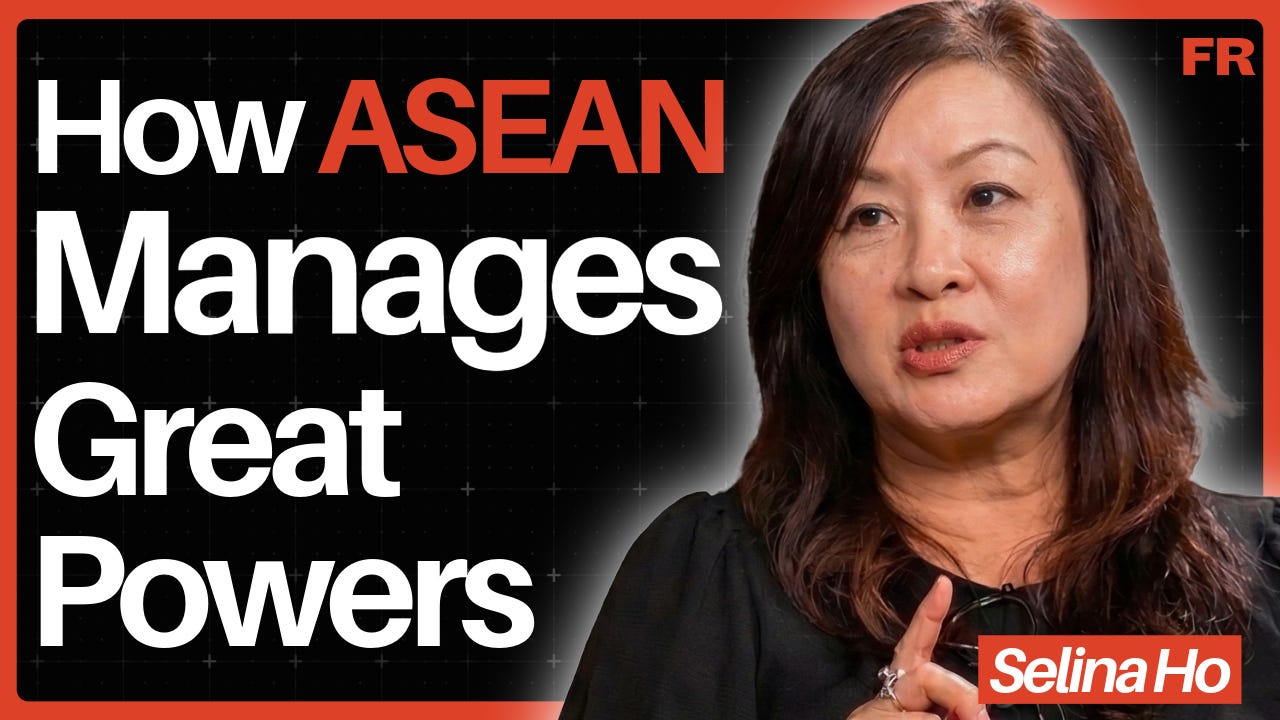
Professor Selina Ho is Vice Dean (Research and Development), Dean's Chair and Associate Professor in International Affairs, Lee Kuan Yew School of Public Policy, National University of Singapore. She researches Chinese politics and foreign policy.
Specifically, she is interested in how China wields power and influence via infrastructure and water disputes in Southeast Asia and South Asia. Her work stands at the intersection of comparative politics and international relations.
Her book, Rivers of Iron: Railroads and Chinese Power in Southeast Asia, is considered to be a definitive text on the Belt and Road Initiative in the region.
If you are interested in her latest research paper - "Elite Perceptions of a China-Led Regional Order in Southeast Asia" - you can download it here:
https://journals.sagepub.com/doi/full/10.1177/18681034241294093#table2-18681034241294093
TIMESTAMPS:
00:00 — Trailer
00:52 — Introduction
01:21 — Why Southeast Asia Matters to Both Superpowers
04:25 — Will Trump Turn His Back on the Region?
09:41 — The Fear of US Abandonment
14:17 — How Southeast Asia Actually Sees China
18:37 — Chinese Influence vs. Chinese Dominance
21:37 — Wolf Warrior Diplomacy In China
29:11 — The Belt and Road
33:47 — When China Owns Your Power Grid: The Laotian Lesson
37:44 — China Wants Regional Dominance
40:16 — How ASEAN Elites Actually Respond to Chinese Influence
43:06 — What Regional Decision-Makers Really Think
47:31 — ASEAN Centrality
51:52 — Why ASEAN Is Strong on Trade and Weak on Security
55:15 — Building an ASEAN Identity
01:00:19 — What Singapore Should Do With Its 2027 ASEAN Chairmanship
01:01:46 — Advice For A Fresh Graduate Entering The Working World
This is the 79th episode Of The Front Row Podcast
Keith 00:00:52
Southeast Asia is a region of interest to both the US and China. But what exactly is our value proposition to them?
Selina Ho 00:01:29
Southeast Asia has been described by many as the battlefield for supremacy between the US and China. It is considered the front line in their competition, and there are good reasons for it. Our value add is in two key areas.
The first is that we are the fastest-growing region in the world. Africa is also growing quickly, but Southeast Asia is growing very rapidly. Some have described this as the Asian century. We are a key hub for manufacturing, services, and infrastructure. We have some of the fastest-growing economies, including Vietnam, the Philippines, and Indonesia, and we have a relatively young population. I must caveat that because while we are still relatively young, all our countries are facing ageing societies. We know that about Singapore, of course, but it is a broader regional challenge that few people are aware of.
We are also a key node for global supply chains, and we know how important that is now in terms of value for superpowers trying to diversify and reduce reliance on any single country. We are China's largest trading partner and a very important economic partner for the United States. We are a vital hub for semiconductors, particularly Singapore, and a source of critical minerals. All of these factors are important in the competition between the United States and China.
The second reason we are important is that we sit at the intersection of two great oceans — the Pacific and the Indian — which means we are where the vital sea lanes of communication are located. The Malacca Straits is extremely important for the shipping of goods and energy supplies for both China and the United States. And if you want to control the seas, as is important for American naval supremacy, you need access to this part of the world.
So economically, strategically, and in terms of sea lanes, Southeast Asia is extremely important.
Keith 00:04:25
My immediate question is that if you look at what President Trump is doing, there seems to be an increased focus back on his hemisphere — mainly Europe and Latin America. Will Southeast Asia once again be pushed to the background, despite the importance you've outlined?
Selina Ho 00:04:42
The interesting thing is that with US attention on the Middle East now, especially with what is going on with Iran, and the turn back to Latin America with Trump's declaration of what amounts to a corollary of the Monroe Doctrine, you might imagine Southeast Asia is not that important. We have always feared this. It is not the first time we have worried about the US turning away from us.
The big question for all of us in the region, especially for US allies, has been what happens with US presence after the Cold War. In the 1990s, we grappled with whether the United States would stay, what would happen to its naval bases, and whether allies would be abandoned — especially Japan, which probably worries the most. There was a drawdown in US presence right after the Cold War. The naval bases in the Philippines were gone, and there were problems with bases in Japan as well.
So this is not the first time we are facing this kind of problem. It has always been a struggle for allies in the region to try to keep the US engaged. In political science, when we talk about alliances, we call this the fear of abandonment.
Now, for the rest of us who are not allies, it is not to say that we do not need the US. We do, because the US plays a very vital role as a security guarantor in this region. There is a reason why we want the US here. We want all the major powers in the region as a way to balance each other out. We are mainly composed of smaller states. I would not call Indonesia a smaller state, but it is relatively weaker compared to the great powers. We want all the powers in the region so they can balance each other off.
The US presence balances several things. It maintains freedom of navigation in places like the South China Sea. It is a security guarantor for Taiwan, Japan, and South Korea. There is always a fear of China, and US presence serves as a form of guarantee and balance.
Economically as well, some people think we look at China as our most important economic partner. But we often forget that the largest source of foreign direct investment is actually the US. The US is our largest foreign investor in Southeast Asia. We look to the US for economic benefits and security cooperation. We exercise extensively with the US through multilateral exercises like Cobra Gold and Super Garuda Shield. Singapore has a bilateral arrangement. We are not an ally, but we are an important security partner.
So if the US were to turn away from us, it would be a great cause for concern. It would mean less stability for us.
But I want to say that despite what President Trump is saying, the alliances are still intact. US presence in the region has not actually gone down. During the Biden administration, there were enhanced defence agreements with allies — the Philippines, Japan, Korea, and Australia. We had QUAD, AUKUS, and ORCAS. These show that the US is staying in the region.
We might fear that the US is turning away, but institutionally, the alliance system is very much intact and alive. There is a lot of talk about the US moving away, going back to its traditional backyard of Latin America and Europe. But we have to look at the effects on the ground, and the alliance system is really still very much in place.
Keith 00:09:41
Going forward, will it actually be stronger or weaker? Especially when one considers the domestic pressures the US faces and the argument that it should focus more at home.
Selina Ho 00:09:58
You will see the US focusing at home, but look at its actions right now. I think it is quite amazing — and I say amazing in a slightly horrified way. Sometimes I look at its actions in Venezuela and Iran and I have a very conflicted attitude towards them.
On one hand, these kinds of interventions are horrifying. But at the same time, the efficiency with which the US military is able to move into these areas demonstrates that its strength is still very much intact. So while one might think the US is turning inwards, I think it is turning inwards in terms of trade. It is turning away from globalisation and international institutions. But when it comes to security interventions and maintaining what it considers world peace and stability, the US is still very much out there.
I would say we should take different slices of what the US is trying to do and judge each one on its own terms.
Keith 00:11:20
That is a very important nuance.
Selina Ho 00:11:22
There were some polls on whether there is domestic support for US action in Iran, and they showed very little support. So when it comes to certain types of foreign policy, the Trump administration has not always followed what Americans want, but has followed its own path with its own reasoning. Different stakeholders within the American political establishment have their own agendas, and they are not necessarily always aligned.
This is something that is really quite interesting — how the administration does not always follow domestic sentiments. While wanting to appeal to Americans, I think they have their own considerations, especially when it comes to security matters and foreign policy.
Keith 00:12:19
What are those considerations, in your view?
Selina Ho 00:12:23
One thing I find interesting about Trump — and I want to caveat that I am not an American foreign policy specialist — is that he wants to be number one. He wants America to be number one in the world. It has something to do with pride, American pride, and America's place in the world.
So it is very unlikely that despite all the talk about cooperating with China, Trump will cede space to China or to another power. He wants to always be winning. He will make deals, but he will make sure the deals are always in America's favour. I think all these different interests within the establishment somehow become aligned when it comes to security and foreign policy issues.
Keith 00:13:18
You mentioned this idea of fearing US abandonment. It reminded me of something Ambassador Bilahari spoke to me about in a previous episode, where he discussed the change in the litmus test around American presence in the region. In the past, when US military presence was very large in Singapore, we would hear protests from our Southeast Asian neighbours. But when we renewed our partnership in 2019 with Prime Minister Lee and President Trump, there was almost nothing. He attributed it partly to a failure in Chinese foreign policy.
So where is this fear actually stemming from? If we take the view that China has risen and ascended, does it really pose a serious security threat to the region?
Selina Ho 00:14:17
The way we look at China is very mixed. We see China quite differently from how the West sees it. China is good for the region because it has been an economic boon, especially after the 2000s. The economic interdependence, access to markets, investments in infrastructure, the trade we have with China, the Belt and Road Initiative — all of these have been good for our economies. Obviously, there is now a mixed picture with China's overcapacity, but the region as a whole has benefited economically from China's growth.
Now, there is still this distrust of China. For every single country in the region, there are differences. There are historical legacies that we worry about. Vietnam, for example, has historical memories of Chinese invasion many years ago. Some would say that Vietnamese nationalism is built on anti-Chinese sentiments. That is not to say the relationship is no good — it is complicated, but they are able to resolve their problems and keep relations stable, primarily because they have party-to-party relations. A lot of problems are solved behind the scenes.
That contrasts with how Vietnam handles the South China Sea dispute with China as opposed to how the Philippines handles it, which is far more confrontational, with no real back channels for negotiation. Historical ties matter and colour the perception of whether we see China as a security threat.
The Philippines has territorial disputes, which is why it sees China as a threat and has enhanced its defence treaty with the United States, working closely with Japan and Australia on the regional security architecture.
There are also racial considerations. If you know the history of racial problems in the region, particularly with the Chinese presence during early nation-building efforts, you see that anti-Chinese riots in Indonesia were actually quite recent. There is a fear of Chinese influence. This is understandable because every country in Southeast Asia is still engaged in nation-building. It is an incomplete project. When you think about our histories as independent nations, it is recent. All these considerations come into play.
There is recognition that China is good for us in many ways, but we also fear Chinese dominance. I think the region is accepting of Chinese influence — we see it as inevitable because China is our largest neighbour. Chinese influence is inevitable, acceptable, and in some ways beneficial because it brings economic gains.
But I do not think the region is comfortable with the idea of Chinese dominance. First, I think it is in our DNA to value diversity. We have always welcomed all the major powers into the region because diversity means a balance of power — each of these powers balances the others out.
Second, the US is still a very important economic partner. It is the largest foreign investor and our security guarantor. The US cannot be excluded, and we cannot have Chinese dominance to the point where the US is no longer in the region.
Third, we guard our sovereignty very carefully and very jealously. Any threats to that sovereignty are something we will always resist. And there is the anti-Chinese sentiment that still exists in the region, especially now with newer arrivals of Chinese labour in certain countries. There is pushback from local populations.
But to be fair, the Chinese have been responding. I just went to Laos recently and brought a group of students there. We always talk about Chinese labour in Laos, but in the last few years, the Chinese have actually been training Lao workers, especially for running the high-speed railway — the subject of my book, Rivers of Iron. They have been training workers not just in soft skills like services, but also in technical skills and engineering, so they can run the railway themselves. Chinese workers who initially manned the stations and worked on the trains are now slowly being replaced by Lao workers. To be fair, the Chinese have been listening to the region.
Keith 00:20:30
When you talk about diversification, it reminds me of an idea that Engagement Ujawan from Indonesia talks about. If you conceptualise our relationship with the US and China, we get a lot of access to financial capital through the US — FDI, for example. From China, especially for developing countries, it is access to technology at a much cheaper price. Seventy per cent of US capability at thirty per cent of the price. That need for diversification is what would enable further development, especially in the developing world.
I would like to get you to focus more on China's foreign policy outlook. You have previously described Chinese policy as both assertive and insecure at the same time. Many of us are not really trained in foreign policy terminology. So let us break it down. What does it mean for China's foreign policy to be insecure, and then we can discuss its assertiveness?
Selina Ho 00:21:37
When I described it as insecure and assertive, that was during the period of wolf warrior diplomacy. Since then, there has been a toning down. China has not been as strident in the way it speaks out, probably because it realises it was counterproductive. From the outside looking in, the wolf warrior diplomacy made China look belligerent. Great powers would not want to appear belligerent. Coercion is one of the most costly ways of trying to get things to go your way, and it seldom works.
So wolf warrior diplomacy has gone away primarily because it does not work. The second factor is that the Chinese economy is in trouble now, so there is less room for chest-thumping. The insecurity stems partly from economic problems, especially the real estate crisis, which will take a long time to resolve. It was also a time when the regime was doing a lot to consolidate power — anti-corruption campaigns, purges — and the insecurity partly stemmed from that.
You could see this insecurity and assertiveness coming together, but I think it is less so now. Wolf warrior diplomacy has gone away. China has realised it is counterproductive. They still face internal problems, without doubt, but the leadership is in a consolidated position now.
One more point: you see this same insecurity-and-assertiveness dynamic happening with the United States too. The US is afraid of its own relative decline. It is afraid that China, its peer competitor, is charging ahead while it is falling behind. That is why you see language like "they have been cheating us" and "now it is time for payback." This is the language of an insecure power.
It stems from a place of insecurity — the feeling that you are falling behind, so you need people to pay up. You become less generous, more calculative, and you tend to lash out. Power transition theories tell us that when a power is in relative decline, or perceives itself to be, it may do things like start a war. I am not saying either China or the US will do that, but there is always that desire to cling to power so it does not decline further. This insecurity-and-assertiveness paradox can coexist.
Keith 00:25:23
I wanted to ask more about this idea of insecurity. China's assertiveness has toned down, as you pointed out, but there is a sense that China remains insecure in its outlook.
Selina Ho 00:25:43
There are many aspects to it. If you want to go back historically, one thing that China — like Tsarist Russia — has always worried about is the security of its borders. Historically, they have always needed to fight what they called the barbarian hordes. The security of borders is natural for continental powers with huge, long borders. That is a good reason why the Great Wall of China was built — to keep out the hordes.
Currently, China has settled most of its border issues with its neighbours, except for maritime borders. That is why you see what is happening with the South China Sea. The other unresolved border is with India — there are ongoing low-level conflicts, primarily because China is worried about its borders.
During Mao's time, he tried to move the biggest economic assets inland, away from the coast, because that is where China's greatest vulnerability lies. The Americans are there, Japan is there, and China has been attacked from the sea by Japan before. The worries have always been on the eastern seaboard. The western side is different because the Himalayas serve as a natural barrier, though the dispute with India persists.
With Southeast Asia, what we are looking at right now are the borders with Myanmar and Laos, where all the scam operations are happening. China is reacting and intervening because it is about the security of its borders and its citizens being trafficked and defrauded.
What I am saying is that this insecurity, both historically and currently, stems from this idea of border security. There are other reasons for insecurity, but it would take a long time to unpack them all.
Keith 00:28:33
That gives us a high-level sense of where the insecurities stem from. If you contrast it with the US, which is often described as relatively secure — friendly neighbourhood, the largest power, two oceans — then the flip side would be to ask why China would be insecure when it is by far the biggest economy and biggest power in the region.
Selina Ho 00:29:11
Long borders and other major powers in what it considers its backyard — all of that is going to be something it is concerned about.
Keith 00:29:31
You talked about China's rise in the region and the mixed effects we are now seeing. One example is the BRI, which has improved interconnectivity, but there are trade-offs. I would like you to help us understand what those trade-offs are, because I think they remain under-appreciated in public discourse.
Selina Ho 00:29:56
The BRI comes with a lot of opportunities but also a lot of risks for recipient countries. The opportunities are clear — China provides loans, aid, and grants for infrastructure development, something the region desperately needs. The poorer parts of the region do not have the money for it. I keep coming back to Laos because it is the most obvious example.
The need for connectivity and infrastructure is real, and the BRI is one of the best answers that has been provided. The Pan-Asia Railway, which my book Rivers of Iron is about, was an idea conceived in Southeast Asia, by Southeast Asia itself. But we did not have the money to build it. When China grew richer in the 2000s, it could export its technology and capital. That is when the Pan-Asia Railway, or at least one part of it, was realised — in Laos and also with the Jakarta-Bandung high-speed rail in Indonesia.
Now there are trade-offs in terms of risk. There are risks to the environment from some of these infrastructure projects, risks to local communities, and risks of Chinese influence. There is a reason why countries like India are not part of the BRI — they do not want that connectivity to China because China is a threat to them. Railways have historically been used to transport troops, so there is that element. Vietnam, although a signatory participant of the BRI, has been more cautious about Chinese projects because they bring in Chinese workers, create strain on the social fabric, and enhance Chinese presence in a country that has traditionally been wary of invasion from the north.
There are also trade-offs to sovereignty. Let me give the example of Laos. I want to be very clear — I do not agree with the description of what China is doing as debt-trap diplomacy, as in purposely going out with a strategy to trap poor countries into debt. I think debt distress is a consequence, and probably an unintended one, of some of these projects, because eventually some poor countries will have difficulties repaying.
The Lao state-owned enterprise for electrical transmission, called EDL, went bankrupt. It was not China's fault. A Chinese state-owned enterprise, Power Grid, came in and bought shares, and now it owns ninety per cent of this national enterprise responsible for electricity transmission for the entire country. That is a vulnerability. When your state power grid is held by an external party, it can be used as leverage. I am not saying China will do that, but it is a trade-off in terms of sovereignty. These are key installations, and if you allow a foreign party to control your electricity grid, it impacts your sovereignty.
So there are trade-offs — sovereignty, cultural impact, environmental impact. But at the same time, there are gains. That is why there is this mixed attitude towards China: appreciation for the economic benefits, but also wariness about the influence China can wield within the domestic context of countries.
Keith 00:35:15
If you look at the Laotian example, what would be the way out? Could they buy back or renationalise their power grid? What is the endgame?
Selina Ho 00:36:27
The concession the Chinese company agreed to is twenty-five years. The question is whether Laos can get it back. It does not have the money. Laos's credit rating from Moody's is C-plus, which means it is essentially in default. It is a highly indebted country, and not just to China, although China holds the majority of its debt.
If you do not have the financial capacity, the resources, or the ability to develop your human capital, then this is the problem a country like Laos faces. It is trying to graduate from being a least-developed country, but it faces enormous challenges along the way. It needs help from others.
Keith 00:37:22
In Chinese rhetoric, they say they do not want to become a hegemon or follow the US model of regional hegemony. But as you have pointed out, China very much seeks to shape a Sinocentric order in Southeast Asia. Can you speak more on that?
Selina Ho 00:37:44
I can, because primarily I am saying this is what all great powers do. They want to secure their neighbourhood. If you are a power with very long borders, you want to secure your surroundings. It is the same thing the United States does with the Monroe Doctrine. It is the same thing Russia is doing now in Europe. It is the same way India behaves in South Asia. You do not want a potential adversary to gain a foothold in your backyard.
China wants regional dominance, and this is not the first time I have said it — I have said it in several publications. It is China's traditional backyard. It wants to ensure its security. It wants the region to take its interests into account when making decisions, especially on foreign policy. And it does not want the region to take sides with the US at China's expense.
But I want to caveat this by saying that this is what all great powers do. I am not singling out the Chinese. This is very normal great-power behaviour. Of course, it is not acceptable for those of us in the region who are smaller or weaker powers with our own sovereignty to safeguard.
We see some of this playing out through the BRI, which enmeshes countries in a set of strategic economic relations with China at the centre. There is also the creation of alternative institutions like the AIIB, the Lancang-Mekong Cooperation in the Mekong region, and the Xiangshan Forum, which is seen as a competitor to what China perceives as the Western-centric Shangri-La Dialogue. All these alternative institutions are another way of staking a claim on the region and building a security and economic architecture centred on China.
Keith 00:40:16
How has the region responded to that kind of Chinese approach?
Selina Ho 00:40:19
ASEAN has eleven members, so everyone reacts very differently. In an effort to understand this, my co-author and I conducted a survey of how regional elites — decision-makers, policymakers, leaders — perceive Chinese influence and whether the region is becoming China-led.
The survey showed that across the six countries we surveyed, more than fifty per cent of respondents said ASEAN is more influential than either China or the United States. Overwhelmingly, more than eighty per cent said they identify most with ASEAN rather than with China or the US.
There is a sense of regional identity and a desire to build up ASEAN so it can be a stronger organisation standing at the centre of the region. That is why there is so much talk about ASEAN centrality and unity. This is what smaller states do — they come together and coalesce in a regional institution to gain strength in numbers.
There is a sense that we need to take care of ourselves, that we need to use ASEAN more effectively to counter imbalances and deal with great-power rivalry. In that sense, it is going to be very important for Singapore in 2027 when we chair ASEAN. I expect the foreign ministry to have a very robust programme to strengthen ASEAN.
Keith 00:42:45
I would like you to speak more about the methodology. Why was this survey needed, as opposed to the existing literature on ASEAN? What was the gap?
Selina Ho 00:43:06
There is actually no study out there that examines how elites in the region view Chinese efforts to establish a Sinocentric regional order. If I am right that China wants regional dominance — and I am pretty sure I am right — we need to see how elites actually react to it.
Why is it important to survey elites? Because elites are the decision-makers when it comes to foreign policy. Most citizens are interested in bread-and-butter issues, meaning domestic politics is more important to them, and domestic policies are shaped more by public opinion. But in the case of foreign policy, traditionally policymakers have the room to make decisions. Obviously, there are cases where foreign policy cannot be immune from public opinion — Gaza is one that has galvanised public opinion all over the world, including in Southeast Asia and Singapore. But where it does not involve such sensitive issues or require mobilisation of resources, foreign policy is essentially the purview of elites.
The survey focused on elites from six countries: Indonesia, Singapore, Malaysia, Vietnam, the Philippines, and Thailand. These six are what I would call least-likely cases — least likely to want a China-led regional order. Some have declared independent foreign policies, like Malaysia and Indonesia. Others are US allies, like Thailand and the Philippines. Thailand has significant Chinese influence, but it is still a US ally. Singapore is an important partner to both China and the United States.
The logic is that if these least-likely respondents show strong support for a China-led order, the study gains a lot of validity. As it turned out, respondents overwhelmingly looked to ASEAN rather than China to be the centre of the region.
The survey used quota sampling. The best surveys use random sampling, but we chose quota sampling because we needed specific types of elites. Across the six countries, on average about a third were policymakers, roughly two-thirds were business leaders, and a small proportion were academics and other types of elites. The average age was about thirty-four, and on average respondents had about twelve years of working experience. Most had university education. So they would qualify as elites, and that is how we ensured the survey was robust.
Keith 00:47:18
When people talk about ASEAN centrality, is it more of a hedging statement? How should we understand ASEAN centrality in context?
Selina Ho 00:47:31
To me, ASEAN centrality and unity is aspirational. But I think the region would be worse off without ASEAN, so the critiques are a bit unfair. We were never meant from day one to be like the EU. ASEAN was never supposed to be legalistic, based on formal institutions, laws, and rules. It was based on the idea that countries can come together and have a platform to talk to each other.
A lot of things happen behind the scenes. We have not seen conflicts primarily because a lot is resolved informally. This informality works well for the region because we are so diverse. If we were more uniform, we might have something more legalistic, but our diversity requires room to play out. Hard and fast rules would be very difficult to implement, accept, or make work.
Without ASEAN, the region would be worse off. That is the counterfactual. But as we enter the twenty-first century, ASEAN needs to change, primarily because the threats have changed and morphed. There are far more existential threats now. During the Cold War when ASEAN was born, the threat was nuclear war. The existential threats today are many — climate change, public health crises, pandemics. Climate change is a massive threat that requires action from many countries.
ASEAN as a whole is not well placed to deal with the challenges of the twenty-first century. We do very well in certain areas. In a recent piece I wrote for Foreign Affairs with my co-author from Brazil, titled "How Multilateralism Can Survive," what was obvious was that where ASEAN countries really excel is in trade. We have been extremely innovative, and for good reason — trade is the lifeblood of Singapore and the region. We are all small, open economies. Without trade and globalisation, we would all be in serious trouble.
We have come up with innovative approaches. We moved forward with our Comprehensive Economic Partnership. Many of us are members of the CPTPP. Singapore just launched something called FITP — Future of Investment and Trade Partnership. The idea is to innovate ways of maintaining open trade and reducing barriers. Singapore's initiative now has sixteen members, and the concept was to bring these innovations up to the WTO level, because the WTO is completely defunct now.
At the regional level, we are working on these issues to keep trade going. But we deal very poorly with security matters. We cannot do anything about Myanmar. We were quite helpless when the border dispute happened between Thailand and Cambodia. We are not good at security. We need to do more in terms of conflict prevention and mitigation. I do not think we can do resolution — that requires hard laws, and that is not in ASEAN's mandate. But we can do more to prevent conflict and strengthen the security realm. We are doing very well in trade and economics; we need to do more in security.
Keith 00:51:52
But intra-ASEAN trade remains low.
Selina Ho 00:51:58
Very low. I think that is a pity, because there is competition among ASEAN countries. The economies are too similar, and this has to be resolved. There is a lot of potential. The idea was that RCEP could help push this along, but RCEP is still in its early days and we need to beef up inter-regional trade.
Keith 00:52:28
I have a follow-on question about the security component. Why are we so weak in this area, especially given that the genesis of ASEAN was actually in response to wanting to ensure our own security as a region?
Selina Ho 00:52:50
There are territorial disputes among us. Several ASEAN states are claimants in the South China Sea dispute. On the mainland especially, borders were artificially created as historical legacies of colonialism. Before the colonisers came, people moved across borders and did not consider themselves as belonging to a particular state.
Economics is something we can all agree on — we all want prosperity, so that is an area where we can move forward. But security is too difficult because there are territorial disputes, historical issues, and security touches on the sovereignty of nation-states even more than economic issues. Southeast Asian nations guard their sovereignty very tightly.
I should share a little about a project that has been given a large grant by the Social Science Research Council in Singapore. It is about regional resilience. We need nation-states to think broader than national resilience. That is how we think about our countries — we guard our sovereignty and focus on national resilience, worrying only about our own borders. But we do not think about regional resilience: how to build it collectively, not just in trade and economic growth, but also in dealing with security matters and the forces that could fragment the region. Especially amid great-power rivalry, we need to be resilient and stay together. This is a project we are about to launch.
Keith 00:55:16
I have always thought that at the grassroots level, there has been a challenge with creating an ASEAN identity. Part of it is attributed to the unresolved systemic security issues you have pointed out. But at a cultural and personal level, we just have not had the kind of ASEAN construction project that the EU has been through. My friends from Europe talk about the Erasmus programme, where the EU Commission sponsors people from Italy to study in Germany, from France to study elsewhere. There is this cultivation of a cross-border, pan-European identity. In ASEAN, we just kind of accept that everyone is different and leave it at that, and engagement happens mostly at the policymaker level.
Selina Ho 00:56:19
Singapore does a lot in this area. In our secondary schools, we have ASEAN scholars. We offer scholarships with no obligations to very good students from regional countries to study in our secondary schools and universities. This is a public good, a regional public good, which in the long term will pay back to us. People may not understand that, but it will benefit us because you build a generation of very good people — whether they end up in government or the private sector — who will remember their time in Singapore and the friendships and networks they built.
NUS now has ASEAN fellowships and scholarships aimed at getting really good people to study at NUS or collaborate with us, with a focus on Southeast Asia. You can see all these pieces coming together to build ASEAN identity and resilience. It is slow and will take time. Nation-building projects take time; regional-building projects take even longer. But that does not mean we should do nothing. We have to start somewhere.
Keith 00:57:51
Would the reverse be something we need to work on as well — sending Singaporeans into other parts of ASEAN more actively?
Selina Ho 00:57:57
I think this is something NUS is looking at. There is a reason why I bring my students to Laos — it is part of getting to know our own region. We have something at the Lee Kuan Yew School called LKYSP in Asia, where we bring students from the various graduate programmes to one country in Southeast Asia to learn about public-policy-related issues. For me, I bring my students to understand Lao foreign policy, because nobody knows Laos.
Laos is a fascinating country with all the challenges of a small state. Very few countries face what they face — surrounded by five much bigger countries along their borders and being completely landlocked, with no access to trade via the sea. How do they survive? Those are the questions.
Through these kinds of projects — and NUS's main campus has its own programmes sending students to other parts of Southeast Asia — we are building understanding. In some secondary schools, there is a Regional Studies Programme where students learn another language from the region and study these countries. While the exchanges are not as robust as our programmes with the West, Europe, the US, or East Asia, there are ongoing interactions at both the institutional and student levels, so that we all understand Southeast Asia better.
Keith 01:00:04
Singapore takes the ASEAN chair in 2027. You alluded to it earlier and mentioned your expectations. What should Singapore actually do in that one year of chairmanship? How can we move the needle?
Selina Ho 01:00:19
One thing I am aware of is that Singapore really wants to have regional projects that most countries can work together on. We are very interested in doing something about climate, in dealing with technology, and in the maritime domain.
The most recent thing I have heard is that we are hoping to get nations to act together to deal with the scam pandemic, which is a very real issue and a transnational challenge. It is considered a project that could bring even rivals together. The US and China are both affected by scam operations — citizens being scammed, trafficked, and worse. There are synergies to be found. These are some of the areas we are thinking about. I am not from the foreign ministry, so I do not know the exact plans, but these are some of the areas being explored.
Keith 01:01:41
If you have one piece of advice for a student entering the working world today, what would it be?
Selina Ho 01:01:46
You need gumption, you need passion, and you need traction. Traction means you need to keep up the momentum. Do not look at the state of the world and think there is nothing you can do. That is not the right way to deal with the challenges ahead, because the world is yours. In the future, it will all be yours, and you are the ones who will have to deal with the problems coming your way.
There has to be a sense of urgency in going out and trying to make the world better — for yourself and for the generation after you. You must have a never-say-die attitude, that determination, that willingness to work hard. I think that is true for every generation, and it is the best advice I can give.
Keith 01:02:53
Never say die, work hard, and always pursue traction. I think that is very good advice. With that, Professor Selina, thank you so much for coming on.
Selina Ho 01:03:01
Thank you very much, Keith. It has been an honour and privilege to be on air with you.
Keith 01:03:05
Thank you for listening to today's episode. If you are watching this on YouTube, please consider subscribing and turning on notifications for whenever new episodes are out. If you are on Spotify or Apple, it would help us greatly if you could leave a five-star review on those platforms. Once again, thank you for tuning in to The Front Row Podcast.