How Disruptors Actually Win - Scott-Anthony
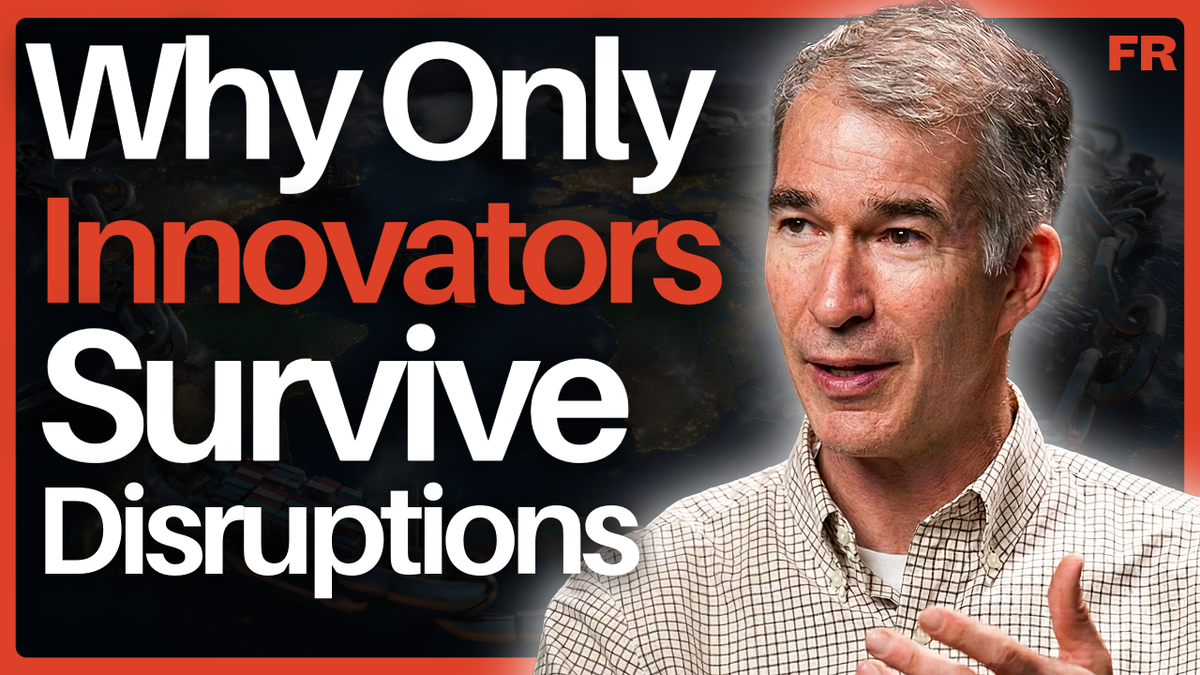
Today, I am joined by Professor Scott Anthony of Dartmouth University. He's currently a professor in practice that looks to teach MBA students how to navigate disruptions and innovation. He recently published this book called Epic Disruptions: 11 Innovations That Shape the Modern World. In this book, he covers 11 modern innovations ranging from the printing press to the iPhone, and he goes into great detail about how each invention and innovation radically reshaped the world that we live in today. I hope you will enjoy my conversation with him as much as I did.
Keith 00:01:36
You are one of the most influential disciples of the notable scholar Clay Christensen, a foundational thinker who influenced many executives and corporate leaders across the world. I know of a story where Jensen Huang keeps his book in his backdrop, and the idea of the innovator's dilemma is something that he keeps at the forefront of his own thinking as well. I wanted to ask a really obvious question: how should one understand the dilemma an innovator faces?
Scott Anthony 00:02:05
The dilemma that innovators face that Clay Christensen identified in his research is a really challenging one. The dilemma is you do everything that feels right. You listen to your best customers. You innovate to meet their needs. You produce the best products and services on the market. You do everything that the Harvard Business School and other schools would teach you to do, and you leave yourself susceptible to someone changing the game with what he called a disruptive innovation. That's the dilemma. The right answer ends up being the wrong answer. You invest to make today better. You miss the opportunity to play tomorrow's game differently.
It's something that is a real challenge because it feels like as a leader, you're doing all of the right things until that moment where it's clear that you have done the wrong thing. The good news is Clay identified this in his research 30 years ago, and there are lots of examples of companies that struggled with it historically. You can think about Eastman Kodak and its struggle with digital imaging, Blockbuster Video and Netflix, some of the old mobile handset manufacturers and Apple and Google.
Today, large established organisations have recognised that disruption need not be a threat. It can be an opportunity. And that really has changed the way that many organisations have approached innovation.
Keith 00:03:18
You wrote this book, Epic Disruptions. There are two layers to this. One, it has to be epic. I need you to unpack that for me. Why is it epic? And two is disruption. I think when people think of disruptions, at least in Singapore, disruptions are like the trains are not working. They're a disturbance. They're an inconvenience. But you point us towards innovations or technological changes that reshape the world that we live in. Take me through the core thesis of what epic disruptions should seek to tell us.
Scott Anthony 00:03:49
Let me define the words in inverse order. Let me do disruption first and then epic. The way that I like to communicate the idea of disruption is doing a very quick tour through the history of computing. If you go back to the year my father was born, 1947, there was one, exactly one computer in the world. It weighed 20 tonnes. It was incredibly complicated to use. My father would never see that computer.
I was born in 1975. At that point, there are tens of thousands of computers. Still, I as an individual would never see them because they're in large organisations. They're for very complex tasks. By the time my daughter Holly is born in 2007, there are hundreds of millions of computers. They're desktops and laptop computers. That's the year that Steve Jobs and team introduces the iPhone. Today, we've got billions of computers in our pockets and our palms. This is disruptive technology, disruptive innovation. You take things that were complicated and expensive. You make them simple and affordable. You change the dynamics of markets. You drive explosive growth.
What is an epic disruption? Sir Francis Bacon in 1620 said that there had been three things in human history where you can draw a line before and after: the printing press, compass, and gunpowder. That's the idea of an epic disruption. Something where the world is materially different after the innovation is introduced, like the smartphone. Now the world is a different world and all the knock-on effects that we could talk about for hours. Just like gunpowder, one of the ones that Bacon identified—the idea that warfare used to be like this, cities used to be defined and defended like that. When gunpowder and the cannon came, everything changed. That's what an epic disruption does. It changes everything.
Keith 00:05:44
One of the things I was thinking about as I was reading this book was how certain things that were once out of reach or exacted too high a price became rapidly commoditised. What was once a luxury is now what most people could consider a common good. I think your book encapsulates the idea across the technological spectrum.
There is a follow-on question I had. If you look at today, the big commoditisation that's happening is the commoditisation of computation in the form of artificial intelligence. You detail in the book—you bring us back to the first information revolution, the introduction of the printing press. Part of me wants to ask this question: what are some of the lessons from the introduction of the printing press, the creation of the printing press, that would inform or should help us think better in the way in which we understand AI today?
Scott Anthony 00:06:46
It's a great question. AI is top of many people's minds right now when you think about today's epic disruptions. I teach a class at the Tuck School of Business at Dartmouth College called GenAI and Consultative Decision-Making. About half of our graduates go into consulting. So let's create essentially a sandbox where we can play and learn about the technology.
What can you learn if you go back to the 15th century and study the introduction of the printing press? Actually, a lot. Very brief version of the printing press story: Gutenberg arrives in Strasbourg, Germany in 1434. He's not working on the printing press. He's working on a completely different business—these trinkets that with a mirror would capture the essence of the Holy Spirit during a planned pilgrimage to the area. The pilgrimage gets called off because the bubonic plague breaks out. That's bad for many people but good for the world because Gutenberg and team pivot to create the movable type printing press which truly democratised knowledge.
Before the printing press was introduced, one historian said you could take every book, every single book in circulation in Europe, and you could put it into a single wagon. After the printing press, there are thousands, tens of thousands, hundreds of thousands, millions of books. A true democratisation of knowledge.
Here's one interesting thing that I think you can take from the story. Who's the first customer of the printing press? The first customer of any scale is the Catholic Church. They've got real problems to solve. They want to standardise how religious services are run. A handscribed Bible would take three years to scribe. With a printing press, you can standardise, you can simplify, you can spread the way you communicate. At first, they're super excited about the technology. But then Martin Luther and other people who have different ideas about things like religion, they get hold of the same technology and they start spreading alternative viewpoints. We have the Reformation. The church splinters. You have the rise of many different religions. A technology that at first was really good for the Catholic Church ended up being really bad for it.
What does this have to do with AI? Right now you have very big consulting companies that are making a lot of money helping their clients adopt and utilise AI. I wonder if it will be the same thing as the Catholic Church where it feels really good for McKinsey, Accenture right now, but it ultimately feels bad because the end customer client business can now do things that no longer require working with consultants.
The second thing I would say is as knowledge spreads, it really changes the way society works, the way that things are organised, because you can capture and transmit knowledge. We will see the same thing with artificial intelligence. The way organisations are set up today, it's a relic of the industrial revolution. I don't know what the organisation of the future will look like. But as everybody has the ability to process data and information at scales that we could never think about, organisations will look fundamentally different—how power structures work, how they're structured. That will all change in the years ahead because that's what happens whenever you get this kind of democratisation.
Keith 00:10:03
The other question I had was on Gutenberg himself. What was it about him specifically? Because before Gutenberg even went and created the printing press, he was an ironsmith. What were his competitors, his partners or rivals in that guilded age? Why did they not develop the printing press? Why is it him?
Scott Anthony 00:10:29
It's a great question. I ask in the book, why is it Gutenberg in Germany? It could be lots of different people. In fact, if you look at history, one thing people ask is why Germany versus China? A lot of the technologies that are used—paper and ink and moulding of letters—those technologies trace back and were originally created in China. Nobody knows the answer for sure. We don't know exactly why Gutenberg. But what I argue in the book is one of the most persistent findings in the innovation literature is that magic happens at intersections when you get different mindsets and backgrounds coming together, and Gutenberg managed to be at the right intersection at the right time.
He's doing work in Strasbourg, Germany. There's a really good bell foundry industry there. You get a bunch of people who are good at inscribing on metal. It's a wine-growing region. People have presses that are used for wine, but they can be adapted into the movable type-based printing press. Gutenberg didn't come up with the press itself. It was this guy Conrad Saspach who joined his team who had that. Gutenberg's father worked at the mint, so Gutenberg had exposure to what it was really like to do fine etchings on mouldings. Turns out the people at the time could etch at something that was many times better than today's laser printers using tools that existed in the 15th century.
It's a big trade route in Strasbourg. You've got people coming from lots of different places. The Catholic Church has a big outpost there. You've got a customer there. You've got money there. You needed money to start a business then, you need it now. Johann Fust goes and provides the original funding. The argument I make in the book is all of these intersections allowed Gutenberg to do something that no one else could do. What exactly was the thing that drove him? Nobody knows. That's lost to history. But I suspect those intersections are what really powered him.
Keith 00:12:18
If we were to map that to the modern times, you would say that it's actually a convergence of location, capital, and talent—talent in divergent fields. But they can't be too divergent. They have to somehow have a sufficient overlap across those sectors.
Scott Anthony 00:12:31
I think very well put. It's one of the reasons why you see great things happening in places like Silicon Valley or Shenzhen or Singapore, because you get those things coming together. Yes, you need talent that is looking at the world in different ways. You need talent that is pushing frontiers. But too much divergence leads to, in essence, chaos, and you cannot create innovation from chaos.
Keith 00:12:57
Before you entered academia, you were an innovation consultant to some of the biggest businesses in the world. One of the things that strikes me as someone who's in that space is if you look at businesses, they often champion themselves as innovators, as disruptors, but even then a lot of them don't sufficiently innovate, or some of them even die as a business. Why is it that that actually happens?
Scott Anthony 00:13:29
It's a great question. I explore it in the chapter that focuses on steel. If you know any of Clay Christensen's research, you know one of his favourite stories was to talk about steel minimills. Very brief overview of that story: there are two basic ways to create steel. You can build a huge integrated mill. Bethlehem Steel built the last integrated mill in the United States in the early 1960s. In today's terms, multiple billions of dollars. They're huge, like a mile long. And they produce pound-for-pound the best quality steel in the world.
Steel minimills are a lot smaller. They use an electric arc furnace that melts scrap steel and turns it into finished products. You don't need to invest billions. You can invest tens of millions and create a steel minimill. Quality is not as good, but it's a lot cheaper. It's a classic disruption.
The way Clay would tell the story is the reason why the integrated mill struggled with the steel minimill was resource allocation. It was completely logical. You invest your resources on your highest-performing, highest-margin opportunities upmarket, and you ignore and don't invest in your least profitable businesses downmarket. The steel minimill looks at those least profitable markets, and because they've got a lower cost structure, they make money at those markets. They get better and better and better until they get into more demanding markets.
The whole story can be told without anyone doing anything that's irrational, except for this: at the end of the day, a company like Bethlehem Steel, once one of the true titans of industry, gets killed. It goes bankrupt. And no rational leader would say, "I want to go bankrupt." So there has to, in my mind, be some irrationality in it.
To me, the biggest thing comes from a 1548 proclamation from King Edward VI. In 1548, King Edward VI issued a proclamation against those that doeth innovate. The king tried to ban innovation. Why? What does an innovator do? They question the status quo. If you're questioning the status quo in 1548, what are you questioning? Who are you questioning? The king. If not the king, God above the king. People didn't like that. That was a heretical act.
Now, we don't issue those proclamations any more. But still, innovation disrupts dynamics inside organisations. It threatens the sense of self that people have in organisations. So for lots of irrational reasons—people wanting to cling to power, being afraid of change—people will say, "No, cannot, not worth doing, somebody else will take care of it." And it leads to organisations, even if they intellectually get it, not being able to ultimately make the change because they're scared. That to me is what really is at the root of it. There are other things that I talk about in the book about getting over past traumas and overcoming invisible patterns, but it really is that fear—that fear of somebody losing power, that fear of somebody losing identity—that I think is the biggest barrier to driving change.
Keith 00:16:32
One of the things that came to my mind as I was reading that part of the book when you're talking about Bethlehem Steel was the story of Foxconn in China. The main reason was because they went into, as you said, the classic disruptor—they went into the low-margin business. I think Terry Gou puts it when he was talking about why he decided to become a cheap contract manufacturer for the big tech giants: he saw the opportunity to learn and optimise. He was willing to sacrifice on the profit margins so that he could optimise and relentlessly improve. I think that's what some economists call learning by doing. By going through that process, you can eventually go upmarket and challenge the incumbents. This is why Foxconn is one of the biggest or best contract manufacturers today.
On that note, I have to ask this question about this bigger macro trend within the US, which is what I'm seeing: there's a lot of discussion about de-industrialisation. Across the board, a lot of the big traditional industrial giants—I won't say expecting a reversal of fortunes of sorts—if you were in their shoes today, I would like to ask: is there a way to reverse that if you're being disrupted now? Is it too late? How does an organisation turn the ship around in that sense?
Scott Anthony 00:18:00
It's a big, complicated question. I'll say two things. Number one: usually by the time it's clear to you you need to do something different, if you haven't already done it, it's too late. I teach my students this by calling it the information-action paradox. Bit of a mouthful, but the idea is by the time the data are clear that you need to do something different, it's too late to act on the implications of the data.
A wise, decisive leader, which is what we seek to build in our school, will paradoxically act when the data tells them not to, because by the time the data tells you to do something, it's too late. I think for some of the really large companies that are finally recognising they're at the end of the road of what they're currently doing, it will be really hard for them to change. But there's plenty that have started to act early and will be in fine shape.
The second point I'd make is there's data to show that large established companies that think and act in the right way can turn disruption from a threat to an opportunity. One great example I think is a company based in France, Schneider Electric, that really has driven what we called in my old consulting days a dual transformation. Transform the existing business of providing industrial goods by driving digital everywhere you can in production, service, assembly, and then create new businesses—services that will take the industrial products that you have and get data insight from them and be able to sell additional services to people.
Schneider Electric, if you look at its stock, a phenomenally performing company that is in a whole bunch of old-line industries, but has shown that if you use the disruption to make today's business better and you use the disruption to create tomorrow's business, and you do both of those simultaneously, as an incumbent, you've got some advantages. You've got assets, you've got access to customers. When you do it well, it can be a really powerful engine of growth. That's the exception. Most companies don't do that, but when they do, it is a really powerful growth engine.
Keith 00:20:00
You have this exposure—you've consulted a lot of these leaders. Part of the challenge is they're at the top of the game, and like you said, you're asking them to act in absence of data. Is it hard for them to actually turn that corner, to actually be willing to take more risk when there's so much at stake for them?
Scott Anthony 00:20:13
A couple things. This exact question—my students said, "What do you mean you're telling us to act when the data tells you not to? Telling us to go gamble?" I said, "No, no. Just recognise the limits of traditional data. What do you have to do? You have to spot the weak signal, which is another form of data, and you have to learn how to amplify it using a tool, model, framework, historical example, whatever. So it still very much is the quest to find the right information so you can say, 'I see something here that suggests that I need to act.'"
That is an incredibly hard thing to do, but it is a doable thing. The thing that gets challenging is the bigger, the more successful you are, the harder it is to do this. Bob Dylan once said, "When you ain't got nothing, you got nothing to lose." You look at the research by Kahneman and Tversky—prospect theory and related areas—as humans we get more benefit from avoiding losses than receiving gains. So when you're the great big market leader and there's a perception that you have to go through what's called a J curve—things get a little worse before they get better—we really don't like that J curve. The entrepreneur? We can just do whatever we want. We don't have anything to lose.
Yes, it is an incredibly difficult thing to do. But here's the thing. You said they have to take more risk. I would have a different point of view. There was a CEO once who came to a gathering at my old consulting company that framed it really well. He said, "Okay, let's talk about risk and innovation. I can invest in innovation and people perceive that to be risky. But best case, worst case. Worst case, I'm wrong. I write the investment off. As long as I don't invest so much that I lever up and bankrupt the company, that's okay. Best case, I'm right. Great. New growth engine, new platform for growth.
Let's say I choose not to invest in innovation. Best case, worst case. Best case, status quo. Worst case, I bankrupt the company because I miss an inflection point and I get way behind my competitors and can't catch up. So what's the risk? Is the risk to innovate? No. The risk is in many cases to not innovate. You've got to be smart about it. You've got to manage your resources. But it's not actually risky if you think about it and act in the right sort of way."
Keith 00:22:30
It's interesting that you say that because I think most folks don't frame risk and innovation that way. I think the common model is just if I take a risk, I might stand to lose something, and most often than not we don't consider the counterfactual, which is if we don't do anything, what's the risk there?
Scott Anthony 00:22:48
It is absolutely right. This is a huge bias and blind spot we have. I know it doesn't feel right, but this is the thing that the mindset has to shift, because the riskiest thing for most organisations to do today—there's so much going on. I said earlier Sir Francis Bacon said three things in world history line before and after. Today you've got augmented reality, artificial intelligence, autonomous vehicles, and additive manufacturing. I've got four and I've not left the letter A. There's so much going on now. You can't stand still. The risk really is saying, "Oh, just wait for this to pass." It's not a good plan.
Keith 00:23:27
In a sense, it's worse to commit the sin of omission than the sin of commission.
Scott Anthony 00:23:32
For sure. But the challenge is if you're a leader, you commit the sin of commission, you get fired. You commit the sin of omission, people are like, "Oh, you know." You feel like you're taking less risk when you're doing it, even though you're taking more risk when you do it.
Keith 00:23:49
I know you've consulted, you've done work in Singapore. Have you been able to see innovation or the work of innovation being done in Singapore? What makes it different here as compared to the US?
Scott Anthony 00:24:02
Another area we could have a long conversation around. We're having this conversation right now—I'm in the midst of a trip with 30 of my MBA students. We're looking at Singapore from as many angles as you can in a week to try and say Singapore has followed an approach where they've managed to balance tensions between short-term and long-term, being a multi-ethnic society, living harmoniously, being friends to everybody, the world's most powerful passport. It's all worked incredibly well. Will it continue to work? It worked well in a rules-based order where meritocracy was successful. As we enter into what might be a different world order, does that continue?
To me, one of the reflections is just what is truly unique about Singapore. As we've looked at things from different areas, you have multiple places where the way people approach things is a very pragmatic paranoia—a paranoia that our success is fleeting, that we're in an area where we've got much bigger countries around us, we're the little red dot. There's healthy paranoia that we have to continue to think differently, but pragmatic. What are we going to do? We can't just despair. We have to take action.
To make that work, you look widely to find the best examples you can find globally. You think very expansively. It's not just about what am I going to do today? We went to URA—what's the 50-year plan? What's the 100-year plan? You need both of those. You debate vigorously. We were with the Monetary Authority of Singapore and they were talking about some of the new policies that they've implemented. I said they listen to all sides and make sure that they've got very careful considerations of all perspectives. They don't know the right answer at the beginning, so they need those different points of view. Then you act very thoroughly. When you do those things in the right way, you can do powerful things.
When I go internationally and I say 2017 I think it was, MAS set up a regulatory sandbox to encourage fintech—the financial regulator, the central bank did that—people honestly just can't believe it. But it's that kind of thinking that gives me optimism that the Singapore story is not over.
Keith 00:26:12
As a young Singaporean, I'm thinking we did a lot of things that helped us succeed in the past, so now you're at this trap where you might think, "Let's just keep working on what has worked for us in the past." I actually don't think that states escape the innovator's dilemma. Most people think of the innovator's dilemma from the company's perspective, but from a government perspective, you should also continually innovate as well.
Scott Anthony 00:26:34
For sure. You look at what has changed globally. I lived here in Singapore from 2010 to 2022. If you just freeze on 2010, what's different globally today than 2010? When you talked about innovation in China, you would say China is a place where you get Foxconn, you get people who do very cheap knockoffs of things and they're fast but they're not innovative. Today you look at EV, AV, you look at the low-altitude economy, you look at artificial intelligence—China's pioneering in many places. This was not the case 15 years ago. That's a pretty big deal.
You look at Singapore then in that picture. First project I did in my consulting days was with the Singapore Economic Development Board, 2003, and one of the questions was how do we make the island more entrepreneurial? We went around and we talked to people—name an innovative company in Singapore, name a startup in Singapore—and people just kind of looked at us blankly. They said, "Creative, maybe," which was founded in 1980. So that was at that point a middle-aged company.
Today you have legitimate unicorns that are being born in Singapore. You go to Block 71, you have 800 active startups. It's a little messy in places and I really like that because I appreciate general cleanliness in Singapore, hygiene standards, but for innovation, you need a little bit of mess. Singapore has gotten a little bit messier and I think that's a good thing. I think a little bit more mess would be even better.
Keith 00:28:05
You talk about this idea of anomalies being wanted. How should one become the right anomaly in that sense? How does one in their own way of thinking about the world try to be more innovative or entrepreneurial?
Scott Anthony 00:28:18
My favourite chapter in the book is the chapter on Julia Child. I love the chapter because I just didn't see it coming when I started writing it. Julia Child, if you don't know her well, you'll read the book so you'll know her, but for listeners who don't know her—a famous chef. In 1961 she's the co-author with Simone Beck and Louisette Bertholle of this book, Mastering the Art of French Cooking. People are like, "Well, what is she doing in a book about disruption?"
Before that book, if you wanted to enjoy great French food and you lived in America, your best option was to get on a plane or a boat and go to France because you just couldn't find it anywhere. She made it, with her co-authors, simple and easy for a greater population to be able to cook French food in their own home. Classic disruptive innovation.
The thing that Julia Child really teaches us is people are not born as great disruptive innovators. She was not born a great chef. The first meal that she cooked for her husband Paul Child was brains simmered in red wine sauce. No idea why she picked that. It was a disaster. Paul Child's family said she can't even boil water. She failed the exam at Le Cordon Bleu, the famous cooking school. What was she? Incredibly persistent. What was she good at doing? Making connections. She had two co-authors. She went and worked with all sorts of different people. She was curious. She asked questions. She kept trying.
For her second main cookbook, Mastering the Art of French Cooking Volume 2, she needed to crack an incredibly difficult problem. How do you enable someone to cook French bread, a baguette at home? No one thought you could do it because you needed a special oven that you have in a boulangerie. How did Julia Child crack it? Persistent experimentation. Thirty different experiments, 284 pounds of flour, and ultimately she figures it out.
The thing about these anomalies, people like Julia Child, is they are not superheroes. They're normal people who follow behaviours like this. They're curious. They're collaborative. They're experimental. They're persistent. Any one of us can do it. One of the key mindsets underneath this is recognising a single failure is not fatal.
Julia Child started working on Mastering the Art of French Cooking in 1951. It was supposed to come out in 1954. It took seven extra years. There were two publisher shifts. There was a near-death moment where right before the book was going to be published, the publisher said, "You know what? I don't think we can bring this book out." And yet through it all, Julia Child was able to overcome and change the world of cooking.
Keith 00:31:00
How does the anomaly or how does a disruptor actually build a team around them? Because a lot of times when you think about an anomaly or someone that's weird or that's weirdly persistent, the idea is that they'll be out alone doing their own thing. How do they actually gather the right talent stack to help bring that disruption to pass?
Scott Anthony 00:31:17
First, if I talk about the persistence for just a second, it's important to recognise whenever you're doing a book like this, there's survivorship bias. We are studying the people who ultimately succeeded. There are plenty of people who persisted and never did. And you don't write stories about them because those stories end.
I look at my own history. I've had plenty of things that have succeeded, but plenty of businesses I've tried to launch that have not. Plenty of investments I've made that didn't pan out. Plenty back in my consulting days of projects I tried to sell that I didn't, even clients I did great work for that had no impact. Students who hate what I do in class, whatever. There are plenty of those things. The key thing to remember is it need not be fatal if you learn the right thing when something bad happens. Where people get into trouble is they persist doing the wrong thing.
Julia Child, to her credit, when a publisher said—the near-death experience—"The recipes are too long, this is too complicated," she took her wounds and she said, "All right, I will respond to that. I will simplify and make it easier." That is something that's really critical. It's not just continuing to run into a wall over and over again. That's bad. That hurts. It's saying there's something here that I can learn from and I can go in a different direction.
How do you then form the team around you? This is something that I learned from the research. I had this view in my mind that there were some stories that were really about the lone genius, like Gutenberg as an example. The story in my mind is it's this dude, say it's 14-whatever. It's this one guy working on his own. Never true. There's no story where it's an individual doing anything. It's too complicated, too hard, even in the 15th century.
What you have to be really good at doing is saying, "Here I am. I've got a certain set of skills. I've got a certain set of assets. What can I do that will complement me with somebody who might have skills in different areas?" Julia Child was a pretty scientific chef. One of the co-authors of her first book was a more intuitive chef, somebody who would just try things. One of them was a bridge between the two. I think there's something really lovely about that.
The prototypical startup is Steve Jobs and Steve Wozniak, where you've got Wozniak who's the technical guy and Jobs who's more of the marketing guy. That idea where you've got different people who've got complementary skills coming together, I think that's really critical. Again, above all else it's a mindset: I can't do it on my own. There's just no way I'm going to do anything material unless I have friends who are helping me out.
Keith 00:33:43
I don't think that actually is the common mindset, at least in Singapore. I think a lot of the thinking goes around—you should try to be compliant. You don't want to rock the boat. If things are going good, you don't want to rock the boat. It goes back to this idea of the innovator's dilemma where you talk about the incumbents are just resistant to change or there's a built-in inertia.
One of the things that I still think about today in terms of bringing innovation to everyday life—how do we actually get people to embrace innovation?
Scott Anthony 00:34:13
Again, no silver bullet answer to this, but there was a study that was done once looking at the people who founded companies and what was common in their background. One thing that showed up in a number of the backgrounds of successful founders was they went to a Montessori schooling programme. The Montessori method of schooling is one where you encourage creativity and curiosity. You have different ages mixed together. So it's not everyone's going through the same thing. There's some degree of freedom. There's boundaries but there's freedom at the same time, and you really are doing a lot of learning by doing.
I put all my children in early ages through Montessori programmes. This is a bit self-serving but I went to a Montessori programme myself. The thing that my mother, who had very strong views on this, said was what I always appreciated about Montessori programmes is the kids who come out of it, they have an intrinsic love of learning. They're not trying to learn because they want to pass a test. They're learning because learning is interesting and therefore they're curious and they're saying, "Huh, why are we doing it this way? Could we not do it a different way?"
To me, above all else, it is the innate curiosity, the wonder. Why do things work this way? How might we do it a different way? That's the unlock. If you have curiosity at scale, you can then apply it to find other people who are curious that you can collaborate with. You can apply it to what do I not know about this idea? How do I do fast-cycle experimentation? You can apply it to, "Hey, this didn't work. I failed. What can I learn from it and do better the next time?" The curiosity is the connected tissue between all of it.
Now, you get back to Singapore. What's the concern? Singapore PSLE is a really big deal. You have very high pressure put on children at an early age to say, "No, no, no, not that. Ace the test." Your score is the thing that matters. It is not the journey, it's the destination. The thing that balances that is many Singaporeans then get out of Singapore for at least a period of time for some of their education, and that I think helps give them a different perspective. Of course, us humans, we are a unique species. Everybody's a little bit different.
But if I could wave my wand about Singapore, it's two things. One is a little bit more mess. Two is just a little bit more encouraging of children just to screw around, just to be curious and experiment.
Keith 00:36:40
If you were to have another wish in your three wishes with regards to the education system, it could be in Singapore, it could be in the US where you're from—how should education systems evolve to encourage people to be comfortable navigating the time of increasing disruption?
Scott Anthony 00:36:54
It's something I think about all the time. It's interesting for me to reflect on this. My first career is consulting. I spend more than 20 years essentially in day-to-day combat because in consulting you're either fighting the problem, the client, the team itself that you're working with, sometimes the world. It's exciting, but it can get really fatiguing.
Then 2022, I become a teacher. I'm like, "Okay, great. I'm going to academia. It's slow-moving. Everything's going to be okay." I start 1 July 2022. A few months later, ChatGPT 3.5 comes out, and then you have an administration come in that has very clear views about what it wants to do with education. Here I am back in the deep end again on the front line of disruptive change, because as educators our question is how do you teach? How do you measure? How do you run a class in a world where people have this new amazing tool?
To me, the biggest thing is pushing on experiential learning. More ways for people not to learn rotely by reading things or having ChatGPT or Claude or whatever do their homework for them, but really getting a chance to have simulations, to play games, to do role-playing, to experience. One of the great things about business education when it's done well, the essence of business education is the case study. What a case study does, it allows you to step in the shoes of someone else.
I have as an example a case study based on a consulting client I had back at Innosight, working with DBS Bank as it's undergoing its transformation. Students step into the shoes of the chief data and transformation officer DBS eight years ago. That chief data and transformation officer, Paul Cobban, opened up this new centre in Hyderabad. It was supposed to be a showcase for everything DBS was becoming. It was a disaster. It wasn't working well. There you go. There's the problem. You don't know what the answer is. What do you do?
Of course, you can get an answer from ChatGPT. But the key thing is getting in the room and having a discussion where people are saying, "We could do this, we could do that. There are pros, there are cons. Let's explore." When it goes well, something magical happens because people have stepped in the shoes of a business leader. They've experienced something and they've learned something from it.
Things like that where you get people more chances to experience and experiment, which tools like AI and augmented reality can really help you do—that to me is critical to help learners. That's a long answer for part one.
Part two will be shorter. Part two: have people leave the classroom feeling excited. Have them feel like this was cool. I love the fact that I learned something and I want to learn more. I don't think—I know education doesn't happen solely in classrooms. When the student leaves the room excited by what they've learned and they want to keep learning about it, the world is their classroom. That is the best circumstance that you can be in.
Keith 00:40:01
Two-part follow-up to the question. You have to tell me what happened in the end with the DBS case study. And the second point I wanted to make was that it seems to me that AI—you could actually utilise AI to make it more human, for people to lean into their humanity and think about how they can have improved executive decision-making. Where else have you seen some of the other benefits of implementing AI in the education space?
Scott Anthony 00:40:22
The first part—so read my book, Eat, Sleep, Innovate, which talks about the Hyderabad case and everything that DBS did. The TLDR summary is if you really want to shape culture at an organisation, you really want people to adopt digital technologies, it's not the technology, it's the day-to-day behaviours. Really trying to actively work and think about how do we have people on a day-to-day basis experiment, be curious, be collaborative, be all the things we've talked about. That was the thing that DBS learned. The book describes exactly what they do to help with that.
On the second part related to AI, back to the class that I teach, GenAI and Consultative Decision-Making—AI can be a huge enabler of learning if used in the right sort of way. The two things that I tell my students when it relates to innovation, what AI can really uniquely enable you to do is number one, imagine different perspectives. AI is really good at taking on different personas and at least sounding like it's somebody who is a cynic or somebody who is excited or somebody who's an early adopter or somebody who's a tough investor, whatever. That ability to then look at a problem from multiple angles really improves if you use AI well.
The second thing is you can use AI to really upgrade your experiments. Whether it's actually running an experiment through AI or it's creating collateral, creating mock-ups, creating low-tech versions of solutions, that dramatically accelerates fast-cycle learning. Those two things to me are really powerful.
Of course, there's the basics. You can get smart about anything quickly if you use it the right way. But the thing that I urge students to remember—ultimately if they want to strengthen this muscle, if they want their brain to be stronger, they cannot outsource to AI. By analogy, you can lift any amount of weight you want to at a gym if you bring a forklift with you. But that does not help you get stronger. If you turn everything over to AI, it's the same thing as bringing a forklift to the gym. It's not the point. The struggle is the point.
Keith 00:42:29
If you look at the incumbents, a lot of them actually logically say that we should have—we did everything right. I think you use the example of Nokia when they were at the pinnacle of their success and they failed to see that Apple was going to disrupt them and out-innovate them radically in the coming years. You pointed out earlier was that there was a part of them that just didn't seek to innovate.
The other question that I had to ask was what were the other actions they could have taken? For example, could Nokia actually have invested in building their own smartphone, or is it really deterministic? Should one think about this innovator's dilemma—the incumbent kind of really just focusing on the high margins and then eventually losing their ground—as something that is deterministic? If today we could play back to Nokia in 2007 and you were in the boardroom with the CEO, what would you have said to him?
Scott Anthony 00:43:28
I think there's data to suggest it's not deterministic. You said anomalies wanted. What would be anomalies to Clayton Christensen's original finding that market leaders struggle in the face of disruptive change? Look at all the big tech companies. A generation ago, Meta would not have bought Instagram. Meta would not have bought WhatsApp. It would have said, "That's not what we do. We're a social network on computers. We're not something where we take pictures on smartphones." So Meta did both of those things.
Go back 30 years ago. When Microsoft stalled 15 years ago, 20 years ago now, that would have been it. It would not have gotten cloud computing. It would not have gotten artificial intelligence, which are fundamentally different businesses and business models. They have very disruptive characteristics to Microsoft. But under Satya Nadella, they did those things.
You go back 30 years ago, Google might not have been leading in the AI race with Gemini, but today the market leaders are increasingly recognising that we have to play offence, not defence. I think you've got some data to suggest it.
What would I have told Nokia back in 2007? I'd say, well, let's start the clock a few years earlier, 2005. Nokia had a version of a smartphone working in its laboratory. So say, "Good, like any incumbent company, they see it. You're never blind to it. You always see it." Number one: you need more, not less here. Number two: the Symbian operating system that you have grounded everything in is going to inhibit your ability to do what the next generation is, which really is a personal computer in your pocket. This is the thing that people get wrong. A smartphone is not a smartphone. It's not about the phone. It's about bringing computing to new context. Tell Nokia you have to think about your operating system, and I'd say you might have to buy something if you want to be a real competitor in this space.
I would say even more—if you look at the research that Quy Huy has done over at INSEAD based here in Singapore in the campus here—the real problem at Nokia was their culture was one where people were very afraid of saying anything that was not perceived to be good news. The fact that Apple was beginning to get market share—bury the news, bury the news, bury the news. When you have a culture that doesn't have what Amy Edmondson at Harvard would call psychological safety, it's really hard to respond to disruptive change.
What I'd want is very simple. I would want a completely different culture. I'd want them to create more space to completely rethink the operating model choices that they made for their devices. And I'd want some pretty big acquisitions. Would it all have worked? No guarantees in life. Business is complicated. That is the thing. Even if you've got the right playbook, I had consulting clients I worked with where I stand by 100% the recommendations I gave them and they didn't work, or other cases where the clients ignored the recommendations and they found great success. Plenty where they did what I recommended, those things work, but business is complicated.
Heraclitus, the Greek philosopher, said you can't step in the same river twice. Every circumstance is different. Even you look at doing financial analysis—where do the numbers come from? God didn't put them on a spreadsheet. Some human went and made an estimate, maybe aided by AI, but that might have made it worse. That said, "This is the number." Is that actual real honest truth? You don't know.
Keith 00:46:53
The biggest reversal of fortune to me in the past decade seems to be Microsoft. They went from struggling company—they'd tried multiple products and they failed over time—and today now they're undisputed one of the leading leaders in, be it generative AI, be it cloud solutions. What do you think sparked that evolution or that reversal?
Scott Anthony 00:47:17
The good news is it's a pretty simple answer. Of course, the reality is always a bit more complicated, but Satya Nadella comes in as the CEO after Steve Ballmer. His biggest thing, the biggest unlock, is we're going to change the mindset of the company from a know-it-all mindset where we're going to force-rank everyone and believe that we're just better than everybody else to a learn-it-all mindset. We're going to embrace the growth mindset and say, "Hey, right answers can come from lots of different places and we really want to embrace curiosity and think about things differently."
That enables you to say, "Cloud doesn't have to be a threat. It can be an opportunity." Enables you to say, "Hey, we have fought fierce battles with Apple and we probably will in some cases continue to do it, but it's the leading smartphone platform. So we better have our enterprise software on that platform." It enables you to say, "Hey, there's this cool company, OpenAI, that's doing some interesting things. This could completely change the rules of our business. Let's invest in it."
Those are things that would be unimaginable a generation ago, but with a growth mindset where you see possibility, they're easy things to do.
Keith 00:48:16
With that, I come to my final question for you, Prof. With this new book that you've written, with all that you've known in the world, if there's one piece of advice you give to a graduate student entering the working world today, what would that piece of advice be?
Scott Anthony 00:48:28
Have more fun. The world can be a very scary place. You have the king's proclamation against those that doeth innovate. Technologies can feel overwhelming. Life can feel overwhelming. It's very easy to say, "I will find comfort in the known, and I will just put my head down and execute and all that." As we said, that's a recipe for stasis, if not moving backwards.
Have fun, explore, try new things. Get in the robo-taxi you've never gotten in before. Take the overseas assignment that you've never taken before. Experiment, and you never know exactly where it'll get you, but the destination will be worth it. So have more fun.
Keith 00:49:07
Prof, and with the viewers here watching the podcast, I'd like to recommend you read Prof's new book, Epic Disruptions. I found it to be tremendously useful in reframing and understanding how we navigate technological changes today. So if you want to understand where the future is, it's useful to understand the past. With that, thank you, Prof, for coming on.
Scott Anthony 00:49:27
Thank you very much. It's been my pleasure.
Keith 00:49:38
Thank you for listening to today's episode. If you are watching this on YouTube, please consider subscribing and turning on notifications for whenever new episodes are out. If you're on Spotify or Apple, it would help us greatly if you could leave a five-star review on those platforms. Once again, thank you for tuning in.