


Quick note: I have migrated to Substack because its just easier to host things here and hopefully, it forces me to write more.
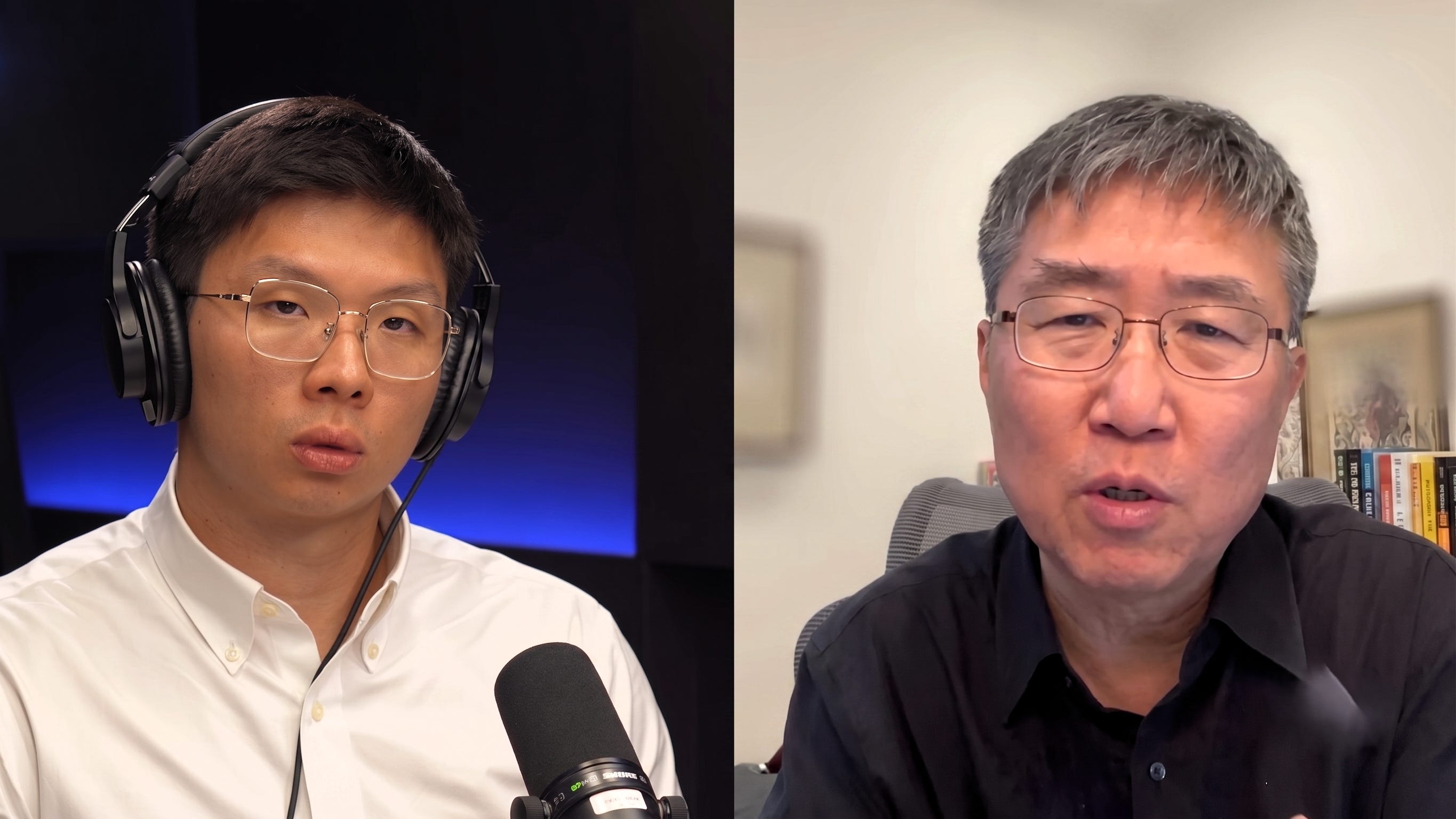
I just published an interview with my one of my favourite economists of the 21st century- Ha-Joon Chang.
Full Transcript can be found here:

I’ll be honest — getting Ha-Joon Chang on the show was one I’d wanted for a long time.
There are economists who are technically brilliant but impossible to read. There are others who are accessible but not very insightful.
Prof Chang is the rare third thing: someone who has done the serious scholarly work — decades of it — and can then sit across from you and explain why the global economy is organised the way it is, in language that doesn’t require a PhD to follow.
In a field that often prizes jargon and mistakes it for rigour, Prof Chang has an uncanny ability to communicate profound insights simply.
His mission, as I read it, is essentially one of myth-busting.
Here are three myths he has busted:
The myth that unadulterated free markets are the natural and superior state of economic organisation.
The myth that the countries preaching liberalisation got rich by following their own advice.
The myth that financialised capitalism — where corporations exist primarily to return cash to short-term shareholders rather than to build things — is a sign of a healthy economy rather than a symptom of a broken one.
He does this not with polemic but with data, with history, and stories. This has made his books a joy to read.
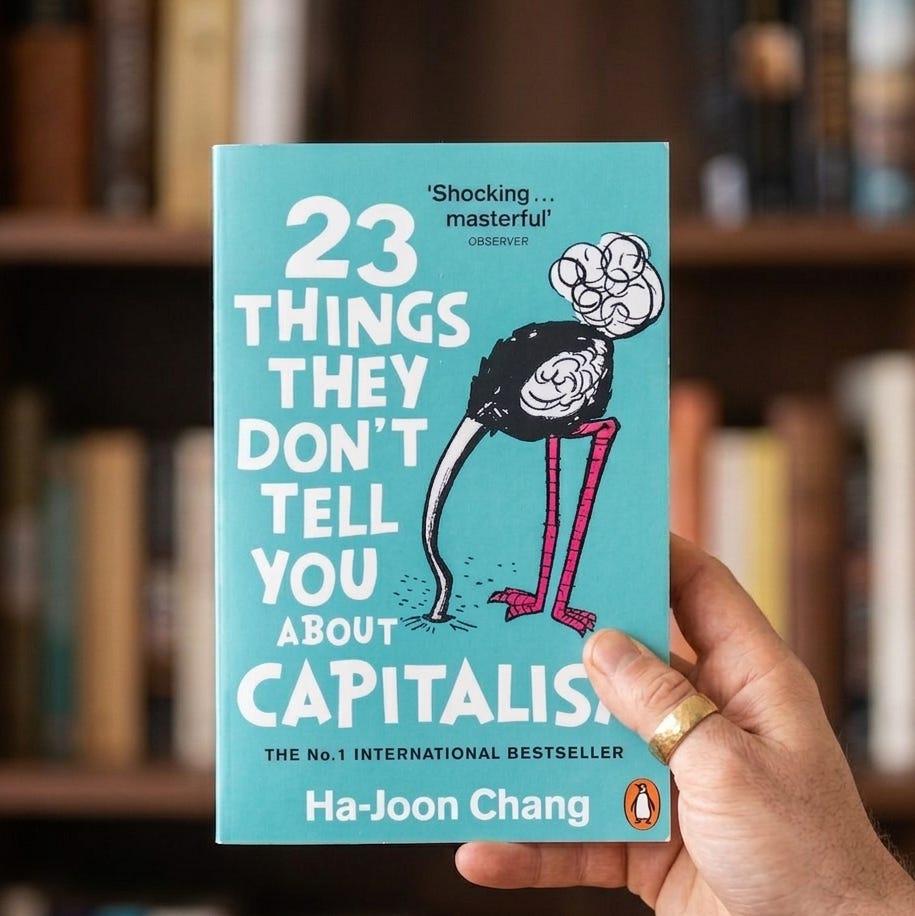
Oh- by the way, I am giving a copy of his book - 23 Things They Don’t Tell You About Capitalism to a lucky subscriber.
To boost your chances, you can do (any/all) of the following:
Reply this email with a 5 star rating of my podcast on Spotify/Apple or wherever you get your podcast
Reply this email with why you want a copy of this book!
Write about a learning you had from any of my podcast episodes on your favourite social platform (tag me!)
Also, since I have you here…
If you want something accessible, fun and light - please read Edible Economics!
The premise is disarmingly simple: each chapter uses a different food to illuminate an economic concept.
For example, I loved how he used coconuts as a way to dispel the myth of the lazy tropics - where tropical countries are poor because the ‘natives’ lie beneath a coconut tree and wait for coconuts to fall, rather than trying to actively grow or, better still, make things.
(I will not spoil the book here)
Without further ado, my three takeaways from this week’s episode.
1. The West Was Never a Finished Story
The big idea from this conversation is that we are living at the end of ideological monotony.
For most of the post-war period, there was a dominant model: the assumption — often unspoken, but deeply embedded — that the American way of organising an economy was simply the correct one.
Free markets, limited government, unrestricted capital flows.
But as Ha-Joon Chang argued, that story becomes much less convincing once you look at the evidence.
Neoliberalism promised faster growth and delivered the opposite.
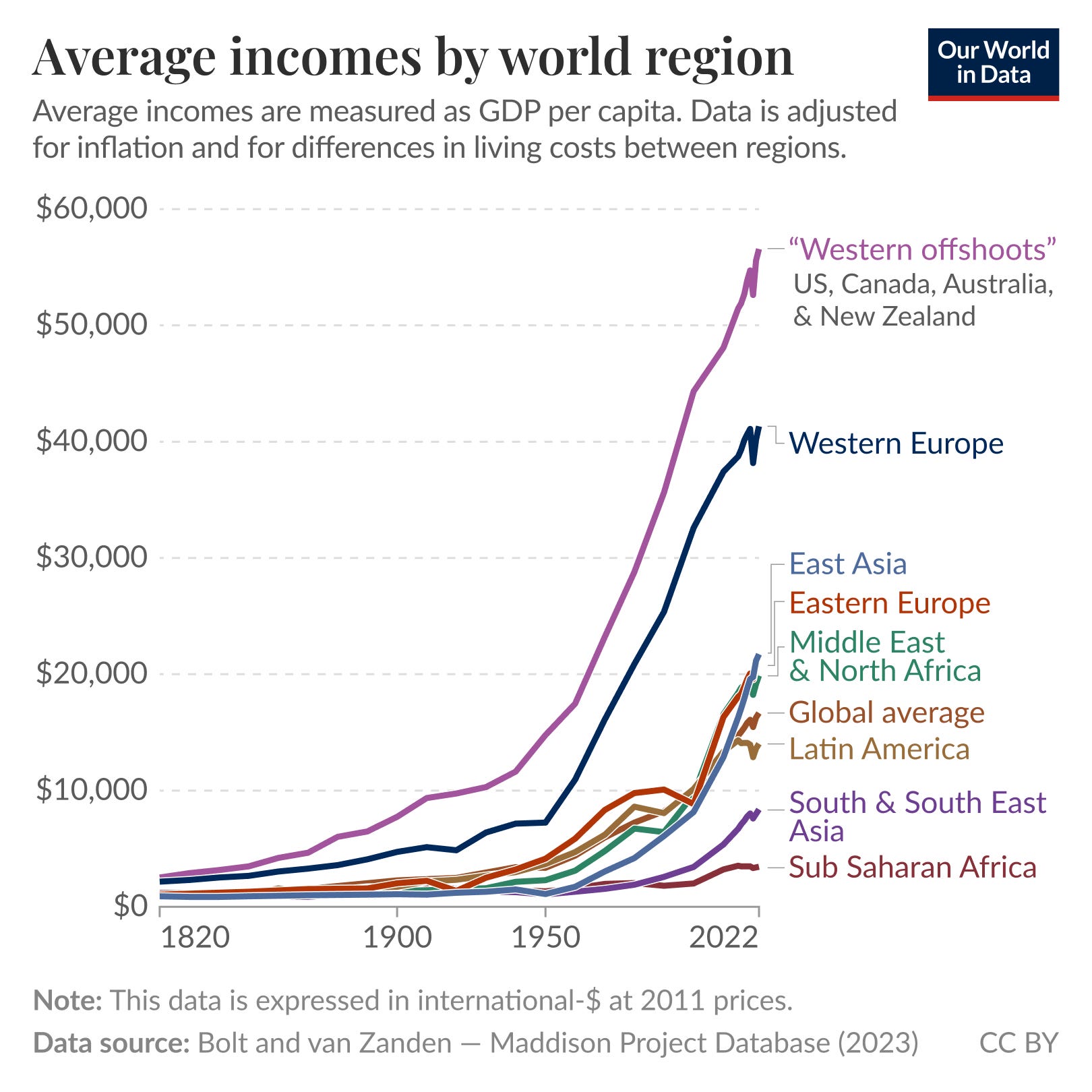
World per capita growth fell from roughly 2.8% annually during the mixed-economy era to 1.4% under neoliberalism.
Sub-Saharan Africa's average income in 2020 was only 6% higher than what it was in 1980.
And if we look at the countries who truly succeeded in development in the 20th century - they reveal a truth about economic development: active industrial policy often achieved rapid development by combining markets with strong state direction.
The lesson is not that markets do not matter.
It is that markets alone rarely explain development.
This is not to diminish what America built.
To become the world’s preeminent superpower in under two centuries is a remarkable civilisational achievement.
But remarkable is not the same as optimal.
The more useful distinction is between admiration and assumption.
We are not at the end of American power. We are at the end of American exceptionalism as an unchallenged premise.
2. Singapore Understood This Early
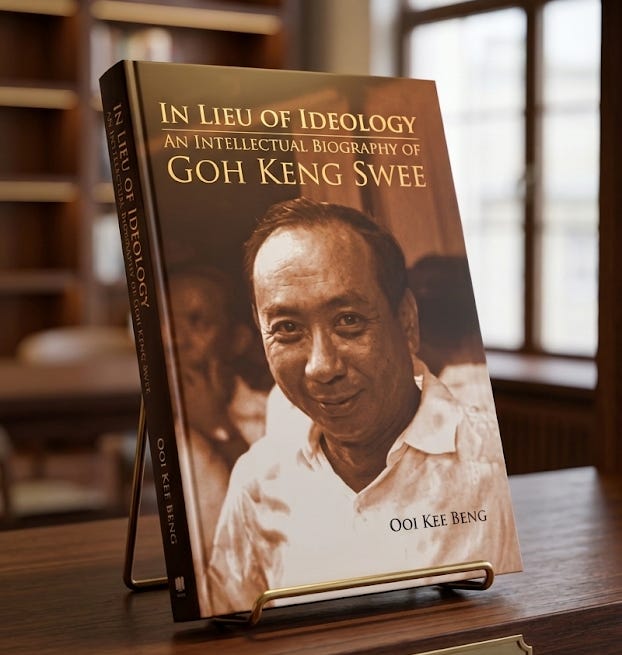
Chang’s comments on industrial policy brought me back to Ooi Kee Beng’s intellectual biography of Dr Goh Keng Swee, In Lieu of Ideology — a book I’d recommend to anyone trying to understand how Singapore actually works.
(See my interview with him here if you’d like)
Dr Goh understood something that mainstream economics took decades to fully absorb: an open and integrated global market is an opportunity for states to fast-track development.
But this does not mean a government should step aside.
It means the state has to be deliberate about how it shapes the economy — courting investors, building institutions, and concentrating effort where the returns are highest.
Here is an excerpt from Prof Ooi’s book- that explains why Dr Goh saw manufacturing as the leading industry that Singapore ought to take a bet on-
In short, industry would modernise and enrich. The general raising of the technological level of the countries, the spread of modern systems of production and management, all these, in the calculations of the planners, would not only generate economic growth but also help to bring about a rapid transformation of social attitudes, more consistent with the needs of modernising societies
Selection was only the beginning.
Singapore via EDB (the Economic Development Board) had to help make those industries viable through infrastructure, coordination, incentives, and institution-building.
That logic is closely aligned with what Prof Chang calls effective industrial policy: targeted sectors, coordinated support, and public inputs that no single firm can provide alone.
Dan Wang calls China - an engineering state because he has come to understand that modern China is unusually focused on solving problems through engineering, industrial capacity, infrastructure, and technical expertise.
My only rejoinder is that Singapore got there first (albeit on a much smaller scale)
3. Wealth Is Not the Same as Health
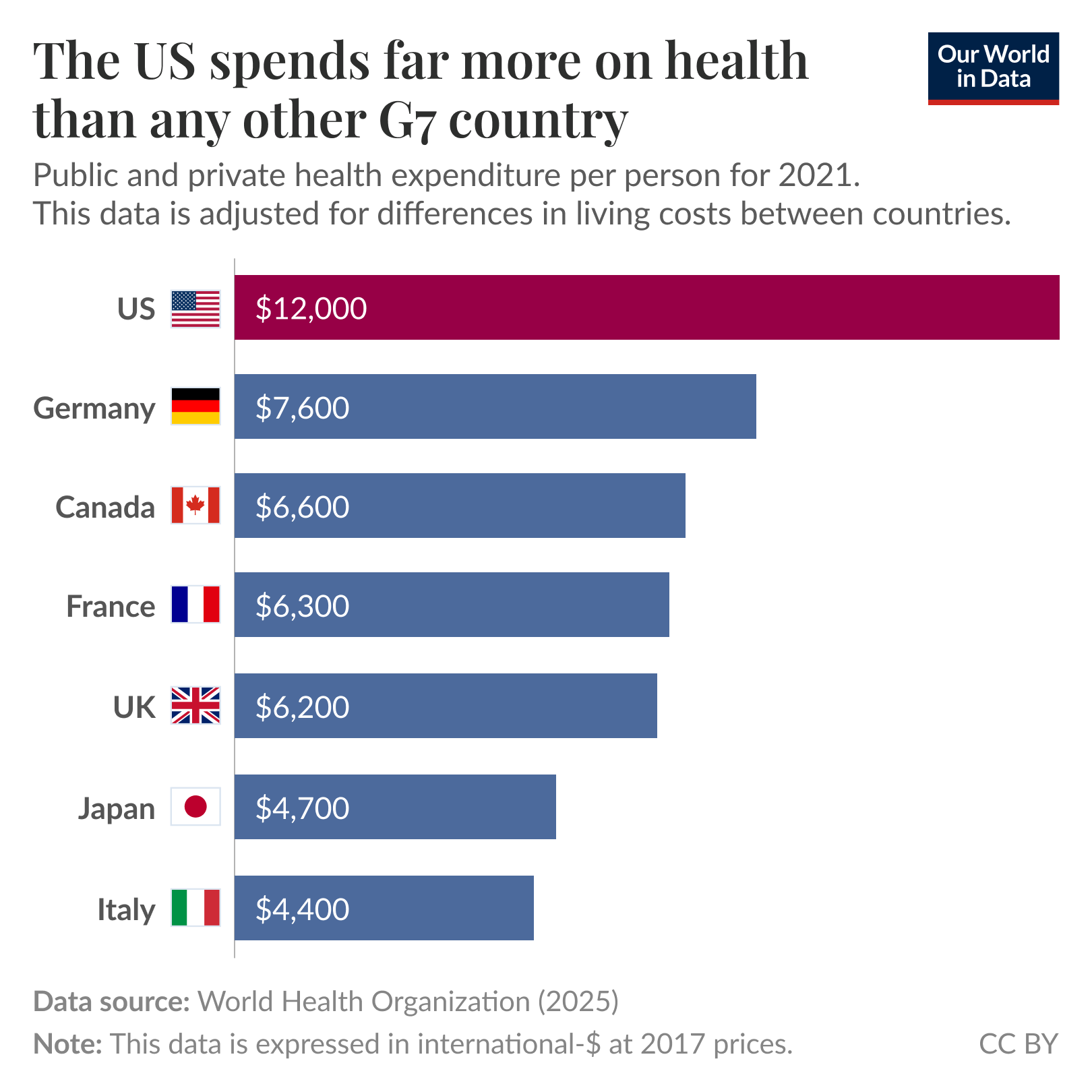
The U.S. spends far more on healthcare than peer countries, but it does not convert that spending into better outcomes. In 2024, the U.S. spent 17.2% of GDP on health, compared with an OECD average of 9.3%.
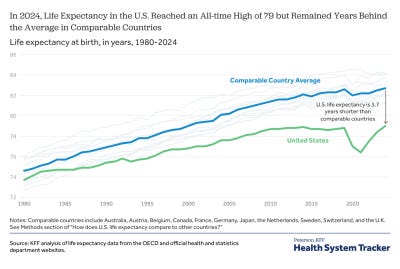
Yet U.S. life expectancy was 79.0 years, while comparable wealthy OECD countries averaged 82.7 years.
Singapore is the sharper contrast here.
Singapore’s health expenditure is about 4.5-5% of our GDP and yet our life expectancy is 83.9 years.
To make a crude comparison, we spend about 1/3 of what the US spent on its healthcare and on average we outlive them by 5 years!
The broader point in my view is not that money does not matter.
It is that beyond a certain level, how wealth is organized matters more than how much wealth exists. Who benefits, how resources are distributed, and what institutions convert spending into outcomes all matter enormously.
And that is really what Prof Chang is inviting us to consider when we engage in the world of economics.
Til the next one,
Keith