

Why Self-Radicalization Is The Newest (& Most Dangerous) Flavor of Terrorism
My interview with RSIS Dean - Professor Kumar Ramakrishna

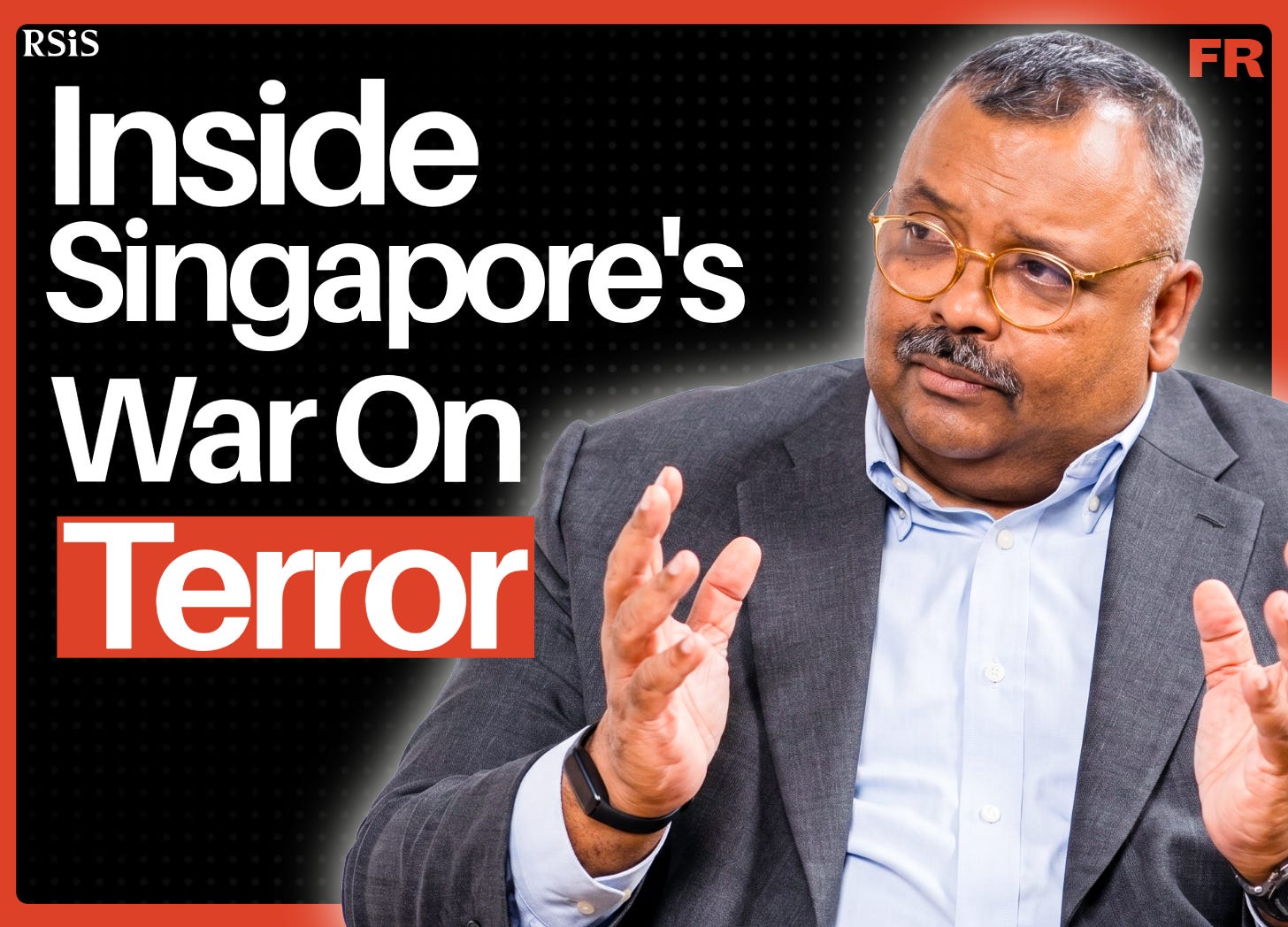
Professor Kumar Ramakrishna is one of Southeast Asia's foremost authorities on terrorism, extremism, and national security. He is Dean of the S. Rajaratnam School of International Studies (RSIS) at Nanyang Technological University, where he also holds the President's Chair in National Security Studies and serves as Research Adviser to the International Centre for Political Violence and Terrorism Research.
He was first appointed Dean in January 2023 and re-appointed for a further term from January 2026, he has spent more than 25 years at RSIS and its predecessor, the Institute of Defence and Strategic Studies, which he joined in 2000.
This conversation is especially crucial because it maps how extremism has mutated since the post 9/11 era — from religiously motivated networks to lone actors, copycats, and localised far-right ideologies such as East Asian supremacy — and what a globalised, multicultural Singapore must do to protect its social fabric.
I hope you find this conversation useful.
Keith 00:00:42
My guest today has spent 25 years doing something most of us would find deeply uncomfortable. He sits with the writings, the logic, and the worldview of people willing to kill and die for their beliefs. Today I’m joined by Professor Kumar Ramakrishna. He is one of Southeast Asia’s leading experts in counter-terrorism and the Dean of the S. Rajaratnam School of International Studies at NTU — definitely one of Asia’s foremost security think tanks. With that, Dean, welcome to the podcast.
Prof Kumar Ramakrishna 00:01:18
Hi, thank you very much.
Keith 00:01:21
I want to start with post-9/11. It exposed the insufficiency of the security paradigm of the early 2000s, or what some might call the post-Cold War years. Looking back at the pre-2001 security mindset, what was it lacking?
Prof Kumar Ramakrishna 00:01:42
At a global level, before September 11, the international relations and geopolitical landscape had been dominated by the Cold War, which lasted from the end of World War II in 1945 all the way until the fall of the Berlin Wall in 1989 and the dissolution of the Soviet Union in 1991. [Note: audio dates the fall of the Berlin Wall to 1991 — corrected here; please verify against audio.] As we know, the Cold War was essentially a worldwide geopolitical and ideological competition for global influence between the US-led liberal democratic, market-capitalist bloc and the communist bloc led by the Soviet Union and China, which was based on completely different, diametrically opposed ideological principles to democratic capitalism.
Until September 11, the biggest threat in Southeast Asia, certainly ideologically, was communism. For many decades, from the late 1940s all the way until the end of the Cold War, from a geopolitical and internal security perspective, the key threat facing Singapore and Malaya — and later Malaysia — was communism: globally and internally, the threat of subversion, and in the earlier decades, terrorism and assassinations by the Communist Party of Malaya.
But after September 11, we came across a different type of threat. It was still terrorism, but certainly a different species of it. If the Cold War era was about communism, this was religiously motivated terrorism. In late 2001, the name Al-Qaeda came onto the global scene after its notorious and quite horrific attacks in New York and Washington. Just a few months after that, we had a very close shave in Singapore, because there was a joint Al-Qaeda–Jemaah Islamiyah (JI) plot targeting Western diplomatic and commercial missions in Singapore, as well as Singapore government targets. That JI plot was fortunately thwarted in late 2001 and throughout 2002.
As we entered the decade of the 2000s, it was clear we were facing a new kind of threat in the terrorism sphere. Transnational terrorism assumed a very big international profile after the September 11 attacks, and Singapore was certainly not immune, because Southeast Asia at that time, 25 years ago, was said to be the second front in the global war on terror.
Keith 00:04:51
Before we dive deeper, I want to ask about the psychological impact of 9/11. You had the chance not only to visit the US, but to be at Ground Zero soon after the attack. What was the paradigm shift, if one might use that word, that Americans and people in the security space undertook after the attack?
Prof Kumar Ramakrishna 00:05:16
I remember that in the lead-up to the September 11 attacks, the Bush administration had just come to power and was focusing — very much like now — on the US–China geopolitical competition. The thinking in the early 2000s, before September 11, was that the US military needed to prepare for a future conflict with China. In fact, in April that year, there was a collision between a US aircraft and a Chinese military aircraft. It got the world’s attention, but fortunately things were resolved. So the thinking was that the future would be about great power competition.
But after September 11, there was a huge rethink. Certainly in the US and affiliated militaries, there was a sense that attention needed to be refocused on creating special forces that could engage with smaller, agile terrorist groups around the world. And in the think tank space — in Singapore, in Southeast Asia, and around the world — we had to retool. I remember being in Washington visiting think tank colleagues in 2002, several months after September 11, and all the people I talked to were saying that everyone had to retool — everybody had to drop what they were doing. I’m not joking; this is what they were telling me. They were saying there was a need to really come to grips with who these guys were. Why would Al-Qaeda do this sort of thing? There was very little understanding at that time of the nature of religiously motivated terrorism.
In academia, from the eighties and nineties onwards, there was an understanding that the world was seeing a revival of religious faith in the form of fundamentalist movements across all the faiths. But this didn’t really slip into general public consciousness until September 11, when the more extreme manifestations of religious fundamentalism — at first in the Islamist sphere — manifested. People realised these guys were very serious. They were willing to die for what they believed in, although what they believed in was pretty much an extremist interpretation of the faith. It didn’t represent the mainstream faith at all. But this small group of individuals — very zealous, very intolerant, and driven by a very extremist, virulent interpretation of the faith — were willing to die and to kill a lot of people. Mass casualty terrorism.
At that point, many terrorism analysts in the early 2000s were talking — apart from the term religiously motivated terrorism — about catastrophic terrorism, apocalyptic terrorism. “The new terrorism” was actually the easiest phrase to remember. The new terrorism was supposed to be in contrast to earlier waves of terrorism in the modern era, starting from the late nineteenth century, which were essentially secular. The focus then was limited attacks to send political messages to the government and the community: give us what we want, or we’ll engage in these terrorist attacks.
The religiously motivated terrorists were not really interested in negotiation. They were interested in cleansing the world of evil. It’s a really different mindset. This is why these guys — Al-Qaeda, later JI, some of them — engaged in suicide attacks: they really believed that if they carried out these attacks, they would go to paradise. It was a different mindset shift, and something we all had to study and come to grips with.
Keith 00:09:19
We are living through one of the most consequential periods in history. There are new powers, new rules, and new risks emerging as we speak. And most of the important structural changes that will affect the world in the coming century are happening right here in our neighbourhood: Asia.
In collaboration with the S. Rajaratnam School of International Studies, we brought together the region’s leading experts on strategic affairs to help you understand the structural forces at play. Together, we will extract lessons from the past and analyse the present clearly, so that we can make better decisions for the future. We hope this will help you see what this means for Singapore in a coming multipolar world.
Keith 00:10:01
You previously alluded to the difference between communist insurgents and the transnational terrorism carried out by fundamentalist groups, and the manifestation of suicide attacks was one shift in ideological commitment. Other than the commitment, or the way they acted, what other differences started to emerge post-9/11?
Prof Kumar Ramakrishna 00:10:30
When you go back to the communist era — the supporters, particularly the guerrillas who fought in the Malayan jungles and the subversive agents in Singapore in the 1940s and 1950s — communism, in a way like fascism, is a secular kind of faith. A secular religion. In the 1950s, when communist operatives in the Malayan jungle joined the Communist Party, there would be initiation ceremonies where they would say a pledge before pictures of communist leaders, whether Mao or Stalin. It’s quasi-religious. So in some ways, the form of allegiance to communist ideology was not entirely different from what we saw post-September 11 with this new category of religiously motivated extremists. There were some similarities in the all-in, total commitment to the cause, because they were true believers — at least the leaders were.
The difference is that the Islamist extremists of the early 2000s were very willing to go all out to achieve their goals and die at the same time. They engaged in actual suicide bombings. The communists would kill people, but — except in very, very rare cases — they wouldn’t want to kill themselves at the same time. They wanted to live, stick around, and carry out future attacks. The Islamist extremists, very driven by their ideology, were willing to die as well as kill people — and they were willing to die because they really believed they would go to paradise. They really expected to be rewarded in the afterlife.
This, to my mind, set them apart. And they didn’t call it suicide — they called them martyrdom operations. Very different. That also matters, because their religious ideas do not permit suicide, but they do permit martyrdom: dying for the faith in a “correct” way. In their thinking, technically speaking, there’s a way to do it. So there were some similarities, but also some very major differences.
Keith 00:13:12
A degree of magnitude, as opposed to commitment — I think that was the key differentiator. The other question is the method of organisation. Because both were relatively grassroots in nature, you would think they might be organised similarly. But what were some of the key differences?
Prof Kumar Ramakrishna 00:13:30
You’re no longer talking about negotiating towards some common ground. You’re talking about good and evil. You cannot negotiate with evil. You can only destroy evil, cleanse the world, and set up your preferred theological-political arrangement, whether it’s a state or an empire.
Keith 00:13:53
You pointed out that this was actually a very clear political project from the onset, and I think that goes against the grain of how people think about fundamentalist groups. A lot of people just think these people are crazy — that they want to commit mass violence for a twisted interpretation of their faith. There are perhaps some myths that require debunking, where people think of them as illogical or emotional. What actually drives people to join such organisations? Is it really something irrational?
Prof Kumar Ramakrishna 00:14:36
One should make a distinction between terrorist leaders and the terrorist rank and file. Take the example of suicide bombing — in the case of Al-Qaeda, or Jemaah Islamiyah, or other Islamist extremist groups from the 2000s onwards. From a strategic or operational point of view, suicide bombing can actually have effects. The suicide bomber is a very scary concept, a very scary tactic. It can demoralise populations, and when populations are demoralised, they will put pressure on the government of the day to give in to what the terrorist group wants. So from the terrorist leaders’ perspective, it’s quite a rational strategy to adopt suicide bombing as a tactic.
By the 2010s — certainly after 2014 — ISIS, the Islamic State, used a lot of suicide bombers in Syria, and they demoralised the US-backed Iraqi army. From an operational and strategic point of view, suicide bombing is a rational tactic. But who are the suicide bombers? The leaders have a plan; they are rational. They don’t necessarily want to kill themselves — they want to be around to plan the strategy. The bombers, some analysts say, are seen by the leaders as cannon fodder. They are expendable.
The motivations of the leaders are very rational. Many ISIS leaders, for example, were radicalised former commanders in the army of President Saddam Hussein. They knew how to plan; they could think strategically. The rank and file — the people doing the suicide bombing — were, let’s just say unfortunately, more gullible. They believed the ideology when the ideologues told them: on the one hand, we will look after your family, so no problem; and you will go to paradise, and you will receive blessings.
Many of those involved in the suicide attacks were either very young or highly indoctrinated. The very young ones frankly didn’t know what they were doing. They were gullible — their friends joined in, so they also joined in. When they saw somebody who looked religious and credible telling them what to do, they would just follow. The very indoctrinated ones, on the other hand, simply hated the other side, and couldn’t really change their minds. So on motivations, one must make a distinction between the leaders, who use suicide bombing as a tactic, and the rank and file, who are impressionable and more likely to buy into the ideology. Two different mindsets at play.
Keith 00:18:07
One stereotype would be that these people are uneducated — that they don’t know better. But if we look at their methods, even the improvised devices they were able to develop, they’re actually sophisticated. It goes to show they required, at the very least, some form of education. And they managed to recruit educated people into not just the leadership but the rank and file. One would assume that if you are relatively educated, you wouldn’t be attracted to such ideologies. Why is it that we still see well-educated people join such groups?
Prof Kumar Ramakrishna 00:18:45
That’s what we used to think, certainly 20 years ago when I first got into this line. The thinking was: you’re right, if you’re well educated, you should be able to figure it out. It wouldn’t make sense to join the likes of Al-Qaeda or JI. But if you look at the composition of the 9/11 attackers, they were not ill-educated — some of them had master’s degrees. Look at Jemaah Islamiyah: one of the key bomb-makers, Dr Azahari Husin, had a PhD in applied statistics from a British university. And some of the people I met in my research were university lecturers who joined Jemaah Islamiyah.
Education alone doesn’t shield you from extremist ideology, because what’s going on around you is also important. In fact, you can argue that education can make you more of a threat, because you are better equipped to do something against the wider society that you have been indoctrinated to think is against you. A lot depends on the context as well.
There is also very interesting literature suggesting it depends on the type of education. Once, I was talking to an ex-extremist who used to be a senior figure in Jemaah Islamiyah — a Malaysian. When I met him, he was already rehabilitated, working with the Malaysian authorities on counter-radicalisation efforts and giving lectures. He said that when he tried to recruit people, there were three groups of students he would encounter. The first group, the humanities students, asked a lot of questions — and in the end, they didn’t join. The second group, the very religious ones, would join, because their thinking was very binary — zeros and ones. If the religious leader says this, we must follow; it must be correct. They were more susceptible. And the third group, according to him, were the engineering students, because they also have a particular kind of thinking — zeros and ones. There’s only one correct way to build a bridge, for example, and they transposed that kind of thinking onto the holy scriptures. That is what this ex-extremist told me. Very interesting.
So when you talk about education, it also depends what kind of education. Broadly speaking, one needs an education that is broad-based. Of course you need to go deep and develop expertise in a particular field, but don’t just stay there — you should also expand your horizons. In fact, it’s very striking. One of the extremists I’ve studied, a British Islamist called Ed Husain, who wrote a very interesting book, The Islamist, said it was only when he read more widely — the phrase he used was that his horizons got expanded — that he began to think less in terms of binary worldviews, less in terms of us and them, black and white. He saw that the world is actually full of shades of grey. That is actually a protective factor against extremist thinking, which tends to be very black and white: us and them, truth and untruth. Of course, the world is very complex. It’s not so straightforward. Sometimes we just need to go with the flow and figure it out as we go along.
Keith 00:22:52
If you look at JI, which you mentioned, there was a very high-profile disbanding of it a few years ago. And if you look at the mainstream conversation today, many will point to the US–China rivalry, which remains the dominant theme of our times. So the question is: the relative quiet right now brings me back to a time, say pre-2001, where terrorism is more ambient — perhaps we’re more updated in our thinking, but it doesn’t feel as important. Is this something that we as a society should still be continuously mindful and careful about? What are some of the lurking threats we might not appreciate today?
Prof Kumar Ramakrishna 00:23:36
I think it’s a great question, and very relevant. It’s not a new point, in the sense that many analysts have pointed out that compared to 20 years ago, transnational terrorism has assumed less of a profile in policy circles around the world. And understandably so: with the dismantling of the Islamic State in March 2019, with the loss of its last territorial holdings in Syria, and with the rise of the US–China geopolitical competition and the Russian invasion of Ukraine, policy focus has shifted.
But then again, look at what has happened in the Middle East, especially after the Hamas attacks on Israel in October 2023, the very strong — very disproportionate — Israeli response in Gaza, and the ensuing conflict between the US, Israel, and Iran. These are exactly the types of conflicts that fuel terrorist recruitment around the world, especially identity-based terrorist recruitment.
On top of that, I should also point out that compared to 25 years ago, the extremist ideological space has become much, much more complex. There is a danger that if we take our eyes too far off the ball in the terrorism space, we may miss important threats. We may get blindsided. What do I mean? Even in Southeast Asia, Islamist extremism is no longer the only game in town. Even in Singapore, since December 2020, we have seen the rise of so-called far-right extremism. Far-right extremism is usually associated with white supremacist ideologies in the West — white supremacy, xenophobia, racism, ultranationalism, disregard for minority rights, anti-democratic ideas. This has been on the rise. A UN Secretary-General report in 2022 mentioned there had been a 320 per cent spike in far-right extremist incidents around the world.
We’ve had far-right cases of youth radicalisation in Singapore since 2020, and in more recent times we’ve had what we could call the globalisation of white supremacist, far-right ideas — even in Southeast Asia. Last year, I think, a couple of young boys were picked up by the authorities for far-right extremist ideas. They were planning to carry out attacks — one case against the Muslim community here — and they were motivated not by white supremacy, but East Asian supremacy. So this is globalisation: you take ideas that were born elsewhere, like white supremacist ideas, and you globalise or adapt them to a local context.
In the West, the concern about white supremacy ties in with the conspiracy theory called the Great Replacement. The Great Replacement ideology holds that the white race is going to be replaced by non-whites — whether Muslims, Hispanics, or Asians — and therefore action must be taken now to prevent that from happening, through force and violence. This idea has been localised in a Southeast Asian context. In one case, people talk about East Asian supremacists, where the idea is that East Asians are going to be replaced by non-East Asians. The Great Replacement — an idea born in the West — has been globalised and adapted to a Southeast Asian context.
And it’s not only the East Asian supremacist idea. There are other Great Replacement themes in Southeast Asia. Some analysts have been talking about Austronesian supremacy. Austronesian is a broad term for indigenous groups within Southeast Asia and the Pacific Islands — if you are Javanese, or Malay, or Cebuano in the Philippines, you are Austronesian. Among this group, there are supremacists as well who say they are going to be replaced by ethnic Chinese, or Indians, or Arabs. You see that in the Indonesian context.
So the point is that the extremist ideological space is becoming very, very complicated. It’s no longer just about worrying over JI and Al-Qaeda and ISIS. It is much more complicated. And now we have, more recently, the rise of what some people call salad bar extremism — a mix and match, where different ideas are thrown together as a justification for violence.
Sometimes it’s not even ideological per se — it’s mimetic. We have some cases now, certainly recently in Indonesia, of young boys wanting to carry out violence. There was a case in Jakarta: a boy carried out a bombing at his school in late 2025, and on his toy gun he had etched far-right symbols and ideas, just like the Christchurch attacker did in March 2019. But when the police investigated, this young boy was not far right, although he had those far-right etchings on his toy gun. He was trying to copycat. It was mimetic. [Note: the raw audio is inconsistent here — it says both “last year” and “late 2025”, and references a toy gun alongside a bombing. Please verify the details of this case against the audio.]
And there’s the rise of what is known as the “true crime community” online. All of this is online — social media is really a big challenge now. This true crime community glorifies crime and glorifies mass killers. It’s not really ideology as such. So the extremist space is actually becoming very, very complex.
Frankly, we are also living in an era of the rise of lone actors. Compared to the groups and organised networks of the past — JI would carry out bombings — lone actors, if they are well equipped, can carry out quite significant attacks as well. In July 2011, Breivik in Norway: one guy killed 77 people through a combination of bombings and shootings. The well-equipped lone attacker could cause a lot of mayhem.
So while, as an analyst, I believe we should of course pay close attention to what is happening on the geopolitical stage — US–China, Russia, US–Israel–Iran, and a whole host of other issues — transnational terrorism is not going to go away. That space still needs to be watched.
Keith 00:31:13
If you want the show notes from today’s episode, just head over to ykeith.com/rsis, where you have full and free access to them.
The implications for a country like Singapore are clear, especially for a multi-religious, multi-ethnic, multi-racial society that boasts not only diversity in race and religion, but also a very dense population. You always have to be aware that these are challenges that could fracture our social fabric. And one live case study we’re seeing happen before our eyes is the war in Gaza. The October 7 attack was seen as a major flashpoint in the conflict — a deliberate terrorist assault. At the same time, as you pointed out, the Israeli response has been extremely forceful and, as many analysts and people in the international community have pointed out, disproportionate. What are some of the implications of that war for a community like Singapore — so far away — such that it could threaten our social fabric?
Prof Kumar Ramakrishna 00:32:26
The world now is a very small place. Everything is very compressed, thanks very much to social media. Whatever happens around the world, one can feel the impact in real time. There’s no time gap, no time lapse anymore.
The Palestinian issue is not new. It has been a real concern not just to the Muslim community in Southeast Asia and around the world, but also from a humanitarian perspective — humanitarian constituencies around the world have been very concerned about the plight of the Palestinian people for decades. The Gaza situation, starting from the Hamas attacks and the Israel Defence Forces’ — I would say disproportionate — response since then, has certainly not made the situation easier to deal with.
Most people would say the only way out of that particular conflict is a two-state negotiated settlement: Israel and a state for the Palestinians. Personally, I think that is the right way to go, because both peoples need a homeland. But unfortunately, my own view is that with the attacks of October 2023 and the Israeli response, both sides — certainly the current government in Israel — are thinking more of a one-state solution. So the two-state negotiated settlement unfortunately doesn’t seem to be on the cards for a very, very long time.
This is amplified on social media around the world, and we certainly feel it in Southeast Asia as well. It is another factor that fuels extremism. There’s no running away from it. So this is a real challenge.
Keith 00:34:30
If we were to spend some time on the question of Hamas — how should we understand its mode of operations as an organisation? Some have deemed it a terrorist organisation, while they see themselves as very much a live and active actor in bringing about Palestinian statehood through violence, because there was no other way. If we were to seek clarity or understanding of what Hamas is, do you have a sense of what the answer should be?
Prof Kumar Ramakrishna 00:35:02
Hamas would of course see itself as a national liberation organisation, but if you look at its tactics, it certainly falls within the realm of terrorist groups as well. Especially in Gaza — Hamas runs Gaza. Hamas is essentially the key organisation in Gaza these days. There’s no way to deal with Gaza without dealing with Hamas.
And that ties into the overall complexity of the situation, because, as we know, you can’t deal with Gaza and Hamas in isolation from the wider geopolitical reality: behind Hamas — and for that matter behind Hezbollah — is Iran. Iran currently is, as we know, in a wider conflict with the US and Israel. To move towards eventually getting back on track towards a two-state solution, the Iranians will have to play a role — a positive role — in that exercise, because Iran does call the shots in terms of funding and arming Hamas and Hezbollah, and for that matter the Houthis as well. You can’t solve the problem by focusing only on Israel and Hamas. There’s a wider geopolitical picture to navigate. It’s very, very complex right now.
Keith 00:36:37
If we were to zoom out and take the Singaporean position: you look at a conflict like this — where are the fault lines, the areas of stress, where this could go from a distant humanitarian issue that we care about into something that could fracture society?
Prof Kumar Ramakrishna 00:36:57
In any globalised, multicultural society like Singapore, there are latent fault lines that can be exploited. The Hamas–Israel conflict — the Palestinian issue — is one such fault line. It roils the Muslim community. [Note: raw audio reads “It walls the Muslim community” — interpreted as “roils”; please verify.]
Even historically, going back to where we started — the 1940s and 1950s — at the height of the communist threat, the Chinese community was seen by the British colonial government as a potential source of problems, because the Communist Party of Malaya was largely Chinese-dominated. Fast forward to the 2000s: because Al-Qaeda, ISIS, and Jemaah Islamiyah said they were fighting for an Islamic state, willy-nilly, Muslim communities in the region got implicated. And fast forward even more, to just last week: we had 14 online postings about the Indian community in Singapore, claiming, so-called, that they were overrunning the place. Suddenly the Indian community is in the spotlight.
So there are many potential fault lines that are latent in a multicultural society which is very globalised, like Singapore. If you ask me, is that a challenge? Yes, it’s a challenge — for any globalised multicultural society. So what to do about it? First of all, we should be aware that within societies like ours, there are potential fault lines that can be weaponised by potential adversaries. They’re not necessarily out in the open, but they are latent. They can be exploited; they can be weaponised.
We need to be aware that these potential latent fault lines exist and take measures to ensure we build societal resilience against them. Because right now — and I keep going back to social media, which is a big factor in today’s geopolitical and security challenges — social media has the potential to amplify these fault lines. Really. It can be done by individuals; it can be done by hostile states. That’s why there is such a thing as hostile information operations, which are being used around the world even as we speak. Number one: being aware of the fault lines that are potentially weaponisable is the first step in effective defence.
Keith 00:39:46
That reminds me of the asymmetry of emotional experience one encounters. If you look at, for example, the conflict in Gaza, the Malay-Muslim community in Singapore will definitely feel a deeper emotional response than, say, a Chinese person. And that asymmetry could create a form of alienation, because you might think: why do you not care about this? You then start categorising the other, because they do not have the same moral compass as you. That becomes one dimension where we as citizens become alienated, or do not empathise with or see ourselves in citizens of other races and religions.
That’s where I’m curious to hear from you on this idea of muscular secularism. What does it actually take for us to maintain and create that common space, where you could be of a different race and religion, with different worldviews, and we can still see each other as common citizens? How do we keep that in Singapore?
Prof Kumar Ramakrishna 00:41:02
The term muscular secularism — I have to say, I’ve written about it, but I didn’t coin the term. I first picked it up from a South Asia specialist who used the term at a conference in the US many years ago. But I thought it was a very interesting term. Ultimately, the idea is very simple. Singapore is a multicultural society. There are many races and religions here. There are old citizens and new citizens, and new citizens bring with them their own respective faith backgrounds. We have to somehow gel everybody on this relatively small island into a relatively cohesive whole.
We have policy and legislative instruments — protective measures that have been in place in Singapore for many years. The Penal Code criminalises any attempt to spread ill will or enmity between different races. That’s very important in a place like ours, which is globalised, secular, multicultural. We have other legislation like the Maintenance of Religious Harmony Act, as well as, for example, the Internal Security Act for very extreme cases. And in more recent times, we have legislation that deals with online falsehoods — again going back to social media, which is a very big reality from a security perspective, all over the world. So we have POFMA, the Protection from Online Falsehoods and Manipulation Act. We have, more recently, the Online Criminal Harms Act, which is very relevant — it was used to take down some of those posts I mentioned earlier about the Indian community in Singapore. Very mischievous posts. And of course, the Foreign Interference (Countermeasures) Act, which is aimed at defending Singapore against hostile information operations. All these various threats from external sources can be aimed at undermining social cohesion in Singapore. So we certainly have these legislative and policy instruments to protect social cohesion and maintain our unity as a united Singaporean community, regardless of your background.
But more than that — I think more fundamental — is the idea of being Singaporean. Our identity, after so many years of nation-building. We still have a way to go, and I don’t think we’ll ever fully arrive — my own personal view — at a time when everybody will be completely race- or religion-blind, because we are very globalised and we’re always open. As one analyst said many years ago, we are an utterly ventilated society. All these ideas and ideologies are floating around, and through social media, they get amplified and spread through society. So we’ll just have to work at ensuring that we focus on what we have in common, as opposed to what we don’t have in common.
We have softer measures there as well. Since 1984, we have had the Total Defence concept, which I think is more than just a slogan. Speaking as an analyst, I think it’s a very important concept. Its foundation is psychological defence and social defence, which to me undergird the other pillars — military defence, economic defence, digital defence. Social defence and psychological defence are, to me, what we need as Singaporeans in today’s day and age.
If we can learn to respond to any external challenges as Singaporeans — not as Singaporean Indians or Malays or Chinese, not as new citizens or old citizens, but as a united, unified Singaporean community — and if we can do that with little prompting from the government authorities, then I think we would have made a very large step towards answering your question of how to maintain social cohesion going forward.
Keith 00:45:29
So it has to be some form of ground-up movement — a ground-up manifestation of a common understanding of what it means to be Singaporean, so that we can’t easily be divided by, say, videos that paint one group in a particularly bad light.
At the same time, the other question I had: you’ve mentioned legislation, and a lot of the legislation in Singapore looks at controlling, for example, religious speakers. Of all the different communities, I think the Malay-Muslim community has the most legislation directed at it. So there’s a part of me that’s curious and concerned: could you risk the securitisation of the Muslim identity? Because of all these different rules, people might say: actually, these rules don’t apply to the other religions as much — they’re only applicable to us. And that could create resentment that then leads to radicalisation down the line. Could that be a potential threat? If so, how does one prevent it?
Prof Kumar Ramakrishna 00:46:45
I think I would have a slightly alternative interpretation of how the regulations are applied. Look at foreign preachers, for example. Yes, certain foreign preachers who spread ideas we could characterise as extreme Islamist would be banned from coming to Singapore. But at the same time, we have also had cases where Christian preachers from the West who had negative things to say about Muslims were also banned. So I think the authorities do take an even hand in ensuring that such policies are applied fairly across the board — precisely to prevent this idea that any particular community is being targeted.
But having said that, this is exactly the kind of perception that those who wish Singapore ill would want to amplify in the social media space, through, for example, hostile information operations — whoever they are. Because, as I mentioned, globalised multicultural societies around the world have all these latent potential fault lines that can be weaponisable under certain circumstances. For example, economic downturns. During economic downturns, you have the rise of scapegoating, because some populist political leaders might say that the reason our community — the majority community — is not doing well is because of all these immigrants coming in, taking all our jobs, worse, marrying all our women, and contributing to the declining birth rate of the majority community. Which is, by the way, far-right thinking. That’s exactly what far-right, nativist politicians in the West would argue — in fact, they have argued it.
So again: first of all, we need to be aware of what our weaponisable vulnerabilities are. As Sun Tzu says in The Art of War: know your enemy and know yourself — a hundred battles, a hundred victories. Self-awareness is the first part of any effective strategy to neutralise potential external threats to our social cohesion.
Keith 00:49:11
I raise that point only because that’s one threat where you’ve seen non-state actors disseminate these kinds of narratives: look at the asymmetry in treatment — you’re especially regulated, others are not. That creates the perception of the securitisation of a certain identity, which then leads to resentment. So I’m very glad you addressed that.
The other question I had is about this idea of winning the ideological battle. As you’ve pointed out, there are a lot of messages out there aimed at turning people towards a certain ideology. From a policy standpoint, outside of the legislative tools and the laws we have passed, how does one inoculate citizens — in Singapore and other countries — against more radical ideologies? Is there a way for states or countries to think about what needs to be done to at least minimise the chances of their citizens being radicalised?
Prof Kumar Ramakrishna 00:50:23
The education system is the first line of defence, in my view. In Singapore — using Singapore as an example, since we are here — the fact that we are educated from young as a combined group builds a sense of Singaporeanness, which I think is very, very important. In other countries, where children are educated separately from other faith communities or ethnic communities, that doesn’t help to build an overarching national identity.
So at least in terms of education, we start early — we start them young. As one of my favourite authors used to say, new construction is easier than reconstruction. What it means is: you train youth early and imbue them with the right values, and they will carry that with them throughout their lives. Whereas if you try to teach an older person to change his or her mind — the older you get, the more set you are in your ways. That’s what this author was saying: new construction is easier than reconstruction. So education, starting young, is a very important measure.
And of course, all the other things I’ve mentioned: public education campaigns and programmes to raise awareness of some of these extremist ideologies out there would help. In the Islamist extremist space, for many years we’ve had the work of the RRG, the Religious Rehabilitation Group, which was set up more than 20 years ago to combat Jemaah Islamiyah ideology. They started off counselling the JI detainees, then expanded the effort to the spouses and families of the detainees, and then they realised they needed to go further, so they did community outreach as well. Along the way, the RRG has done very sterling work, in my view, in creating a norm in the Muslim community in Singapore against violent extremist ideas.
And perhaps, to deal with the mutation of some of these extremist ideas beyond radical Islamism — to extremist interpretations or mutations of other faiths — various religious organisations, community organisations, and grassroots agencies can work together to build resilience more generally, across the board, against extremist ideas of any stripe. That, to me, would be another layer of protection for Singapore’s globalised multicultural society.
Keith 00:53:13
Hearing you say that reminds me that a lot of it is really about how we build community in Singapore. On your comment about education: it’s not necessarily the teacher telling you that you need to have racial harmony, but the fact that the schools are set up in a way that makes racial interaction part of daily life. From there, you’re able to cultivate racial harmony. So something we need to reflect on is how we continue to build community — even as the ideological, social media, and technological landscape evolves — so that we continue to have real-life, physical communities as well.
Prof Kumar Ramakrishna 00:53:54
Yes. And when you talk about community — community is made up of families. In fact, some of the academic literature on counter-extremism and counter-terrorism has pointed out that many of the youth who become vulnerable to extremist manipulation come from family backgrounds that are not very stable. Either they have a missing father figure, or family relationships are broken or very bad, or they come from very large families and are neglected. So there is a need for family support — support for healthy, stable families. This is a theme which, come to think of it, I encounter very often in the literature and in my research.
For example, in the counter-extremism space, take the role of mothers — of women — in radicalisation. We have seen that if you have a mum who is religiously moderate, and the authorities ask her to talk to a child who is going down the radicalisation route, that can be a protective factor, because the child will listen to the mum. On the other hand, as we have seen in Southeast Asia, there was a family cell associated with Jamaah Ansharut Daulah in Indonesia, implicated in the May 2018 Surabaya church bombings. Both parents were radicalised. The mum was radicalised. If that’s the case, then there’s no protection for the children against extremist ideologies. So the role of the mother, the role of women, the role of moderate youth — there’s a whole host of potential stakeholders that can be involved in building the community we’re talking about, which can guard against the spread of antisocial and extremist ideas.
Keith 00:56:00
So the idea is about using community to create a virtuous cycle — you want to escape the vicious loop of radicalisation. We’re reaching the end of our time here, so I want to wrap up with two quick-fire questions. You’ve spent 25 years studying very dark topics. What is the central lesson about human nature that you’ve uncovered through your work?
Prof Kumar Ramakrishna 00:56:33
Many years ago, I met one of the Indonesian militants at the Jakarta police headquarters. I have to be very careful — I don’t just go and meet these people. I have to get permission and that sort of thing. This guy could speak English, because although he was Indonesian, he had been involved in training Philippine militants in the southern Philippines, and he spoke English to them. I had a good chat with him at the Indonesian police headquarters, under the watchful eye of my police friends.
He came across as very earnest. He was saying, basically: there’s a reason I went down this route — because nobody else was standing up for my community. That’s his twisted thinking, but that was his reality. That was his worldview, as he tried to articulate it to me. The sense of victimhood — that comes across.
When I study many of these people, there are very few terrorists I’ve encountered, researched, or studied who enjoyed it. They are the minority — the real sociopaths, the psychopaths, who enjoy violence for the sake of violence. Many of them feel they are doing the right thing — that nobody else is standing up for the community. The tragedy is that they just went down the wrong path. To redress a wrong, you don’t need to perpetrate a wrong. This is where they made a mistake.
Somebody once told me that some of these terrorists, these extremists, are very sincere. I don’t disagree. It’s just that I also think they were sincerely wrong. They were sincere, but they were also sincerely wrong. Two wrongs don’t make a right.
Unfortunately, the tragedy is that many of them were motivated to do the right thing — which, by the way, is something I also saw when I did my research on the communists of the past. They were motivated to do the right thing. It’s just that the methods they used were wrong: totally unethical, immoral, and should never have been permitted. If they had gone down the right route, if they had had better peers to guide them, if they had not fallen under the sway of exploitative leaders — who were the real criminal minds behind the scenes — they would potentially have turned out right. They were very idealistic. That’s the sad thing.
Keith 00:59:23
My last question for you today. The world feels like a dark place now. If you had one piece of advice for a fresh graduate entering the working world, what would it be?
Prof Kumar Ramakrishna 00:59:34
Accept the world for what it is, but at the same time think very hard, and try very hard, to make a small contribution in whatever way you can to try to make it a better place.
Keith 00:59:47
With that being said, thank you so much for coming on the podcast.
Prof Kumar Ramakrishna 00:59:49
You’re welcome. Thanks very much. I enjoyed the talk. [Note: raw audio reads “Enjoy the top” — please verify against audio.]
Keith 00:59:54
Thank you for listening to today’s episode. If you are watching this on YouTube, please consider subscribing and turning on notifications for whenever new episodes are out. If you’re on Spotify or Apple, it would help us greatly if you could leave a five-star review on those platforms. Once again, thank you for tuning in to The Front Row Podcast.