


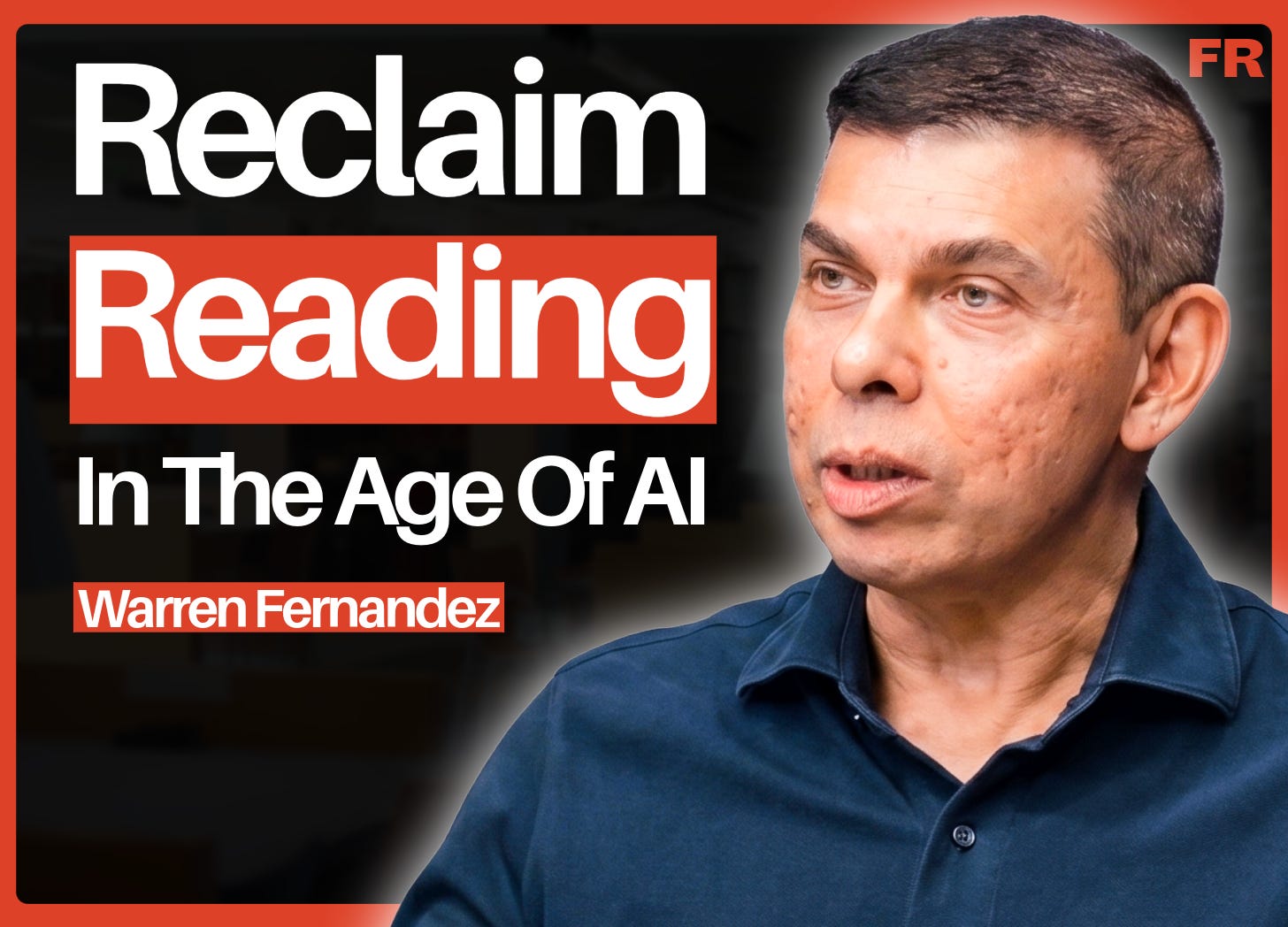
Warren Fernandez is a journalist, editor, and public intellectual whose career spans more than three decades at the centre of Singapore’s media landscape.
He served as Editor-in-Chief of the Straits Times — Singapore’s flagship English daily — and is perhaps best known beyond journalism as one of the principal collaborators on several of Lee Kuan Yew’s landmark books, including The Man and His Ideas and The Singapore Story.
His close working relationship with Mr. Lee gave him an unusually intimate vantage point on Singapore’s founding generation and the ideas that shaped the nation’s development.
More recently, Fernandez joined the S. Rajaratnam School of International Studies (RSIS), where he is now engaged in research on world order and the shifting dynamics of great power competition — work he describes as the foundation for his next book.
He is also the author of What We Read and Why, an anthology in which leaders, educators, and young people reflect on their relationship with books and reading, making the case for literacy as both a life skill and a civic responsibility.
In this conversation, Fernandez draws together threads from an exceptionally varied career: the craft of communicating ideas, the media’s role in a small state, the mechanics of world order, and why the capacity to read carefully and think critically has never mattered more.
Keith 00:00:00
Today I am joined by Warren Fernandez. He’s best known for being the former chief editor at the Straits Times, but he’s also known as one of the key collaborators on many of Mr. Lee Kuan Yew’s books, including The Man and His Ideas and The Singapore Story. He recently put together this book, What We Read and Why. It’s an ode to reading. In today’s conversation, we hope to explore how reading can actually help make a better society.
If you enjoy this show, please double-check that you’re subscribed. Every subscription matters and really helps us grow this show to serve you. Thank you so much for the support. Now back to the show.
You helped put together some of Mr. Lee Kuan Yew’s early books, one of which was The Man and His Ideas — based on 13 exclusive interviews held over 30 hours. Take me back to those days. What was it like working on that book?
Warren Fernandez 00:53
It was a very long time ago. The honest answer is I got roped in because Mr. Lee was getting impatient with the project — he felt it was taking too long. I was very young at the time, so I wasn’t involved in the actual interviewing. That was done by the editor at the time, Han Fook Kwang, with Sumiko. They took several rounds of interviews with him over many months, did the transcripts, conceptualised the structure, and started working on the chapters.
Mr. Lee then said, “This is taking too long — we’ve got to hurry this up.” I was called into the editor’s office one day and told I’d be working on this full time to help write the chapters.
It was a bit of an experiment, actually. Initially, Mr. Lee was quite averse to the idea of writing his memoirs. He had this view that he didn’t want people to put him on a pedestal and hold his views up as though they were sacrosanct and good for all time. He said people write their memoirs basically just to settle scores. But we tried to persuade him that there is genuine value in telling the story of how he came to some of the big decisions, and why. So we did the book. It sold very well — better than any of us expected.
I think that convinced him there was value in sharing his story. So he decided to do his own memoirs, The Singapore Story. He gathered his notes and oral histories, drafted the chapters, and sent them to us as he was writing, asking for honest feedback.
I remember being very excited to be involved. How many people get to work on the memoirs of a founding father of their country? It was a huge privilege, but also quite daunting — because it was Lee Kuan Yew, and he was a formidable character. By that stage, I had got to know him. I’d covered many of his big speeches, travelled with him. He knew of me, and I had worked with him quite a bit. What I found was that he was actually quite open to suggestions.
He would send us a draft and we would go back to him and say: this part isn’t clear, you need to make it clearer; this part is a bit dull, cut the detail; tell us more about the personal side, because that’s what people will be interested in. And he would be quite diligent about it. You might send him comments in the morning and sometimes by the next day you’d get a rewritten draft with a note: “Does this work? Is this better? Is that what you had in mind?”
And I found that he was very eager that the book should actually be read. He wasn’t doing it as a vanity project. He wanted to connect with Singaporeans — especially a younger generation — and get them to understand how what we had managed to build was actually possible.
Keith 04:10
What made him such a force of nature on the international stage — something a younger generation like ours might not fully appreciate?
Warren Fernandez 04:20
Leaders and observers around the world appreciated that he spoke his mind. He was very upfront. He told it like it is, and he gave a clear assessment of what was going on in our part of the world — based on his deep understanding, his track record in Singapore, and the people he knew at first hand. That made him someone they sought out, someone they were willing to give time to and listen to.
Travelling with him was also a fascinating experience. You got to go to places you might not otherwise have been. And he was always very anxious to make sure that the journalists accompanying him understood what he was trying to achieve on that trip. He would meet us very often — sometimes over coffee, sometimes over tea, sometimes after dinner — to say: for the next leg of the trip, I’m going to be doing this, articulating these ideas. Please understand the backdrop to what I’m trying to say.
It struck me then — I was only in my twenties — why is he taking the time to do this? Over time it became clear: this was the hallmark of a good communicator. He knew he was working through us, and unless we understood what he was trying to do, we would not be able to help him deliver on that message. To me, that is the mark of someone who is genuinely interested in communicating his ideas — not just putting them out there and hoping for the best.
Keith 05:56
Fascinating to hear what transpires behind the scenes. There’s him as the politician that many people are familiar with, but people may not fully appreciate him as a statesman — and those are often two very different roles.
Warren Fernandez 06:11
And him as a person as well. I used to write the wrap-up reports for something like the National Day Rally — where he’d be speaking almost off the cuff, but from notes. He would bring us in fairly early in the process to say: these are the big ideas, I might be using some anecdotes to tell the story, please understand where it’s coming from.
That was very helpful to us as journalists, because we got the thinking behind what he was going to say. I often think that’s the hallmark of good communication: you’ve got to help people join the dots, see where you’re coming from, understand the backdrop that shaped the thinking.
Keith 06:56
The traditional role of media, as conceptualised in Western circles, is the fourth estate — independent, adversarial. Whereas in Singapore, a different frame was offered by Mr. Lee Kuan Yew: that it is an institution that supports the building of the state. How does that look operationally, as someone who lived it as a journalist?
Warren Fernandez 07:19
I’d say it’s not so different from how big international leaders operate as well, because they often work with journalists they know and trust. You build up that rapport over time. To get access to top leaders, they would tend to work with someone they’re comfortable with — someone on the same wavelength who understands where they’re coming from. That building up of trust is a fundamental part of being a good journalist. You can’t just send an email or a WhatsApp and expect good answers. You need the time to build that relationship. I think that’s no different from anywhere in the world.
Second, I think Mr. Lee’s understanding of the media was that its primary role was to inform the public — help people understand what’s going on — and then to explain the context and background to events and why. He didn’t believe the media should simply repeat or parrot the government line, because then you wouldn’t be very useful or credible. The mission for the media was always: stay connected with the readers you’re trying to serve, be credible in their eyes, and help put things in proper context. If you agree with what the government is doing, say so. If you disagree with aspects of it, say so, and be able to back it up. But don’t say things just to be contrarian or too clever by half. That’s not helpful — not to the media, not to policymakers, and not to voters.
Keith 09:03
Were there examples from your own career where that played out?
Warren Fernandez 09:08
There were often times when we would discuss issues and say: this part doesn’t sound very credible, or this part is going to cause you trouble — you should come out and address it. And very often he would take that advice. He would also get a group of journalists together over lunch and ask: what is on people’s minds? Are they worried about jobs, cost of living, some bilateral issue? Why are they concerned? He would listen. He wouldn’t always agree, but you could tell he was listening.
The interesting thing about him was that he would often cross-check. You would get a sense that he’d taken what you’d said seriously — because he might come back and say: you told me this, but I’ve heard from someone else that it looks quite different. So you knew your part of the bargain was that if you were going to make a point, you’d better be able to back it up.
Keith 10:02
As a journalist, you have to digest information, understand the world, and your value proposition — especially for a national newspaper — is to give people context. How do you prepare yourself for that?
Warren Fernandez 10:20
You want to be as well-read as possible and have a good grounding in what’s going on in the world. But when I was starting out, there was a practice: before any big assignment, you went and read the files. Literally. You walked into the Straits Times library and asked the librarian to bring you the file on health, or education, or whatever subject you were covering. They would bring you a physical file of all the newspaper cuttings on that topic. A good journalist would read through those stories to get up to speed and understand the context.
These days I don’t think anyone does it that way because you can get it off your phone. But the practice still applies: understand where this issue has come from, how it got to be the way it is. If there’s a policy, why was that the policy? The people who created it weren’t dumb — they did it for a reason. If you’re going to change the policy, what has changed in the underlying premises that led to it? And does the change make it better in some way?
Understanding the context in which an issue played out is, I think, a big part of being a good journalist. And often you are moving from one subject to another — one day health, the next education. So the training, the instinct, is to learn quickly, go as deep as you can, and make sure you have the best possible understanding of the subject before you get into it.
Keith 12:00
It’s been almost a decade since Mr. Lee passed, and the world is radically different today than even when he was in politics. What are some of the ideas that have endured?
Warren Fernandez 12:13
The key thing I took away was his sense that you had to take the world as you find it — not the world as you wish it to be. You had to be nimble, adapt to the way you find the world, make yourself useful and relevant, and then you would have a place at the table.
The day we get to a position where we say “this is the Singapore view, this is how it’s always been done” — I think that’s when we get into trouble. That was a key element of how he approached policymaking: very pragmatic, very realistic, almost non-ideological, with a sense that we’ve got to find our way in the world and nobody owes us a living. Given all that’s happening in the world today, that is a principle we should hold on to: be nimble, make yourself useful, be relevant, and adapt to a changing world.
Keith 13:15
You come from a time when social media didn’t exist and journalism was still seen as a very important source of truth. When the Straits Times reported something, that was a credible and legitimate source of information.
Warren Fernandez 13:28
I hope that’s still the case.
Keith 13:46
Now we live in a much more digital age, with many more alternative positions and perspectives. And in this age of social media, the incentive for depth has been significantly reduced. As someone who experienced this transition, what do you think is the biggest downside of being so fully immersed in the digital world?
Warren Fernandez 14:13
I was at the cusp of that transition. When I started, we were still moving from typewriters to word processing. Then it accelerated into the internet age and social media. One of the big challenges when I was editor of the Straits Times was making that transition in the newsroom — getting people to operate across platforms, no longer just thinking about print. My mantra was: how is this going to travel across platforms? Where’s the digital version, the online version, the video version, the podcast version? Getting the mindset to shift from thinking about what comes out tomorrow to what comes out in a few hours — even a few minutes — that was the big challenge.
By the time I left, that process had gone very far down the road. The newsroom had become much more multimedia, much more conscious of the need to operate on a different timescale and engage audiences across all platforms. I was happy with how far we’d come, but I felt the new generation had to take it much further.
And I do see it as a big plus. In the past, if you’re a journalist or editor, you write something, you wait until the next morning when it lands on somebody’s doorstep, and that’s your one contact point. They read it and go to work — you don’t connect again until the next day. Now you can engage with your audience on phones, screens, podcasts — many touchpoints throughout the day, constantly, at their leisure. In that sense, it’s a richer experience for both the producer and the audience.
The key challenge is that there is so much out there. The competition for attention and the challenge of building loyalty and brand affinity have become far more intense. That is what media everywhere in the world is facing.
Keith 16:38
There is an idea that we should try to read deeply into something rather than consume a podcast, watch a YouTube video, or scroll Instagram for news. What do you think is the genuine value of reading — a practice that has perhaps been lost?
Warren Fernandez 17:07
First, I’d say that even someone like Mr. Lee would have valued the medium we’re using right now — a podcast. Don’t forget, in the sixties he went on radio: a long series of radio interviews. He had a sense that you had to master whatever medium was dominant, whatever was the way to connect with your audience. When it was radio, he used radio. When it was TV, he learned to get good at speaking on TV. When he travelled overseas and met politicians or newspaper editors, he was very good at those roundtable discussions — articulating his views, taking questions, winning people over.
I don’t think he would have seen today’s media environment in a different light. You see our politicians, across the spectrum, now very active on social media and podcasts. They’re all learning, in their own way, that you have to connect on whatever platform your audience is on. So I think it’s platform-agnostic. But that doesn’t remove the need to go deep into a subject. It’s wonderful to get information quickly at your fingertips, consume it on a blog or Substack or wherever — that makes things much easier. But it cannot replace the need to slow down, read carefully, think about what you’re reading, and reflect on it. That part, I don’t think, ever goes away.
Keith 18:47
How does reading actually benefit the average citizen?
Warren Fernandez 18:54
If I’m reading for information — a report, a quick update on a subject — I find I can consume a lot of content digitally, whether on my phone, iPad, or screen. But if I really want to reflect on a topic, a physical copy makes a huge difference. You can sit with it, carry it wherever you’re going, write in it, circle things that interest you or that you might want to follow up on. It stays with you.
I find the process of actually interrogating a book very useful — it helps you think through issues and reflect on them. That’s something I was trying to get across in What We Read and Why: this idea of festina lente — hurry, but slowly. It’s not a new idea. It comes from Maryanne Wolf in her book Reader, Come Home. She’s a neuroscientist, and she says: yes, we have the facility to read quickly and efficiently, but we must not lose the ability to read slowly, carefully, deliberately, and thoughtfully. The brain needs to be biliterate — capable of both. Her worry is that we’re doing more of the former and less of the latter, and that this may impede our ability to think deeply.
The implications go beyond literacy. They touch on how we look at policies, how we understand issues, how we distinguish reality from rhetoric, how we spot someone who isn’t quite telling us the whole truth. How we’re not swayed by simple answers to complex problems, or by populists who play on our emotions. This is not just an issue for schools. This is an issue for being a good citizen and a good voter.
Keith 21:01
One of the more interesting data points I came across: Singapore consistently ranks at the top of PISA scores. But at the same time, we also found that adult literacy declines after 35. That paints a rather disconcerting picture.
Warren Fernandez 21:32
Let’s tease that apart so we get a good handle on it. The OECD study looks at adult literacy across age groups — 16 to about 65. Singapore’s average score is below the international average. When we all saw that finding, the reaction was: how did this happen?
But if you drill down, the picture is more nuanced. We have very high scores for younger cohorts — 16 to 20, 20 to 30. They score above the international average. The older cohorts, above 35, start to fall. And they pull the whole national average down.
The really worrying thing is the gap between those two groups. We have very capable readers at younger ages, and people who fall well behind at older ages. The gap in Singapore is much higher than elsewhere — roughly twice the OECD average. So it reflects generational differences: the educational opportunities available to young people today compared to those who came up earlier.
But it also reflects something Maryanne Wolf identified: the less you use your mental capacities, the more they atrophy. Use it or lose it. That muscle, if you don’t exercise it, will weaken over time. I think both factors are coming into the mix here.
And it complicates matters further, because there is a correlation between declining literacy and declining civic participation, declining employability, and therefore fewer socioeconomic opportunities and less confidence to participate. Those have implications for us as a wider society.
Keith 23:48
Is this something we should reflect on within our education system — whether, as we grow older, we no longer see learning or reading as something worth pursuing for its own sake?
Warren Fernandez 24:05
It’s not that after 35 you suddenly start getting dumber. It’s that if you let yourself get lazy and stop exercising that muscle, you will get weaker. It’s a bit like studying a second language in school — I’m as guilty of this as anyone. My Mandarin is not what it used to be because I don’t use it as much. The same applies to your ability to process information: unless you’re actively doing it, you will find it harder to interpret and reflect on what you’re reading.
So it really is use it or lose it. And that’s why you want to inculcate reading as something you do throughout your life. The way to do it is to make it a pleasure. The last thing we want is to make reading a chore — something you do to pass an exam or tick a box. The more we can get people to enjoy reading and see it as one of the great joys in life, something that will enrich them — that, to me, is the real challenge: how to make people genuinely enjoy reading.
Keith 25:24
When we talk about leisure and reading, is there an ideal we should strive for as Singaporeans?
Warren Fernandez 25:32
The shift I was trying to make with the book was to take reading in a much broader sense. It starts with words on the page, but reading goes far beyond that. You learn to read people, to read situations, to read the room. And that comes from what you take in, reflect on, and your ability to read in that wider sense.
For me, reading is not just a leisure pursuit — it’s a life skill. Almost a civic duty. If we frame it that way, I think we have a greater chance of people seeing the genuine value of it.
I’ll give you an example. Two very different countries — the UK and China — have both decided this is a national priority. In China, Xi Jinping has come out and said reading is a matter of national priority: public officials will promote it, there will be big public events, it is part of national culture. It’s mandated.
In the UK, they’re taking a very different approach: we want this to be part of your identity. Their catchphrase is essentially — if you’re interested in a subject, go deep, read about it, make it fun, make it something you do because you want to, not because you have to.
It’ll be interesting to see how the two approaches play out. My own instinct is that making reading a pleasure — something you do because you value the benefits you derive — is more likely to succeed.
Keith 27:32
On that note, if we were to implement a national reading movement in Singapore today, how would you approach it?
Warren Fernandez 27:44
I certainly wouldn’t want it to become a project that a young person feels compelled to do just to tick a box, take a test, and get certified. That would kill the love of reading.
You really want to give people opportunities to discover the joy of reading. That’s the approach I took with the book. I could have written something that analysed the data and advocated the value of reading — but I thought: that’s not going to resonate with many people. So I fell back on my old journalistic instinct: show, don’t tell. If you want to explain something, show people what it’s like. That is far more powerful than simply telling them.
What could be more effective than talking to people who do read and asking them: what do you read, and why? A very simple question. From their answers you derive a sense of why they do it — to get information, to understand people, to go to places they can’t get to, to travel through different times, to meet people they’d never otherwise encounter, to feel how other people feel going through experiences you might not face yourself. They read to share, to give, and ultimately to live. Those are the six categories I’ve grouped the essays into.
A reading movement that takes that approach — showing rather than telling, letting people discover their own way in — would be far more likely to succeed. Start with a manga or a graphic novel. Maybe that leads to the Hardy Boys or Harry Potter. It doesn’t matter. Let them discover it in their own way, find pleasure in it, and they will grow into other areas naturally. I wouldn’t push a line and say you must read this, in this form, at this time. I think that would fail.
Keith 29:46
Let a thousand flowers bloom. And to a certain extent, I think that’s what the point of silent reading was in school — you had thirty minutes, and as long as you had reading material, anything went.
One could make the argument that with a machine in your pocket, an AI model can extract, retrieve, summarise, and synthesise information on demand. There’s a case to be made that you don’t need to read per se. And the now-convicted Sam Bankman-Fried was famously dismissive of reading — saying every book can be condensed into a blog post. How would you make the case that reading is still a fundamentally valuable exercise, even for information retrieval?
Warren Fernandez 30:51
It is the best of times and worst of times for reading. You’re right — information is infinitely available. Whether it’s ChatGPT, Gemini, Claude, or whatever you choose to use, you can call up information very quickly, interact with it, ask follow-up questions. And the more actively you do that, the more useful the tool becomes.
But if you are passive — if you just say, summarise it for me, tell me what I should think — you lose the ability to form your own thoughts, to connect what you’re reading to other experiences you’ve had. That’s where the real loss comes. And increasingly, there is a very real risk that we become lazy and outsource our thinking. Then when the time comes to make a genuine judgment call, when you need to come to a view, when you need to make a decision — you can’t, because you haven’t done the practice.
That is what we’ve got to guard against. It is about reading, but ultimately it is about honing your ability to think critically and developing the capacity to make judgments — which is what we all have to do, as a professional, as a leader, as a voter, as a parent. You want to hone those essential life skills.
Keith 32:15
When people think about reading, there is often a very self-improvement lens to it — especially in my peer group. I read to get a certain outcome, and the faster I can reach that endpoint, the better. But one of the interesting framings you’ve made is that reading actually helps you better fulfil your civic duty. That’s something I haven’t seen many people champion.
Warren Fernandez 32:48
There’s nothing wrong with self-help books — if that’s what takes your interest, start there. But there’s also a kind of self-help in learning to understand people. If you’re in a relationship and want to understand the other person better, I think reading will help — you encounter many of those situations through the books you read, especially good novels.
If you’re a parent with a child who is struggling with growing up, reading to them helps. And letting them read themselves will also help them understand that other people growing up have had similar challenges. It builds empathy. It helps them understand the world around them. It helps them separate what’s real from what’s rhetorical, what’s true from what’s false.
That makes you a much more rounded individual. And that is self-improvement — not in a narrow functional sense, but in a more holistic one.
Keith 34:00
If you want full access to the transcripts of every episode, just head over to ykeith.com and you’ll get full and free access to each transcript. Now back to the show.
One of the earliest essays in What We Read and Why was by Senior Minister Lee Hsien Loong, who wrote about why he reads — treating it as a form of cognitive discipline. I found his book recommendations very insightful, though quite demanding. When you’re talking to top leaders in policy, business, and education, what is their approach to reading? Is there something the rest of us can learn from them?
Warren Fernandez 34:49
It varies greatly. For Senior Minister Lee Hsien Loong, I was very glad he agreed to write the piece — and he was very fast about it. I think he saw the value in it immediately.
For me, to see him say that he made time to read even while running the country was remarkable. We all say we’re too busy. He was far busier than any of us, and yet he said: this is important, I have to set time for it. And not just in his own subject — he read outside it. He was constantly learning, constantly staying up to speed.
The takeaway from that essay is simply this: we all say we’re too busy, but actually we’re not. It’s just a matter of deciding that this is important, and therefore devoting time to it. You see that in many of the other contributors as well — CEOs, top leaders across many spheres — saying: I have to prioritise this, the same way I prioritise nutrition, exercise, or time with my family. Those things shape who I am. So the easy answer that “I don’t have time” becomes far less convincing when you see other people making that same time and finding genuine value in it.
But the other thing that came through was not just purposeful reading, but reading for pleasure. Many contributors said: yes, I may have started reading for a practical reason, but over time the more I did it, the more I derived real pleasure from it. Pleasure in the sense that it reveals something you hadn’t considered, takes you into a world beyond your normal circle, lets you time travel, lets you visit places you might never get to. I found that across the essays, and I’d certainly experienced it in my own life.
Keith 36:57
There were also quite a few young people featured in the book, which is not that common.
Warren Fernandez 37:03
I wanted a very wide spectrum. Not just politicians or business leaders — I wanted teachers, parents, professionals, and young people: some in school, some in polytechnic, some in university. I consciously went out and looked for them. The more I asked, the more people said: you should talk to this person. And sometimes it was pure chance. I sat down at one dinner next to a couple who mentioned they had children who’d started a reading movement. I said: really? I’m writing a book about reading — can I meet them?
What I found was that the myth that young people don’t read is simply not true. They do read, but in a different way. They read across platforms. They’re very comfortable in the digital space. And if you can get them to a subject they’re genuinely interested in, they will go very deep.
The hard part is figuring out what that subject is. I call it the water cooler principle. If you walk up to a water cooler and everyone’s talking about a film, and you start talking about climate change, you won’t get much resonance. But if you can tap into what’s on people’s minds, what drives them, what they’re passionate about — you can get into the conversation. And from there, you can open it up. But first you’ve got to get on the same wavelength.
Keith 38:54
As a journalist, as someone who has spent a long time in the world of ideas — give me a short masterclass on how we should read today.
Warren Fernandez 39:08
Start with wherever you are. Start with what interests you, because that will build up the facility, the instinct, the desire to read. The more you do it, the more it comes naturally. It’s like public speaking — the more you do it, the less frightening it becomes. Practice makes perfect. So: begin where you are.
Then try to read as widely as you can — different genres, different authors. Go with what sticks. The instinct to say “I’ve explored this a lot, let me try something different” will emerge quite naturally.
I’d also distinguish between functional reading and exploratory reading. Very often you need to understand something quickly — say, AI. You read for efficiency. But you should also make time to say: I’ve never read anything about kitefoiling, or architecture, or whatever is quite off-beat for you. Freshen the mind. One of my predecessors once told me: every now and again, pick up a magazine on a subject you have no interest in, because it will spark new ideas. It’s like going to a place that’s new and unfamiliar.
So keep the knife edge sharp, constantly refresh your thinking — and often, read something that challenges your own view. That will frequently surprise you and make you want to keep going.
Keith 41:00
Daniel Kahneman talks about Type 1 and Type 2 thinking. I feel like your type of functional reading and exploratory reading is quite similar — Type 1 reading optimises for fast absorption, and Type 2 is—
Warren Fernandez 41:15
It’s like — I can read magazines and articles quite comfortably on my iPad, but I find it hard to read a book on an iPad. Sometimes I listen to an audiobook first just to gauge: do I like this author, do I like the direction of the book, should I invest more time in it? That helps me sift through which books I really want to buy and keep.
When I find a book I genuinely want to invest in, I go for the physical copy. I sit down, make time for it — try to set aside a good hour or so. And I mark my books heavily. I normally start by signing my name and writing the date so I remember when I began reading it. Then I circle things, highlight things, write my thoughts in the margins. When I come back to the book, it carries a record of that reading.
At the end, one of my practices is to sit down and ask: what do I take away from this? I’ll scribble things down at the back, because writing helps you remember. And when you return to the book, you can see what you were thinking at that point in time. Sometimes you reread a book and find you think quite differently about it — which is also interesting.
Keith 42:46
In this coming age of great power rivalry and geopolitics, these things can seem very distant or abstract to many people. What has reading got to do with it?
Warren Fernandez 42:59
So much is happening in the world geopolitically, and it’s changing very rapidly. The technological space is also changing very rapidly. Unless we are able to read and understand where things are coming from — and how we’ve arrived at today — we’re not going to be able to figure out where we are going.
Churchill had a wonderful phrase: the further backwards you can look, the further forwards you can see. I think that’s very true. Understanding geopolitics without being able to situate it in political, historical, and cultural context means you cannot find your way forward.
That’s one of the things I’m now working on in my new role at RSIS — trying to understand today through the lens of where things have come from. If you look at what’s happening in the world today, the world order is changing. We all lament that the so-called rules-based order is no longer being underwritten by the Americans. But even that world order, which we grew up with and took for granted, was a bit of an aberration. It was always going to end. It couldn’t go on indefinitely. That structure came about post-World War II, and the world has changed fundamentally since then. China today is very different from the China of twenty or thirty years ago. Technology is different. So world orders come and go.
In the grand sweep of history, things ebb and flow. That’s normal. We should see this change not as so unusual. And the more history you read, the more you realise there were previous periods of world order — even of globalisation — which suddenly shifted, and people adapted.
One of the books I mentioned in What We Read and Why was Henry Kissinger’s World Order. He looks at moments in history when world order shifted: what happened, why, how people responded. He examines different conceptions of world order. The American understanding is very different from the European one. Europeans went through the Thirty Years’ War and shaped the Westphalian system, then Napoleon came along and they had to build a concert of powers to uphold it. The Chinese conception of world order is entirely different — Zhongguo, the middle country, with other states in the periphery approximating their cultural hierarchy. The Japanese, Indian, Iranian conceptions are also very different.
To assume there can only be one perspective on how the world should be ordered borders on being naive and arrogant.
At RSIS, we’re trying to figure out what comes next. Over recent months we’ve been fortunate to have some leading thinkers in this space — Professor Hal Brands from Johns Hopkins, Professor Barry Buzan, who literally wrote the textbooks I read as a student, and Sir Robin Niblett, Distinguished Fellow at Chatham House. I’ve had the privilege of moderating all of these sessions, and I always ask: so what comes next? To hear their articulations of where things might go is quite fascinating — because it is genuinely open. It can go in many different paths.
We are in uncharted waters. There are no maps, no signposts. Even the stars don’t quite signal what they once did. When you set out on a journey with no charts, the danger of ending up somewhere you didn’t intend to go — or don’t want to be — is very high. So this is an unusual period where it is important for us to start thinking seriously about what comes next, what the possibilities are, and what we can do now to nudge things in the direction of peace and harmony rather than the alternative — which is quite possible if we are not careful.
Keith 48:01
I have to ask — so what comes next?
Warren Fernandez 48:04
That’s the subject of a book I’m trying to work on next. I’m gathering inputs, trying to understand the driving forces — civilisational, cultural, historical — and the different perspectives various societies and civilisations have about what they want from a world order.
But I’m also trying to understand the technological forces at play, because technology does shape world order. Gunpowder led to a certain order. Nuclear weapons led to another. Drones change the nature of warfare and security. AI will change it further. The technological underpinnings of world order are a factor that has to be taken into the picture.
Exactly where things will land, I think, is a fool’s errand to predict. But one thing I learned when I was at Shell was scenario planning. The value of scenario planning is that you don’t try to predict the future. You paint alternative possibilities of what the future might look like. If it goes this way, these are some possible responses. If it goes that way, with this set of assumptions, these are some things you might need to do.
A book which looks at it through that scenario-planning lens — I think that would be quite useful.
Keith 49:37
If Singapore is to thrive in a world that will be far messier — what do you think our new value propositions should be? What are your preliminary sketches?
Warren Fernandez 49:50
I think we have considerable credibility as a country, built on what we’ve managed to do over the decades. We have sufficient convening power: when we bring people together, when we put forward ideas, they do listen. You’ve seen the role we’ve played in furthering trade liberalisation, in upholding freedom of navigation. I think we can continue to have agency.
We don’t just sit back and doom scroll. I think the more we can say: let’s get like-minded people together, let’s work towards a framework that makes sense for a coalition of the willing, and push that agenda. I call this the Shinzo Abe playbook. He single-handedly saved the Trans-Pacific Partnership when the Americans pulled out. He got leaders together and said: let’s not let this die. They reshaped it, and others came back. I think the middle powers can and should get together.
Some people call this the Canadian version — Prime Minister Mark Carney spoke about this in a famous speech in Davos. So in that sense, we all become Canadian: the middle powers band together.
That may well be the best possible outcome for now. The question is whether it’s the best possible outcome for the world. A world order that doesn’t include the US and China, or where they are not actively engaged, is not inherently more stable. It may be the best we can do. But when you think about the big challenges — climate change, the governance of AI, making sure it doesn’t harm us — you need both the US and China at the table. A world order that excludes them, to me, doesn’t sound very stable or optimised.
Keith 52:09
It seems to me it’s probably still going to be very much shaped by the US and China. And I’ve heard scholars like Prof. Danny Quah talk about the idea of middle powers or organisations like ASEAN operating as swing states in this age of great power rivalry — sometimes aligning closely to one power, sometimes not, with multiple configurations. It feels like Doctor Strange’s multiverse theory: there are multiple versions of how the world could play out, possibly infinite possibilities.
Warren Fernandez 52:49
I call it the GX world. Some people say G1, G2, G20, G7 — I call it GX, because the X is variable. Groups form and shift. It’s a coalition of the willing on a specific issue: fluid, in many ways fragmented, transactional, but not necessarily more stable.
People talk about a multipolar world as though that is inherently a more stable way of operating. Not necessarily. History has shown us multipolarity leading to very large clashes. It may well be the state of the world we’re heading into, but we should try to find an operating model that is somehow stable — and, more importantly, one that helps us address the big challenges of the day.
Keith 53:48
What are the big challenges right now that you think not enough people are paying attention to?
Warren Fernandez 53:54
Climate change and the climate crisis is something we are not addressing adequately, because of gridlock. The two big players are either disinterested or not engaging on it enough. We could be going much further to tackle that issue, and we should.
AI is the other. And I’ve just written a piece in the Business Times this week on what I call the three imbalances.
If you look at economic imbalances within societies, globalisation created many positives, but the benefits were not shared broadly across the population. Some people won, some people lost. That built up resentment in communities that felt they got the raw end of the deal — because of tax cuts for the wealthy, the benefits accruing to the top one per cent. Societies will have to figure out how to allocate resources in a way that everyone feels they have a proper stake.
Second, trade imbalances. This has been discussed for a very long time — Martin Wolf and others have written about it. The savings glut, the financial crisis, imbalances in trade: when a few countries run massive surpluses and others run massive deficits, the politics will eventually catch up with the economics. You’re seeing it play out now. Donald Trump’s response is tariffs. But tariffs won’t solve the trade imbalance, and they won’t solve the economic imbalance either.
Third, what I call the strategic or fiscal imbalance. As a result of globalisation, countries benefited from the peace dividend and spent that money on social programmes — and took their eye off the ball in terms of maintaining their own security, outsourcing that to the US. Now they’re realising that if the US pulls back, they’re in a very difficult position. And undoing that quickly is a major challenge: the money is hard to find, many countries have debt close to or exceeding GDP, and when your fiscal position is strained you don’t have what I call the fiscal firepower to make strategic bets. And it’s not just money that’s short — it’s people. The men and women to serve on the front line. The mindset has changed. You’ve lost the industrial capacity to produce the missiles and munitions. Money, munitions, and men — all in short supply.
Which explains why you see countries doing everything possible not to upset the current US administration. They know they have to buy time to undo these imbalances.
My sense is that we pushed these imbalances aside all this while because globalisation seemed to be working. But at some point, we were always going to have to address them. Donald Trump is a symptom of the problem, not the problem itself. He reflects a deep sense in the US that they have not had the full benefit of globalisation. When you travel to the US, you see it: massive underinvestment in infrastructure, in public services, in airports, in trains. Flying from a US airport to Europe — or coming to Changi Airport — is like going from third world to first. The sense in the US is: why are we spending all this money on forever wars when we need to invest in our own public schools and infrastructure? I think it’s perfectly understandable why they feel that way. So that imbalance has to be addressed. Donald Trump is reflecting those sentiments — but his solutions aren’t necessarily the best options.
Keith 58:29
Typically at the end of a conversation I ask my guest to give advice to the audience. But I’m sure you’ll just say “read more.” So instead, tell me the three books you’d recommend every Singaporean should read.
Warren Fernandez 58:44
World Order by Henry Kissinger. He wrote this in 2014, and even then he was signalling that the world order was due for a rethink. He talks about revisiting the Westphalian system and adapting it to contemporary realities. He goes into far more detail than I did earlier about the different conceptions of world order, all of which are worth revisiting as we think about what comes next. That’s the first.
The second is a book by one of my favourite authors, Donna Tartt — The Goldfinch. It won the Pulitzer Prize and was made into a film, but the book is much better. It’s about a young boy visiting a museum when a bomb goes off. His mother is killed. In his panic he picks up a painting and steals it. He spends the rest of his life guilt-ridden, running from his past, eventually ending up in Amsterdam in a grand plot twist I shan’t give away. It’s a stunning account of a young man growing up with a sense of guilt and finding his way in the world. A plot twist worthy of a Netflix series — though as I say, the book is much better than the film that was made.
Third is what I’ve just finished reading: Ian McEwan’s What We Can Know. One of my favourite authors. It’s set in the 22nd century, with a researcher looking back at our time. There’s a lot about the impact of climate change on the geography of the country — parts of the UK are completely inundated. To get from where the narrator is to Oxford, he has to take a boat, and a funicular to reach the library because it’s all underwater. It’s darkly comic in that way. But there’s real angst: his students are asking him, what were those people thinking? They saw the warnings. Why didn’t they act? There’s also a mystery — he’s researching a lost love poem, trying to track it down, and it turns into a murder mystery when he uncovers a letter and realises someone killed to conceal certain facts. I won’t give the ending away, but it’s well worth a read. I would recommend it to anyone.
Keith 01:02:04
With that, Warren, thank you so much for coming on.
Warren Fernandez 01:02:06
Thank you, Keith. Enjoyed myself. Thank you.
Keith 01:02:07
Thank you for listening to today’s episode. If you are watching this on YouTube, please consider subscribing and turning on notifications for whenever new episodes are out. If you’re on Spotify or Apple, it would help us greatly if you could leave a five-star review on those platforms. Once again, thank you for tuning in to The Front Row Podcast.