


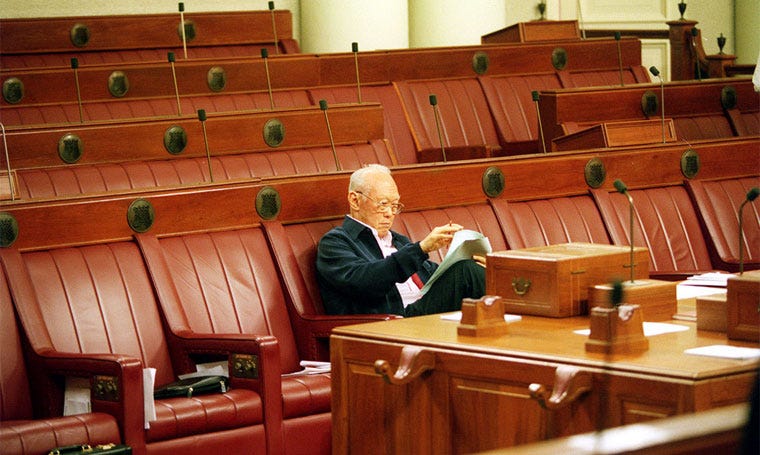
Lee Kuan Yew refused to write his memoirs.
The reason was characteristically unsentimental: people write them, he said, just to settle scores.
It took a small team of journalists to persuade him that explaining the reasoning behind his decisions had genuine value.
So they worked with him on The Man and His Ideas — and I recently published an interview with one of LKY’s key collaborators.
Warren Fernandez was a young journalist then, who would later become Editor-in-Chief of The Straits Times. He recounts that once LKY decided to write, he committed entirely — or as the Gen-Zs would put it -he locked in.
Two examples have stayed with me since that conversation.
He sought feedback relentlessly. Each time Warren sent him his notes, a revised version would come back swiftly. “Is this better? Does it work now?” he would ask — version after version, until Warren lost count. He never seemed to tire of it. The caricature of the fearsome leader impervious to outside opinion quietly dissolved. Bear in mind: Warren was a young journalist then, not the seasoned veteran you see today.
In his seventies, he taught himself to use the PC so he could get feedback faster and work more efficiently. In a separate conversation, Ambassador Chan told me that watching LKY painstakingly master the computer compelled her to pick it up as well. Her reasoning was simple: if the founding father of Singapore could muster the time and will to adopt a new technology, what excuse did she have?
What drove all of this?
LKY’s answer, when Warren asked him directly, was almost brusque in its clarity: “I want it to be read. No use if I write it and people don’t read it. I want them to read it, especially the young, and understand how we got here.”
His deepest worry was not support for the PAP or even the survival of any political arrangement.
It was something more fundamental: that younger Singaporeans would lose the instinct for what made Singapore tick.
The fragility of a small, multiracial city-state.
The need for a constant refresh of our value proposition to the world.
How easy seemingly settled arrangements can unravel.
He wrote because he believed that certain kinds of understanding cannot be transmitted through headlines, speeches, TV appearances, or policy papers.
They require the sustained encounter that only serious reading — and serious writing — can create.
The best and most important ideas travel through the written word. And to receive them, one has to be capable of reading.
Which begs the question: do we still read?
The Curious Case of Singapore
I need to start from where I was born and raised- Singapore.
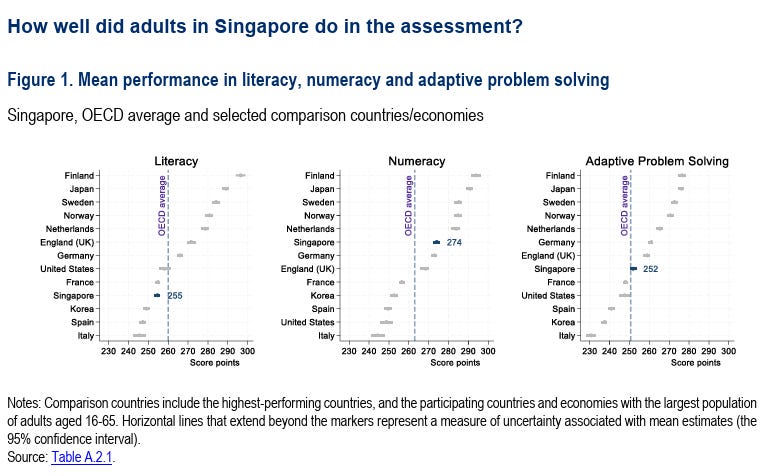
The 2023 OECD PIAAC survey — the most comprehensive assessment of adult skills across developed economies — found that Singapore’s adult literacy proficiency sits below the OECD average overall.
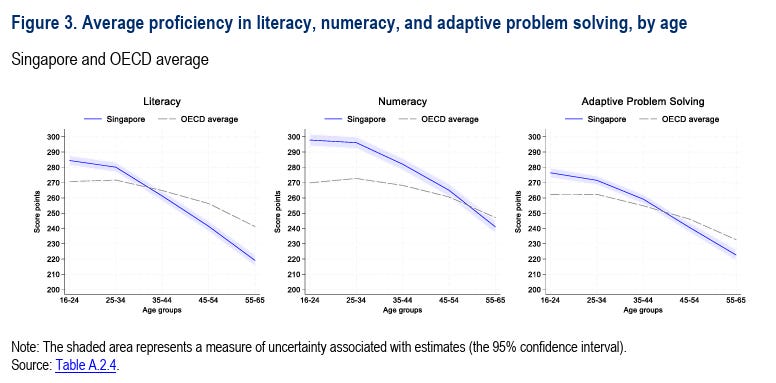
Older cohorts fare particularly badly: Singaporeans aged 55 to 65 rank 27th out of 31 countries assessed, and literacy skills decline sharply after 35.
The headline reads as damning — evidence, it seems, that we could be entering a post-literate society.
But let us look more carefully.
First, Singapore’s 15-year-olds ranked first in the world for reading in the PISA 2022 assessment.
Young Singaporean adults aged 16 to 24 rank fifth globally in literacy in the same PIAAC survey that shows the overall adult population lagging. [1]
Singapore is also above the OECD average in numeracy and converging on it in adaptive problem-solving.
Taken together, this does not reflect a society in cognitive decline.
The more accurate thesis is that the headline average is driven by a generational gap, not a contemporary collapse.
The first generation of Singaporeans came of age before the country had built its world-class education system, competing in an OECD cohort drawn largely from wealthier societies with longer traditions of mass literacy.
Of course they trailed.
The more meaningful signal is the trajectory: as each successive, better-educated cohort enters the workforce, Singapore’s aggregate scores improve.
The mainstream interpretation — that social media is responsible for the adult literacy decline — while persuasive, on its own is not particularly useful.
The same variable cannot explain divergent performance across age groups within the same country at the same moment.
If smartphones were the culprit, we would expect the sharpest drop-off among the young, who are most exposed.
Instead, young Singaporeans are among the most literate populations on the planet.
None of this is cause for complacency.
The same PIAAC data suggests a measurable atrophy effect — younger adult cohorts might experience literacy decline as they age.
The takeaway is simple : Skills, once built, must be exercised to be retained.
Don’t Fall Into The Trap of Doom & Gloom
There is a well-established genre of cultural commentary that treats declining reading figures as evidence of civilisational decline.

The concerns are genuine: in America, reading for pleasure has dropped sharply over two decades; in the UK, more than a third of adults say they have given up reading entirely; universities report students who cannot parse a paragraph of Dickens.
(But even in the UK - its reported more children and teenagers are enjoying reading for first time in 5 years)
As Neil Postman observed long before the smartphone — channelling Huxley — the real threat was never that books would be banned, but that there would be no reason to ban them, because no one would want to read one.
Before we declare an age of intellectual darkness, though, consider what access to knowledge actually looks like today.

We have public libraries stocked with books our great-grandparents could only have dreamed of. In Singapore, these spaces are beautiful, generously resourced, and offer borrowing limits that would astonish earlier generations — literary abundance at a public level.
Beyond the library, personal intelligence is now on tap: an LLM can summarise and extract the key arguments from any article in seconds.
A lecture that would once have required a plane ticket, an institutional affiliation, and a conference fee can be watched online or transcribed with ninety percent accuracy in three minutes, for free.
Great ideas, concepts and lessons are now accessible to anyone with a working laptop.
The cost of accessing insight has collapsed.
For all the criticisms of social media, it has also opened new routes to material worth engaging with — intellectually and for leisure.
The post-literacy panic, in short, is a category error.
It conflates a decline in a specific mode of reading with a decline in human intelligence or curiosity itself.
The democratisation of knowledge is accelerating, not reversing.
But — and this is the crucial caveat — the form of attention we are cultivating at scale is real cause for concern. It’s not because we are getting dumber.
But, because we are systematically exercising one cognitive muscle while allowing another to atrophy.
Two Kinds of Reading
Daniel Kahneman’s most enduring contribution to popular thought is the distinction between two modes of cognition.
System 1 is fast, instinctive, and associative — it pattern-matches, skims, and reacts. System 2 is slow, deliberate, and effortful — it analyses, reasons, and holds complexity.
Both are necessary.
The error is letting System 1 colonise territory that only System 2 can handle.
The same distinction maps onto reading.
Type 1 reading is scanning, skimming, processing for relevance — staying current, extracting signal from noise. This is where many of us operate comfortably in - skimming newsletters, scrolling our newsfeeds and reading articles on our smartphones.
Type 2 reading is slow, sustained, and unhurried: reading not to extract information but to construct a comprehensive worldview - working through a difficult argument until it lands, re-drawing your mental map of the world. And- this endeavour is both cognitively demanding and time-consuming.
The neuroscientist Maryanne Wolf argues that the goal for every digital native should be a biliterate brain — one that moves between these modes the way a truly bilingual person moves between languages: effortlessly, with full fluency in each, neither cannibalising the other. [2]
Her developmental research reveals something uncomfortable: this capacity does not emerge naturally in a digital environment.
It requires active cultivation, almost in opposition to the default tendencies of screen-based reading.
Her blueprint for children makes explicit what most of us assume will happen on its own.
In early school years, print must be primary — because physical books build what Wolf calls cognitive patience: the neurological expectation that understanding takes time, that some ideas require the reader to slow down and dwell.
Digital tools are introduced simultaneously, but for different purposes — coding, creation, design — so that children develop facility with screens without letting screen-reading habits pre-empt the development of deep reading circuits.
And when children eventually read complex material on screens, they must be explicitly taught counterskills: how to resist the skimming instinct, how to read for meaning rather than speed.
It is tempting to dismiss this as advice for children — to assume that in adulthood it is too late. It is not. The biliterate brain is an achievement, not a given, but it remains achievable at any age.
Why Physical Books Still Matter
“Therefore I feel that we of this generation give too much time to news about the transient present, too little to the living past. We are choked with news, and starved of history. We know a thousand items about the day or yesterday, we learn the events and troubles and heartbreaks of a hundred peoples, the policies and pretensions of a dozen capitals, the victories and defeats of causes, armies, and athletic teams — but how, without history, can we understand these events, discriminate their significance, sift out the large from the small, see the basic currents underlying surface movements and changes, and foresee the result sufficiently to guard against fatal error or the souring of unreasonable hopes?”
— Fallen Leaves by Will Durant
There is a version of the digital optimist argument that dismisses physical books as sentimental fetish objects.
If the goal is absorbing ideas, why not read on a Kindle, or let AI summarise? Wolf’s research gives a more rigorous answer.
Physical books offer what digital formats largely cannot: spatial and temporal permanence.
The weight of pages, the ability to sense where you are in a text, to flip back and feel the distance between a paragraph and its premise — these are cognitive scaffolding.
They communicate to the brain that reading takes time and sustained effort, that some ideas require the reader to dwell rather than swipe.
Books teach, literally, that some things are worth lingering over.
That lesson, it turns out, is best absorbed in the medium that embodies it.
What We Read And Why
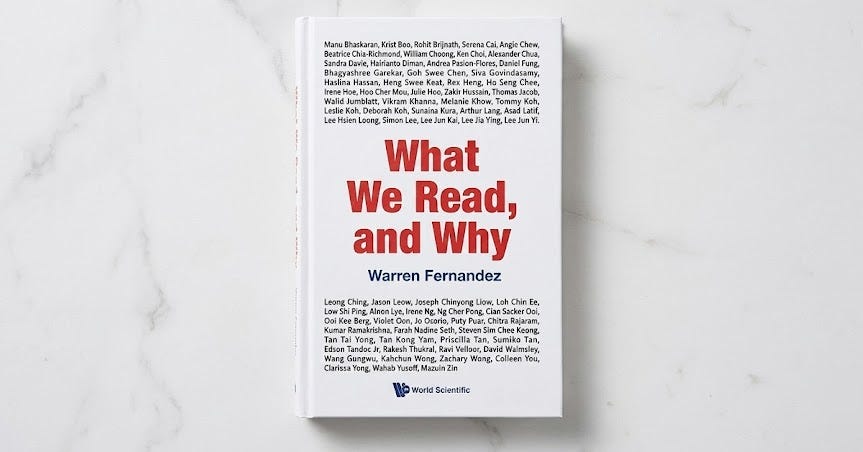
A good way to start reading more to be shown — concretely, by people you recognise — what a life shaped by books actually looks like.
That is the best case I can make for Warren’s anthology, What We Read and Why, which he published together with World Scientific. (You can buy it here)
The book gathers short, personal essays from Singaporeans across every imaginable station in life: ambassadors and senior ministers, academics and students, retirees and young children.
What struck me was not which books people chose, but the quality of intimacy they brought to the subject. Ask people about their cars, their smartphones, their trinkets — you get a ho-hum answer. Ask them about books, and something shifts. The language becomes more personal, more specific, more emotionally unguarded. There is an anthropological curiosity here: the book is the one object that, across vastly different lives, carries the same weight of private memory.
The essays I found most affecting came from children aged nine to twelve — shot through with a carefree curiosity that most adults have trained themselves out of.
(One child even jokingly wrote about her dismay that her parents had started encouraging her to watch television instead of read.)
As a young dad, these perspectives were the most instructive part of the book. The families that produced voracious young readers were not, by and large, the ones running structured enrichment programmes or drilling comprehension exercises. They were the ones who treated their children’s appetite for books the way other parents treat appetites for sport or music: as something to be indulged, resourced, and shared.
The Real Obstacle: Hyperbolic Discounting
The deeper barrier to Type 2 reading is not the smartphone.
It is human psychology.
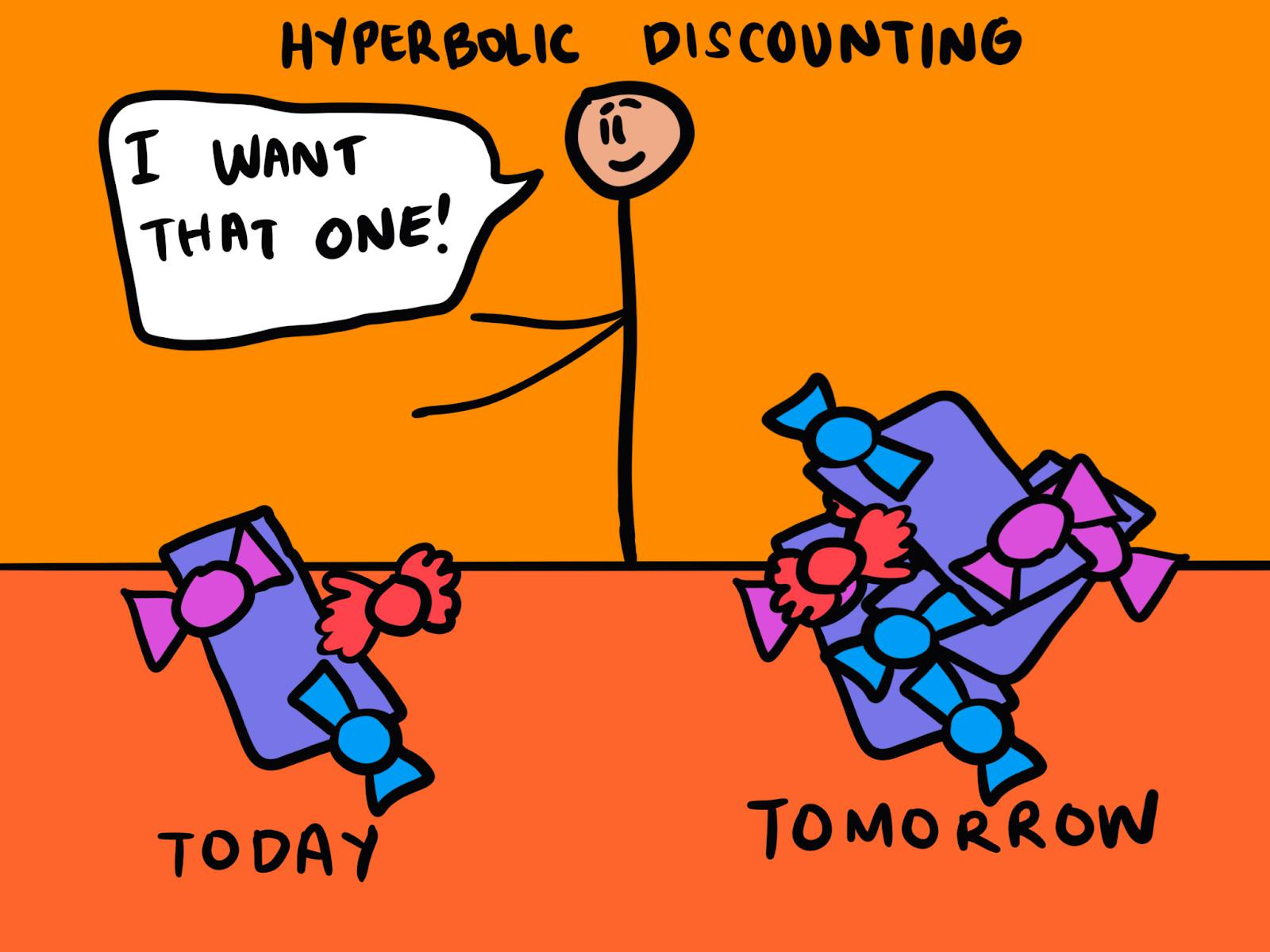
Hyperbolic discounting is the tendency to overweight immediate rewards relative to future ones — even when we know, rationally, that the future payoff is larger. [3]
We choose the dopamine hit of a short video over the slow accumulation of insight from a book not because we are irrational, but because our reward systems are tuned for immediacy. The book’s return is real but deferred. The scroll’s return is trivial but now.
This is why willpower is the wrong prescription.
The right intervention is environmental and motivational: change the conditions, and encounter — concretely — what deep reading has done for people you respect.
SM Lee Hsien Loong’s contribution to the anthology did this for me.
Citing Kissinger, he wrote something I had long suspected but never seen stated so plainly: the convictions that leaders form before reaching high office are the intellectual capital they draw on for the rest of their tenure.
In office, there is almost no time for reflection — the urgent perpetually crowds out the important.
Leaders who do not read, who do not build those reserves before and during their ascent, find themselves operating on increasingly stale assumptions without the capacity to recognize the staleness.
Reading, he wrote, gives him the chance to step back from immediate preoccupations and reach for something more distant and enduring. Without it, intellectual reserves run down. Leaders become stale and jaded — locked into path dependency, unable to bring fresh thinking to standing problems.
Here was a serving prime minister managing a city-state in one of the most consequential periods in geopolitical history, who still carves out time to read.
What legitimate excuse do I have?
His essay also clarified something I had not quite articulated before: the only reliable defence against intellectual path dependency is a deliberate reading practice that includes material written by domain experts — so that your convictions are stress-tested rather than merely reinforced — and material outside your immediate domain of work, so that you can bring novel solutions to persistent problems.
You Need a Forcing Function
The podcast is what keeps me reading. Knowing I have to interview someone whose work I respect in a matter of weeks is a forcing function I could not manufacture by willpower alone.
The preparation — reading properly, thinking carefully about what to ask — taps into my kiasu Singaporean instinct: I do not want to paiseh in front of my esteemed guest.[4]
Remove the podcast, and I am not sure if I would be reading as much.
The broader point is that we all need mechanisms that convert good intentions into reliable habits.
Here are three that I think works well:
1. Sign up to present a book at work, or participate in a book club regularly. The social accountability of having to say something interesting to colleagues concentrates the mind considerably.
2. Start a podcast and explicitly try to interview people whose work you want to understand deeply. The preparation required to make a good interview will make you a cracked reader. That’s what I did but I must warn you this is way tougher than it appears.
3. Buy books for friends as gifts — and mean it. If you are going to hand someone a book and tell them it is worth their time, you had better have a good reason. That obligation forces you to read with enough attention to actually recommend. It also, conveniently, starts conversations.
With that — wherever you are — I hope you discover the great joy of reading in this digital age.
Footnotes
[1]Two different OECD surveys are cited here and they measure different populations. PISA (Programme for International Student Assessment) assesses 15-year-olds across participating countries. PIAAC (Programme for the International Assessment of Adult Competencies) assesses adults aged 16–65. Singapore performs exceptionally on PISA and well among younger PIAAC cohorts, with the aggregate PIAAC score dragged down by older generations who received less formal education. The contrast is not contradictory — it is generational.
[2]Maryanne Wolf’s case for the biliterate brain is made most accessibly in Reader, Come Home: The Reading Brain in a Digital World (2018). Wolf is a cognitive neuroscientist at UCLA whose earlier book Proust and the Squid (2007) remains the definitive account of how the human brain learns to read — a process she describes as one of the most remarkable feats of neurological repurposing in evolution, since the brain has no reading circuit at birth and must construct one from scratch.
[3]Hyperbolic discounting was formalised as a concept by the economist David Laibson and draws on earlier work by Richard Thaler on present bias. The “hyperbolic” refers to the shape of the discount curve: rather than discounting future rewards at a constant rate (exponential discounting, the rational model), humans discount the near future steeply and the far future relatively mildly. A reward available now is worth far more than the same reward available in an hour; but the difference between a reward in a year versus a year and an hour barely registers.
[4]Two Singlish terms for non-Singaporean readers. Kiasu (from Hokkien: 怕輸, “afraid to lose”) describes the competitive, loss-averse anxiety — about falling behind, missing out, or being outperformed — that is a widely acknowledged feature of Singaporean culture and a genuine motivational force.
Paiseh (from Hokkien: 歹勢, roughly “awkward” or “embarrassing”) is used to describe the social discomfort of being caught underprepared or having caused inconvenience.