


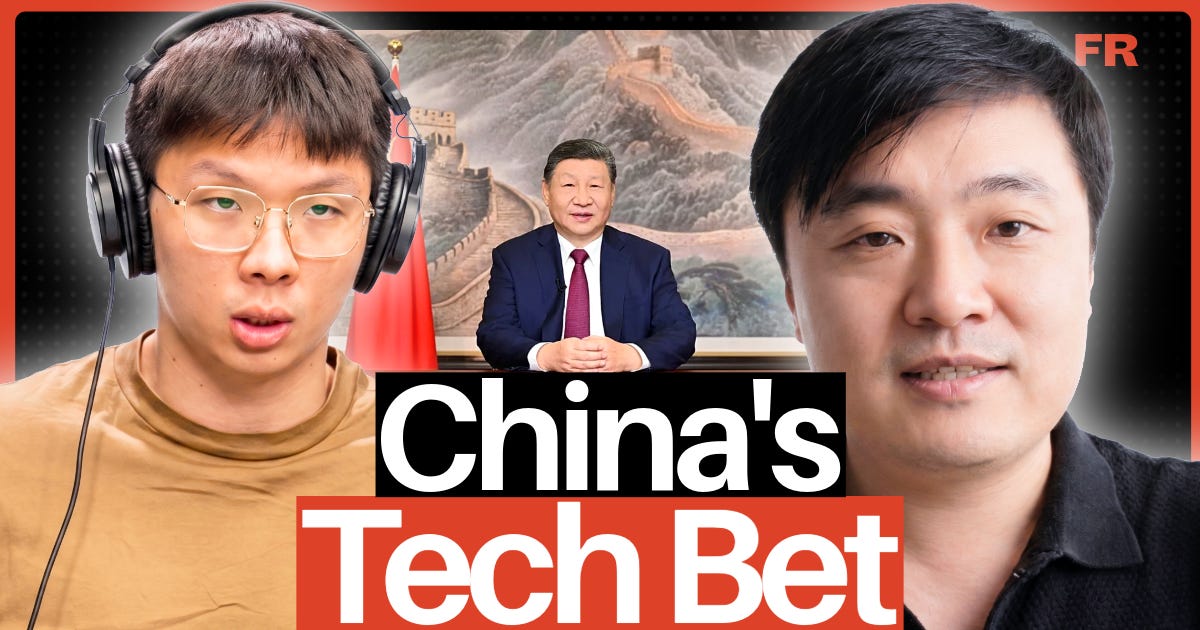
The following is a transcript of the my podcast interview with Robert Wu, an expert China-insider and CEO of BigOne Lab.
Enjoy!
Robert Wu is the CEO of BigOne Lab, China’s leading alternative data and research company, backed by S&P Global and used by institutional investors and corporations around the world to track what is actually happening on the ground in China’s economy and tech sector. He is also the founder and co-editor of Baiguan, a data-driven newsletter on Chinese business and markets, and writes China Translated, a personal newsletter offering a practitioner’s review of the events shaping China’s economy, society, and technology sector.
Wu’s career path into China-watching was unconventional: before BigOne Lab, he worked across sourcing, travel, and corporate restructuring in Myanmar, Switzerland, and Hong Kong. He later joined BigOne Lab as an employee and partner before taking it over in a buyout and becoming its CEO. He also writes for the opinion section of The New York Times.
Through Baiguan, Wu has organised on-the-ground tours for foreign investors into China’s robotics and manufacturing sectors, giving institutional clients direct exposure to the country’s AI, EV, and advanced manufacturing ecosystems. His work sits at the intersection of data and narrative: translating the granular, often-overlooked detail of China’s industrial policy and technology development for an international audience that, in his own words, still has a shockingly low level of understanding of the country driving the most consequential geopolitical shift of the century.
In this conversation, Wu draws on years of on-the-ground research to unpack why the US-China tech rivalry is structurally locked in rather than easing, why China’s EV industry is the template for understanding its semiconductor and AI ambitions, and what the real bottlenecks are in robotics, chips, and AI monetisation as China’s next phase of growth takes shape.
Robert, thank you once again for coming onto the podcast. It’s been about a month or so since Donald Trump visited China and met with President Xi Jinping. This was hyped, or touted, as a period of détente for the US and China in their ongoing geopolitical rivalry. A month on, if we look back, how should we understand its developments with regards to the technology competition between the US and China? Do we see an opening up of trade, especially in critical technologies, or will we see more of the same as the past year?
Robert Wu 00:31
Thank you for inviting me.
You mentioned the good word, détente. To me, it’s the same as saying there will be no further escalation. There would be, at least in the foreseeable future, no worse situation than what was before, so everything was kind of frozen in place.
But on the other hand, I also don’t think there’s going to be any material improvement in terms of the relationship between the two sides, in terms of the tech competition and the control programmes already in place. I don’t think any of that has moved in any meaningful way, and I don’t think anyone is expecting it to.
China has been doubling down on developing its own technology, its own tech stack. Maybe two years ago, people were talking about the US restricting Nvidia chips to China and how China would deal with that. Now you’ve got something in reverse: Beijing itself doesn’t want China to import these high-end chips anymore. That’s not to suggest that Chinese chips have caught up to the global standard. They’re definitely not there yet. But it’s a way for Beijing to say we really need self-sufficiency in these most crucial sectors, and we need to preserve this new market that’s been created by the export controls.
A few years ago there was really no market for Chinese domestic high-end chipmakers, because why bother? You had the best GPUs and CPUs in the US. No user wanted to pay extra for a lower-quality product. But because of the controls, a real domestic market for indigenous chipmakers was created, and I think Beijing doesn’t want that to end.
We’re actually enjoying a sweet moment right now, a sweet period where there’s a real market pushing everyone to develop, and you don’t want this to end too soon. You want to come out of it with a self-sufficient industry. So I think it’s just more of the same, and even more so. Doubling down, assuming there’s no turning back, until China reaches a standard equivalent to US technology across the board. Only then would I imagine any kind of real détente.
Keith 04:15
The US tech export controls on chips have backfired to a certain extent.
Robert Wu 04:21
This kind of policy definitely caused some short-term pain, and by short term I mean two to three years, even four or five. So not exactly short term, more medium term. But in the end, it set in motion some big historical changes that, in the long term, five to ten years and beyond, are deeply detrimental to the US.
If I were a US policymaker, I wouldn’t have done this. I would have tried to get all the Chinese companies hooked on our technology, because American standard-setting power, the technology standards themselves, are what’s valuable. What the export controls did was force China to create its own standard, and everything will now develop along that standard. I think it’s backfiring, and it will be remembered as a backfiring policy.
Keith 05:25
There’s this bifurcation of the two technological ecosystems happening in real time. Maybe at a more fundamental level, in the past it was at the level of the internet, consumer internet applications. We think about social media, for example, where there’s a clear Chinese version of the ecosystem and a more international version. I suppose we’re seeing that happen at the same time with chips.
Robert Wu 05:52
The fundamental models of social media, e-commerce, and so on are similar, the same even. They’re just separated from each other. I think the best example is actually EVs.
The automobile sector is a very important sector. Every respectable industrial power needs a strong automobile industry. China wanted that too. For decades China wanted to build a domestic automobile industry, but it never succeeded, until EVs. Before EVs, China was trying to follow the West in traditional internal combustion engine cars, and it never delivered a globally competitive ICE brand. No one remembers that.
Then the thinking shifted: why compete in this old game? Why not create our own technology path? Which, at the time, was EVs. It was a totally new thing. Everyone had the same baseline. The traditional powers like Germany and Japan didn’t really have an advantage there. Everyone started at the same time, so China developed independently. The bottleneck then was the same for everyone: better batteries, better smart-driving systems.
I think a similar thing is happening right now in the semiconductor world. Before we talk about the bottleneck in China, we have to talk about the bottleneck of the whole world. The entire semiconductor industry, the entire AI industry, is bottlenecked. All this crazy bull market in memory, in optics, in interconnects, is precisely a bottleneck trade.
Modern-day AI isn’t really restricted by the quality of the chips anymore. We’re not talking about needing better chips with smaller nodes. We’re already nearing the physical constraints of how small you can make a transistor. You cannot build something half the size of an atom. So the entire industry, worldwide, is trying to figure out how to piece all these chips together, how to have a massive array of chips that can talk to each other so fast they function as a single piece of silicon. That’s where the whole industry is moving. And that’s a totally new thing. It’s not about chipmaking anymore.
If the question is when China will be able to make a chip as good as TSMC can, that could be forever, or at least a very long time, long enough to discourage anyone. It’s the same as fifteen years ago, when people asked when China could have a globally competitive car. That seemed like it would take almost a lifetime. But if the problem isn’t the chips themselves, but the systems, how chips talk to each other through optics, from chip to memory, then it’s a new technological pathway where everyone has a similar baseline. I think that’s where Chinese industry is moving too.
If you look at Huawei, they recently announced a concept they call logic folding, or die-stacking at scale, which is really about overcoming the limitations on transistor size by folding and stacking chips together. And if you look at the DeepSeek model, the recent V4, a lot of the innovation is about achieving a global standard of performance with a minimal level of memory cost, so that inference can be done at a fraction of what it costs US models, helping China bypass its disadvantage in memory technology like HBM4.
All these bottlenecks, shared by both the Chinese market and the global market, also create opportunities for invention and innovation that wouldn’t otherwise exist. It’s a new game, forced by the constraints of the export controls in the first place, and China is choosing not to play the old game but to open a new one and play there. I think that’s happening very fast right now.
Keith 11:34
The use of the EV analogy is quite instructive, because it creates a new paradigm shift. You create a whole new category and you’re able to capture the market because you’re one of the early movers, one of the creators of the new market itself. If you reflect on the lessons of EV development within China, it was clear to observers and analysts that China didn’t just pick winners. It was a much more sophisticated play in terms of creating an ecosystem. If you look at this idea of developing an ecosystem, what would that actually look like in your view?
Robert Wu 12:20
Yeah, EVs are a great example. It’s a masterclass in industrial policy, and a very important aspect of it is timing.
When people think about industrial policy in China, when people think about EVs in China, they tend to think it’s just subsidies. People in Europe say we have to ban these Chinese EVs because they’re all subsidised, it’s unfair, and so on. That doesn’t really make sense. You can’t subsidise an industry into being globally competitive. If subsidy were the answer, whoever subsidised the most would have the most competitive industry. Europe subsidises plenty of industries too. Why can’t they subsidise their own automobile industry into competitiveness? It’s just not how things work.
Are there subsidies? Definitely, at the central and local government level, in tax credits and so on, and they’re a great way to jump-start a whole new industry, to do a greenfield development that requires a huge amount of fixed-asset investment. In that regard, they’re helpful. But that’s definitely not the only part of the industrial policy.
There were several important decisions Chinese regulators made in the development of EVs in China. The first was introducing a foreign competitor, and a very strong one, Tesla, into China, and allowing Tesla to operate as a hundred per cent wholly owned subsidiary, which was a major exception to the historical rule. Historically China only allowed joint ventures. But in Tesla’s case they made a special exception, and it mattered because at the time Tesla was so much better than any other Chinese EV, far better than BYD, far better than anyone else. It was simply the best out there.
If you’re a government in the mindset of subsidising and protecting your indigenous industry, you wouldn’t normally introduce such a strong competitor, because of the risk that this player kills everyone else. But they did it, for two reasons. First, they wanted to create an environment where some companies had to die. At the time there were maybe a hundred or more EV brands across China. Every local government wanted a piece, because automobiles are great for local GDP and local employment, so there were countless brands you’ve never heard of and will never hear of, soaking up billions in investment and subsidies. Most of them had to die, and the only way to kill them was through very strong competition, a real game of survival. I call it a hunger game. The ones you remember today, BYD, Nio, Xiaopeng, are the winners out of maybe a hundred losers. When Tesla came into China, it set this hunger game in motion. You don’t just allow companies to rise; you also allow a lot of companies to die. That’s very important.
The second lesson is that by introducing this very strong player, Tesla also helped build a complete ecosystem of suppliers underneath it. A lot of companies became big by supplying to Tesla: components makers, chip makers, auto glass makers, powertrain makers, and most importantly battery makers. By doing that, all these suppliers also gained knowledge of what a high global standard for an EV actually requires. That helped set up a whole supply chain in China, and the same supply chain went on to supply many of the domestic leaders as well. You can’t stop that. It’s not about technological theft or anything like that, it’s just natural. If your factory is in China, you’re going to want to rely on local suppliers, otherwise what’s the point of having a factory in China at all?
So if you come in with one strong player, you end up helping build a whole ecosystem, and that ecosystem benefits everyone. I think that’s also masterful: not just supporting one brand or two or three, but supporting a whole ecosystem through external pressure. It can’t just be summarised as subsidies. It’s a whole package.
Keith 18:16
If you enjoy this show, please double-check if you’re subscribed. Every subscription matters and really helps us grow the show to serve you better. Thank you so much for the support. Now, back to the show.
Patrick McGee wrote the book Apple in China, where he details a similar dynamic, the entrance of Apple into China via Foxconn. Like what you’ve described, that’s created an ecosystem of consumer electronics manufacturers and subcontractors which, when we look at Chinese brands emerging in the consumer space today, you can trace back to that. Is that a similar dynamic at play?
Robert Wu 19:03
Yes, definitely. I’d say that’s the real technology transfer. A lot of people, when they criticise China, say China is forcing Western companies to transfer technology. I think that’s quite a naive view of how technology actually works. People imagine technology like an email, a file you can attach and send to someone, and it’s transferred. It’s never like that.
When you want to build something, you need know-how, you need talent, you need operational knowledge. It’s a myriad of large and small things, knowledge you can really only gather by working through it yourself. That’s the most important part of technology. I call it process power. How do you understand the process? Maybe there are ten thousand steps. How do you know why each step is needed, how much of it you need to do, which steps aren’t needed? All of that knowledge is subtle and complicated, and it’s only really possible to acquire by actually working through it, by working with the best people, supplying to them, letting them be your clients, co-developing the product together. It’s natural, and it has to happen. Otherwise Tesla wouldn’t have built such a strong manufacturing base in China, and neither would Apple. Their success came from this. It’s mutually beneficial. There’s no way to earn that much profit without giving something back in terms of process knowledge.
Keith 21:03
That was actually one of the central insights I took from McGee’s book. He talks about how Terry Gou, through Foxconn, was very smart in offering very competitive, almost no-margin prices, so he could pick up what you’d call the tacit, processed knowledge that would let him earn a better margin once he started selling to other manufacturers. He saw the discounted prices he was offering Apple as a kind of tuition.
If we look at the Chinese tech scene on the flip side, there’s a phenomenon the government has now acknowledged as a problem, what’s known in Chinese as involution, 内卷. There’s been an anti-involution campaign going on too, an effort to consolidate players so you don’t have cut-throat competition throughout the economy. We see that in a few sectors, even in food delivery and e-commerce operations. How effective has it been?
Robert Wu 22:30
I wouldn’t say it’s been super effective so far, because it’s fighting against a huge structural bias towards overcompetition, towards involution. Chinese people work incredibly hard. Local governments, Chinese companies, everyone wants to be the best, and if something’s good, a lot of people rush in and cut each other’s prices, squeezing out the margins. That’s just part of our cultural DNA. There’s both a structural and a political inertia here.
What’s important is that about a year or two ago, Beijing finally made an explicit commitment: we are not fine with this. We understand this is what we’ve been like for decades, but it isn’t good, and we have to label it clearly as something that isn’t good. That overcapacity, overproduction, producing too much and competing too much, is not good. That’s an important message in itself, because up to that point the assumption had always been that to compete is good, to produce is good, and to not have enough product is bad. So that’s already a historic pivot, and it’s not realistic to expect such a pivot to play out within one or two years.
If you look at the specifics, things are edging up. It’s not changed overnight, but it’s getting better. If you look at the PPI, the producer price index, it’s been edging up for the last few quarters, which means that across many industries people are raising prices rather than undercutting each other. In sectors like food delivery, which we track closely at Baiguan, we’re starting to see a lowering of subsidies and an increase in restaurant margins recently as well.
So it’s not a huge change overnight. It’s like a glacier, moving slowly, gradually, but surely. The direction is very clear. There’s now a consensus, society-wide and politically, that involution isn’t good, that there needs to be balance. We’ve changed, and we’ve moved, but it’s not a drastic, revolutionary, overnight change. Definitely not.
Keith 25:57
Where do you see Chinese tech companies playing in this increasingly global market? How are they positioned against, say, their US counterparts?
Robert Wu 26:07
One relatable historical experience is the Japanese example. Over the last few decades Japanese companies have been very global. If you look at the annual reports of many Japanese companies, most of their revenue comes from overseas markets, because the domestic market is only so large.
I think China is moving in that direction, with more and more big and small companies deriving most of their revenue from a global base. The big change from before is this: China has always been very export-oriented, a big exporter, but for many decades it was an exporter of low-margin products, supplying the true leaders of the industry, the ones with real pricing power. A lot of iPhones are made in China, many Apple components also come from China, but it’s the American company, Apple, that captures the majority of the profit from the whole ecosystem, because Apple has the brand power, the design power, the soft power, and that translates into formidable pricing power.
Until recently, that’s what China’s foreign revenue looked like. Only recently have we started to see Chinese companies gain real pricing power in their own fields. A good example is Pop Mart. Pop Mart isn’t exporting to other companies, it’s talking directly to foreign consumers, selling a high-margin product. You can imagine the manufacturing cost of a toy from a Chinese factory is really low, but it can totally justify a high margin because people want it, people like it. That’s the gap many people haven’t realised yet, that you’re going to see more and more companies like Pop Mart, in consumer goods, in manufacturing, and in technology too.
People like to imagine Chinese companies as underselling each other, selling cheap goods and cheap services, but in future it could be either cheap or expensive, just definitely higher quality. That’s where the real competitiveness comes from. Specifically in tech, if you look at the big internet firms, the cloud service providers, and the AI companies, I think there’s huge potential growth for the new AI companies in China. Many of them are global from day one. I’m talking about companies like Minimax, Zhipu, and DeepSeek. From very early on they’ve been globally known, their products globally used, and essentially they’re selling tokens. Underlying those tokens isn’t just their algorithms, it’s also the electricity, the power. China has notoriously cheap electricity. People talk about China essentially exporting cheap power in the form of tokens to the rest of the world. That’s going to be a huge difference, because historically, technology products, cloud services, internet products, China has been very big domestically but not so much internationally. Tencent, WeChat, aren’t really popular outside China. Nor is Alipay. TikTok is the exception, not the rule. Most big Chinese internet players are strong domestically but weak internationally.
AI could be different. AI is a field where Chinese companies can be global from day one, and they are global from day one. Many of these companies, Minimax for example, have most of their revenue from outside China. That’s their own choice from day one, and it shows real competitiveness. People like it. If you go on OpenRouter, where all these AI APIs sit, you’ll see a growing share of API calls coming from Chinese models. That’s a big trend we’re observing.
Keith 31:30
If we look at the AI dimension, which I’m glad you brought up, it’s become an increasingly sensitive area, especially given rising geopolitical tensions between the US and China. You have, for example, the Manus case, the legislated unwinding of that deal. Many Chinese companies do look to sell overseas, but at the same time, in bigger markets like the US, there’s increasing scepticism about using Chinese AI service providers. That speaks to a breakdown of trust at a very fundamental level between the US and China. In that more fraught geopolitical landscape, how do Chinese AI companies stay nimble while remaining commercially viable?
Robert Wu 32:23
Counterintuitively, what I understand from recent conversations is that a lot of US companies are also adopting Chinese models. One thing about Chinese AI is that they always have an open-source version and a closed-source version. Most AI companies in China run on this open-plus-closed model. Their open-source models are being widely adopted, in China and in US companies, to save costs.
Maybe a year or two ago people had concerns and scepticism about Chinese models. What I understand now is that people don’t refer to them as Chinese models any more, they just call them open-source models. The thing is, the only viable open-source models right now are Chinese models, so people are using a kind of euphemism for Chinese models. That, in itself, shows the dominance and the quality of Chinese models. Even the open-source versions are already being widely adopted.
I think this open-source-plus-closed-source strategy is very helpful for Chinese companies. The open-source version is something you give away for free, share with the community, which serves as a kind of marketing and branding effort. Even without people paying for your services, they can use your branded free service and implement it locally in a safe environment for themselves. If you put out a very good open-source model, that’s a huge branding boost for yourself, and people looking to subscribe to your closed-source models will naturally come from the people who already use your open-source models. So Chinese companies are doing very innovative things in how they develop, and they’re different from how Anthropic and OpenAI develop, both of which are very closed-source. Each approach has different advantages and different weaknesses.
Keith 34:59
In that case, when you have an open-source model, the challenge is always how you monetise it well, because it’s one thing to showcase technological superiority, but from what I hear, even from friends working in the Chinese tech space, it’s actually very hard to convert a customer, because some users are happy with the open-source model and feel there’s no real incentive to go further down that customer journey. How are tech entrepreneurs, especially in the AI space, thinking about paths to monetise and expand?
Robert Wu 35:35
Companies are starting to pay much closer attention to financials and monetisation now. The reason they have the patience and the nerve to do this is that this is what Chinese companies, especially internet companies, have been accustomed to for more than a decade. It’s almost like the early internet playbook: you give a lot of free services to users in China, make it really cheap, even free, get people used to your services through subsidies, and then figure out how to monetise. It takes time to find the right price points and the right difference between your open-source and closed-source offerings.
I think right now, because of the importance of the AI industry, there’s a lot of support coming from capital markets and from the state, so companies will have enough time to figure it out. I wouldn’t be very worried about that. As long as they can survive and keep iterating, there should be a bright future, at least for some of them.
Keith 36:50
The adjacent question would be the geopolitical constraints. The Manus case study, which I referenced earlier, suggests there’s a clampdown on how a company can rebrand or reposition itself as an international company. There was one very clear example where the founders found themselves on the wrong side of the regulators. What are the implications of that for Chinese tech founders thinking about rebranding their companies as more international?
Robert Wu 37:23
What the Manus team did has been an unspoken rule for a while. It’s not just Manus, there are many companies I know of. It’s not even rebranding, it’s more like remaking yourself, a conscious choice not to be seen as a Chinese company, but as something else, washing yourself into a different identity. That’s something that’s been happening quietly, and everyone knows it happens.
The Manus case was special for two reasons. First, they only made that decision later in their life cycle. If a company decides from the start to go overseas and become an overseas company, that’s actually still fine. But Manus had been developing in China for a while, and only later decided to move away. Second, they were very vocal about the deal when Meta made the acquisition. A lot of entrepreneurs and VCs in China remember all the PR articles and interviews where Manus and their investors talked it up, held it up as a huge success story, without any apparent concern for the political implications. That’s special too, because most companies who do this kind of thing do it quietly. Manus was just too successful, and they had to brag about it. That, in effect, forced Beijing’s hand. Beijing had probably known about this kind of thing for a while but hadn’t done much to stop it. This very public deal forced a response. Beijing had to make a statement that this isn’t acceptable, that it has to be covered under regulations, that you can’t use this as a loophole.
Is it a clampdown? I don’t think so. I think it’s more a reiteration and tightening of the existing regulatory regime. If you’re a Chinese company and a foreign company wants to acquire you, there are certain regulations you have to go through, and that’s all fine. What was different about Manus is that, having rebranded itself as something other than a Chinese company, it appeared not to need to go through those regulations and approvals at all. Beijing is saying you can’t do that and assume it’s fine.
The reaction from the Chinese tech and VC industry has been pretty normal, I’d say. People weren’t shocked. The combination of Manus bragging about the deal so publicly, and doing it so obviously, trying to wash themselves into something else, made Beijing’s reaction feel natural to most people. People weren’t scared, because they figured Beijing had to do something about it. The end result is that if you don’t want to be a Chinese company and you want to do a startup, you should just do it from day one, leave the country and start up there. If you want to be in China and enjoy the benefits of the Chinese ecosystem, you have to be a Chinese company. You have to make that decision at the very beginning. I think that’s the real lesson, and it’s actually a lesson many people already knew, even before the Manus case. Manus just made it a very clear one, so now everyone knows. That’s just my two cents on this.
Keith 41:46
If you want full access to the transcripts of every episode, head over to ykeith.com and you’ll get full and free access to each one. Now, back to the show.
At the grassroots level, you’ve also been organising tours for foreign investors to go into China and better understand the local market and the local ecosystem. One of the things you’ve focused on in recent months is helping others understand AI and robotics in China, and the advancements there. Could you share some learnings you think are pertinent to those of us who are foreigners investing in or observing China from overseas, and give us a sense of the developments that aren’t being talked about today but will be crucial in the development of AI robotics?
Robert Wu 42:36
In April we organised a tour to cover the robotics industry, mostly in Shanghai and the areas close to it. We had almost twenty people from all over the world join. We visited large and small robotics companies, and there were several interesting takeaways, both from our participants and from me personally.
In terms of movement, the bodies, China is very advanced. The robots you see can not only dance, they can do kung fu, they can run. But the thing is, they’re still very stupid at this moment. Their brains are very small. A lot of the movement is pre-programmed, or even teleoperated. If you look at the Spring Festival Gala in China, where you see all these Unitree robots doing sophisticated movements and manoeuvres, a lot of that is teleoperated. It’s a great testament to the hardware, but the software is very lacking, and the main reason is the lack of data to train on.
If you think about large language models, they have the whole internet, the entire written history of humanity, to train on. If you look at autonomous driving, Tesla has an existing fleet of millions of cars rolling on the roads every day, collecting data. But if you look at robots, how many robots are operating every day? Maybe ten thousand at most, in motion. And they’re doing something far more complicated than autonomous driving. So you have a far more complicated data environment, but a much lower level of existing equipment to collect that data. Data becomes the bottleneck.
We’re starting to see companies, even startups, working specifically on the data side, what’s called teleoperated data, or imitation data. You have real people using simulation devices to control the robots, teaching them what to do, repeatedly. We actually visited one of these data collection centres at a major robotics company, and you have around twenty people sitting at their stations. One person is controlling a robot to fold clothes, folding it, unfolding it, over and over. Another is teaching a robot to open and close a wardrobe door, opening it, closing it, again and again. It’s quite remarkable, all these people doing mechanical, repetitive work, and the robots learning to do it after them. It’s manual data collection, and there are companies in China specifically working on this now.
There’s only a limited amount of real-world data you can collect this way, unless you have ten million robots out there working every day, and right now you only have a few hundred. So you also have what we call simulation companies, creating simulated data, recreating virtual worlds for robots to react to, generating massive amounts of synthetic data to train on as well. That’s a very important field that I don’t think many outsiders pay enough attention to, because when you think about robots you think about flashy performances. That’s the obvious part. The real bottleneck right now is the data: how do you collect it, and synthesise it, to build a bigger, better, stronger brain. That’s really where the front line is at the moment.
Keith 47:17
When your visitors come and look at the manufacturing capabilities within China, what do they see that gives them a different paradigm on how manufacturing really plays out there?
Robert Wu 47:33
This time we visited a software company in China, a tech unicorn that serves only the manufacturing sector. It helps factory owners and managers manage their processes, their manufacturing lines, and many other details in their factories, all through their phones, through an app, a mini-program, very internet-based, with a system for every worker.
You only get this kind of startup, this kind of AI company, in China, because China has a huge manufacturing sector to support its existence. In the US you’d have startups in many other fields, but in China you have this whole ecosystem of manufacturing partners, and that’s something that really amazed some of our participants, looking at the growth trajectory of these companies and the specific niche they fill, a niche that’s large enough simply because China’s manufacturing sector is so vast.
On this last tour we went to AI and robotics companies, which is actually softer, more office visits, watching robots, at best visiting some data collection centres. But in future we’re going to organise manufacturing tours, taking people to manufacturing bases in China, the Pearl River Delta, the Yangtze River Delta. We want to show people some of the average factories, not the best ones, the average ones. What I understand is that many average factories in China are already what we call dark factories, lights off, very few people, all automatic, all robotic, even mid-sized factories. That’s something we’ll be very interested to watch. It’s a very interesting thing about China, that it will always be a manufacturing power. It’s going to be the world’s factory for a long time, and it’ll be very interesting to follow.
Keith 50:26
As we head into the last question, I want to quickly plug Robert’s work. I think you’re doing great work, I’ll link the Substack and the tours in the bio so people can check it out. Reading your work, it’s clear to me that you don’t just understand China at a very fundamental and intimate level, you’re able to communicate that to the outside world, so we have a clearer understanding of where China is headed. I’ll link that in the bio.
My last question: given this age of fragmentation and competition we’re living in, if you were to give one piece of advice to a young person today, what would it be?
Robert Wu 51:07
Do something you love. I know this sounds like a cliché, but it’s becoming more and more existential. Because now, AI can do almost anything you can think of, but it doesn’t have one thing: a motive. AI doesn’t have a motive. It’s just a tool, a very powerful tool, one that has the potential to replace a lot of people, but it can’t replace creativity, and it can’t replace motive, knowing what you actually want to do.
That’s a bigger problem in China. Most kids, growing up, aren’t given much chance to develop what they actually want to do. It’s all exams, all memorisation. But now that’s getting more and more serious, because if you just take exams and memorise things, you’ll never outcompete AI. AI will remember things faster, better, and more comprehensively than you ever could. But if you know what you want to do, if you love what you want to do, AI becomes your weapon. It becomes the workhorse for you. So finding what you love is becoming more and more important, and for many people that’s still considered a luxury. But you have to make the room for that luxury. That’s just my very simple, humble piece of advice.
Keith 52:40
With that piece of advice, Robert, thank you once again for coming on.
Thank you for listening to today’s episode. If you are watching this on YouTube, please consider subscribing and turning on notifications for whenever new episodes are out. If you’re on Spotify or Apple, it would help us greatly if you could leave a five-star review on those platforms. Once again, thank you for tuning in to The Front Row Podcast.
Robert Wu 52:43
Thank you. Thank you for inviting me again.