


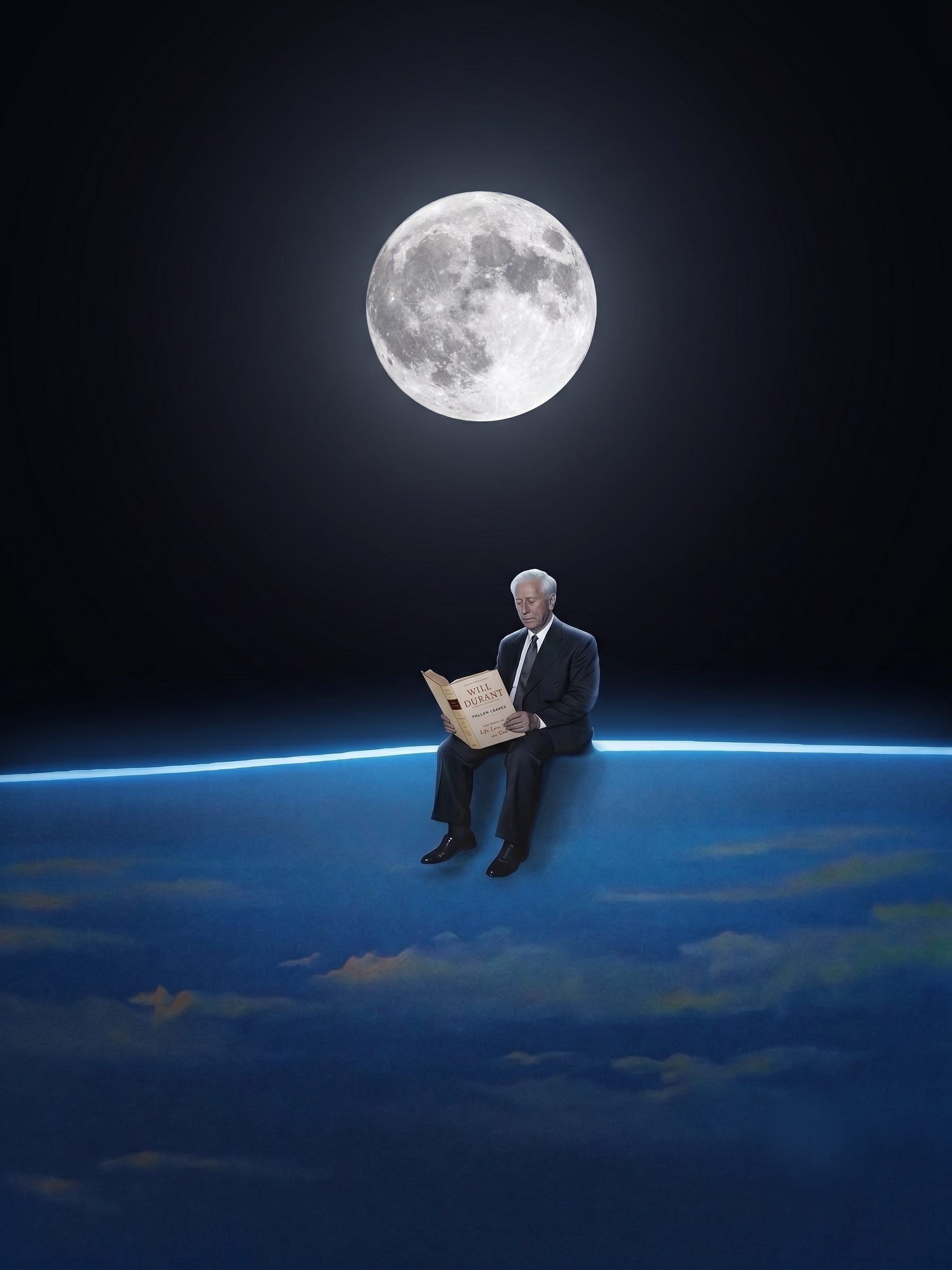
Will Durant spent his life making history accessible.
Across the 11 volumes of The Story of Civilization, written with his wife Ariel over 4 decades, he turned 6,000 years of human record into prose that ordinary people actually wanted to read.
Durant is the epitome of a rule I try to live by: take your work seriously, and yourself much less so.
And, if there was one book I could recommend for us who live in the age of cognitive convenience - it would be his last book- Fallen Leaves.
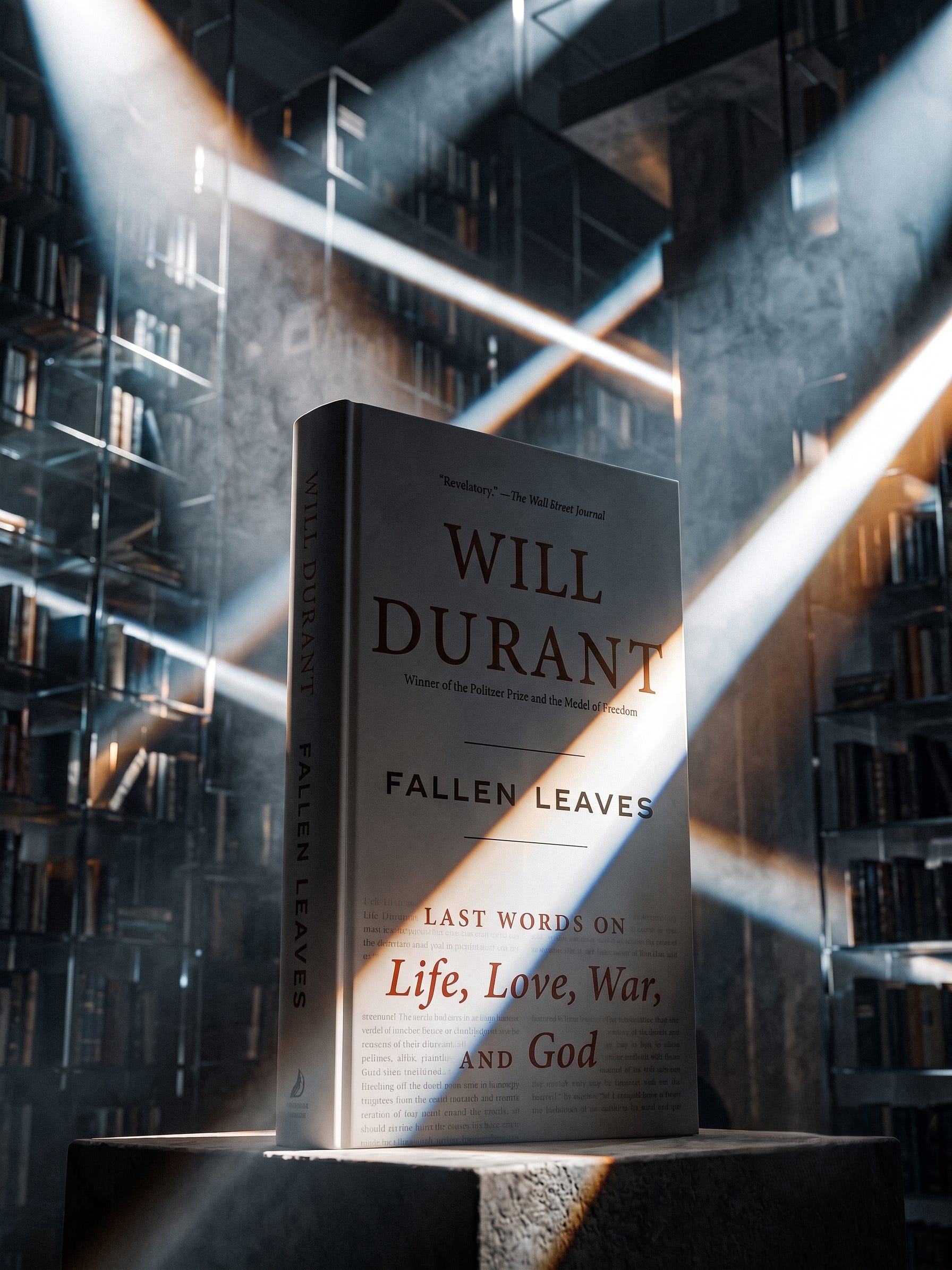
It was his last. Durant died in 1981 at the age of 96, and in his final years he had been quietly working on this slim volume of reflections on life’s biggest questions: love, religion, morality, ageing, war, politics, art, and death.
The manuscript then sat among his papers for 32 years before Simon & Schuster published it in 2014.
I put Fallen Leaves alongside Lee Kuan Yew’s Hard Truths as must reads for us millennials and Gen-Zs.
Lee gave those interviews at 87, long past needing anyone’s approval or political support, and it shows.
Both books are the work of a man in the twilight of his years, looking back over the whole of it, with a single intention: to pass on the best insights of a lifetime to the generations coming after him.
The best books are written by such men and women.
They have nothing left to gain or lose, and all they want to do is desperately transmit their best ideas to the next generation.
Why history, and why now
We live in an age of information customised to our palates, available at the tip of our tongue or fingertips, depending on which app you use.
When you have knowledge in abundance, wisdom is scarce.
Durant felt this half a century before we started doomscrolling.
“We of this generation give too much time to news about the transient present, too little to the living past. We are choked with news, and starved of history.”
Choked and starved at once.
His question gnaws at me- without history, how do you sift the large from the small, or see the currents running under all that surface movement?
He makes the case for the remedy in a single passage:
“Other studies may tell us how we might behave, or how we should behave; history tells us how we have behaved for six thousand years. One who knows that record is in large measure protected in advance against the delusions and disillusionments of his times.”
Epistemic humility
The biggest lesson I took from Durant is to carry a healthy dose of epistemic humility.
Don’t presume to know it all.
Don’t entertain illusions of grandeur.
However successful you become, the sands of time will prevail and you will eventually be forgotten.
Take Lee Kuan Yew.
He is the iconoclast of Singapore, the founding father who willed this country into existence.
It has been 11 years since he passed, and he has already faded from public consciousness.
There is scarcely any serious engagement with him or his ideas in our day to day beyond the occasional anniversary retrospective.
Let me try to drive this point home.
Consider the great men who tried to cheat this fate outright.
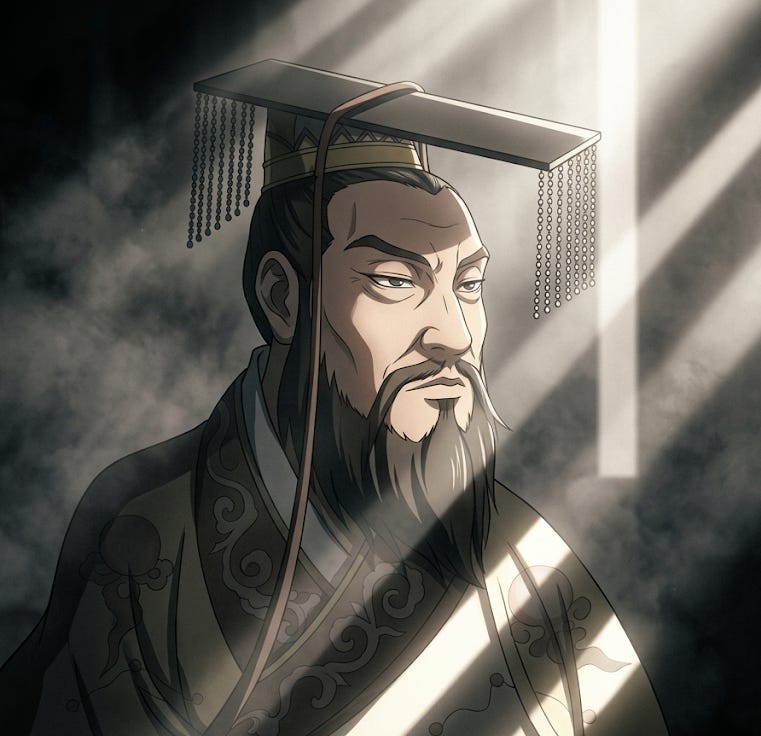
Qin Shi Huang unified China in 221 BC and titled himself First Emperor, on the expectation that his dynasty would last 10,000 generations.
Then he set about trying to live forever.
He despatched the court sorcerer Xu Fu across the eastern seas with a fleet of ships and thousands of boys and girls to find the elixir of life.
Xu Fu never returned.
Meanwhile the emperor’s own alchemists prescribed him pills of mercury, the substance they were certain held the secret of immortality. He died on tour in 210 BC, aged 49, most likely poisoned by his own medicine.
His ministers, too frightened to announce the death, hid his decomposing body in a carriage and surrounded it with carts of rotting fish to mask the smell.
The dynasty built for 10,000 generations collapsed within 4 years.
Now, Psalm 39:5 reads like a plain statement of fact:
“You have made my days a mere handbreadth; the span of my years is as nothing before you. Everyone is but a breath, even those who seem secure.”
Resisting Cynicism
It’s easy to get cynical now.
Why bother at all?
Durant looks squarely at this brevity, this cosmic insignificance, and comes away grateful for it.
Across chapters that range from his views on sex to the Vietnam War, he comes across the same way every time: pragmatic, yet empathetic.
His chapter on war shows the temperament best.
Watching the present violence in the Middle East and Europe from afar, aghast, the natural wish is for a world finally rid of war.
Durant would call that wish ahistorical.
He describes war grimly as “the Darwinism of states” and traces its causes to things that do not go away.
Human nature, scaled up: “the state is the soul of man enlarged under the microscope of history,” with all our acquisitiveness and lust for power enlarged along with it.
Populations that multiply faster than their food supply. Industrial economies with an insatiable appetite for raw materials and foreign markets. The tools have evolved from Stone Age flints to guided rockets; the drivers have barely moved.
For all that, Durant does not despair.
He simply has no patience for vague pacifism or appeals to “the conscience of mankind,” because international morality awaits international order, and order requires enforceable law.
His proposals are practical, like everything else in the book.
Peace must be planned and organised as realistically as war: permanent international commissions assigned to defuse the specific triggers of conflict, from food shortages to population pressure to unequal access to markets.
In the long run, he concludes, war ends only when nations yield their sovereignty to some superstate.
A global superstate sounds unrealistic.
So does a world without war.
His gentlest proposal is the one I 100% agree with : broader education, impartial history, and travel, so that we might “love our country without betraying mankind.”
Cultivating the garden
The change I notice in myself since reading Durant is simple: I no longer assume I know best.
Before I jump to a conclusion about the news of the week, I look at the record.
Has this happened before?
How did it go?
Almost always the answer is yes, and the outcome is instructive.
The habit takes 5 minutes and it has saved me from repeating a great deal of confident nonsense out loud.
On a side note, I have to acknowledge my intellectual idol, Dr. Goh.
A lifelong student of history, he believed that the lessons of the past held the key to shaping the future. In Singapore's formative years, he was relentless in applying those lessons to help lay the foundations of our growth story.
The other change is a moderated ambition.
I still believe I can change the world.
But, only in a small way in hopefully the right direction.
It frees you from the emperor’s problem and gives your attention back to the work itself.
Durant’s commentary on the transition to middle-age is telling.
He watches the fever of romantic love and physical passion cool into the familiar routines of marriage and prose, and observes that most people settle into a “moderate peace.”
Meaning, he suggests, lives in the practical, everyday, domestic tasks.
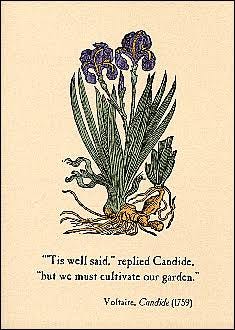
He echoes Voltaire’s Candide: we must cultivate our garden.
That is where the last book of a 96-year-old historian leaves you.
You are but a breath, even if you seem secure.
Tend your garden anyway.
Push the world an inch in the right direction.
Take the work seriously, and yourself not so much.
For anyone remotely interested in history and philosophy, whose attention span is getting cooked by social media, please I beg of you to read Fallen Leaves.
You won’t regret it.