


Hi friends,
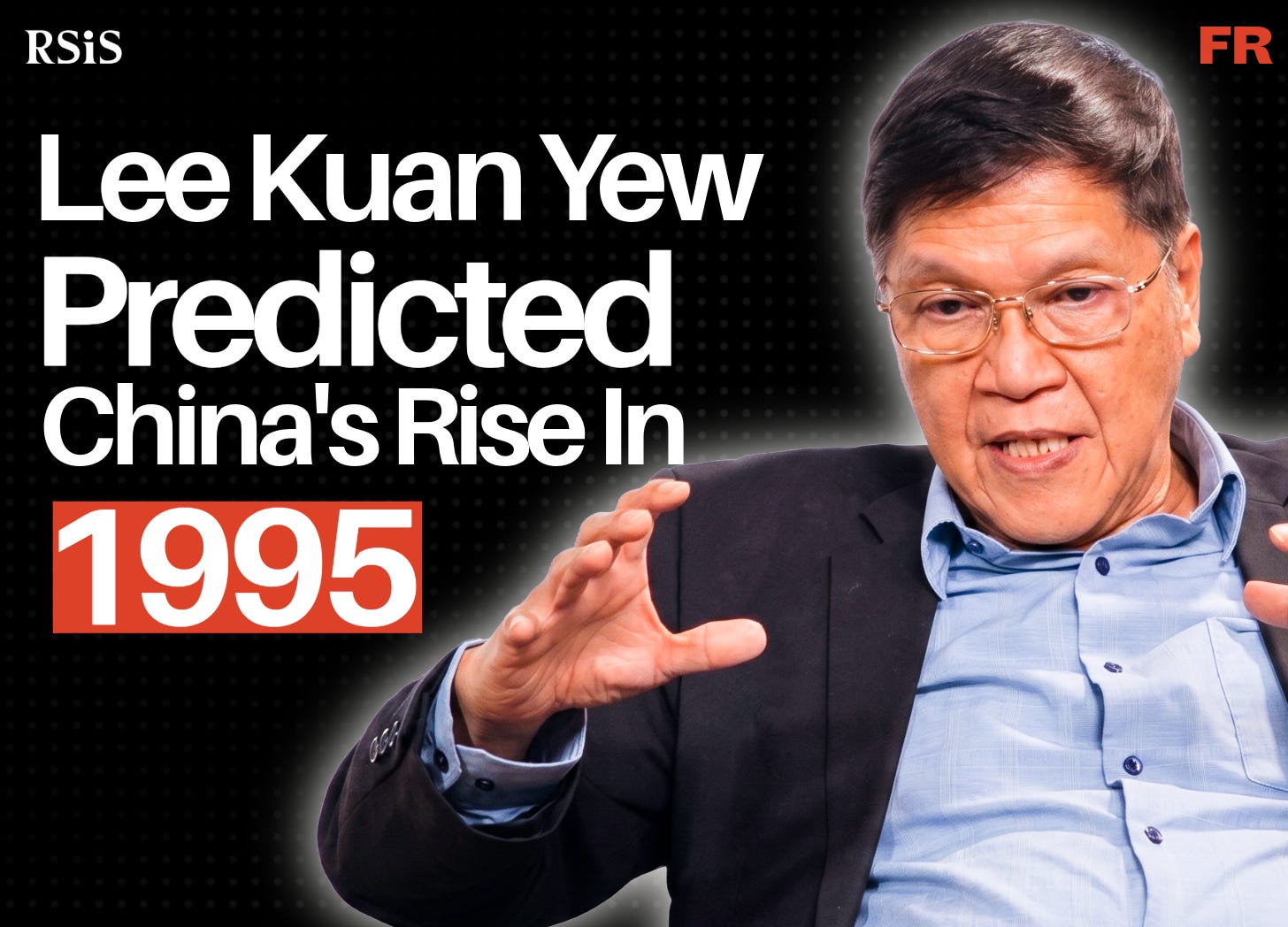
My interview with Professor Tan Kong Yam is out now.
Professor Tan is Emeritus Professor of Economics at Nanyang Technological University and NTUC Endowed Professor at the S. Rajaratnam School of International Studies.
From 1985, when Deng Xiaoping invited Dr Goh Keng Swee to advise China on its economic development strategy, Tan served as Goh's chief assistant.
Fluent in Mandarin, he sat close enough to Deng to take his own notes through the Sichuan accent, and travelled with the Singapore delegation through Beijing, Shanghai, and the coastal cities as the architecture of China's Special Economic Zones was being drawn.
He went on to serve as chief economist of the Singapore government from 1999 to 2002, as a senior economist at the World Bank's Beijing office from 2002 to 2005, and as a member of the World Bank expert group advising the State Council on China's Eleventh Five-Year Plan.
So if you want an informed understanding of China’s economic rise and Singapore’s small but pivotal role in it - this is the conversation for you
This podcast is brought to you by The S Rajaratnam School of International Studies.
You can find out more about them here.
In the meantime- if there was only one essay from Professor Tan I could recommend to you, it would be this essay on what China under Xi Jinping looks like.
If you want more grounded analysis on geopolitics, economics and security from the RSIS researchers - subscribe to their newsletter here.
Prof Tan, thank you so much for coming on. I want you to take me back to the first few days when you went with Dr Goh to China for the first time.
Tan Kong Yam 00:01:18
Thank you.
When Deng started the reform, he wanted to get someone experienced in developing a country in the market economy, as well as in industrialisation. So he invited Dr Goh, because that is someone who actually had all this experience. And they took the trip very seriously. They put our whole delegation in the Diaoyutai State Guesthouse — the villa next to the one where Nixon and Kissinger had stayed. They gave us that villa. So it was a very significant event for them, and Deng gave us a lot of faith in that sense.
When we arrived at the Great Hall, where Deng met us, Deng asked Dr Goh, “How old are you now?” Dr Goh said, “I’m 67.” Then Deng asked, “What are you doing now?” Dr Goh said, “Oh, I just retired.” Deng laughed. He said, “I’m 81, and I just started work.” So everybody was laughing at that point.
I noticed that a lot of the senior government officials — Vice Premier Gu Mu, Foreign Minister Wu Xueqian — were very respectful in front of Deng. They were taking notes, like primary school children taking notes. This gave me a very serious observation. Because the reform was so traumatic, and involved so much change, Deng’s charisma and his seniority were able to carry it through. Otherwise, there would have been a lot of resistance overall.
Their key point was that they wanted to learn from the Singapore experience: how to attract foreign investment, and how to have different rules and regulations for different parts of the country. And don’t forget one thing — the whole country was under central planning. Deng’s idea was to carve out a separate zone that would develop under different regulations. So our advice was about how to carve that out: develop a separate part of Chinese territory as a market economy, let it grow, let it expand, and then show that the experiment can actually be successful. That was the most important thing.
Later I discovered that a lot of the revolutionaries who were with Mao and Deng in the early period were very against it, because it went against their early ideology of having a revolution and building socialism. And now you are encouraging capitalists from Hong Kong to come and exploit the workers. So a lot of them cried, and a lot of them were very resistant to this policy. But to the credit of Deng, he was able to carry it through.
Later we met Zhao Ziyang in Zhongnanhai, we met Wan Li, we met Gu Mu. Those people were very keen on reform, and they were the ones who were interested in absorbing some of the lessons. It was much later that I discovered that some of the key people — Chen Yun, Yao Yilin, Wang Zhen, Li Xiannian — refused to see us, because they saw us as bringing capitalism to China. So there was a very serious tension, and it was to the credit of Deng that he was able to push against some of this resistance.
Gradually, as the fruits of success came in, more factories came into Shenzhen. People got jobs. Even though the pay was not so high, they started to have income, they sent remittances to their poor villages, and that is where more and more people were convinced that this can work.
The other point that I observed was this. The Chinese were poor, but they had a lot of nationalistic self-confidence, and cultural, civilisational confidence. For example, their Red Flag car is the official car. The quality was not good in 1985. Dr Goh was the official guest of Deng Xiaoping, so he got a Red Flag. I was the assistant carrying his bag — I got a Mercedes. Later we exchanged notes. Dr Goh asked me, “How was your car?” I said, “Mine was not so bad.” Then he told me that his car was a bit warm. But this shows the cultural confidence. They insisted that the guest of honour is given the official car, even though their technology was quite weak at that point.
And then, when we were in Zhongnanhai — when we met Zhao Ziyang — the ceiling, the carving, was very beautiful, and it reminded me of the carving in the Forbidden City. Zhongnanhai was an extension of the Forbidden City. And I found that the curtains were very thick and very heavy, symbolising the intrigue on the Chinese high political side.
During that period, we had very limited information. So I was doing some background research for Dr Goh, and I was able to find a book. It was a Japanese book, translated into English. And to my surprise, the Japanese had gone through all the newspaper clippings of all the various officials in China, and compiled a list of who had worked with whom. That was the most comprehensive information on China at that point, when no information on who was in what position was available. Dr Goh was very pleased, because that was a book that allowed us to identify some key individuals. Most of us were there for the first time.
Some of the senior people who went along were not so fluent in Chinese, so I played some role. Because I was fluent in Chinese, I was able to sit closer to Deng and take notes independently. Deng’s Sichuan accent was very strong. It was not easy to decipher what he said.
[Sponsor Message] 00:08:13
We are living through one of the most consequential periods in history. Today, there are new powers, new rules, and new risks emerging as we speak. And most of the important structural changes that will affect the world in the coming century are happening right here in our neighbourhood: Asia.
In collaboration with the S. Rajaratnam School of International Studies, we’ve brought together the region’s leading experts on strategic affairs to help you understand the structural forces at play. Together, we will extract lessons from the past and analyse the present clearly, so that we can make better decisions for the future. We hope this will help you see what this means for Singapore in the coming multipolar world.
Tan Kong Yam 00:08:55
Another observation that is quite important was Lao Zhang. Lao Zhang was a director at the Special Economic Zone Office in Beijing. The Chinese were poorly paid and very poor. They didn’t have foreign exchange at that point, so Lao Zhang was smoking local, poor-quality cigarettes. As I got to know him, I bought the foreign cigarettes — at that time it was called 555. High-quality foreign cigarettes that needed US dollars. So I passed them to him, and he was so grateful, because it was the first time he had smoked expensive foreign cigarettes. And he was able to tell me some of the detailed information about the policymakers, and so that helped us to understand, and to give better advice overall.
Don’t forget, at that point everybody was wearing blue and green, and they read the newspapers posted along the road. Nobody had money to buy their own newspaper. It was a very different China.
Keith 00:10:06
What was Dr Goh’s assessment then, when he looked at this country, this nation that was just beginning its reconstruction journey?
Tan Kong Yam 00:10:16
I think Dr Goh had studied history very well. The fact that he accepted this so early on, when China was very weak, was an indication that he understood the long historical path and the decline over that period. And he must have thought long and hard that once Deng decided to drop the iron rice bowl, central planning, and Maoist ideology, the potential of the Chinese people — its hardworking civilisation, its emphasis on education — would give it a very strong possibility of being able to master science, technology, and industrial upgrading. The potential is there. So I think he judged correctly. The country has enormous potential to utilise its labour and its emphasis on education, and eventually to build up the infrastructure.
The key thing is to open up to attract investment, technology, and education, and to be able to get the people to work hard and upgrade. And he sensed that the ingredients for dynamic economic growth exist. He was willing to accept the job. At that time, they were very poor. We didn’t ask for any payment, except the local hospitality. But he saw it as a challenge, and also as a chance to see how a country that had gone down for 100 years now restructures its incentive system and its economic policy.
Nobody — including Dr Goh, and including Deng himself — expected that the take-off would be so fast, and at such high speed, for such a long period of time.
Keith 00:12:31
When we think about Chinese political leaders today, a lot of us think of technocrats: people who are really smart, people with engineering or economics backgrounds. And there is this kind of assumption that this is a scholarly class that was there from the start. But China was coming out of a period of revolution, where a lot of the political leaders back then were of a different build. Can you speak a little more about some of the leaders that you encountered, be it in Shanghai or Guangzhou? What were they like, and what was the policy agenda, or the way they carried themselves as officials?
Tan Kong Yam 00:13:05
After we met Deng and Wan Li in Beijing, Deng sent us to Shanghai. Shanghai, as you are aware, was the industrial centre at that point. In a way, communism crushed the industrialist spirit. Some of them left, but some of them stayed on. And the one that I remember very vividly was Rong Yiren. Rong Yiren was a major, well-known capitalist, a very successful industrialist before the revolution took over China. He was rehabilitated by Deng, and he hosted dinner for us. Around the table were all these [bushy-bearded], very powerful older industrialists, who were the great businessmen in Shanghai before the revolution took over. They were the big guys when Li Ka-shing was a nobody.
When the dessert came, it was half-rotten bananas. They all scrambled to get the half-rotten banana. I was shocked. It shows that the Maoist revolution, and the discrimination against major industrialists, had broken their spirit, and they became no longer forceful individuals. Deng, to his credit, was able to rehabilitate some of these people, and eventually some of them — not they themselves, but their children and grandchildren — became the key people who eventually drive China’s development today. They themselves missed out.
And I have a good sense of this, because when I recall the trip in Shanghai — I look like a local, and I speak the regular Mandarin — after Rong Yiren hosted the dinner, I was able to run away on my own, going around the whole Shanghai old city. It was a very drab city. Some of the people and houses were so poor that you could look into the place and see old people sleeping on the bed.
But one thing that was very, very significant to me was this. I met some Anhui labourers. They were working on a road at night. And the most important incident I observed in Shanghai was a boy. I walked around and I saw a boy studying English under the street light. The house was cramped, the lighting was poor, and I was impressed, because I went to talk to him. He was studying English. That to me was very significant, because this shows that there is an underlying urge to improve, in emphasising education, in absorbing Western technology and language.
I remember at that point, I reflected back. As an economist: how do you create dynamic growth? Firstly, you need a top leader who is determined to push the nation forward. And that was effectively what I saw when we met Deng in Beijing. Then you need the ingredients for dynamic economic growth: hardworking people who build infrastructure, like those Anhui labourers building the road at night. And then you need people who emphasise education, absorbing foreign technology, and learning English as a major ingredient in dynamic economic growth.
So at that point, it suddenly struck me, as an economist, that some of the necessary ingredients were there. It is just like trying to make a cake. You’ve got flour, you’ve got eggs, you’ve got sugar. You just need it to be built up properly. And the most important thing was incentive. Mao destroyed incentive, because he had the iron rice bowl.
During that period, I think a lot of early foreign visitors laughed, because when they went to China and went to a shop and asked the salesgirl to bring down the souvenirs or other things, the salesgirl would say — they didn’t want to bother to do all this, because they had an iron rice bowl. There was a joke that the only two words in Chinese that early Westerners who went to China learned was [méiyǒu — “we don’t have it”]. What was needed was to effectively incentivise people to work hard. And that was, in some way, a turning point.
And I think we from Singapore gave him some confidence. Because, as you might be aware, Deng visited Singapore before he started the reform. In November 1978, Deng’s reform publication from the Third Plenum came out. Three months before that, he visited Singapore, and he was brought around by the then minister. And Deng went to visit Jurong. He asked, “What is Singapore’s oil refinery capacity?” When he heard it, he was shocked. It was three times larger than China’s.
Then he asked to visit some of the ordinary people’s houses. They brought him to a three-room HDB flat. He was surprised that the place was quite big compared with the homes of senior Chinese government officials then. And then he went to the kitchen. He was curious. He saw a refrigerator. He said, “Can I open it?” They said, “Okay, open.” They found vegetables, they found meat, they found Coca-Cola, and they found fruit. He was surprised.
So before he left, he met Lee Kuan Yew and Goh Keng Swee in the Cabinet room, and he asked, “How do you manage to achieve this?” Lee Kuan Yew said, “It’s very simple. We don’t have an iron rice bowl. You work more, you get more. You work less, you get less. You don’t work — that is your problem.” That was an inspiration to him.
Years later, when I was teaching some students in China, they told me that that trip had such a major impact on Deng Xiaoping that he redrafted the Third Plenum document that promulgated Deng’s reform in November 1978. He redrafted a few sections of it after the trip to Singapore. And that document — November 1978 — laid the foundations for China’s reform. So in that sense, Singapore’s experience was relevant and impactful.
Keith 00:20:36
As a young Singaporean, you don’t really appreciate how some of these path dependencies played out. Just listening to you recount that iconic visit in 1978, it inspires a lot of confidence — that even as a small country, we can make big differences. What kind of advice did he give to the Chinese leaders? He saw the huge potential, he saw that there were the ingredients, as you’ve put it. But tactically, what did he suggest to them that a big country could do that a small country could never endeavour?
Tan Kong Yam 00:21:08
After the first trip, we submitted internal reports. Subsequently, there was advice and discussion, including notes to Gu Mu, and everything.
I think the key thing is this. The fact that Singapore, with a group of relatively less educated migrants, was able to develop the place, industrialise, and gradually upgrade — and some of these were ethnic Chinese migrants from poor provinces — gave them some confidence and inspiration.
I remember Gu Mu visited Singapore later. He was the main person in charge of the Special Economic Zones. Dr Goh and I went with him. He went around Kreta Ayer. Kreta Ayer was a very poor constituency earlier. So in some way, I suspect it came to his mind that these poor Chinese migrants can make it. China, with a lot more resources, a bigger market, and more well-educated people — or intellectuals who could become potentially more educated — should be able to do quite well too, as long as their incentive system is right.
So they gradually discovered that the Maoist ideology — rigid communism, rigid central planning, without flexibility for the market or the private sector — was like a strong rope that tied the hands and legs of this potential basketball player. And once they released that rope, the basketball player started to play and improve. But nobody expected that he would turn out to be Yao Ming.
Keith 00:23:16
Talk to me a little more about the Special Economic Zones — the formation and development of them. They were seen as very crucial in the opening of China’s market reforms. What role did we play in it?
Tan Kong Yam 00:23:28
I think Deng was a smart person. He realised that the whole of China was under central planning and he couldn’t change the structure. So he needed to carve out a small area that could do the experiment. So he identified these four areas. Shenzhen, basically attracting Hong Kong capital. Zhuhai, attracting Macau capital. Xiamen, attracting Taiwan capital. And the Shantou area, attracting overseas Chinese — the qiao — who were in Thailand, Malaysia, and Singapore.
That, I think, was the right strategy. Because when we were in China, we discovered that the roads were bad, the regulations were weak, the infrastructure was poor, and the electricity supply was unreliable. There was no joint venture regulation. No US, European, Japanese, or Korean companies wanted to invest. So if you look at the FDI inflow into China from 1979 up to almost 1991 or 1992, the bulk of investment was very low, and it was all from overseas Chinese.
Overseas Chinese were less sensitive to political risks, less worried about weak regulations and everything. And a lot of them were running small businesses, labour-intensive factories. So they relocated to China. And that first maybe eight to ten years allowed China to gain capital, to gain FDI, to have factory jobs. And all this started to have some impact on the economy. And then, later, they entered the WTO. And that’s where the Western — US, European, Japanese — capital and money started to come in.
So the overseas Chinese played a very, very important role in the early days, in giving it the initial push. This is like China. China is a car that has a flat battery. It cannot move. The overseas Chinese give it the first push. Then the thing starts rolling. And that came later.
So Deng was smart in identifying this first push, and that’s the reason why, if you look carefully, he drew a circle in Shenzhen. Initially, it’s quite small. Then he gained more confidence, more capital coming, and he expanded the Shenzhen Special Economic Zone bigger and bigger.
And then, as the Special Economic Zone prospered and developed — initially, if you went to China during these early days, the officials in Shanghai looked down on all this. But over time, as Shenzhen started to develop, more investment came in, and they became more prosperous, the Shanghai officials had to eat humble pie and go down to Shenzhen to learn from them. And that’s where it spread to become Pudong. After Shenzhen, the Special Economic Zone was successful, they opened up 14 coastal cities, and then the whole coastal region became like a special economic zone. And then eventually the growth spread inland, to central and western China. And that’s how the Chinese economy took off in the last 40 years.
Keith 00:27:24
I would like to talk a little about Fuzhou, which is a relatively important part of China’s political history. And Singapore’s role, through Dr Goh, was quite crucial in helping Fuzhou develop. Help me understand a bit of what actually happened behind the scenes.
Tan Kong Yam 00:27:43
Taiwan and China issues were very tense during that period. You remember, even in the early period, when Lee Teng-hui went to visit the US, there was a lot of tension between Taiwan and Fujian. And Fuzhou was on the front line, because Fuzhou was across the Taiwan Strait. And nobody wanted to invest in Fuzhou, because the political risk was too high.
So there was a young man, mid-40s, who was the mayor of Fuzhou. He had a lot of problems getting investment and improving his position in the party, because a mayor’s job in China is to develop the city, and that means he has to attract investment, create jobs, and generate tax revenue.
When Dr Goh visited Fuzhou, this young man came all the way to the hotel to brief Dr Goh. He was very humble. And eventually Dr Goh and some officials in Singapore were able to identify Liem Sioe Liong, Mochtar Riady, and Sam Goi, who were willing to invest in Fuzhou. Why? Because it was their hometown. Even though the risk was very high, these people were willing to invest in Fuzhou. And Fuzhou started to have some investment, and eventually the mayor got some credit for the development.
So years and years later, in 2012, Xi Jinping was Vice-President and on his way to becoming one of the senior leaders. He visited Singapore. He had a long discussion with Lee Kuan Yew on development strategy, and he was supposed to leave for South Africa on an official visit the next morning. But he insisted, late at night, on visiting and paying his respects to Liem Sioe Liong. Liem Sioe Liong was the man who helped to lead the investment in Fuzhou.
But a lot of the officials discouraged him from doing that, because it was the middle of the night, and the next morning he had to go to South Africa on a long trip. And Liem Sioe Liong was really a bit senile. He couldn’t recognise people at that age. He was very weak and senile. He couldn’t recognise people. But Xi Jinping insisted on paying his respects, on thanking him. So I think he is a bit of a traditional person, who remembers old friends.
Keith 00:30:40
Just given your understanding of the small role that we played in China’s economic history — how does one try to understand Xi Jinping’s view of the world?
Tan Kong Yam 00:30:50
I think, to understand China today, and especially Xi Jinping, you need to look at the background of the Politburo Standing Committee. At the moment, the top seven of them in the Politburo Standing Committee — the most important people in China today, the ones who run the country — you notice that five of them were born in the 1950s, and their formative period was the Cultural Revolution. Xi Jinping, Zhao Leji, Cai Qi, Wang Huning, and Li Xi.
Xi Jinping tells people internally that he suffered a lot during the Cultural Revolution, but he was proud of the fact that he survived. And one of the things that he felt very proud of was 十里山路不换肩 — he told people that means: I’m able to carry a weight of 50 kilos and walk for ten miles in terms of distance, and never need to shift it to another shoulder. A kind of ability to withstand hardship.
And this explains the policy. You notice Chinese policy: delay gratification. They focus on production. They focus on building up industrial capacity. They do not want to spend too much resources on high consumption. They always worry about problems, prepare for contingencies, emphasise food security, energy security, oil storage, uncertainty — a little bit like the early generation of leaders in Singapore, like Lee Kuan Yew and Dr Goh.
So this, in a way, is a generation that has a certain experience, and it is reflected in some of the existing policy. And this explains also why the consumption-focused policy is there, but not as strong as the production-focused policy on expanding EVs, semiconductors, and others. They explicitly rejected giving vouchers to the people to stimulate the economy.
Let me venture to predict the future. The present Politburo Standing Committee people, including Xi Jinping, were born in the 50s. In another ten to fifteen years, the new leaders will be people who were born in the 60s and 70s. Those who were born in the 60s and 70s — as they gradually take over, their formative period is not the harsh Cultural Revolution period, but a gradual period where China started to grow to become a stronger economy. And their worldview, I would predict, will be different.
The harsher authoritarianism, in the next ten or fifteen years, will become a softer authoritarianism. It will still be authoritarianism, but the Chinese leaders will become softer in terms of social policy, in terms of support for consumption and people’s welfare. They will be softer, and they will be more confident on external relations, because they will have grown up in a period when China was stronger rather than weak, and they will not remember the century of humiliation too much. They will be less paranoid about external threats, more relaxed, and more confident about China’s relative power. And I think there will be policy that focuses more on consumer welfare, subsidy, and support for consumption, rather than purely driving resources towards production.
Let’s see whether I turn out to be correct or not.
Keith 00:35:17
As you look to the future, I think it might be interesting to revisit a moment in history. In 1989, the Tiananmen incident happened. And that was a moment of reckoning, I think, for a lot of people — Chinese political elites, but even at the grassroots level, Chinese citizens. One of the big questions that was being grappled with then was: what is the best system going forward? Similar to what you’ve pointed out — the soft authoritarianism versus hard authoritarianism in the coming years. What should that new system be? In the past, it was a question of capitalism versus communism. That was one of the central debates in 1989. What were the kind of conclusions they took away after that moment of soul-searching in 1989?
Tan Kong Yam 00:36:03
Yes, I think that was a critical turning point. 1989 was a very significant shock to the system, because Deng’s reform was moving along, but there was inflation, there were all kinds of unhappiness. And so this anger and unhappiness — particularly inflation, and some of the increasing instances of corruption — created anger among the population, and of course the student movement was a combination of that.
So eventually we all know that Deng stood on a harsher policy measure, as opposed to Zhao Ziyang, who preferred a more conciliatory position towards the students. Deng prevailed, because he controlled the military, and that’s why there was the suppression then.
Reform went backwards. Zhou Xiaochuan told me that the reformists like him were very dejected, because the world thought that China had closed the window again. Foreign investment pulled out. There was a lot of thinking that maybe China would go backwards. And from 1989 to 1991, that was the case. Chinese policy became less reformist.
Interestingly, Singapore was one of the few countries that continued to engage China and never isolated China during that critical period, when the West condemned China and a lot of investment pulled out.
And then, in 1991, two years after Tiananmen, when China was still being condemned, Deng sent his favourite daughter, Deng Rong, to Singapore. The idea was to learn from Singapore how the CPF institution was able to create a pool of savings to help Singaporeans buy public housing.
So I told her this story, which is a genuine story mentioned by Lee Kuan Yew. One day Lee Kuan Yew was driving in a car along a street. He saw people burning tyres, throwing stones, and everything, because the unemployment rate was 25%, and there were a lot of angry people. Then he suddenly saw someone on the fourth floor of an apartment rushing down to take up his battered old motorcycle and bring it up. He suddenly had an inspiration.
He said: this guy owns a small property. A small, battered old motorcycle. He was afraid of the riot, because the riot might destroy his property. Then he said: suppose I give every Singaporean a small HDB flat. That means everybody has a property. Everybody is worried about the riot, because the riot will destroy his property. If everybody is afraid of the riot, there will be no riot, and there will be stability, and then foreign investment will come, wages will go up, and then I use the wages to force them to do some saving, and use the money to build the HDB flat, and everybody has a stake in the stability of the system.
And that’s how Dr Goh and Lee Kuan Yew came up with this idea of the CPF for saving, channelled to the HDB to build the apartments and then sell them to them.
So I told this story to Deng’s daughter, and I said: you go back and tell your father. There is no point quarrelling about capitalism, socialism. The reason why Singapore is stable and able to develop was that we convert everybody from a proletariat to an asset-owning class, and all of them have a stake in the stability of the country. There is no point quarrelling about socialism, capitalism, all kinds of ideology. The most important thing is to try to develop the country and ensure that every individual and household has an asset, which is a small apartment.
She took down the notes. I don’t know how much that might have affected things. But in 1992, in the Nanxun, Deng went down south. Eventually, his slogan was: don’t talk about capitalism and socialism — develop the economy. And that was a turning point after the Tiananmen riot. And China eventually moved on beyond the 1989 tragedy, and the development became unstoppable.
Whether our Singapore experience of Lee Kuan Yew and the HDB made any difference, I don’t know, because I don’t know what she told her father. But at the end of the day, that saved China. Because had the 1989 Tiananmen reversed China’s reform, it would have gone backwards. Because 1992 gave the reform a further push, the momentum of reform was unstoppable. And even after he died in 1997, the train had left the station. And that’s why we have China today.
Keith 00:42:14
Before we even get to China today: in 1991, you were in a room with Lee Kuan Yew. He made this famous prediction that China was going to be a peer competitor to the US. And at that point, China’s GDP was only $384 billion, which was about 6.2% of the US GDP of close to $6 trillion. As a matter of percentage, China’s economy was still very small.
When LKY was making that statement, was it obvious to someone like you, who was there at the start? Or did you feel that it was a bit of a stretch?
Tan Kong Yam 00:42:50
In 1995 — 30 years ago — the Pakistan Prime Minister, then Nawaz Sharif, invited Lee Kuan Yew to advise Pakistan on some development strategy. So I was one of the small group of people who went with him. He gave a public speech and, not surprisingly, there were a lot of questions about China and Deng’s reform.
But later, in maybe a five-person discussion — an internal, closed-door prediction — he said that one day China would be a serious competitor to the US, and that the US–China dynamic, which was very cordial, would become more conflictual, with greater tension. We were all surprised. Don’t forget, this is 1995, when China was making shoes, textiles, and cotton underwear. They couldn’t even make silk underwear at that point. And here is this man predicting — when the relationship was very cordial — that the two countries would be in serious tension.
So we asked him why. He gave two reasons.
He said, firstly, China is a big country with a lot of talent. When the revolution came, and over time, a lot of the talent did not leave. The historically capable people in North China and Central China did not migrate to the US or Southeast Asia. So these talents and capable people, he predicted, would eventually absorb Western technology, improve their engineering skills, and borrow technical knowledge. And this group of smart people is big in China in volume, and over time they will become more capable. The next generation will do a master’s or PhD in engineering or technical subjects, sometimes overseas, sometimes domestically. And eventually this group of capable people, after absorbing foreign knowledge and technology, would be able to produce better and better high-end products. Not just shoes and textiles: they will move, like Japan, to cars and others, and eventually go to very high-end technical expertise and scientific progress. And that would start to threaten the US.
It’s like climbing a ladder. They have many more capable people who can climb up the ladder, and as they climb further and further up the ladder, they will start to hit on the US and European talent, and they will compete with them, and at that point the US will get worried. So in his own way, he predicted that somebody like Liang Wenfeng of DeepSeek would appear in China.
The second reason he gave was this. He said: market. Why is the US such a major competitive force? Because it’s a continental economy. That’s why the US was able to nurture Ford, Chrysler, and General Motors. He said China is poor, but eventually the income will gradually rise. There will be more domestic demand. The market will become bigger and bigger. So, like a big, big pond, it will start to nurture big fish.
And he predicted that the domestic market in China will become bigger and bigger as income increases. And because a big continental economy and a big market naturally have internal competition — you have Ford, Chrysler, and they will compete against each other — he said there will be big companies in China domestically that will compete ferociously against each other in new products. And this Darwinian process of competition will result in tiger eating tiger. And some of the tigers will become very ferocious tigers, who eat up the others and strengthen themselves. And eventually they will come out to the international market. And this ferocious tiger, after surviving the Darwinian competition within the domestic Chinese economy, will be very ferocious. And they will start taking over markets globally.
In summary, he was talking about BYD.
By giving these two examples and projecting into the future, he actually foresaw the tension 30 years later. He had a remarkable insight into this. Even though he is no longer around today, what he predicted is happening now. So now that I recall what he has done, it’s quite an impressive assessment. It shows his deep insight and his ability to predict based on a certain assessment of the trend.
Keith 00:48:57
[Ad Break] If you want the show notes from today’s episode, just head over to ykeith.com/rsis, and you have full and free access to it.
I spoke to Professor Kishore Mahbubani, and one of the things that he consistently shares is that the founding generation of leaders were extremely great statesmen — that they were able to understand geopolitics at the very fundamental level. What do you think that generation of Singaporean leaders, be it Dr Goh or Mr Lee, understood about China that was fundamentally different, and right, where the Western world did not understand?
Tan Kong Yam 00:49:44
I think they got a deeper understanding of the history. If you look back at Chinese history, one of the things that they fear most was chaos — luan. Because it’s a big country, and there have been periods of chaos and instability. And so Chinese leaders have internalised this understanding of their history, and discovered that the most important thing is peace and stability, rather than falling into a state of chaos and an inability to develop.
So they focus — you notice — their priority is stability and development. They are not so interested in all this ideology of liberalism, individualism, and others. Their focus is to make sure that the country is stable and that they have resources to develop the place. History has taught them that stability under an authoritarian system actually is preferable to chaotic checks and balances, individualism, or liberalism as a form of political and economic organisation.
So there is this consensus, and I think Mr Lee and Dr Goh understood that history and that mindset. They felt that an authoritarian, unifying communist party that focuses on development — rather than a multi-party democratic checking system, or liberalism — that China could better develop the economy through a more centralised authoritarian party, as long as the party doesn’t strangle some of the private sector dynamism, as well as focusing on allowing individuals to flourish.
So their system is that everybody should recognise that the party and the central government is supreme. The private sector can develop and flourish, with big incentives, but nobody should think themselves bigger than the party and the emperor, and take over the emperor.
And that was the lesson that Jack Ma learned. This is a lesson that all the business people have learned. I have a lot of students who are businessmen and who did very well. And I think that is a clear understanding: you do your development, you contribute to jobs, you contribute to foreign exchange, you contribute to export, but you should never think that you can take over the leadership of the country or the party.
So at the moment, you can see that the country flourished because of the early generation of very poor people. I have 1,500 students who are senior government officials at different levels, and they are the ones running the country, doing all the planning. But I have another 5,000 former EMBA students from the private sector. And quite a few of them are multimillionaires in Shenzhen. They are usually in their 40s and early 50s. They told me that when they were little kids, they walked to school. Some of them had only one meal a day. One of them told me he took off his shoes when he walked to school, and put them on only when he arrived at the school, so that the shoes could last longer.
These are the people that built China. And they are still around today, in their 40s and 50s. This is the reason why I think China is still quite production-oriented. These are the people who drive China.
In 20 years’ time, as the Xi Jinping generation passes from the scene, and some of these students of mine pass from the scene, their children, or younger people, might create a China that — as I said — is softer in its authoritarianism, a bit more relaxed, a bit more focused on consumption and private welfare. A softer China might emerge. The Communist Party will still be there, but the policy would be less harsh, and China would be softer, and probably less insecure.
Keith 00:55:19
From your sharing just now, the common thread seems to be that China wants to go its own way. The way it sees itself vis-à-vis the West is that you can absorb technology, you can learn, you can even leverage access to Western capital to build up your technology and your own economy, but you will choose to go your own way and embark on your own cultural, civilisational renaissance. And the Singaporean leaders understood that at a very core level — that you have to learn how to manage China rather than change China.
The follow-on question I had was more of policy. How did that insight translate into the way the Singapore government, during your time or even now, manages its relationship with China?
Tan Kong Yam 00:56:15
I would say that globally, Modi is in some way following the same way: we have a great civilisation in India, we will carve out our own path. And that is a message that China’s development has gradually sent to some of the Global South.
I think in dealing with China, the Singapore leaders have some special insight, partly because they studied Chinese history, and partly because they had a closer network with the Chinese leaders. So we have some advantage in terms of understanding their mindset, especially in the early days, where they needed us to understand the West.
So that is the way things have worked out. But further down the road, we should have no illusion about the new dynamics. I have 1,500 students who studied under me in the mayor programme. But you can see the dynamic changing. In the early days, Singapore was a model. They came and studied how the airport is managed, how the industrial estate is managed. But now their airports are bigger, their technology is stronger. And once in a while, my students will tell me, “You know, teacher, we learned a lot from Singapore. But now I’m a mayor of a third-tier city — I’m running 5.5 million people.” He’s hinting that his city is bigger than the whole of Singapore.
So I have become a lot more humble when I deal with the Chinese officials. And I think ASEAN and Singapore eventually are learning that. But we have a certain unique insight that is probably still very useful.
In fact, there is something that I have noticed over the last few years. There’s a danger that China becomes overly confident. They become a bit cocky, because they are so successful. “Hey, our EVs are taking over the whole world.” Some of my students are multimillionaires. They have tech companies that are very big in Shenzhen. And then some of them are pharmaceutical companies that are very strong globally. There is a danger that China overshoots, becomes too confident, too cocky, and it might alienate a lot of other Asian countries and eventually create some tensions, which I think they need to be careful about. There’s a danger of overshooting.
So in some way, Singapore could play a role by advising them to be more moderate, so that they do not overestimate themselves. Don’t forget that the US is still very strong. The military is very strong, the US dollar is still very strong, the technology is still very high-end. And in terms of major innovation, despite what Trump has done, the US is still able to capture a large part of the global talent.
And I think there is a danger that China overshoots because of their recent success. You can begin to see that sometimes their companies have insufficient focus on the interests of the ASEAN countries. For example, a lot of the textile and garment over-expansion and export has created a lot of disruption in Indonesia, causing factories to close down, and unemployment. And that is something that I think the government should probably pay some attention to — to make sure that their dumping does not actually create hardship for some of the poorer people within ASEAN. So these are some of the things that they might need to be more conscious of.
Keith 01:01:02
There’s this idea of involution, right? Where, to a certain extent, the way you escape involution within China is to go out into the global markets, especially Southeast Asia, for example, where you have a greater consumer preference for value and lower costs. One of the unintended effects is that you create a lot of local negative externalities, and a lot of them lose their jobs, like what you’ve pointed out. In navigating that reality, where does Singapore fit in? Do we face the same challenges, or the same threats, that some of our Southeast Asian neighbours do, even though we’re quite different in our economic development stage?
Tan Kong Yam 01:01:39
[Recording gap — answer begins mid-sentence] … having a negative effect on some of the local textile and garment factories. Overall, at the moment, China and the US, China and ASEAN, are still relatively more complementary.
I remember in the early days, when China was industrialising, in the 90s and 2000s, there was very, very serious pressure on ASEAN, because ASEAN was starting to develop shoes, textiles, and garment factories in Indonesia and Malaysia, and consumer electronics and others in Thailand. And then China came up with all these labour-intensive exports that are very competitive and cost-effective, and took over some of the market share in the US.
So that was a period where you would visit Indonesia, visit Malaysia, visit Thailand, and there’s a fear of China, because everybody is climbing up the ladder of industrialisation. The US and Japan are on top. ASEAN is at the early, middle level: shoes, garments, consumer electronics, and all this. And China is moving up very rapidly in the same type of product. So when you climb up the ladder, the ASEAN countries individually are not so big, so they take over some of the things that Japan and Korea didn’t want to do. But China is such a big panda bear that when it came into climbing the ladder, it squeezed out the others.
And for a while, the ASEAN countries — I look at Indonesian data — actually de-industrialised. They didn’t do as much manufacturing. They moved into coffee, palm oil, and commodities.
So fortunately, now China is increasingly going to the middle and upper level. So ASEAN and China now are much more complementary, even though there’s some competitiveness. Chinese factories relocate here, and they increasingly see ASEAN as a major market.
And this is the reason why there is something that is very significant if we look at the Chinese deployment of their capital. In the past, they generated a lot of US dollars, and they put them in US Treasury bills and bonds. Now they are moving into investing in fixed assets in ASEAN. Instead of buying US Treasury bills and bonds, they invest in ports in Indonesia. They build highways in Malaysia. They put money into infrastructure in Thailand. And so they spread out their risks.
And their hope is that they help ASEAN to improve their infrastructure. You get better roads in Indonesia, better ports in Indonesia. Then some of the factories relocate here. And over time, Indonesia will develop. There will be more middle class, lower-upper middle class coming up. And they can become a market. And they hope that as the US and Europe get protectionist, the ASEAN market, which is 600 to 700 million, will become a potential source of demand. Their exports will be able to be sustained, and then their capital in some way will be less susceptible to potential tension with the US.
And so they see this whole zone as integrated in some way, and ASEAN will provide an important locomotive effect for China, and China will also provide a way where their industry can help ASEAN to develop. And so this is a period where I think they will increasingly see ASEAN as a complementary zone of development. And of course different ASEAN countries take different positions, but the overall likely complementary mentality is likely to increasingly improve overall.
So I foresee a situation where the negative side of the ASEAN–China relationship would continue to be there, but the dynamic is toward greater complementarity and co-development in some way. As long as the Chinese government makes sure that some of their — you see, the Chinese private sector are different from the government. Sometimes they do all kinds of funny things that could undermine ASEAN.
Keith 01:07:07
So as long as the Chinese government is able to kind of regulate all of that.
Tan Kong Yam 01:07:10
Yes. If they go too far, I think the Chinese government will probably come in, because it has foreign policy consequences.
Keith 01:07:18
There’s so much to talk about, but I want to wrap up with this last question for this conversation. The last question I have for you is that if you look at China and Southeast Asia, there seems to be, as you’ve pointed out, a convergence, or a push towards greater complementarity and integration. Where does Singapore fit in in this new model? In the past, we have primarily engaged China at an economic level, through being a capital allocator, as a foreign direct investor. Will that role change? How will that role evolve as we go forward?
Tan Kong Yam 01:07:51
I was chief economist before. We have gone through quite some metamorphosis and transformed ourselves, and Singapore is quite a flexible place.
I would foresee that in the next ten or fifteen years — as long as US–China tension doesn’t explode, that’s an important precondition; as long as US–China tension remains contained and doesn’t explode into a serious conflict — then we are in good business.
And that’s the reason why I focus so much of my attention on the recent visit of Trump to Beijing. The recent Trump–Xi summit is an indication that they will actually continue to compete, but they will make sure that it doesn’t explode out of bounds. One way of saying it is that the two big countries will always compete. But as long as they compete without being explosive — like a kettle, the water in a kettle; as long as the kettle doesn’t explode — the relationship will always have tensions and competition, but they do not go out of bounds. Then I think ASEAN is in good business, and Singapore is in good business.
Because Singapore has carved out a niche as a regional hub for ASEAN. You see a lot of logistics go through here: airport, seaport, transport, financing of capital, One Belt One Road projects, clean energy development. And even in legal disputes, we are a trusted centre. And of course, the financial logistics, and project financing. And Singapore played its important role.
Through this role, we help Indonesia to create jobs. We help Malaysia to improve its infrastructure. We help Thailand to develop. They are our hinterland. If our hinterland is prosperous, Indonesian young people get jobs. They are not likely to become radicalised. If Thailand and Malaysia are more stable, they will become better neighbours. And we play this role: it helps us, it helps them.
As I said, the most important thing is that US–China tension doesn’t create a point where ASEAN is forced to make a hard choice and it becomes very conflictual. As long as that overarching framework has competition but doesn’t explode into an uncontrollable situation — then I think we would be able, under this broader, less conflictual geopolitical environment, to carve a niche that helps our neighbours, and our neighbours help us, and then link with China here, and then a lot of US investment also comes in. And that will allow us to play a very important role that is mutually beneficial, and we can continue to prosper, because we have built up such a reputation in finance, in clean energy financing, in project financing, in confidence, in legal disputes, and others.
So in some way, that would be a role that Singapore continues to play, but at a higher level. And China, the US, and ASEAN will see Singapore playing this role as very constructive. And if all these three groups — China, the US, and the rest of ASEAN — see Singapore playing a constructive role, our economic and geopolitical survival is well.
Keith 01:12:23
With that, Prof Tan, thank you so much for coming on.
Tan Kong Yam 01:12:25
Thank you so much for your excellent questions.
Keith 01:12:30
Thank you for listening to today’s episode. If you are watching this on YouTube, please consider subscribing and turning on notifications for whenever new episodes are out. If you’re on Spotify or Apple, it would help us greatly if you could leave a five-star review on those platforms. Once again, thank you for tuning in to The Front Row Podcast.