


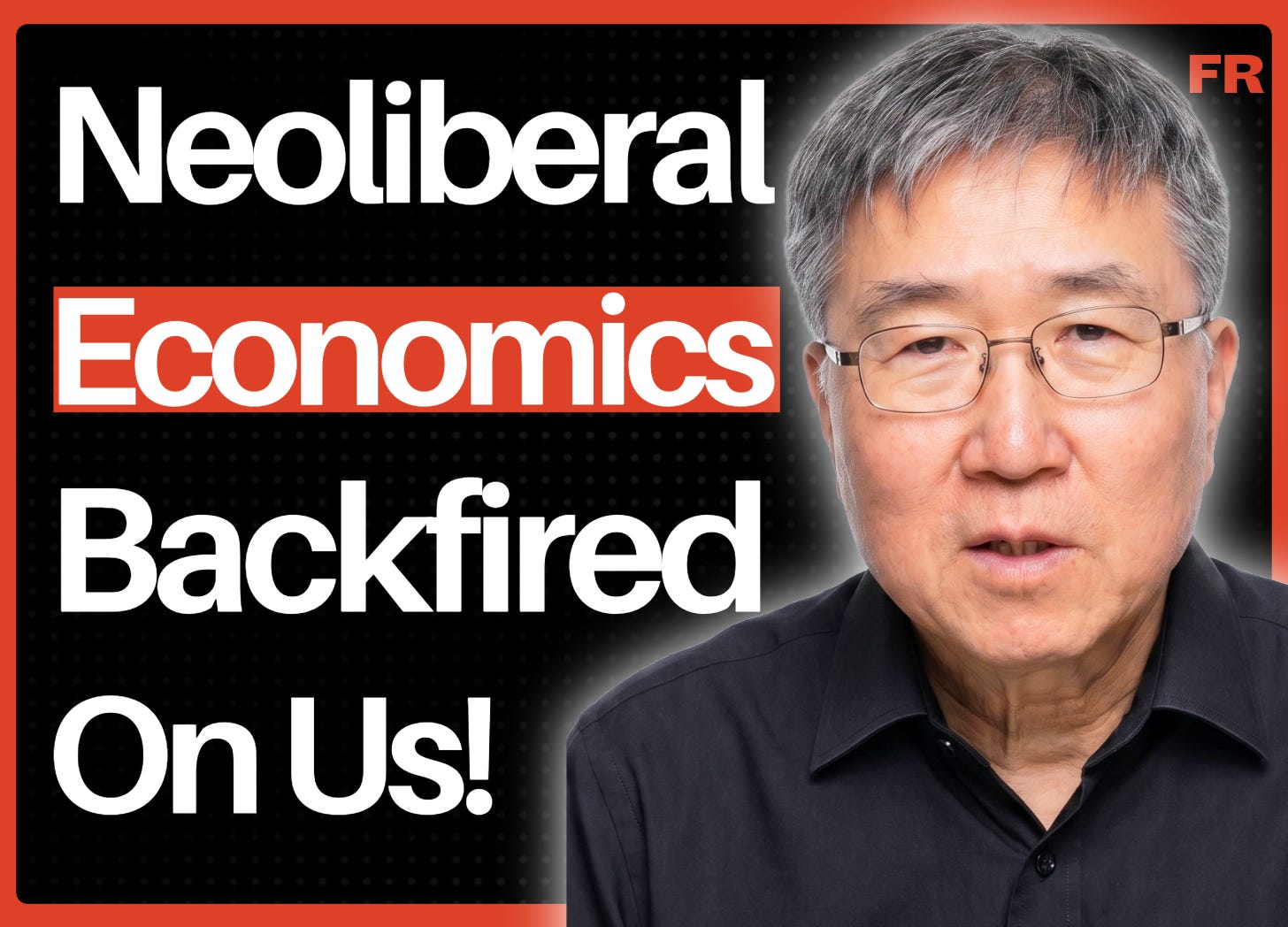
Ha-Joon Chang is a South Korean economist and one of the most widely read critics of neoliberal orthodoxy working today.
He is currently a professor of economics at the School of Oriental and African Studies (SOAS).
He is best known for his book 23 Things They Don't Tell You About Capitalism, published in 2010, which challenged the foundational claims of free-market economics with rigorous historical and empirical argument.
His earlier work, Kicking Away the Ladder, demonstrated how today's rich countries used protectionism and industrial policy to develop — before turning around and telling developing nations to liberalise.
Chang's research spans developmental economics, the history of economic thought, and the political economy of globalisation.
He has been a vocal proponent of what he calls "non-mainstream" economics: not a single doctrinal school, but a pluralist approach that draws on institutional, Keynesian, and developmentalist traditions to analyse how economies actually grow and change.
In this conversation, Chang offers a sweeping critique of neoliberalism's track record on growth and inequality, a dispassionate assessment of Donald Trump's industrial policy ambitions, and a pointed analysis of the AI boom as a speculative bubble shaped by concentrated wealth rather than genuine demand.
TIMESTAMPS:
0:00 Trailer
1:08 Introduction
1:54 Growing Up in South Korea's Economic Miracle
4:36 Why Ha-Joon Chang Is Not "Heterodox"
4:58 The Gwangju Massacre and the Limits of Neoclassical Economics
10:45 How the Neoliberal Turn Happened
18:32 The Real Cost of the Free-Market Experiment
25:20 Why Singapore Works
29:58 Trump's Industrial Policy: Will It Work?
37:50 The Three Elements of Good Industrial Policy
40:54 The Right Lessons From China
44:44 How Bad Is Inequality in the US?
53:18 The AI Bubble
58:36 AI as Public Infrastructure
1:00:48 How to Build a More Just World
1:06:14 Closing
This is the 86th episode Of The Front Row Podcast
See below for the full transcript :
Keith 00:01:08
Today I have the privilege of speaking with Professor Ha-Joon Chang. He is best known for his work on developmental economics and his critique of neoliberal economics. I read his book, 23 Things They Don’t Tell You About Capitalism, and I’m surprised that a book written in 2010 still holds so much weight in 2026.
To thank you all for your support, I’ve decided to gift a copy of this book to a lucky subscriber. All you have to do is sign up for my newsletter at ykeith.com, and I’ll notify the winner through the newsletter.
With that, I hope you enjoy my conversation with Professor Ha-Joon Chang.
Before we start, I’d like for you to share with us what got you interested in the world of economics.
Ha-Joon Chang 00:01:54
I was born in 1963 and grew up — I don’t remember much before the age of six or seven — basically in the 1970s, when South Korea was growing at ten, twelve percent per year. New industries were springing up, people were moving into modern apartments. It was a time of great achievement, but also of huge social upheaval.
As usually happens in developing countries at the early stage of economic development, you had people moving from the countryside into the cities, illegal settlements growing, and developers hiring thugs to beat up residents with police complicity. It was a very harsh time, even as living standards were rising.
At the time, most Korean industries were in labour-intensive sectors working on paper-thin margins. Some factories would refuse to have a canteen so they wouldn’t have to give workers an extra toilet break.
It was a period of enormous economic and social change, and I just wanted to understand it. When you’re fourteen or fifteen, you don’t know how to do that. My father was working at the Ministry of Finance at the time — he didn’t push me in any direction — but he said, “Have you heard of something called economics? This might be useful in helping you understand what’s going on.”
So I went to university and realised this was what I wanted to study: to understand how my country had evolved, why some other countries were not doing as well, and why so many developing countries are structurally held back by the global system against their will to develop. I never looked back.
Keith 00:04:36
You are quite a heterodox economist. A lot of people who look at your work say you’re someone who isn’t really mainstream. I’d like for you to give me a sense of when that moment of disillusionment with mainstream economics — neoliberal economics — first emerged, even as a young academic.
Ha-Joon Chang 00:04:58
I actually don’t use the word “heterodox” myself if I can avoid it. What is heterodox depends on your point of view. If you’re a member of the Greek or Russian Orthodox Church, the guy in Rome is the heterodox one. I try to say “mainstream” and “non-mainstream” rather than “orthodox” and “heterodox,” because orthodox and heterodox imply a doctrinal position. Mainstream and non-mainstream is simply a description of who is more dominant.
I became interested in these so-called heterodox ideas as soon as I started studying economics. As I said, there was a huge social upheaval going on. A couple of years before I entered university, there was a second military coup. We had the first coup by General Park in 1961 — he imprisoned and tortured many people, but his army never shot civilians. The second military government, which took power after General Park was assassinated by the head of his secret police, committed a massacre in my father’s hometown of Gwangju. They killed thousands of people. This story was later written as a novel by Han Kang, the Korean Nobel Literature Prize winner — the English title is The Human Acts.
So many of my friends were deeply upset and wanted to understand what was happening. And then you entered the classroom and there were professors talking about marginal utility, general equilibrium, and regression analysis. I just couldn’t take it seriously.
What these teachers were saying was essentially: things might get out of whack for a while, but they’ll always return to equilibrium. Whatever exists, exists because it has to. But step outside the classroom and there were plainclothes policemen on the university campus. I just couldn’t take that seriously.
More fundamentally, studying economics, I realised you need a more dynamic approach. Neoclassical economics, however much people have tried to make it long-term oriented, has limits — because it starts from the assumption that we do not question the underlying distribution of power, income, and wealth. It then tries to make society better using something called the Pareto improvement: you cannot call a social change an improvement unless it makes someone better off without making anyone worse off.
That’s a noble ethical principle, but if you take that attitude, there are very few changes you can make — especially in the early stages of development, when you really need to change things like the distribution of land through land reform, when you need to redistribute power so that more forward-looking capitalists can take the lead. In that kind of situation, neoclassical economics becomes very weak.
It also has no real theory of production. All it says is that there is a relationship between different combinations of inputs and outputs — that production happens when you combine abstract quanta called capital and labour, and something comes out at the end. There’s no story about power struggles on the factory floor, about how people learn skills, about how production organisations develop. It’s a very static theory — very good for looking at static market exchange, information asymmetry, short-term things, but not useful for the long term.
So I wanted to study different things, and here I am.
Keith 00:10:45
There was a time in the post-war era where active state intervention, high taxes, and managed trade were considered perfectly normal — part of every state’s policy toolkit. And then something shifted. There was this huge wave of neoliberalism, and an almost default switch to free-market economics where any form of state intervention became seen as wrong.
Even in Singapore, I recall that when we were negotiating the free trade agreement with the US, the American government was very much against the idea of a sovereign wealth fund actively operating in equities markets. How did that transition actually happen, in your view?
Ha-Joon Chang 00:11:42
To understand the transition, you have to go back to the 1920s and 1930s. Capitalism was spectacularly failing during that period — the Great Depression, mass unemployment, class struggle that produced on the one hand the Russian Revolution, and on the other the rise of fascism. After the Second World War, people recognised that they needed a more equitable society to ensure stability. They needed what was then called a mixed economy, because they understood that the free market on its own doesn’t work.
Many countries nationalised enterprises. Many imposed controls on financial markets. Many started using industrial policy. This was the situation in the rich capitalist economies. At the same time, a wave of decolonisation swept through the 1950s and 60s, and the developing countries that had been forced to operate under free trade and free markets during colonialism realised this was getting them nowhere. They wanted to do things differently.
So for roughly thirty years — between 1945 and 1975 — you had a world where wide-ranging state intervention was accepted as normal, even in capitalist countries. In Britain, until the 1970s, something like 15% of GDP was produced by state-owned enterprises. Countries like France, Finland, Norway, Germany, and Italy all used various forms of industrial policy.
At the foundation of all this was a class compromise: workers would cooperate with capitalists to raise investment and productivity, and capitalists would reward them. During this period, productivity growth and wage growth were almost identical.
But by the 1970s, the weaker parties had become too strong, if I may put it that way. Many trade unions started pushing for further redistribution, and developing countries came together calling for a New International Economic Order. The leading capitalists grew very upset and wanted to turn the clock back — to create a world where they faced no constraints on making money.
People don’t realise this, but during this thirty-year period — sometimes called the golden age of capitalism, or in France, the Trente Glorieuses — the top income tax rate in the United States was 92%. Even until the 1970s it was around 70%. Then Ronald Reagan brought it down to 40%, and his successors brought it down further.
The capitalist interest saw an opportunity in the rise of inflation, the oil shock of the 1970s in the rich countries, and then the third-world debt crisis of the 1980s, and pushed back massively.
The reality, of course, was more complicated. By the 1990s, if not the 1980s, almost all countries had moved in a more free-market direction — but it was a very mixed picture. In the US and UK they went all the way to the right; in many European countries the backbone of the mixed economy was maintained, the welfare state was preserved.
And Singapore — well, you might have free trade and welcome foreign investors, but 90% of the land is owned by the government, 85% of housing is provided by the Housing and Development Board, and over 20% of GDP is produced by government-linked enterprises. It’s a very mixed economy.
So if you look at countries in detail, you see these variations. But overall — especially after the collapse of the Soviet bloc — the idea that free markets, free trade, and free movement of capital would make everyone better off took hold. And of course, we know now that the outcome has been rather disappointing, to put it mildly.
Keith 00:18:32
If you want full access to the transcripts of every episode, just head over to ykeith.com and you’ll get full and free access. Now back to the show.
In this book, and in another book called Kicking Away the Ladder, you showed that rich countries used protectionism and industrial policy to develop — one thinks back to the early 1800s United States, where trade protection was at an all-time high. But now they’ve told everyone else to liberalise. That seems to be the Western establishment mode of thinking.
I’d like for you to share with us what the real cost to the global economy has been — especially to developing countries that took the free-market approach of opening everything up and privatising completely.
Ha-Joon Chang 00:19:21
The biggest lie propagated by neoliberal economists is that neoliberalism saved the world. Their line of argument is that it unleashed entrepreneurial spirit, that countries started growing faster. Yes, it may have increased inequality, but if a country wants to tax and redistribute, it can. If a country stands by while inequality rises, that’s their choice.
But the truth of the matter is that neoliberalism has been spectacularly bad at delivering economic growth. And that was their central promise.
During the period of the mixed economy, the world economy was growing at about 2.7 to 2.8% in per capita terms. In the next forty years of neoliberalism, it has grown at only about 1.4 to 1.5% per year. Growth collapsed, especially in developing countries.
In the 1960s and 70s, per capita income in Latin America was growing at 3.1% per year. In the next forty years, it fell to 0.8%. In sub-Saharan Africa, per capita income was growing at 1.6% during the 60s and 70s. In the next forty years, it grew at just 0.3% per year. That means that by 2020, the average income in sub-Saharan Africa was only 6% higher than what it was in 1980.
The underlying dynamic is simple. It led to a collapse in investment. In order for an economy to grow, you need real investment — but today when people talk about investment, it’s all financial investment, much of it speculative. Investment rates fell across the world — except in China, which is why China has done so much better than other economies.
And what little investment there was went poorly coordinated, because industrial policy had been abolished. You might create a big industrial park, but then there’s no accompanying investment in roads and rails, so you face added costs if you want to export.
The numbers are there if you care to look, but they are not told. Many developing countries, as a result of this kicking away of the ladder — rich countries using the IMF and World Bank in the 1980s and 90s to force these countries not to use the protection, subsidies, and regulation on foreign investment that had made the rich countries themselves wealthy — experienced what is known as premature deindustrialisation.
This concept was developed by my former teacher and later colleague at Cambridge, the Chilean economist Gabriel Palma. Processing enormous amounts of statistical data, he showed that developing countries since the 1980s began experiencing deindustrialisation — a declining share of manufacturing in the economy — well before they had reached the level of development at which this process began in today’s rich countries.
In Brazil, for example, in the mid-1980s the manufacturing sector accounted for 35% of GDP. Today it’s barely 10%. At Brazil’s income level, this shouldn’t be happening — deindustrialisation is what you see when you become very rich and services naturally rise as a share of the economy. But at Brazil’s level of income, it shouldn’t start yet. And this is why Brazil has been struggling to grow. It has basically lost its engine of growth.
Keith 00:25:20
Singapore — I’ve had the chance to speak with some of our early economic architects, and the big lesson I’ve taken away is that they were very embracing of free trade and free capital flows, but very persistent about state intervention — industrial policy, as some would call it. You had civil servants actively scouting for the best land on which to put factories. What we have today — one of the world’s largest petrochemical facilities, even though we don’t produce a single drop of oil — is the result of deliberate industrial policy planning.
Ha-Joon Chang 00:25:58
Absolutely. Singapore is the ultimate example of why you should not be driven by ideology when designing economic policy. When I take new PhD students, I tell them to read about Singapore and ask them to give me one economic theory — it doesn’t matter which: neoclassical, Marxist, developmentalist, Keynesian — one economic theory that can single-handedly explain Singapore’s success. There is no such theory.
Singapore is the outcome of very pragmatic choices, not bound by any ideology or any particular economic theory, which led the country to choose what was best for it.
Singapore was initially developed as a trading port by the British Empire. It would have been foolish to abandon that position as one of the main trading hubs in Asia by adopting protectionist policies. So you adopted free trade.
But with pure free trade, it’s very difficult to develop your own manufacturing capabilities. So you started courting foreign companies to come and set up shop in Singapore. But unlike most other countries, what you did very well was to work with these companies so they could actually develop capabilities locally. Typically what happens — Sri Lanka is a classic example — is that foreign companies come in, local workers assemble high-tech products, but they only earn wages. When wages rise slightly, the companies move on because there’s no reason to stay. Singapore recognised that shouldn’t happen and worked with foreign companies to develop local capabilities.
Subsequently it also recognised that if you leave all productive enterprises to foreigners, you lose economic sovereignty. So you started creating state-owned enterprises — in semiconductors, steel, ports, and so on. And unlike some who believe state-owned enterprises should not operate according to market principles, Singapore made sure these enterprises respected commercial principles and became internationally competitive.
So you ended up with, from any mainstream economic point of view, a very peculiar mix. One that shouldn’t work in theory. How can you have an economy where 90% of the land is owned by the government and over 20% of GDP is produced by government-linked enterprises, alongside free trade and all the things free-market economists advocate?
Keith 00:29:58
There is this comeback of industrial policy, most clearly illustrated by President Trump, who is imposing tariffs and talking about bringing jobs back to America. On the surface, reindustrialisation sounds sensible. I have two questions. First: what are the core elements of successful industrial policy? What does it take to industrialise successfully? And second: is what President Trump is doing actually economically sound in terms of reshoring manufacturing to the US?
Ha-Joon Chang 00:30:36
What Donald Trump is trying to do is essentially give protection from superior foreign competitors and subsidies to help American enterprises raise productivity behind the wall of protection. At the most abstract level, this is the very principle behind the economic success of nineteenth-century Britain, then the US, then Japan, South Korea, and so on — known as the infant industry argument.
Interestingly, the argument was invented by the very first Treasury Secretary of the United States, Alexander Hamilton, who argued that American manufacturing industries are like children — industries in their infancy. We need to nurture and protect them until they can grow up and compete with better-established firms from Britain and Europe, just as we protect and nurture our children until they can compete in the adult labour market. Country after country used this principle to raise their economies from a poor agrarian base to a highly industrialised status.
So Trump is essentially trying to apply this not to infants but to geriatric industries. It’s like trying to give a second chance to your 45-year-old son who has run the family business into the ground. The hope is that you protect these enterprises and then they’ll invest and grow.
It’s not going to work. Period. For two reasons.
First, American corporations do not invest. If you look at the data produced by the American economist Bill Lazonick — sometimes working with my Korean friend Professor Chang Sup Shin at the National University of Singapore — American corporations have given away 90 to 95% of their profits to short-term shareholders in the form of dividends and stock buybacks over the last thirty years.
We learn in economics textbooks that the stock market is a way of aggregating household savings and channelling that money to productive enterprises. It used to work like that. Not anymore. With financialisation, these companies are not just not investing — they are borrowing money and selling assets to give money to shareholders. During the 2010s, General Electric distributed 313% of its profit to shareholders. There’s no money to invest.
So unless Donald Trump can force the American companies receiving this protection and these subsidies to stop doing stock buybacks — if not stop paying dividends — and instead invest that money to raise productivity and ultimately international competitiveness, this is not going to work.
Second, even if he could do that, he needs a proper industrial policy. The current approach is essentially random. You shouldn’t protect every sector equally — that’s absurd. You should target certain sectors, concentrate support there, and make sure the targeted sectors are coordinated with each other. These are exactly the kinds of policies Singapore, Korea, and China have been very good at. What Trump has is not industrial policy. It’s just saying: we’re going to protect you, see what you can do. You cannot do it that way.
Trump instinctively knows that American companies are not going to invest, so he’s been twisting the arms of Korea, Japan, and some European countries to invest in the United States. Korea has promised $200 billion, Japan has promised $550 billion over the next ten years. So he’s succeeded to an extent. But the problem is that the United States is so big it cannot be rebuilt with other people’s money.
Back in 1950, the US produced 60% of world manufacturing output. Today, even though we think China produces everything, it still produces only about 30%. The US has fallen to 16 or 17%. Even if Japan, Germany, and South Korea were to relocate one-third of their respective manufacturing production to the United States, my back-of-envelope calculation suggests this would raise the US share from 17% to just above 20%. He cannot rebuild the American manufacturing sector with other people’s money. The money has to come from within — but the companies within are not interested.
Keith 00:37:50
So a good industrial policy, in your view, involves a few targeted sectors and good coordination within those sectors. What else does a policymaker need to think about to implement good industrial policy?
Ha-Joon Chang 00:38:03
You have to design an incentive system. You cannot do it like central planning, but you have to push companies not to become lazy but to raise productivity — which requires investment in R&D and worker training.
Around these sectors, the government also needs to provide collective inputs that individual enterprises, however large, would find impossible to supply on their own: infrastructure, skilled workers, a good education system, a worker training system, export marketing services — things like that.
And then of course you need to find a way to mobilise long-term finance, whether through government-owned development banks or through reforming the stock market so that long-term capital is rewarded. Some countries, for example, have tenure voting, where if you hold a share for longer you get more votes. It’s very marginal at the moment, but you could intensify the system — give higher dividends to long-term shareholders. In the United States, the average period of shareholding is less than one year. You cannot expect people who own shares for less than a year to be committed to the long-term future of a company. This is why they want instant gratification — give us the money, give us more money than you earn, borrow, sell your assets. Companies have turned into ATMs.
So: targeting, providing collective inputs, and mobilising long-term finance in different ways. These are the three most important elements of industrial policy.
Keith 00:40:54
Earlier you mentioned China, which represents a very significant paradigm shift. There’s this term in popular culture now — “China-maxxing” — where people look at China’s industrial policies and technological progress over just the past ten years with a kind of awe, and in some cases see it as something to emulate. From your perspective as someone who has studied development and industrial policy, what are the right lessons to draw from the Chinese experience — bearing in mind that it’s still a very unique economy that may differ from a smaller, mid-sized economy like ours?
Ha-Joon Chang 00:41:32
At one level, China is so unique that the only country that could possibly emulate it is India — we’re talking about countries with 1.4 billion people and vast territory.
But at another level, what China has been doing is exactly what other economically successful countries have done: making sure that infant industries are protected and promoted, and only then opening those sectors to foreign competition. That principle is there.
If you look at history, all countries have done it differently. Singapore is the most unusual case, but even within East Asia: Taiwan relied very heavily on state-owned enterprises, as did Singapore. Japan had hardly any. Korea had a few — somewhere around the international average.
Japan and Korea had very strict regulation on foreign direct investment. If you wanted to invest directly in Japan or Korea, many sectors were closed off; even in open sectors you couldn’t hold a majority share; you had to sign up to local content programmes; you had to agree to technology transfer arrangements over time. Singapore didn’t formally have those restrictions, at least not in the same way.
China actually didn’t have as many formal restrictions as Japan or Korea — not because it didn’t want them, but because it had such a huge internal market that it had enormous bargaining power. It didn’t need to do it formally. It could simply say: well, if you want to come here, it’s not a requirement, but it would be very nice if you did these things. And foreign enterprises would comply because who can resist the temptation of 1.4 billion people with rapidly growing incomes?
So all these countries have done it differently, and in that sense it’s not unusual that China has done it in its own unique way — because every other country has also done it in its own unique way.
Keith 00:44:44
In the very free-market world that I think we live in — especially in the US and UK — if you take the more free-market orthodoxy to its logical conclusion, you naturally get increasing concentration of power, resources, and capital among the business elites. Can you talk about how serious the inequality problem really is? Because one might argue: yes, there’s some inequality, but we’ve driven huge technological and economic progress. The average consumer today has far more access to goods and services than previous generations. So why should one concern themselves too much with this issue?
Ha-Joon Chang 00:45:34
When people look at the United States, they get overawed and think it’s a great country. It may have a higher per capita income than most other countries — Switzerland and Norway are higher, but the US is above most. Yet the quality of life that this income actually delivers is visibly lower than in other comparable rich economies, partly because the income is so badly distributed.
Look at real indicators of quality of life, not just the money. The fact that the US has $80,000 per capita income doesn’t mean everyone has $80,000. There are families struggling with $50,000 in household income.
Take life expectancy — probably the most fundamental indicator of human welfare, since your life chances are what matter most. Life expectancy at birth in the United States is 78 years. The average for rich countries is 84 years. Americans on average live six years less than people in comparable parts of Europe — a life expectancy you’d find in Central European countries like Poland and the Czech Republic, countries with less than $30,000 per capita income. So if this income level delivers six years fewer of life, there is clearly a serious problem.
18% of Americans live in poverty. The rate is 6% in Denmark, 8% in France. Of course, this is relative poverty — poor by the standards of others in the same country — and these Americans are not poor by the standards of poorer countries in Asia and Africa. But still.
Every social indicator you look at — social mobility, homicide rate, incarceration rate — the US performs very badly. It spends something like 18% of GDP on healthcare, and yet has the worst health record in the rich world, where the average spending on healthcare is ten to eleven percent of GDP.
At a low level of income — the kind I grew up with — economic growth and higher incomes are a matter of life and death. If your economy grows one or two percentage points faster, fewer people literally die. People can eat another bowl of rice. They can heat or cool their homes a little more. They can go to the hospital or at least the pharmacy to get medicine. They don’t have to watch their children die at age one or two. At that level of income, faster growth absolutely matters.
But there’s no evidence that beyond a certain income level — I’d say around $20,000 to $25,000 per capita — there is any correlation between income and people’s welfare or life satisfaction. So why are we so fascinated by a country that, with $80,000 per capita income, fails to take care of its own people? What is the point of that high income when people are unhealthy and unhappy?
And this is why we have Donald Trump. American voters — especially in the so-called Rust Belt areas, which once had very high standards of living and healthy communities built around world-class enterprises — have seen all of that disappear. These people are desperate. In the US, you cannot even go to a hospital if you don’t have a job, because health insurance is tied to employment rather than citizenship.
Meanwhile, Elon Musk and others like him are working very hard to become trillionaires. And these voters are saying: enough. We want a better life. And along comes someone like Trump who says: the way to get it is to kick out immigrants, give more money to the rich, be nasty to our allies, make them invest in America, and keep their exports out.
The US as it is today is exactly the consequence of neoliberal policies that created this huge inequality. America was always more unequal than European countries, but it was not this unequal before.
Keith 00:53:18
Looking at the way AI is developing now — in the US especially — you have this huge boom where AI is absorbing an enormous share of capital. The Magnificent Seven are concentrating more and more capital even within the S&P 500 and the Nasdaq. Is this a sign of unsustainable wealth concentration? What’s your read?
Ha-Joon Chang 00:53:54
I think at the moment it’s a huge bubble, caused partly by this inequality. Because what you have to bear in mind is that, unlike democracy, the market is one dollar, one vote. It will do whatever the people with the most money want to do.
This is why, during the pandemic, when literally millions of people were dying because they lacked basic things like plastic covering and face masks, Bezos and Musk were having a private space race. How crazy is that? But that’s the market for you.
The AI boom, at the moment, is basically a repetition of that pattern. Simply because these individuals with literally trillions of dollars at their disposal somehow decided this is the future.
This bubble is likely to burst. I don’t know when, but it will — because they are building data centres and developing programmes well ahead of actual demand. It’ll end in tears. But the danger is that we might end up destroying what is genuinely useful in AI in the process. The development of AI should have been more regulated and more deliberate, because it is a big public infrastructure — like railways or the air traffic system. It’s not something only one group of people uses, or only a few industries use.
In the same way that many countries have government-owned railways, AI is a sector that could be in public ownership. I say “could” because even with railways, if you regulate well you don’t have to have public ownership — Japan has a state-owned rail company, but most of its rail is privately owned and has an excellent record of punctuality and safety, because the government regulates it very strictly. So I’m not necessarily saying AI should be taken into government ownership. But it needs to be regulated for the benefit of the broader society.
There’s also the question of competition with the Chinese approach to AI. The American approach is, essentially, a hoax. They talk about artificial general intelligence, about the day when machine intelligence surpasses human intelligence. Some say it will destroy humanity. It’s grand talk, very good for massive speculative investment.
The Chinese approach treats AI for what it is and what it should be, in my view: a highly advanced version of an abacus. A calculator. A way to mechanise our mental labour. They are focusing on more practical applications. In my view, in the long run, that approach will win. In the short run, of course, the American approach looks like it’s going to sweep the world because so many tech billionaires are betting on it. A lot of them will end up in tears.
Keith 00:58:36
I really appreciate that perspective, because even the tech CEOs in the US position these tools as utilities — as almost public utilities. So if that’s the case, could you make the argument that you treat them as public utilities in the way you regulate and produce them?
Ha-Joon Chang 00:59:01
You should, yes. Especially because AI can also generate false information. People are already worried about AI’s tendency to hallucinate and to make things up. The World Bank recently produced a major report on industrial policy, and a former student of mine — now a professor in Portugal — had to write to the World Bank because they had made up a reference under his name: an article that didn’t exist, listed as published in a journal that doesn’t exist. The AI had apparently harvested a good quote from him, couldn’t quite find the source — it may have been something he said at a conference — and simply fabricated the reference.
When AI has the potential to spread false information even without anyone actively manipulating it to do so, you need strict regulation. You cannot say it’s just a random occurrence. AI can shake the fundamental fabric of society by making it impossible for people to know what is true and what is not.
Keith 01:00:48
I’d like to end on a more positive note. If you were to share with us — in brief — your prescription for how we can improve the world we live in, to move towards a more just and equitable society, what would it be?
Ha-Joon Chang 01:01:03
Two things. One can talk at the level of philosophy and ethics, and one should also talk about more concrete actions.
At the more philosophical level: we have to stop believing in this simplistic model of the world used by mainstream economists, where everyone is selfish and rational. Human beings are very complex. I have a textbook called Economics: The User’s Guide, published in 2014, in which I devote a whole chapter to exactly this. We have multiple motivations. Self-interest is one of them, but it’s not the only one. We are sometimes altruistic.
A former professor of mine, the Italian economist Ugo Pagano, once told me that the biggest challenge for people who believe in rational, selfish individuals is to explain how a man who wouldn’t even clear the dishes after dinner at home would take a bullet in a war for his comrade. That’s how complex we are. We have to recognise that we have multiple motivations, that we are sometimes rational but only in a limited way, and sometimes not at all.
We have to build a system that rewards the better sides of human beings: honesty, cooperation, solidarity, trust. We have to build institutions that encourage these things.
Unfortunately, the world is moving in the other direction. We are building a system on the premise that everyone is out to enrich themselves, that we cannot trust anyone, that we have to verify and surveil everything. And in doing so, we are creating a world where people think increasingly in individualised ways, making it harder and harder to have a meaningful society.
At the practical level: we have to create mechanisms that encourage long-term commitment — especially for developing countries, but also for countries like the US. Without long-term commitment to machines, technologies, particular forms of organisation, and finance, you cannot develop capabilities.
The problem with those who believe in shareholder capitalism is that they often think: what’s wrong with moving money around all the time? Money is money. If I take money out of General Electric today, and it does well five years later, I can always put my money back in. The world doesn’t work like that. It takes decades to build successful productive enterprises.
Samsung may be one of the leaders in semiconductors today, but it started out as a trading company exporting fish and vegetables to Japan during the colonial period in the 1930s. Then it got into sugar refining, textiles, then basic electronics, before setting up a semiconductor company that lost money for a whole decade — and even then had to be massively subsidised by the government.
If you destroy these enterprises once, you cannot build them back. This is why long-term commitment matters.
Keith 01:06:14
On that note, Prof, thank you so much for coming on. May we encourage more people to think long term.