


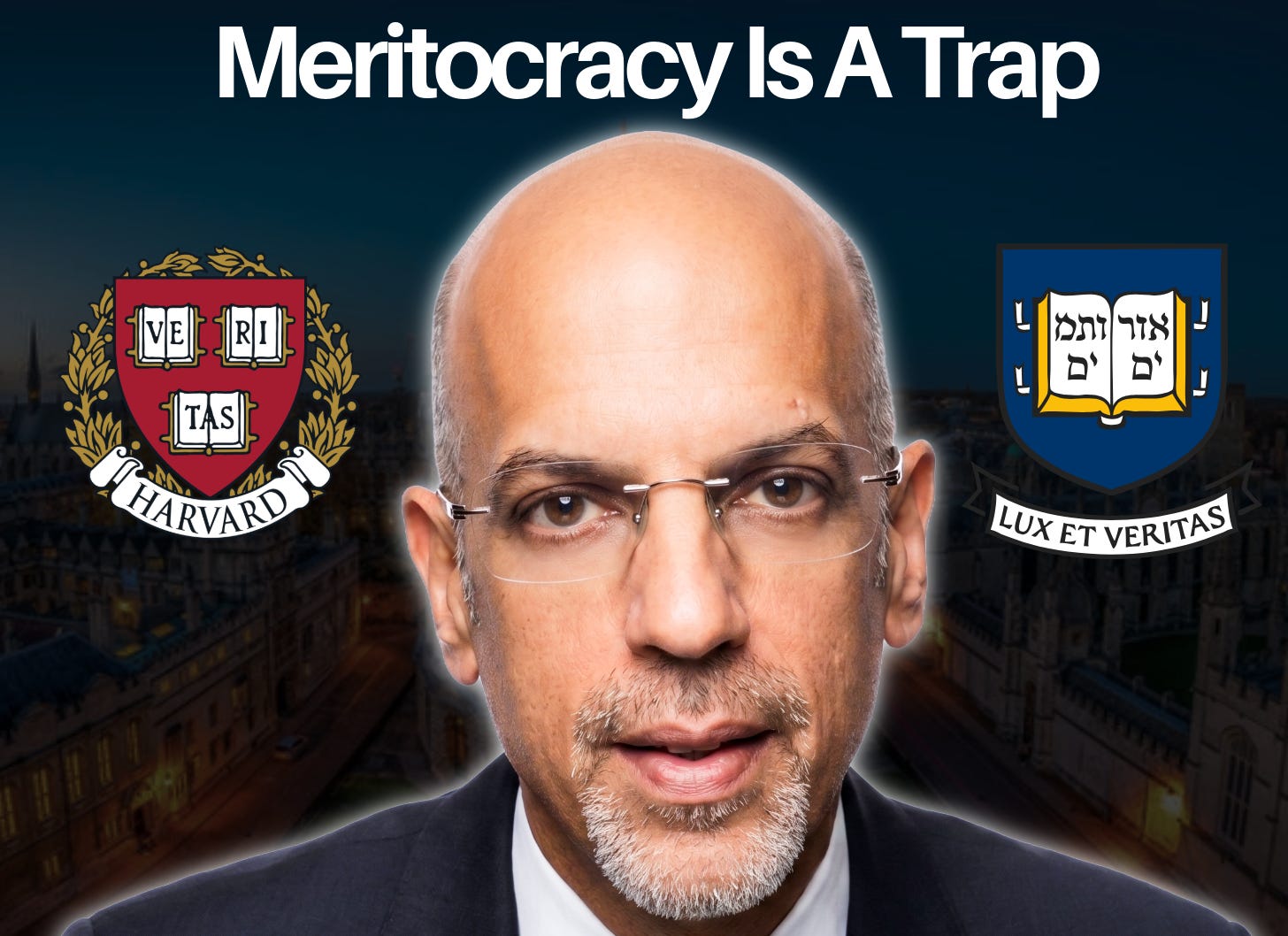
Daniel Markovits is the Guido Calabresi Professor of Law at Yale Law School and the founding director of Yale's Center for the Study of Private Law.
He is the author of The Meritocracy Trap (2019), which argues that meritocracy, the system meant to replace inherited privilege with earned advantage, has become the main mechanism by which wealth and status are now passed between generations.
The book drew responses from Michael Sandel, Thomas Piketty, and a wide readership beyond the academy, and in 2021 Prospect named him one of the world's top 50 thinkers.
Markovits trained as a mathematician at Yale before a Marshall Scholarship took him to the LSE for econometrics and to Oxford for a doctorate in philosophy.
He publishes across law, economics, and philosophy, with work appearing in Science, the American Economic Review, and the Yale Law Journal, as well as the New York Times and The Atlantic. His next book turns to demographic decline and what a good life looks like once growth slows.
This conversation matters because Singapore has spent 60 years treating meritocracy as settled doctrine, and Markovits offers the clearest account yet of the flaws of meritocracy.
Keith 00:00:48
This term meritocracy in Singapore is one we use very loosely. It’s almost part of our national vocabulary. It’s so ingrained within us to embrace meritocracy wholeheartedly, but it is a term that somehow eludes definition. So I’d like to start off with this simple question. How should we understand the term meritocracy?
Prof Daniel Markovits 00:01:32
I think that’s a terrific place to start. The most general way to understand a meritocracy is that it’s a social, political, and economic system in which advantage is allocated based on accomplishment rather than something else: race or gender, or who your parents are, or your social class. And advantage could be quite general. It could be wealth, it could be income, it could be status, it could be office.
So meritocracy is a system in which the people who get ahead, in whatever way you can get ahead, get ahead based on their accomplishments.
Keith 00:02:08
Those who have better skills deserve higher income and higher status within society. And that is perhaps a fairer way to create an elite class, as opposed to what you had in the past, which was aristocracy, for example. What is wrong with that? [Ear-check: raw reads “What is wrong with that, Freely?” — the final word is unclear; possibly a cut-off “Professor” or a false start. Removed pending confirmation.]
Prof Daniel Markovits 00:02:27
Well, first of all, there’s a lot right with that. And you’re right that historically, the origins of meritocracies, wherever they have arisen, have been in values very much like that.
One way to think about meritocracy is as an effort to make consistent, on the one hand, the fact that every society needs hierarchy. Not everybody can be the boss, not everybody can be the prime minister, not everybody can be the chief surgeon. And on the other hand, a democratic commitment to the idea that all people are equal.
The way meritocracy makes these two things consistent is by saying: if we let people get ahead based on their accomplishments, then, on the one hand, everybody has a fair shot at success. Everybody can accomplish something, and you get ahead based on who you are or what you’ve done, not based on your race or your gender or your parents, because those are all undemocratic ways of allocating advantage.
On the other hand, the idea is that if you let people get ahead based on their accomplishments, sure, there will be some people who get further ahead than others. But because they get ahead based on their accomplishments, all the rest of us will benefit too. Instead of having an elite composed of lazy or incompetent or corrupt people who cheated, or who were just born into their status, you’ll have an elite that is chosen because it’s done good things, valuable things that everybody else benefits from too.
So the allure of meritocracy is that it’s a fair way of deciding who gets ahead, and that it squares private advantage with the public good. That’s the story that was told in France when Émile Boutmy founded the French meritocracy. It was told in the United States by Jefferson, and in the post-war years by the leaders of American universities who founded the American meritocracy. And it’s very much the story that Singapore tells about why the Singaporean meritocracy is a good thing.
On its face, there’s a lot to say for that story. What we’re going to talk about over the rest of the discussion is where that story has gone wrong. But it’s important to begin by acknowledging that it’s a perfectly sensible and even salutary, valuable story.
Keith 00:04:43
When Michael Young coined the term in 1958, meritocracy was framed as a warning: that this was going to create a new elite that felt entitled to their place in the world. Yet by the seventies, you saw a wholehearted embrace. It wasn’t seen as a warning, but as a celebration of a new form of social revolution, one might say. Why is that the case? Why did people miss that warning?
Prof Daniel Markovits 00:05:15
The warning had two components. The first is that Michael Young really disliked hierarchy of all sorts. The German socialist Bertolt Brecht once said, I want no worker under me and no boss man over my head. And it doesn’t matter whether it’s justified who’s the worker or who’s the boss. Just the fact that there are workers and bosses was unappealing for someone like Michael Young.
He especially worried that what meritocracy would do, and we can talk about this more a little later, is give those who got to the top a smug feeling of their own superiority. So he thought, in a way, a justified hierarchy is almost worse than an unjustified hierarchy. Because in a justified hierarchy, everybody believes it. And so they believe in a bad thing. That’s one problem he had.
The other problem Michael Young had with meritocracy is that he thought that in the end, the hierarchy would not be based on a fair decision procedure. And he got wrong the mechanism of unfairness. We can talk about why it’s so unfair.
But it’s important to realise that one of the reasons why meritocracy became so popular, and one of the reasons why it is still popular in a lot of places, is that meritocracy was a very powerful way of dismantling old forms of inequality that are clearly immoral. A meritocracy is a great way of breaking down a racial hierarchy. In the United States, if you looked at the distribution of status and wages in 1960, there were almost no Black people at the top. The reason is that if you were Black, you were categorically excluded from high-paying jobs or high-status jobs based on your race, no matter how talented or accomplished you were.
So when American meritocracy started allowing people to get ahead based on their accomplishments, look what happened. Some people from previously excluded groups started getting ahead based on their accomplishments. Moreover, the old elite, the aristocratic elite, was not very hardworking and not very smart. And so it found it very hard to get ahead in a meritocracy.
What meritocracy initially did is it opened up opportunities to deserving outsiders, and it broke the stranglehold of undeserving insiders. Those two phenomena together made it extremely attractive. That’s why people liked it.
Keith 00:08:12
In meritocracy, there are three components: natural ability, effort, and training. A lot of the popular discourse around meritocracy centres on natural ability and effort. But that training component is often under-discussed in public discourse. Why does it matter so much, and why is it often swept under the rug?
Prof Daniel Markovits 00:08:38
Why is it under-discussed? I think there are three reasons.
The first is that it’s new. Until two generations ago or so, it was impossible to get into the really elite class of economic actors simply based on your training. New things take a while to get noticed. That’s the first reason.
The second reason is that training is morally complicated, because part of the feature of training is that you have to really work at it for it to help you. So training and effort are connected to each other. That means training often gets the moral benefit of the doubt because it’s connected to effort. You look at the student who does really well, and you say, look at how hard she studies. And that’s true. She really does study incredibly hard. But that leads you not to see how good her teachers are.
The third reason this gets neglected, which is the more nefarious one, is that the people who are spending a lot of time talking and writing and arguing about inequality themselves tend to be super well trained. They tend to owe a lot of their income and status to elite institutions of training. So neglecting training makes it possible for a significant part of the current elite class to launder its own privilege. It’s convenient to neglect training.
Keith 00:10:29
If you end up being a world-class surgeon, you underplay the private school education that you enjoyed along the way, and perhaps even the foregone income that you were willing to give up as part of your training, which allowed you to achieve your dream.
Prof Daniel Markovits 00:10:51
And it’s not just you. It’s the private school itself, and the elite university you went to, and the New York Times. Those places all have an interest in not thinking of themselves as sources of unjustified inequality, but instead thinking of themselves as channels of opportunity.
Keith 00:11:11
The first sentence in the book says merit is a sham. It’s a central claim in your argument that this idea of meritocracy is a complete myth, and that it was a trap for America. On top of that, for the most part, the elites are not cheating, and the injustice arises within the rules rather than against them. Could you unpack that apparent tension?
Prof Daniel Markovits 00:11:30
I think there are two parts of that claim.
The first is this. If it’s true that accomplishment depends not just on talent and effort but also on training, and that training is a really important part of accomplishment, and that training is extremely unequally distributed, and in particular that the children of elites get much, much more training than everybody else, then it will turn out that meritocracy, which distributes advantage in the next generation based on accomplishment, will actually perpetuate inequality across generations.
We said a minute ago that one of the attractive things about meritocracy is that it opened up opportunities for people who were excluded, and that it broke the stranglehold of the elite over advantage. Well, that was true in the first generation. But when the new elite is itself composed of meritocrats, and the new elite is exceptionally good at training its children and exceptionally committed to investing in training its children, then it can turn out that through the mechanism of training, meritocracy becomes the avenue by which inequality is perpetuated across generations. That’s the first sense in which it’s a sham.
The second sense: remember, the other thing I said that made meritocracy so attractive is that it generates an elite whose private advantage is connected to its promoting the public good. It generates an elite that is not lazy, not self-seeking, but really does valuable things for society as a whole. Well, the other thing that’s happened in meritocracies is that over the generations, the way in which we make goods and deliver services has changed to favour exactly the skills that elite training gives.
Take my own field, law. We have a legal system that tremendously rewards extreme creativity and sophistication in super-elite lawyers. That’s good for the rich clients who can hire them, and it’s good for the elite lawyers who get paid, but it doesn’t produce cheaper or more accurate justice. It produces the reverse.
There are lots of things that we conceive of now as elite skills which, in our economy and our society, are indeed extremely valuable, but which don’t make everybody better off. Instead, what they do is serve the elite that has them. So the second sense in which merit is a sham is that the things we call merit no longer promote the common interest. Instead, they promote the private interests of those who have them. And that makes them not that valuable.
Keith 00:14:33
In 2023, our Minister for Education made a public remark on meritocracy in a speech that echoed your point, which is that meritocracies create an endowment effect. It allows the previous generation of meritocrats to pass down not just their wealth or finances, but opportunities, social capital, and even the opportunity to train.
Even in China, when I spoke to Professor Keyu Jin, she pointed out that because of the one-child policy, you now have the six-wallet effect, which is that grandparents and parents pool money together towards helping that one kid. And what does that one kid get? Almost an overconsumption of education. [Ear-check: raw reads “Professor Kerryin” — Keyu Jin (LSE) matches the six-wallet reference; please confirm this is the guest you interviewed.]
When you choose to buy into meritocracy, you accept that it creates this arms race. Even if you were to create a very good public education system, to a certain extent the private actors will still create the arms race amongst themselves.
Prof Daniel Markovits 00:15:43
I think that’s fair. There are two parts of it.
One thing about an arms race is that everybody is competing and only one person can win. So when you make the race more intense, you don’t create more winners. There’s still only one winner. That’s one problem with an arms race.
The other problem with arms races is that you spend all your money investing in arms rather than in other things. In a world in which there are now a large number of law firms in New York City, to take the US example, in which profits per partner are more than five million dollars a year, you can make enormous sums of money if you manage to become an elite lawyer. You cannot make enormous sums of money if you manage to become a very good teacher. But it turns out that teachers are socially just as productive, maybe more socially productive, than lawyers.
So what meritocracy does, by identifying success with your ability to command a large wage on the labour market, is create this incredibly intense competition that only one person, or only a few people, can win, and everybody else is a loser. But it also directs all their efforts at being lawyers, not teachers. The result is we have too many lawyers and too few teachers.
Keith 00:17:10
I had a conversation with a former minister for trade in Indonesia, who is one of the big podcasters in Southeast Asia, and he made the point that in Southeast Asia, because merit is judged by the kind of skill set one can get and the kind of pay one can command, in Indonesia you would take the job at Meta over being a teacher, even though it’s clearly in the interest of the country and the people for you to work as a teacher. Because of the way value is ascribed to a job, not just in its economic value but in the status it provides, even if you’re an engineer, you would rather work for big tech than be a teacher in the public school system. [Ear-check: raw reads “even if you’re an E” — “engineer” is my best inference from context.]
Prof Daniel Markovits 00:17:59
There’s actually systematic data about this. A group of English economists, some years back, tried to measure the relationship between the private pay that people capture by working certain jobs and the public value that their work creates. One thing they discovered is that lawyers and people who work in finance get almost a hundred percent, and some of them even more than a hundred percent, of their social product as a private wage. But nurses, home care workers, and garbage collectors get less than ten percent of their social product as a private wage.
So there are certain jobs where, in some sense, to do that job is to give almost all of your social product away as charity to other people. If I’m a nurse, almost all of the product that I produce goes to other people. Whereas if I’m a banker, all the product I produce goes to me. And that system, as you say, gives people very powerful incentives to become bankers rather than nurses.
Keith 00:19:13
And that creates this inequality of opportunities and outcomes, which you’ve pointed out. But there have been peers in your circle who have challenged your thesis. Some would point out that in America, you essentially have a rigged game. One might say America has become a plutocracy, where the people who have made it to the top have rigged the system in their favour. One example would be the weakening of trade unions in the US over the last few decades. Perhaps the meritocracy paradox is a misdiagnosis of the problem. What is your view on that?
Prof Daniel Markovits 00:20:05
First of all, there’s a lot in that view. The system has, in important ways, been rigged non-meritocratically. The decline of trade unions is a good example of that. Elites also can cheat their way to get ahead. There have been various scandals recently in the United States about people bribing their way into university. And there are perfectly legal ways in which universities privilege their own alumni, or maybe even privilege extremely large donors. Those are unmeritocratic forms of inequality.
The question, though, is how much of the inequality that we see is attributable to those techniques, and how much is attributable to meritocratic techniques? In my judgement, the much larger contribution comes from meritocratic techniques.
Why does one think that? Well, if you look at university admissions, the top five law schools enrol something like 75 or 80 percent of the top scorers on the law school admissions test. If you look at the average grade point averages and test scores of Harvard undergraduates, they’re incredibly high. What that suggests is that most of the reason why people get into those places is meritocratic. At the same time, it’s also true that if you look at the student bodies of Harvard College or the top law schools, they’re full of rich kids.
How can both those things be true? The answer is the thing we talked about earlier, which is that the training works. Rich kids get enormously intensive training. That means that when it comes time to test them meritocratically, they win the meritocratic competition. That’s the most consequential mechanism by which we have so much inequality, which isn’t to deny that the other mechanisms also exist. It’s just that if you really want to get rid of inequality, you have to solve this difficult problem, rather than just solving much easier problems about corruption and so on.
Keith 00:22:27
Even in China, South Korea, Japan, and Singapore, those who have embraced meritocracy as a tenet of national culture, you see that dynamic happen. To a very large extent, it creates a lot of stress, even for the middle class.
Prof Daniel Markovits 00:22:51
One important point here is that wherever inequalities in outcomes become really big, you see this problem, and you get inequalities in opportunities. The great hope of the meritocrat is that meritocracy can be a way of accepting unequal outcomes while still securing equal opportunities. And that’s a myth. One thing we’ve seen across country after country after country is that when inequalities in outcomes become big enough, equality of opportunity becomes impossible.
Keith 00:23:30
If you look at the Harvards and the Yales of the world, there is nothing stopping the schools from expanding and providing more options for more people to enter, be it through locating in different geographies of the US or overseas, and perhaps democratising access. Would that be sufficient?
Prof Daniel Markovits 00:23:53
You’re getting at something important here, which is that really elite schools and universities throughout the world have this prayerful strategy: they want to find deserving outsiders, and fill their class as much as possible with people who win the admissions competition even though they didn’t have any advantages.
The structural problem is that insofar as training works, there will be very few such people. Because if training works, the people who win the admissions competition are going to be the people who were trained. And those are going to be the people who had advantages.
So the hope of these schools and universities is that they can maintain their exclusivity and eliteness, and at the same time become engines of social mobility. And that, I think, is impossible. The solution that needs to happen is the one you’ve described, which is that they simply have to become less elite. And the way to become less elite is to educate more people.
Now, I’m not sure I would start with NUS or Harvard as opposed to starting with primary schools. It might be best to pursue both of these things together. But by the time people get to Harvard, there’s so much inequality baked in that, while Harvard should do this, Harvard is small and won’t be able to solve the problem on its own. What’s needed is a system-wide reallocation of training resources that dilutes the training that the elites get, and increases and intensifies the training that everybody else gets, by spreading educational privilege around.
Keith 00:25:58
If you want full access to the transcripts of every episode, just head over to ykeith.com, and you’ll get full and free access to each transcript. Now, back to the show.
In Singapore, one of the things that the government has been quite intentional about, and I think they reflect on this quite often, is that early in the country’s history, they saw that if you left it to market forces, you would have very underpaid public school teachers, for example. You wouldn’t actually have good training for public school teachers, and it wouldn’t be seen as an enticing profession. So they were very deliberate about giving generous scholarships, so that teachers could study at the top schools overseas. They were very intentional in making sure that an average teacher could earn an above-average income within the country.
So there is a certain way that they’re trying to mitigate this. If there are jobs that generate social good, how can we ensure that the people working in them at least capture a fair share of it in their income?
Prof Daniel Markovits 00:27:09
Let me ask you about this, because this is a very interesting feature of the Singaporean state. Singapore, in general, pays public sector workers extremely well, compared to a country like the United States, which pays its public sector workers not very well at all. The political economy of this is complicated.
In the United States, there is widespread political hostility to the idea that technocrats or civil servants should get paid more. Although they are paid significantly less than they could make in the private sector with their qualifications, the fact that they’re highly educated means that they’re paid more than the median income. And in a democracy, it becomes difficult to justify paying elites more than average.
But Singapore seems to have managed to pay its government sector workers well without losing political support for that programme. It’s an interesting question how it has done that, and what other countries could do to improve the pay of people who have a high social product, and draw more talent and more people into those lines of work.
Keith 00:28:34
Speaking to a lot of public policy leaders, it starts with the question of why they imported this ideal of meritocracy. If you look at our region in Southeast Asia back then, if you’re Singapore in 1965 or 1970, and you’re trying to attract foreign direct investment and build up your national capacity, the only way you could appeal to a multinational company was to say, we will ensure that the people you work with, in government or the private sector, are the best people you can find. These people are not connected to a political elite. Whereas in other countries, it might be, I’m the president’s right-hand man, I’m the president’s general, so you go through me. Meritocracy was a good mental model to appeal to them.
I think to a certain extent it worked, because there is this idea of performance legitimacy. Because we captured those early gains, and the government did a really good job of ensuring our security and ensuring that people had access to housing, which was a huge issue back then, it gave them the political legitimacy to, first, enshrine meritocracy, and second, ensure that public servants could be paid well.
Prof Daniel Markovits 00:29:53
What’s interesting about Singapore is this. Performance legitimacy is a big deal. When Singapore achieved its independence, really by expulsion, Singapore was extremely poor. The ability of the Singaporean state to make everybody transformatively richer inside of a generation or two creates a huge amount of political legitimacy.
But Singapore seems to have sustained a significant measure of its internal legitimacy even when it reached the point at which it became quite wealthy. As opposed to other countries, like China, which had performance legitimacy for a long time when it was dragging people up out of deep poverty by the hundreds of millions. But as China gets richer, it needs more repression in order to sustain itself.
Keith 00:30:50
Singapore, I think, benefits from being small, and that’s something the government is very conscious about. How can we ensure that most of Singapore benefits? One of the things the government has been actively doing is ensuring that every Singaporean, even in the younger generation today, has access to housing. The average Singaporean has a roof over their head, and eighty percent of the population lives in public housing. That creates all kinds of internal contradictions, but it allows you, to a certain extent, to retain that legitimacy.
The second thing I would add is that it’s an interesting paradox. I spoke to a famous sociologist in Singapore, and he said that only in Singapore could Singaporeans expect a risk-free return on their assets, which is public housing. As people age, they expect to sell that public house back to the government and make a profit. No other market in the world has that feature, where someone buys public housing of their own and can expect a future return. There’s no other asset like it. Even a bond has a certain risk premium baked into the product itself. But it’s only in Singapore that public housing doesn’t. [Ear-check: raw reads “sell that public house back to the government” — please confirm; HDB flats are typically resold on the open market rather than to the government.]
So there is that paradox, where the government accepts that this is the deal you have to make with the general public. The social compact keeps people happy. I think that’s one of the very important factors as to why our government today still has that political legitimacy.
Prof Daniel Markovits 00:32:27
So what you’re saying is really not just that Singapore is small, but also that Singapore’s economic model is highly distinctive. There are other countries that are small, Luxembourg, Switzerland. They have a very different internal political economy from Singapore.
Keith 00:32:51
Yes. And we’re young. We’re very young as a country.
Prof Daniel Markovits 00:32:54
This is another part. The book I’m working on right now, among other things, is interested in demographic trends. Almost all of the rich countries have this ageing population, which is rendering their model of social provision unsustainable. A younger country like Singapore has real advantages there also.
Keith 00:33:24
But we’re also a super-aged society, so that becomes a new challenge as well.
Prof Daniel Markovits 00:33:29
Interesting. What’s the birth rate in Singapore?
Keith 00:33:34
It’s very low. So this is a huge concern.
Prof Daniel Markovits 00:33:35
Very low. So you have that problem coming too.
Keith 00:33:38
It’s 0.87. It’s the lowest it’s ever been. The government set up a task force to try to tackle the total fertility rate, and this has been a huge concern. Coming up, we have the National Day Rally, where the prime minister will give his address, and he’s made it clear that it’s going to be very family-oriented. They’re looking at how to improve the infrastructure for people to have more kids. [Ear-check: raw reads “point eight seven” and “set up a tough area” — please confirm the figure as spoken and that “task force” is correct.]
Prof Daniel Markovits 00:34:09
One thing that connects the conversation back to meritocracy is that one of the features of meritocracy is that it makes being a child and being a parent incredibly exhausting and stressful. The arms race that you talked about earlier, to get the most training you can and to win again and again at a competition in which almost everybody loses, means that childhood becomes a kind of Stakhanovite production process, trying to build human capital. And parenting becomes exhausting and stressful, because you have to be absolutely, intensively engaged all the time. Certain kinds of failure are an almost inevitable result. So one thing meritocracy does is create disincentives to having children, by making childhood so stressful and parenthood so exhausting.
Keith 00:35:15
I spoke to James Liang as well. He’s the founder of Trip.com and a Stanford graduate who has a very keen interest in demographics. He made the point that in those high-stress exam environments, based on his research, even in China and Singapore, and in a lot of these societies where examinations are a function of meritocracy, the parents who went through that process themselves, when they become parents, are very disinclined for their kids to go through the same process. So it’s not just that they’re exhausted, but that they have some form of PTSD, one might say. They can’t imagine having two kids go through the same process that they did, and it’s increasingly stressful over time. So I think there is a very huge, pardon the pun, merit to what you’re saying about the stress that a meritocratic society engenders.
Prof Daniel Markovits 00:36:12
Yes.
Keith 00:36:14
There is another question on the middle class. So far in our conversation, there has been a sense of a certain oppression of the elite: the elite are really just working all the time, and even in the way they enjoy their privileges, they can never let up. But you also made a point on the dismantling of the middle class through meritocracy. I’d like you to expand on that. How are you seeing the dismantling of the middle class, specifically when you look at a society like the US?
Prof Daniel Markovits 00:36:57
You can look at this initially statistically, in terms of distributional national accounts. It used to be, and by used to I mean in the years immediately following World War Two, that the great dividing line in most rich societies, at least, was between the poor and the middle class. The poor were numerous and very poor. And the middle class was growing, but not distinctively poorer than the rich. So you had a society with a lot of poverty, and then a group that was out of poverty that was internally relatively undifferentiated.
In the years since the 1950s, what’s happened across wealthy society after wealthy society is that poverty has become rarer and rarer. Especially deep, absolute poverty is very rare. And at the same time, the central dividing line in society has become not between the poor and the middle class, but between the middle class and the rich.
The rich have left the middle class behind, and inequality has itself moved up the distribution. In the United States today, for example, there is more inequality inside the top five percent of the distribution than there is across the distribution as a whole. So the middle class and the poor have converged significantly, by the poor becoming richer, but the rich have left the middle class behind.
One of the things that means is that while the middle class is not in absolute material deprivation and distress, it has been pushed out of the centre of economic, social, and political life. It has been relatively demoted and disempowered. And in a democracy, to have a demoted and disempowered middle class is a very bad and dangerous thing.
Keith 00:39:24
If you look at healthcare in the US, and you look at the innovation, it seems to me that it’s increasingly concentrated on appealing to the rich. Think about the push towards longevity medicine, or plastic surgery, for example. It seems to me, at least as a third-party observer in Singapore, that there is a lot of capital being allocated to serving the rich. So what you’re alluding to is that the middle class suffers from a lack of access to quality goods that would materially improve their lives, because the rich are absorbing a lot of the capital that would otherwise be deployed to help the middle class. [Ear-check: raw reads “the village are kind of absorbing” — “the rich” is my inference from context.]
Prof Daniel Markovits 00:40:11
Not just the capital, not just the innovation, not just the new technology, but also the simple, straight-up supply of medicine and doctors. The fastest-growing segment of the US medical profession now is what’s called concierge care. These are doctors who don’t take insurance. It’s a cash-for-services model.
Here’s a straightforward example of how it works. You have a doctor who charges a $50,000 retainer per year to be a family’s doctor. This doctor signs up 20 wealthy families, and so has revenue of a million dollars a year, and is the doctor for those 20 families. That means those families can call the doctor whenever they want. The doctor makes house calls. They have as much medical attention as they need or want. The doctor has an extremely comfortable practice, because the doctor might have 200 patients. And the doctor’s skills and talents are removed from the general population. Even if you have very good health insurance, you can’t access this doctor, because they don’t take insurance.
What this does is concentrate medical resources in the rich and exclude the middle class from that doctor’s services. As more and more doctors adopt this model, the middle class has fewer and fewer doctors available.
Interestingly, and this is the surprising but I think important additional point, it’s not even clear that it’s medically good for the rich. It turns out that if you have a concierge care doctor who, in some sense, is your employee, you massively overconsume medical treatments, including in circumstances in which it’s not in your health interests. You call up the doctor, and the doctor works for you. So the doctor kind of has to say, yes, I’ll give you that test, or yes, I’ll give you those antibiotics, when in fact you’re being over-tested, over-inspected, and over-prescribed, and it’s not good for your health. That’s true, by the way, of a lot of these longevity treatments that the super-rich are getting. They’re probably harming them.
Keith 00:42:35
Because the merit, the skills at the top, are seen as justified. If you’re a startup founder, or a high-paying banker, or a top CEO, this pay is totally justified. You deserve whatever you have. And as a result, the dismantling of the middle class is seen as inevitable.
Prof Daniel Markovits 00:43:04
I think there are two parts of this. We began by talking about the dismantling of the middle class in the data, in the distributional national accounts. There, the observation was that inequality has moved up the distribution, so that the key distinction is no longer between the poor and the middle class, but rather between the middle class and the rich.
Now we’re talking about something different, which doesn’t show up in the data, but shows up in the social meanings: in the narratives that society tells itself, in the understandings that people have of what it is to succeed. In a middle-class society, the idea is that what it is to succeed is to get something that other people can also have. A successful life is one in which you have achieved middle-class status alongside all the other middle-class people.
But in a hyper-meritocracy, in which success is to get inside the elite, success itself becomes defined in terms of exclusivity. What it is to succeed is to have something other people can’t have. In that sense, the middle class has been pushed out of the centre of the social, economic, and political narrative, and is no longer the thing to aspire to. And that has a separate kind of cost, apart from the purely data-driven, statistical, distributional national accounts part of the story.
Keith 00:44:39
If I understand you correctly, the American dream used to be middle class, and now it’s increasingly elitist. [Ear-check: raw reads “increasingly atheist” — “elitist” is my inference; please confirm.]
Prof Daniel Markovits 00:44:49
Yes. And not just the American dream, but the thing that gives you status. Not just what you are dreaming about when you’re a young person, but what makes you charismatic in the world, what gives you access and political influence, what is valued by society. All that has shifted away from the middle class and towards the elite.
We see this, by the way, in a very striking thing. If you think about taste in art, in houses, in dress, in furniture, until the twentieth century, good taste was aristocratic taste. Good taste was marked by extravagant opulence that broadcast that not everybody could have it.
Modernism as an aesthetic movement was in part the social, political, and economic triumph of the middle class. Good taste became something that everybody could have: the simple furniture, the unadorned house, people dressing in casual clothes in public. The middle class occupied the centre of the aesthetic imagination of the society in a way it had never done before.
What we’re starting to see now, again, is the return of aristocratic taste and habits, in which the aesthetic and cultural and aspirational norms are again becoming about things that not everyone can have. So the middle class is losing the cultural, artistic, and aesthetic competition as well.
Keith 00:46:52
It’s not just in the income, or the numbers, or the data, but a certain qualitative feel of life itself.
Prof Daniel Markovits 00:47:00
Yes. It’s economic, it’s social, it’s aesthetic, it’s political, it’s literary. It’s a full-spectrum demotion of what used to be the centre of the society.
Keith 00:47:15
In that sense, when you look at the narrative of AI today, this AI revolution, especially with the huge amounts of capital going into investing in the technology and then deploying it, it seems to me that it’s only going to worsen that meritocratic doom loop. Because now it’s only the people who are extremely hyper-specialised and trained in AI itself who benefit. Is that an accurate assessment?
Prof Daniel Markovits 00:47:51
I think it’s really complicated, because nobody really understands the technology and its prospects well enough to know exactly what it’s going to be capable of doing, and what it’s going to be good and bad at.
Obviously, there’s one story in which it becomes a superhuman superintelligence. That’s the world in which either we’re all saved or we’re all doomed, depending on what you think about it. My own more-than-casual but less-than-expert guess is that that’s not what’s going to happen. Instead, this is going to become another highly potent, transformative technology, like others we’ve encountered.
Here’s what’s going to be interesting if that’s what happens. Historically, in the last 50 or 60 years, new technologies have been skill-biased. They’ve been biased in favour of relatively more elite skills. They’ve made elite skills more valuable, and they’ve made less elite skills less valuable. That wasn’t always the case. In the first industrial revolution, new technology was biased against skill. It made it possible, for example, for unskilled factory workers to make guns that previously only a skilled artisan could make.
So the interesting question for AI on this account is what its relationship to the human skill profile will be. One story is that it’s just going to move the divide between who is benefited and who is burdened by technology up the skill distribution. You’d have to be more elite to be benefited, and others would be excluded. But another possibility is that certain skills that have been elite will become no longer so valuable, and certain less elite skills will become more valuable again. The skill of the carpenter, or the plumber, or the nutritionist, or the counsellor might turn out to be difficult to replace by AI. Whereas the skill of the high-yield bond trader might be much easier to replace.
I don’t know. We’ll have to see what happens. But there are at least three different futures, depending on what the technology turns out to have as its affordances. And we don’t know.
Keith 00:50:21
I tend to concur with you. In Singapore, the country is quite an aggressive adopter of AI, mainly because it’s a small country, and the people in our population are aware that this is a technological change. As a small country, as a price taker, you need to understand it and get on it.
My exposure to policymaking in Singapore is that they are concerned about two things at the same time. One is that you have that AI skills divide, which is what you talked about, which is only going to deepen the chasm between the haves and have-nots. But at the same time, there is the plus side that it defetishises elite training. Then the question for the government becomes: for a long time, you pushed high skill, high income as part of the growth story. What do you do now? Where are the new frontiers of growth? I think that’s something we’re still grappling with today, even as technology continues to evolve.
Prof Daniel Markovits 00:51:25
Can I jump off from that thought? The book I’m working on right now is a little bit about possible futures. The hopeful story about AI goes as follows, and it’s a story in which AI really is the solution, or the way of escaping the meritocracy trap.
The hopeful story is, on the one hand, that it produces enough of a productivity revolution that everybody can get rich enough, and that we have enough stuff. One of the things about material things is that after a while, more of them don’t make you better off. So if we can get rich enough collectively that more and more people have enough, then the competition to get more starts making a lot less sense.
On the other hand, if we go back to education, for almost all of human history, education has had two very different purposes. One of them I call sacred, which is that education helps the person to understand themselves and their world, and to become more fully themselves, and therefore freer. And the other is profane, which is that education builds human capital, which the educated person can sell on the marketplace for a wage.
One of the things we’ve seen over the last 50 years is that the profane part of education has come to dominate the sacred. That’s because meritocracy has made certain forms of human capital incredibly valuable. If, as you said a moment ago, the hopeful part of AI is that it can take away some of the extreme value of certain kinds of profane education, we can return to the sacred part. Education can once again be not about getting ahead, or learning how to build up and then exploit yourself, but about becoming yourself, becoming free, and understanding the world that you’re in. That’s the hopeful story of the future that AI could offer.
Keith 00:53:41
When you look at countries in the world today that are actively trying to prevent this new form of aristocracy, and at the public policies being implemented, are there any that inspire you, where you’d say they’ve got some part of the formula right?
Prof Daniel Markovits 00:53:59
I think a country like Finland is remarkable, in two respects.
First of all, although it has this reputation of the sort of Nordic model of socialism, it’s actually quite capitalist. Finland produces almost as many millionaires and billionaires per hundred thousand people as the United States. But what it does not have is the massive class of the very, very rich but non-entrepreneurial. Instead, it has a fair amount of equality below the super-elite.
The second thing that’s striking about Finland is its education system. It produces results on the PISA tests that are almost as good as Singapore’s. But where Singapore produces these results through enormously intense, competitive schooling, Finland produces the results through much more relaxed, almost anti-competitive schooling.
So as a model that manages, on the one hand, to produce extremely good educational results without this rat race, and on the other hand, to produce enormous amounts of wealth creation without the creation of a large elite-earning overlord class, Finland seems to be pretty successful.
Now, how and why it does that, I’m not even sure the Finns know. The Finnish Minister of Education used to come to other countries and give lectures about the Finnish model. One of the first things they would say is, don’t think that you can just replicate our schools. You have to replicate our whole society. Well, that’s a very hard thing for a massive, multicultural, diverse immigrant society like the United States or Brazil, or for that matter a country as large as China, to do.
But that’s an inspiration: to try to understand why Finland is as successful as it is, and what parts of that model can be exported. That’s a country to look at.
Keith 00:56:16
You’ve been championing this fight against the meritocracy trap, and you’ve had the chance to inspire and educate many young people in your time at Yale University. If there was one piece of advice you could give to someone entering the working world today, trying to find their way in the world, what would it be?
Prof Daniel Markovits 00:56:37
It’s going to have to be two pieces of advice, because I think it depends on where you’re situated.
If you are outside of the elite, or if you have not had an enormous investment in your schooling and training, the important piece of advice is that the fact that you’re finding it difficult to get ahead is not your fault. It doesn’t reflect badly on you. And it’s also not the fault of immigrants and other outsiders. It’s the fault of a structure of inequality that you’re caught in. So don’t become self-hating, and don’t become other-hating. But organise politically to take on the structure.
If you’re inside the elite, then the advice is in some ways the opposite, which is that you don’t deserve your advantages, even though you’ve worked very, very hard for them. And in your private life, your freedom is more valuable to you than your wealth. So try to escape the trap on your own as much as you can. But in your public life as a citizen, join with the first group I’ve just talked about, and try to dismantle the structures of economic and educational competition that are excluding them and ensnaring you. And maybe together we can build a fairer society.
Keith 00:58:14
With those stirring words, Professor Markovits, thank you for coming on. [Ear-check: raw reads “with those sea Shri Words” — “stirring” is my inference; please confirm.]
Prof Daniel Markovits 00:58:19
Thank you so much. It’s been a pleasure to talk to you. Really interesting conversation. Thank you.
Keith 00:58:23
Thank you for listening to today’s episode. If you are watching this on YouTube, please consider subscribing and turning on notifications for whenever new episodes are out. If you’re on Spotify or Apple, it would help us greatly if you could leave a five-star review on those platforms. Once again, thank you for tuning in to The Front Row Podcast.