How America Became Great - Professor Michael O' Hanlon
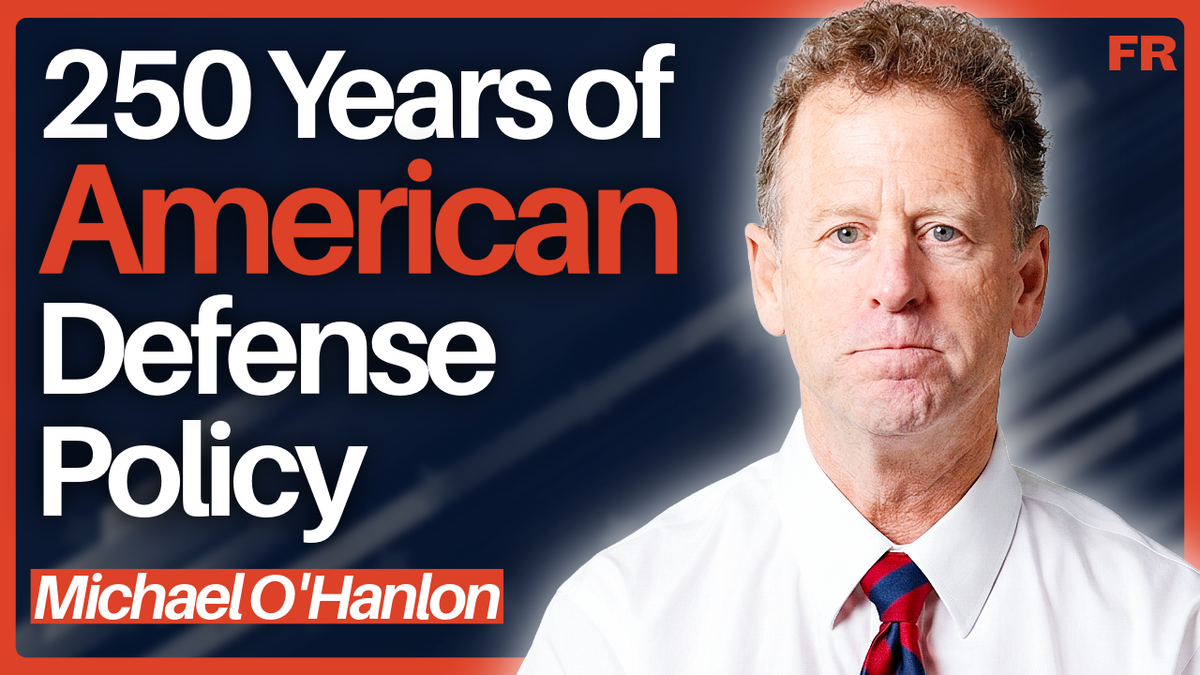
Professor O'Hanlon is the inaugural holder of the Philip H. Knight Chair in Defense and Strategy and Director of Research in the Foreign Policy Program at the Brookings Institution. His newest book, timed to coincide with America's 250th birthday, called "To Damn Mighty Things," was an interesting read for me as it helped unpack the growth of America as a nation, then industrial power, and eventually superpower.
In today's conversation, we talk about America's evolving defence strategy from its birth in the Revolutionary War all the way to the Iraq War. I hope you'll find this conversation as illuminating as I did.
TIMESTAMPS:
00:00 — Trailer & Introduction
01:37 — Grand Strategy vs. Defence Strategy: What's the Difference?
06:50 — George Washington's Guerrilla Instinct: How the Revolutionary War Shaped America
11:45 — The Founding Fathers Were Not Minimalists
15:10 — The War of 1812: Punching Up at the World's Number One Power
18:50 — Was America Ever Really Isolationist?
21:10 — The Uncomfortable Ethics of American Expansion
30:15 — How World War II Made America a Superpower
32:55 — Three Wars That Built a Nation
34:30 — The Cold War Was Scarier Than We Remember
37:45 — Vietnam: America's Worst War — and Why Lee Kuan Yew Still Defended It
40:20 — The Cold War Was About More Than Containing Communism
42:30 — The End of the Cold War: Triumph or Anxiety?
46:05 — 9/11, Fear, and the Road Into Iraq
49:30 — The Paradox of American Power: Winning the Grand Game While Losing the Wars
51:20 — Nixon's Art of Losing Without Admitting It
53:35 — Iraq: What Went Wrong and What Didn't
55:15 — Trump Through a Historical Lens: A 19th-Century President in the 21st Century
56:40 — If You Had 15 Minutes With Trump, What Would You Say?
This is the 78th episode Of The Front Row Podcast
Keith 01:36
There is a lot of interest today in geopolitics and grand strategy, but you make a very clear distinction between understanding grand strategy and defence strategy. Can you help us understand that distinction?
Michael O'Hanlon 01:53
First of all, Keith, thanks for having me on. It's great to be speaking with friends in Singapore. We in the United States have just great admiration and appreciation for Singapore as a polity, as an economy, as a security partner. So it's just great for me to be speaking with you tonight.
Grand strategy is the big idea for how you keep yourself safe and ideally also powerful. It is the most conceptual, most far-reaching, most sweeping idea that guides overall security policy. It may or may not be explained in any official document. You may have to figure it out by looking at how a country behaves, not just what it says.
For example, in the United States, for the first half of our history, our grand strategy was expansionism. We wanted to make this country bigger and more powerful. We also believed we had a form of government that had never been seen before on earth, one that was worthy of being expanded and covering the whole continent.
To give one more example, in the Cold War, the grand strategy was containment. Push back against the Soviets, push back against the Chinese Communist Party when they wanted to try to spread their idea of governance around the world. That's the big idea.
The defence strategy or military strategy is what you do with your armed forces to back up your grand strategy. How big is your military? Where does it choose to fight, or where do you decide as a country to have it fight? Which countries do you ally with? Which kinds of weapons do you buy for the possibility of future warfare? All the elements of the nitty-gritty of how you build a military and how you commit it to fight in certain places. That's defence strategy.
So grand strategy is the big idea. Military strategy is how the armed forces support that grand idea with the military instrument of national power.
Keith 04:04
Why do people conflate the two often in American public discourse when it comes to America's military involvement overseas?
Michael O'Hanlon 04:11
I'm not sure how many people lose a lot of sleep over this issue, because political scientists try to be very precise with their terms, but most normal people and most normal politicians don't really insist on using that kind of language.
The term grand strategy is sort of a grand term. It's a fancy word. It's not really a phrase we use a lot in normal conversation. Military strategy is a word you hear quite a bit, and it covers everything from how you fight a certain war to how you prepare for a possible future war or how you try to prevent that future war.
Political scientists sometimes try to explain these terms very clearly, and some of them say that grand strategy is just how you try to make your country safe. But in the United States context, that's not a good enough definition, because for the first half of our history, our goal was not just to be safe. It was to be more powerful and bigger, to cover more of the territory of North America, and to have the resource base to build a military that, if we wished, could do other things and bigger, mightier things.
In that sense, there are at least three definitions out there and it's confusing. One is how do you keep yourself safe. One is how do you keep yourself safe and powerful. And the third is how do you guide your overall foreign policy — not just defence, but economics and diplomacy.
I think that last definition is too big and broad and not specific enough to really be very useful. And the first definition does not do very well at explaining the United States. So I settle on this definition of grand strategy: it's how you try to keep the country secure, but also how you try to make the country powerful militarily. That's the way I think about the term.
Keith 06:22
I wanted to quote this from page 13 of your book. You said the Revolutionary War was the main existential struggle in American history. The very creation of the United States hinged on its outcome. Only in the Civil War, which threatened to divide the country in two, and then World War II, which had the potential to rip the entire planet apart and perhaps even lead to a direct attack on the US mainland if Hitler had realised his greatest dreams — so here we see three wars that shaped America. Maybe it might be useful before we jump into the present to go back to the start, to the Revolutionary War. You describe it as an existential struggle. Can you tell me more about how the Revolutionary War shaped America's outlook towards defence strategy?
Michael O'Hanlon 07:10
That's a great question and I look forward to responding to that. Let me also say there were a couple of other wars that were important for the United States because they involved our expansion into a great power.
One of those was the US-Mexico War of 1846 to 1848, where we wound up with the entire southwest of the United States. Previously that had been Spanish and then Mexican, and we essentially forced Mexico to give it to us. And of course also all the battles over the centuries against Native American tribes who were here before the United States was ever present. This raises a lot of difficult ethical issues, but in terms of the expansion of the country, those battles were crucial as well.
But you're right, the Revolutionary War was the war that gave us our independence. I think at a military level, the most interesting part of the Revolutionary War legacy to me is that George Washington figured out how to change from fighting a traditional open field battle kind of conflict against the British. He realised pretty soon he was going to lose that, especially in New York City in 1776, and he had to be more of a counterpuncher. He was one of the modern world's original guerrilla warfare experts — not quite guerrilla warfare in the sense of Ho Chi Minh, but he tried to counterpunch and avoid the battle in many cases rather than engage in it.
George Washington realised defending New York, defending any given city like Philadelphia, was not really essential. He could afford to lose those cities temporarily as long as the army stayed intact and still had resources to keep punching and punishing the British. That led to a couple of big victories, for example in Saratoga in 1777.
Then France joined the American side. Without France, I'm not sure that the United States would have won that war. But France, always at war with Britain throughout this whole period, joined once they realised the United States had an idea for how to fight the British that might just work.
It was counterpunching. It was an alternative to open field battle. It was a little bit like guerrilla warfare in some cases, although Washington was willing to have big fights with the British if he had the right circumstances and conditions. Fascinating conflict militarily and obviously crucial to the country's independence.
Keith 10:05
You spoke about the early republic leaders like Washington and Jefferson. They were almost allergic to a standing army of sorts. I think you alluded to how Washington, when he stepped down from power, voluntarily stepped down as president and was happy to wash his hands of future military engagements. So the question would be, where does this sort of assertiveness come from if the founding fathers didn't really have that strain in them?
Michael O'Hanlon 10:42
I love George Washington just like almost every other American. But Washington himself was ambitious in the sense that, yes, he stepped down from the presidency after two terms and he set a great example and became a magnificent influence on our future politics.
But as soon as he won the Revolutionary War in 1783, he set off to the west of the United States. At that time, the west was not very far west. It was Pittsburgh, Pennsylvania. He rode there on horseback, then took a boat down the Ohio River. He was interested in bringing Ohio, which was then part of the Northwest Territories, into the United States and building a big canal from the Ohio River to the Potomac River, creating this broader eastern United States that went well beyond the original colonies.
Washington was not content just to have our independence. He wanted to expand our territory, and this was more or less accepted by everybody at that time. It was not a debate. There were other debates that were very vigorous, and the early decades of the United States were not always happy and not always peaceful. Remember the duel between Aaron Burr and Alexander Hamilton, for example. In the early 19th century, there were a lot of very ugly political engagements. But everybody pretty much agreed we needed to go west, needed to keep expanding. That started with Washington and others of his generation.
In that sense, Washington was not a minimalist. He did not want to be the general forever. He did not want to be the president forever. But he wanted the United States to keep growing.
Keith 12:40
On page 23, you talk about how Washington stayed true to the idea that the federal government needed to be strong enough to hold together and protect the union. Was it that once you achieved a union, a United States of America, you needed to draw down militarily? Or did the expansionist train continue even after him? Help us understand a little bit more about America's expansionist tendencies in those early years.
Michael O'Hanlon 13:06
There were a lot of things going on in those early years. Some people considered the United States to be a plural word — that this was a confederation of 13 states, and the states were the most powerful. They had collectively decided to fight the British and collectively defeated the British, but their main loyalties were to their own states. We saw this again 80 years later in the Civil War, where the South felt that states' rights were more important than federal rights.
In those early years in the 1790s, with Washington as president and Alexander Hamilton as Secretary of the Treasury, the United States decided to behave more like a single unified country. All the debts of the different 13 colonies were brought together under federal control. The federal government assumed responsibility for those. The federal government imposed its own taxation policy on states, even where some places like Pennsylvania, with the Whiskey Rebellion in the 1790s, did not really want that kind of federal influence.
Washington, Hamilton, and later John Adams were instrumental in creating this sense of a single unified country. That was not really solidified until 1865 with the end of the Civil War and the defeat of the Confederacy. But it was fascinating to watch how, for the early decades of American history, some people really wanted the individual state to have the centre of power in our system, while others thought that the federal government should be ultimately the arbiter and the most powerful part of the government. Obviously the latter won out, but only really with the Union victory over the Confederacy in 1865.
Keith 15:07
I now have to move on to this seemingly unimportant war, but a war that you talk about quite often — the War of 1812. You describe it as powerful evidence in support of your main observation about America's strategic character, which is its highly assertive and self-confident nature. It picked a fight with the world's number one power at the time, which was Britain. Why was the War of 1812 so important in understanding America's strategic character today?
Michael O'Hanlon 15:38
First of all, for friends in Singapore and everywhere else who may be watching this show, it is fascinating. The American national anthem was written during the War of 1812 — "The Star-Spangled Banner" — and you probably watched some of our athletes singing it at the Olympics. It's a famous song.
But if you ask Americans what the War of 1812 was about, most of them cannot tell you. I know this because I've been giving a lot of speeches about my book and I sometimes ask people who feels like they understand that war, and hardly ever does anyone raise their hand — except in Baltimore, Maryland, where the Star-Spangled Banner was written close by. That's where the British assault on the United States sort of ended in 1814, leading to the negotiated settlement of 1815.
Basically, the War of 1812 reflected an American assertiveness because we thought the Brits were being a little bit mean and unfair in the way they would impose tariffs on us, because we still wanted to trade with France. France was ruled by Napoleon. Napoleon was trying to conquer all of Europe and Britain didn't like that, understandably. But we said we're not part of that war; we're going to trade with whoever we want. So Britain started imposing tariffs and also stealing some of our sailors from ships to put on British ships through the policy of impressment. Those were the causes of the War of 1812.
But what I say is that psychologically, the real cause was American confidence and assertiveness and a desire not to put up with this kind of treatment, even by the world's number one power. You might have thought that after winning the Revolutionary War, we would be content to leave Britain alone, not look for a rematch, not try to have a second fight with the world's number one military power. But we decided that we would prefer to fight them rather than put up with mistreatment.
That led to the War of 1812, which really resolved nothing. Ultimately, it was essentially stopped three years later with none of the underlying issues resolved. Britain did stop taking our sailors and putting them on British ships, but for the most part, the territorial gains were insignificant on either side. Nobody really won. Yes, the British burned Washington DC, but we just fled back into the hinterland just like we had in the Revolutionary War. Britain was not going to be capable of dominating the whole United States, so they didn't really win the war because they took Washington or torched the White House.
It was sort of an inconclusive war, but it reflected this American assertiveness that I think is pretty strong in our national character and was always pretty strong in our national character.
Keith 18:48
Despite this strong and consistent assertiveness in America's national character, there seems to be a trending view that America was actually relatively isolationist. Naturally, my question is, where did this stance or belief come from?
Michael O'Hanlon 19:03
The simplest answer is that now in today's world, we Americans think of our natural borders as the Atlantic Ocean and the Pacific Ocean and Canada and Mexico, because we're used to that. All of us were born when that was already true. But that was not the original condition of the country. Those were not the original borders.
The original United States was a small piece of land along the Atlantic seacoast of North America, stretching from today's New England down to Georgia, not even including Florida. We pushed west and roughly quintupled the size of the country in the next century — magnified our territory by five or six times.
When we look back on it, we Americans think those are the natural borders of the country. So we don't even think of this first 125 years as being a period of assertiveness. We think of it as consolidating our territory. But talk to the Mexicans, talk to the Spaniards who were in Florida, talk to the Native Americans. They will understand better than we sometimes do ourselves that the United States was pushing them off land they previously controlled.
That's why I say the United States — I think we're a very good country. I think it's good that we became powerful and big because it helped us have the resources to win the World Wars, to prevail in the Cold War. I think we've been a generally positive force for world peace and international stability. But we did not become big through any kind of minimalist approach to foreign policy. We were pushing and expanding and looking for new opportunity from the very beginning of this country's founding.
Keith 20:56
As an aside, I just wanted to ask you a little bit more about how you grapple with these questions of history, especially when we learn that a lot of the history was actually written in blood, especially of its less powerful neighbours.
Michael O'Hanlon 21:10
In the book, my book is a history of defence strategy. In a sense, I don't really have to answer your question about the ethics, because what I'm trying to describe is what happened and what strategies were guiding this behaviour.
But I acknowledge — I don't want to completely ignore the important ethical issues. There are some very tough ethical questions to wrestle with as an American. I have friends who are Native Americans and I have friends who are Mexicans. To go through our history and justify everything we did to push and expand our territory is not really going to work with them. It's not going to seem credible.
I can't go back in time and change any of that. I would acknowledge that the expansion of this country under a new system of government the world had never seen allowed us to have the resource base to defeat the Nazis and the Tojo government in World War II and prevail in the Cold War. In the grand scheme of things, over 250 years of American history, I think we've had a lot of beneficial results from this expansion of the United States into a continental power and ultimately the world's number one superpower throughout the 20th century and into the 21st.
But that's not to say it was all done in a proper and ethical manner. I think you can really debate the ethics of this.
Let me make one more point. Taking land from Native Americans was a sad chapter in our history, just like having slaves in the first 80 years of our country was sad. But with Mexico, it's interesting that Mexico inherited the American Southwest from Spain. Mexico became independent in 1821 and had very little control of territories that are now California, Arizona, New Mexico, and Nevada. They had a claim to it based on the fact that Spain had stolen or taken that land.
So the idea that the United States would simply defer to Mexico inheriting this land from Spain in what was a big imperial conquest from a previous century — I'm not going to feel too bad about that. I think the United States was a more natural country to control the current southwest than Mexico or Spain. I'm not going to lose too much sleep over the fact that the United States expanded in the Southwest in a way that was at the detriment of Mexico.
Our battles against Native Americans — they trouble me. I can't really justify those. If I could go back and redo the history, I would try to find a way to share the land with the Native Americans much better than we did.
If I could make one other comment — today's China likes to say that it's basically peaceful, that it has a Confucian ethic, that it hasn't been launching foreign wars for a long time, and that in the 19th and 20th century, China was a victim of European and Japanese aggression. All that's true. But let's also remember that China became a continental power by conquest a long time ago. Both China and the United States had grown into these giant countries because they were willing to use military force against their neighbours. It's a reality of human history we're just going to have to accept. We can't change it, but we should be aware of it.
Keith 25:28
I was wondering if you personally had to grapple with these questions as you were writing the book, because I can't imagine going through 250 years of history, a lot of it being bloody, without it stirring some thoughts within yourself.
Michael O'Hanlon 25:42
You're right. I think when you're thinking about history, it's good to wrestle with some of these ethical issues. Even if you know you can't change the past, and even if you know that maybe the overall good was greater than the overall bad, it's still worth reflecting on the nature of human beings and human government.
If nothing else, it should remind us all that we are all capable of making mistakes. I think that should be sobering in a world where the great powers are all pursuing their own advantage and where Russia's attacking Ukraine and China's flexing its muscle in the Western Pacific. We all need to be aware that everyone's capable of making a mistake, and sometimes the goal should be to try to walk back from the brink rather than to have a great showdown.
Keith 26:34
I was just struck by how impressive America's rise was from its birth to today. It's only been 250 years and it's emerged from one small European-sized country and become the world's leading superpower. I think that's very impressive, but you can only understand the scale or the rapidity of its rise when you take a step back.
If you enjoy this show, please double-check if you're subscribed. Every subscribe matters and it really helps us to better grow this show to serve you. Thank you so much for your support. Now, back to the show.
The full question I had was actually about the uneasy relationship or dichotomy between grand strategy and defence strategy that you pointed out in the early 1900s, where America was going through a relatively isolationist interlude but at the same time was building a lot of capabilities — be it military institutions or industrial capability.
Michael O'Hanlon 27:35
There are a couple of periods within this time. When you go to the late 19th century, the United States is becoming one of the world's dominant industrial powers. We had a lot of thinking at the Naval War College in Newport, Rhode Island, with Alfred Thayer Mahan, a great writer, arguing that the United States should take advantage of this moment and become one of the world's great naval powers. That debate continued.
But we also continued to believe that Europe's ground wars were sort of stupid and unnecessary and not wars that we should allow ourselves to be dragged into. So yes, we wanted to be a world-class naval power. We did not really want to be a world-class ground force because we didn't want to use that military to fight wars over borders in Europe. That seemed unimportant to us.
It's understandable for a while why we didn't want to get into World War I, why Woodrow Wilson thought it was a silly war — a war of imperialist, jealous powers. I think Wilson was right about a lot of that. But unfortunately, as time went by, we realised that maybe Germany was the bigger problem and really needed to be dealt with. Then of course in World War II, Germany was the huge problem and definitely needed to be defeated.
But between World War I and World War II, we decided we didn't want any of this. All the progress we had made with our navy, we basically dismantled a lot of it. We no longer tried to compete with Japan in the Pacific. We tried to pretend that World War I was a war that happened by mistake, that we should never have gotten involved. We allowed the Europeans and our own military-industrial complex to drag us into that. The presidents of the 1920s and early 1930s just tried to say, "Let's just ignore all that."
So that was the great isolationism in American history. It was interesting because in the 1880s, 1890s, 1900s, and 1910s, we were building up this big navy because we wanted to be a great global power. But in the 1920s and 1930s, we decided to ignore that and just hope we could not be bothered with Asia or Europe any longer. Of course, that proved to be a great mistake.
Keith 30:10
World War II — that's the moment where America became truly a superpower. Its industrial capability matched its ambitions as a power. How did American military leaders and political leaders see themselves being involved in the war as it progressed?
Michael O'Hanlon 30:33
In 1935 and 1937, the United States Congress passed neutrality acts that prevented us from even helping Britain and France with their military modernisation. We couldn't even sell them weapons, even as Hitler was rising in Europe and starting to do terrible things.
Then by the late 1930s, Hitler starts attacking countries. In 1939, it's Poland. In 1940, it's France. In 1941, it's the Soviet Union, after attacking the Balkans. At this point, we're starting to wake up, but not completely. We're still hoping maybe we can stay out of it.
The best single indication I can give you is that in 1940 — remember, 1940 was the year in the spring when Hitler conquered France as well as Belgium and Norway, and revealed just how sinister his goals were — that year, the United States passed a law to allow for military conscription, drafting young men to join the army. But in the summer of 1941, Hitler had already attacked the Soviet Union as of June. We had not yet had Pearl Harbor — that was December. In the summer of 1941, the US Congress had to decide whether to continue the draft, and it passed by one vote.
At this point, we had started to provide weapons to Britain, France, and the Soviet Union, but we still wanted to stay out of it. We did not want to get involved directly. So those are some of the big milestones: the 1935 and 1937 neutrality acts, the 1940–41 conscription policy, and then Lend-Lease in 1941 that started to help us provide weapons to our friends.
But it was not until the Pearl Harbor attack, and then Germany deciding to declare war on the United States right after that, that we really realised we could not stay out of this war.
Keith 32:54
It might be useful to take a step back and put these three wars into context. The Revolutionary War established that America would exist. The Civil War proved that you could have total industrial-scale warfare without the country collapsing on itself. And World War II really transformed America into not just an industrial power but a foreign military superpower. Is that the right understanding?
Michael O'Hanlon 33:22
Yes, but I would also add the US-Mexico War of 1846 to 1848, because that created the size and scale of the country — together with all the individual battles against Native American tribes throughout the 18th and 19th centuries that contributed to the control of this entire big resource base.
Originally, the United States was sort of the equivalent of another European country in size, population, and scale. If that had remained the case, we could never have played the role we did in the 20th and 21st centuries. So it required the expansion, then the Civil War to reconsolidate the country, and then the industrial revolution to give us the kind of economic, scientific, and industrial power that we brought to bear.
It's all those things together. But yes, I would otherwise say you're exactly right. That's the way to think of our history. We're into a new phase now and who knows where this one is going, but ever since the 1940s, the United States has thought of itself as a global power — as the global power.
Keith 34:30
Another interesting point you made was this idea of looking back at the Cold War with rose-tinted glasses or having a certain nostalgic view of that period. But you pointed out that during the early stages of the Cold War especially, it was actually very terrifying. There were a lot of difficult decisions being made. You made this point about President Eisenhower, where he was the president who had to resolve some serious military quandaries, and some of the solutions he proposed were going to be extremely violent or costly.
Michael O'Hanlon 35:12
Think of it this way. Douglas MacArthur — who I think was not a very great general, but maybe I'm unusual in that opinion — in the Korean War, he was fired because he threatened nuclear attack against China. He wanted the United States to attack China on the mainland and maybe use nuclear weapons. Of course, it was not his job to have that opinion because he was a uniformed military commander, not a politician. But it was seen as outlandish and he was fired.
Then Dwight Eisenhower becomes president and he proposes the same kind of idea to try to force China to negotiate an end to the Korean War. This is a very calm guy, the hero of World War II, and yet he is threatening nuclear attack. He did it again over the Taiwan Strait crisis in the 1950s.
We had a period which was very tumultuous, very unsettled, very scary, and we sort of got through it. Then we had Berlin and the Cuban Missile Crisis of the late 1950s and early 1960s. Then we had the Vietnam War, which was extremely scary to people of my generation — well, actually, people just a little bit older. I was still a kid during the Vietnam War, didn't really understand it, but it affected the country profoundly.
The United States in the 1950s and 1960s was a very unsettled place. This notion that we somehow had a very clear sense of purpose in the Cold War and we were all working together and didn't really disagree with each other — that's not true. It was tough and it was scary.
Then the 1970s, we felt defeated in many ways by the loss of the military campaign in Vietnam, by the oil price shocks, by the stagflation of the Carter years, going into the 1980 failed Iranian hostage rescue mission. That whole period was unhappy.
The United States in these Cold War years was not some great bastion of happiness, power, strength, and consensus. We were often fighting with each other and we were often very scared about what was going to happen next in the world. I don't think the Cold War mellowed out until the mid-1980s. That was the first time when Gorbachev came to power and we were starting to ratchet back.
Keith 37:48
I remember there were a few interviews of Lee Kuan Yew talking about the US role in Vietnam. It was deeply unpopular in Southeast Asia, the American presence. But I think he was one of the huge defenders of American involvement because it was essentially a public good — it provided for regional security to a certain extent.
Michael O'Hanlon 38:18
I hope that some American military men and women who served in that period listened to your comment, because for our country it was a disaster. It was the worst war we ever fought in our whole history. It was a war that maybe we should never have fought in the first place. It was a war that we fought very badly. It was a war that tore us apart internally, and it was a war that we lost.
But you're right, there might have been some additional effects that were in some cases not all bad. At least we showed the Soviet Union and China that we would push back even in a place like Vietnam, which for the United States is very far away and not really at the centre of geopolitics.
My own view is we should not have fought that war. But because we did, and because a lot of American men and women — especially men, but also women — lost their lives, served their country, and came home traumatised in many cases, I do want them to know that there may have been some broader benefits to this conflict, even though I think it was still a bad idea.
Keith 39:26
I think his comment was that having fought the war, it wasn't a complete failure.
It might be useful to also elaborate a little bit more about America's role in the Cold War, where you pointed out it wasn't just about containing the Soviet Union, which although was crucial in its Cold War strategy. You pointed out it was containment plus building an alliance structure, building multilateral institutions. So what about America's Cold War strategy remains misunderstood today, and how should one actually understand America's defence strategy during that period?
Michael O'Hanlon 40:16
In this period, we wanted to contain the communist threat, but we also wanted to strengthen the underlying democratic community — and not just pure democracies, but countries that had elements of democracy, like Singapore, that still wanted to play by the rules and be contributing and fair-minded members of the international community.
We realised we needed to strengthen that group of nations in order to buttress our position vis-à-vis Moscow and Beijing. So there was a positive side to the grand strategy in addition to the negative side of pushing back against communist expansion. The positive side endured even after the Cold War ended.
Now, President Trump is calling into question a lot of those precepts and principles, and we'll see where the United States goes next. But I think the Cold War grand strategy was not just about fighting communism. It was also about building a community of market-oriented, fair-minded, pro-human rights countries that, in varying degrees of democracy, still wanted to better the condition of their own people and work together to build a more prosperous planet.
Keith 41:35
If you look at America's formula throughout the Cold War to the end of it, it wasn't just containment but also actively building partnerships and alliances, however imperfect they may be. We think about the multilateral institutions — the IMFs, the World Banks, the United Nations — and their crucial role in upholding American primacy.
Naturally, the following question I had was, when you reached the end of the Cold War, there was this idea by Francis Fukuyama about the end of history, where America's unipolar moment had become a new norm. How real was this impression?
Michael O'Hanlon 42:27
I think back to the end of the Cold War. That was 1989. I was 28 years old. I had just finished graduate school. I had just arrived in Washington. It wasn't a bad period in US history.
But one of the ways to understand where our collective mindset was is to think back to a famous book written then by Paul Kennedy called "The Rise and Fall of the Great Powers." Ironically, this book was written throughout much of the 1980s, published in 1987, and became popular in 1988 and 1989, just as the Cold War was ending. It basically said the last 500 years of history should tell the United States that we are probably now on the decline and other countries are probably going to surpass us.
At that point, we were worried about Japan and Germany — two of our friends, two of our allies. It wasn't so much that we resented their success. We worried about ourselves. We didn't think we had the same prowess, the same ability to reach the new frontiers of technology and manufacturing that we had had in the 1940s, 1950s, and 1960s.
Even though the Vietnam War was terrible in the 1960s, we reached the moon in 1969. The 1960s are a fascinating period of almost strategic schizophrenia in the United States. We were still feeling very good about our capabilities, but we were fighting this war in a place we wished we weren't, dividing the country.
By the 1980s, even though Ronald Reagan ultimately made the country feel better about itself and strengthened the military and helped win the Cold War — and when you look back, it seems like it must have been a wonderful time — Paul Kennedy's book captured the moment almost better than anybody else. He was saying, "I think we're in decline, like Britain in the early 20th century or other great powers in previous periods."
So there was never this moment of triumphalism. There really wasn't. If you look at the economic trend lines, it's really in the 1980s and 1990s and thereafter where American manufacturing was declining, the American middle-class dream was becoming less realistic, people no longer felt that their kids were going to have a better life than they had. We started to have this polarisation in American society to some extent between the white-collar and the blue-collar workforce. That was really already starting to happen in the late 1980s.
When I look back on my life, I don't really see any period where the United States was fundamentally happy and content. We were always anxious about something.
Keith 45:26
As America entered into the Iraq War, you were one of the earlier commentators that pointed out that a war in Iraq was going to be much more protracted, bloodier, and violent than people thought. There was a Washington consensus at the time that viewed America as going to achieve a swift and decisive victory. Can you speak a little bit more about the concerns you had about America entering the Iraq War, and what were the underlying motivations that pushed US involvement into the Middle East?
Michael O'Hanlon 46:01
9/11 was scary in the United States. I know you saw a little bit of this in Indonesia in the same period — in 2002, I believe — and of course Pakistan contributed to an attack on India in 2008 that had a little bit of the same feel. But both of those attacks, in Bali and in India, were 200 people killed. The United States was 3,000 people killed in one day.
This was a huge shock. The United States felt vulnerable. We didn't know who had nuclear weapons, if al-Qaeda could get its hands on nuclear weapons, if Manhattan would be threatened. I was in Tokyo the day of the 9/11 attacks. It happened in the nighttime in East Asia, the morning in the United States. I remember I couldn't sleep that whole night because I was in a hotel in a skyscraper.
Then I started to think that East Asia was not really part of this fight, except maybe Indonesia and the Philippines. But my point is simply to say that for the United States, this was really scary. We realised we were the target and we spent a lot of the next few years trying to figure out how to make sure a 9/11 never happens again. We had a lot of good ideas for how to do that and also a lot of bad ideas. We made a lot of mistakes, especially in Iraq.
But we were doing it primarily out of fear. I don't think we were doing it primarily out of arrogance. It was primarily out of fear that it could happen again and be even worse next time. That was a defining moment in American national security policy. It really played out for the next 10 to 20 years.
Really only Donald Trump changed that, because when he first ran for president in 2015, he told Republicans that they had supported these big wars overseas too much. It was a mistake. We needed to focus more on our own defence and get out of these long, protracted conflicts. It was sort of stunning that Donald Trump could take the Republican Party away from George W. Bush and people like that and turn the Republicans into more of a stay-at-home, focus-on-the-Western-Hemisphere party, because we had sort of overreacted to 9/11 and then maybe overreacted in the other direction 10 or 15 years later.
Keith 48:53
Here's a quote from your book. You said that the paradox of American power is that since 1945, the nation has developed and implemented the most successful grand strategy in the history of civilisation, even as it continued to struggle on the battlefield — meaning it lost a lot of wars that were pretty much inconsequential, but from a grand strategy level, it was relatively successful. Naturally, I have to ask, what were the lessons from the Iraq War that one should actually learn?
Michael O'Hanlon 49:27
It's sort of like Vietnam. The first lesson is try never to fight this kind of war again. We're not very good at it. When you're done with it, it seems less important than it seemed at the time. We could actually afford to lose these wars, which makes you wonder why we fight them in the first place. Why would we want to spend so many of our resources and lose so many American lives on conflicts that turn out to not be that important? So that's one lesson.
But another lesson is these wars tend to happen anyway, even if you decide you don't want to be part of them. And a third lesson is that actually showing resoluteness in places around the world helps us convince friends like Japan, South Korea, Australia, Singapore, Western Europe, and Middle East allies that we are a dependable partner. Because if we would fight for Vietnam and Afghanistan and Iraq, of course we would fight in defence of more important allies or more strategically important partners.
Obviously, Iraqis and Afghans and Vietnamese are very important and great people, but in terms of their significance for the global economy or for the United States, they are less crucial than Japan or Western Europe or South Korea, Australia, or Singapore. In a sense, we are signalling that we're very committed to stay engaged in the world, and that's an important message to send.
I still wish we had found a way to do it without these terrible, protracted, bloody conflicts in Vietnam, Iraq, and Afghanistan — especially Vietnam and Iraq. Those are the two that I think are the most troublesome for most Americans.
Keith 51:14
Why did the US perhaps still continue to venture there? Was it because of this fear, as you pointed out?
Michael O'Hanlon 51:20
It's worth going back to study the Nixon presidency, because I think Richard Nixon was one of our most flawed presidents but also one of our most brilliant. He realised when he ran for president that we did not really need to win the Vietnam War. We could even afford to lose it. But he developed a whole strategy for losing the war without really admitting we had lost it.
He bombed in Cambodia and in Hanoi. He tried to have the Paris peace talks give a certain amount of cover to our withdrawal. Then he opened up the relationship with China. He was doing a lot of different things all at the same time. He did not want to admit that we had lost. He wanted it to look more complicated and to have other positive things happening at the same time.
I'm not supportive of his bombing of Cambodia or some of the other things he did, but the overall strategy was complex and fairly well thought through. He realised as an American president it was not going to work politically at home, and maybe not internationally, to just accept a defeat. You had to wrap it up in a broader strategy.
It took him four years to do that. By the time he finished, he had been impeached. A very complex American president. He will always be one of the most controversial and complex presidents in our history. But I think that shows just how much we wanted to make a change but also not do so quickly or in a way that was admitting defeat. We wanted to find a way to wrap it in a broader new strategy.
Keith 53:26
With the benefit of hindsight, what would your post-mortem of America's involvement in the Iraq War be?
Michael O'Hanlon 53:34
One thing about Iraq is we were not ready for that kind of fighting, because the US Army had decided it didn't want to be ready for that kind of counterinsurgency. Vietnam's lesson was: don't prepare for it and maybe you won't have to do it. That was the wrong lesson.
Luckily, in Iraq we had better commanders than we did in Vietnam, especially David Petraeus. We had a more humane way of fighting that focused more on protecting civilians. Ultimately, we found a way to limit our involvement. We were not quite as preoccupied with Iraq as we had been with Vietnam.
Iraq was still a very unfortunate experience, but it was not nearly as bad as Vietnam. We ultimately extricated ourselves with some hope that Iraq as a nation will move forward in a positive way, but with far fewer casualties and far less of a blow to our overall national esteem than Vietnam caused.
Keith 54:44
We sprinted through 250 years of American history and understood America's growth and development as a superpower all the way to the end of the Cold War. I wanted to ask you, if you look at someone like President Trump today and we take a historical lens, consulting the American history you've unpacked in your book, how should we understand and interpret President Trump's strategy in this new era?
Michael O'Hanlon 55:11
It's hard to make sense of President Trump in one final question. But what I would say is that he reminds me of a lot of our 19th-century presidents at the time of American expansionism. He doesn't really fit very well in the 21st century or even most of the 20th century.
He is not isolationist. He wants to be involved in everything. Sometimes that's good, sometimes that's bad. He is not like our 1920s and 1930s presidents — Warren Harding, Herbert Hoover, Calvin Coolidge — who were content to just focus on the United States. He is very global. He wants to have a hand in every part of the world. He also wants to expand the country's power and maybe even its territory, like many 19th-century presidents.
I am not a supporter of President Trump, but I do see echoes of his behaviour coming out of the 19th century.
Keith 56:18
The last question I have for you is slightly different from the one I ask every other guest. I'm going to ask you this: if you were in the room today with President Trump and you had 15 minutes with him and you could pitch him on how he should conduct foreign policy, what would your pitch sound like?
Michael O'Hanlon 56:38
I sort of like the way he's handling China overall. Maybe the tariffs aren't always perfect, but he wants to maintain a positive rapport with Xi Jinping at the same time that he's pushing back against certain Chinese policies. I like that.
I also like the fact that he's become a much clearer supporter of President Zelenskyy and the Ukrainian people. I would encourage him to go further and actually have policies that back up Ukraine, including new American aid packages for Ukraine and tougher economic punishment on Russia.
I would encourage him to keep trying to make peace in the Middle East and to challenge Israel and promote a two-state solution with the idea of a Palestinian state someday, and to do that with the kind of energy that he is capable of providing.
I would encourage him to stop picking fights with our European allies. I think that's weakening deterrence and stability in Europe. It was very scary last month when he seemed to want to take Greenland militarily. That was frankly ridiculous. That's the single most anxiety-provoking and concerning policy of his to me. I would ask him to discard that way of thinking.
Venezuela, Mexico — these are complicated issues. I don't want to get into them case by case right now. But I would say he's doing okay with China, he's doing better with Russia, but let's remember the importance of allies and friends. And definitely don't pick these fights inside NATO the way that he's been doing lately.
Keith 58:30
With those illuminating insights, Professor O'Hanlon, thank you so much for gracing the show. Always welcome to have you back again.
Michael O'Hanlon 58:38
I would enjoy that. Thank you very much.
Keith 58:42
Thank you for listening to today's episode. If you are watching this on YouTube, please consider subscribing and turning on notifications for whenever new episodes are out. If you're on Spotify or Apple, it would help us greatly if you could leave a five-star review on those platforms.