Why The Future of Technology Is Global - Mehran Gul
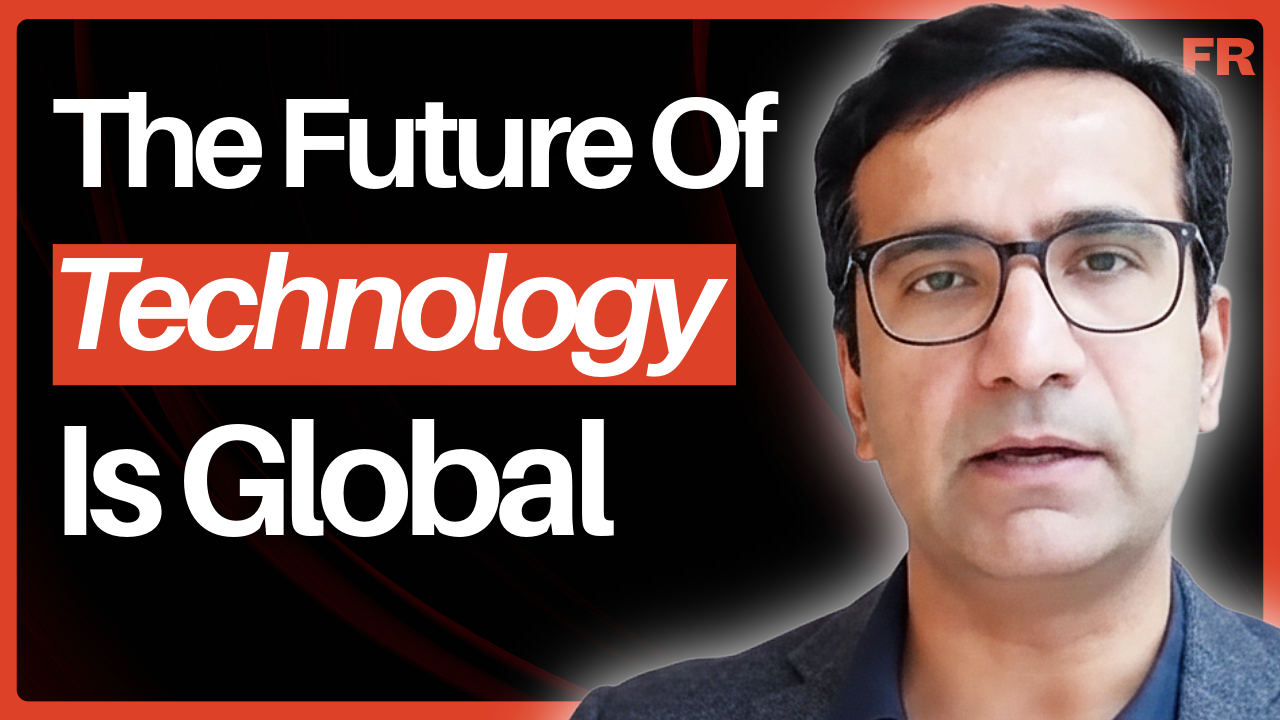
Mehran Gul is an author and researcher exploring the shifting geography of technological innovation and the rise of breakthrough companies beyond traditional Western hubs.
He is the author of The New Geography of Innovation, published by Simon & Schuster (U.S.) and William Collins (U.K.), which charts the emergence of dynamic tech ecosystems across Asia, Latin America, Africa, and beyond. The book originated from an essay that won the Financial Times/McKinsey Bracken Bower Prize for the best business book proposal by an author under 35. It has since been translated and published in China, Japan, Taiwan, South Korea, and Russia.
TIMESTAMPS:
00:00 Intro: The New Geography of Innovation
00:35 Why The West Used To Dominate
01:24 The Global Inflection Point in Tech
01:54 3 Lenses to Map Modern Innovation
04:46 Govtech Innovation in Singapore
06:05 Researching the Map: Lessons from 200 Interviews
07:39 3 Through-Lines of Singapore’s Success
09:37 Beyond the US-China Binary
12:51 The ResNet Case: Why US-China Synthesis is Ending
14:14 Debunking the Silicon Valley "Obituary"
16:58 Why Some Hubs Die and Others Survive
19:42 Talent Density vs. Relationship Density
21:41 The Geopolitics of Capital & Reserve Currencies
24:30 Can You Actually Replicate Silicon Valley?
27:07 The London Paradox: Why UK Startups Exit Early
31:20 Is Europe a Regulator or an Innovator?
34:10 The Hidden Strengths of European Universities
37:13 The Mittelstand: Germany’s Deep Tech Backbone
41:10 China: The "Precocious Student" of Innovation
43:47 Invention (USA) vs. Execution (China)
49:03 Watching India
51:44 Singapore as an ASEAN Launchpad
55:22 Solving the Exit Bottleneck in Singapore
57:23 Switzerland vs. Singapore: Two Small State Models
01:01:42 Why Innovation is a Biological System
01:07:05 Advice for Policymakers: Diversifying the Horizon
01:11:44 Advice for Graduates: Learning to Learn AI
This is the 74th episode Of The Front Row Podcast
My guest today is Mehran Gul, author of The New Geography of Innovation, a Financial Times best book of the year in 2025. This book is a groundbreaking exploration of the shifting landscape of technological innovation and how it has transformed into a global phenomenon, challenging the traditional dominance of Silicon Valley.
In today's conversation, we discuss why, despite China's growing technological dominance, America remains the world's most innovative country, why we should not discount Europe today, and what small states like Singapore can teach the world.
If you look at the old order of innovation — the old map of innovation, as one might put it — how did that look?
Mehran 00:00:48
If you go back about 25 years to the first internet boom, just about all the major technology companies that were globally relevant and that monetised that technology were almost entirely American. And it's not just the internet. If you look at one platform shift after another from the 1970s — whether it's desktops, mobile, social networking, or internet search engines — all of those technologies and all of their monetary value went primarily to one country.
But we do seem to be at something of an inflection point right now where that is changing. It's no longer an American technology-driven world. It's going to be much more diversified. We are most vividly seeing that in the case of China, where it is competing head-to-head with the US in a number of technologies. But my point is that it's not just China — you're seeing a lot of this activity happening in other places as well, in places like Sweden, Canada, and Singapore. That is worthy of our attention and focus.
Keith 00:01:59
Your book opens with a methodology where you use three complementary lenses to map out innovation geography: venture metrics, cumulative market cap, and the global innovation index. Can you walk us through why?
Mehran 00:02:12
When we talk about innovation, we primarily talk about fast-growing companies. But over the course of my research, I very soon understood that this is a very limited way of understanding innovation. Take Singapore, for instance — it's a country that has notably not produced much in the way of globally relevant technology companies. If you look at the neighbourhood, China has produced dozens, South Korea has produced many, but not a lot of technology companies have come from Singapore specifically. And yet at the same time, Singapore is richer than both China and South Korea. If you look at the World Intellectual Property Organisation's rankings, it is ranked as one of the ten most innovative countries in the world. It has more venture capital under management than the rest of the ASEAN region combined.
So you come across all of these examples that don't necessarily fit into our conventional understanding of what innovation is, which means we need to broaden our understanding of what we talk about when we talk about innovation.
I use three different lenses. The first is to look at high-value companies — fast-growing companies — the way a venture capitalist would. But this has an obvious limitation, primarily that in a world where Nvidia is now worth over $5 trillion — bigger than the entire economy of Japan or India — you cannot make the argument that innovation only happens in new companies. Older companies are also innovating, at times more than new companies. Samsung, for instance, sells more smartphones than Apple. One in four smartphones sold in the world is a Samsung.
So the second lens takes into account both new companies and old ones. When the world is looked at through this lens, it looks something like: the US is the head, then China, then Europe, then the rest of the world.
The first two approaches still have the drawback of making everything about financial valuations and high-growth companies. So the third lens is much more multifactorial — WIPO's global innovation index, which looks at everything from the number of STEM graduates coming out of universities to patent filings. That gives you a slightly unorthodox list, led by places like Switzerland and Sweden, and also including Singapore, South Korea, and others.
Keith 00:04:48
I really appreciate the inclusion of something non-financial — the global innovation index — mainly because as a Singaporean, I use the parking app here. Parking.sg is an app most of us who drive around would use. It's government-funded and government-produced. If this were in America, it might have raised hundreds of millions of dollars in venture capital.
Mehran 00:05:16
And that is why Singapore is such a compelling example that I included in the book. A lot of the focus in the Singapore chapter is not on startups or companies. I mention that when you look at GovTech — Singapore's government technical capability — that is as relevant to examine as companies like Grab. I hope that people in other governments can look at the example of GovTech, the agency that built both Singpass and Parking.sg, and say: we don't need to just compete over who has the most unicorns. We can also compete over who has the most innovative government.
Keith 00:06:05
I'd like to double-click further on your research process for mapping out this geography of innovation.
Mehran 00:06:12
I very quickly realised that the only way to do that is to go to those places myself and meet those people myself. If you rely overwhelmingly on secondhand accounts — if you read the usual things like Startup Genome reports — every country looks like it's doing really well, all rainbows and sunshine. But when I go there and really talk to the people, and that's why people are really at the centre of the book, I've tried to make sure I include as many perspectives as possible rather than just my own. I interviewed more than 200 people to write the book, and that's how I got the gut instinct about what's really happening out there.
I came to Singapore as well. I was invited by DGX — the Digital Government Exchange — which is the major event organised by GovTech to get other governments involved in discussing government innovation. So the short answer is: a lot of it had to do with travelling and talking to people.
The map is not a territory — it's not meant to be accurate down to the decimal, but it's supposed to give you a good sense of how a country feels and the different ways in which it's innovative.
For instance, coming back to the example of Singapore: if there are three through-lines in the Singapore story, the first would be immigration. I start with the example of the Croup, which is at this point the largest company Singapore has ever produced — bigger than the next three companies on the stock market combined — and it is primarily a story of Chinese immigrants starting this company. The amount of economic activity that can be attributed to immigrants is something that cannot be underestimated.
The second through-line is the role Singapore is increasingly playing in the ASEAN region. Singapore's wealth was initially built on it becoming an outpost for Western multinationals to expand into Asia. But now it's trying to attract Asian companies — like Grab, which was famously a Malaysian company that moved to Singapore — to serve almost the opposite function: attracting Asian companies to Singapore so they can conquer markets abroad.
The third through-line is government-led innovation, which is what we just talked about. I tried not to make every chapter about one person or one thing, but to have multiple angles of entry to figure out what a place is doing.
Keith 00:09:26
So you're looking at different countries across different metrics, and that gives you a sense of complexity that perhaps the headline narrative of US versus China misses. What are some of the nuances of innovation that you've discovered through this process?
Mehran 00:09:37
If we start with the US versus China narrative and then move on to the more global picture — the first thing about US versus China is that I mention in the book that perceptions about China have lagged reality by about five years. When I first started writing the book, people were still saying that China is primarily copycat innovation, that they don't come up with anything new. Just yesterday, I was watching an interview with Demis Hassabis, and he was still making the argument that China has shown it can be three weeks or six months behind on foundation models, but whether it is able to innovate at the frontier remains an open question.
I mention the example of ResNet in the book — a research paper authored in Beijing that, within a decade, has become the most cited research paper in artificial intelligence, the most cited paper in computer science, and is now the most cited paper in all of science ever. If that doesn't make us question whether we are systematically underestimating what's happening in China, it ought to give us pause.
The second thing I try to address in the book is why we need to expand our scope beyond the US-China binary. First, there is genuinely interesting stuff happening elsewhere. Spotify is the largest music streaming app in the world. DeepMind is one of the most important AI companies in the world. Samsung is one of the most diversified technology conglomerates in the world. But also, if we only ever talk about the US-China binary, that's what it's going to become — because perceptions really drive reality in the tech industry. That's one of the reasons OpenAI can almost achieve a trillion-dollar valuation even though it has only $13 billion in revenues.
We cannot afford for technology development to be about just two countries. If you look at the top ten American tech companies, they're now worth more than the entire GDP of every single country in the world except the US itself. If economic outcomes are already so skewed and going forward we only see technology development in two countries, what happens to Latin America? What happens to Africa? We're already living in a world where the largest company in Africa, Naspers, essentially does nothing in and of itself but simply owns a small stake in Tencent. That's why we need to look at countries other than just the US and China.
Keith 00:12:50
I like the ResNet example because ResNet was a research effort funded by an American MNC — Microsoft — but the paper itself was produced by four Chinese researchers who were born, bred, raised, and educated in China. So in a sense, it represented the best of an East-West synthesis, and that synthesis seems to be on the decline. Is it over?
Mehran 00:13:23
I'm not sure whether the East-West synthesis broadly is on the decline, or whether it's primarily the US-China element that's declining. If you look at Singapore, American tech companies are still present in full force — OpenAI opened an office there in 2024. The collaboration between the US and South Korea is still going very strong. The US often looks at India as an alternative to China, even though there have been some challenges in moving supply chains there.
So while the China story is definitely one of decoupling — Google closed its AI labs there, and there's a lot of pressure on Microsoft to close the MSR lab in China from which ResNet came — there's a bifurcation where on one hand relations with China are clearly tense, but the rest of Asia still seems to be working just fine with the US.
Keith 00:14:16
I wanted to quote you something from your book — an Atlantic article from 2022 that talked about the end of the Silicon Valley myth. The article says that the tech giants that have shaped our lives online and off over the course of the 21st century have at last hit a wall, now ruled by monopolies, marked by toxicity, and over-reliant on precarious labour. Where does this eternal doomerism about Silicon Valley spring from?
Mehran 00:14:59
I think when anything is doing really well, there are always predictions of when that's going to end. It's not just true about Silicon Valley specifically — it's also true about the US as well. I've been hearing about American declinism since the 1960s, just about as soon as the US won the Second World War. Within ten years, people were talking about whether the US is in decline. You always hear these things — with Vietnam, with the wars in Iraq and Afghanistan, there were big predictions about the US being in decline.
Similarly with the Valley: just because it's doing really well, that creates a market for people making predictions about why it won't be important in the future. But at the same time, some of these predictions about other places have come true. Detroit is no longer the centre of the automotive industry. Japan is no longer the centre of the electronics industry. Germany is no longer the centre of the automotive industry either — a lot of that has moved to China.
People tend to assume that what's happening in the Valley is similar to what's happening in Detroit or Pittsburgh. But there's something about the Valley that makes it unique and different. You mentioned that Atlantic piece came out in 2022 — a very unfortunate time, given that 2022 is now the year we look at as when AI really started making an impact, and just about all the companies in the AI revolution, starting from OpenAI to Nvidia, are from the Bay Area. So 2022 is probably the most unfortunate time to be writing an obituary for the Valley.
Keith 00:17:03
You made a very interesting point, which is that hubs sometimes die and sometimes lose their advantage. It is not clear to me why Silicon Valley continues to have such a dominant advantage as the world's premier talent hub and network.
Mehran 00:17:19
There are many different reasons, which I mention in the book. The key one is the flexibility of the Valley. A lot of other hubs are built around a single technology or a single industry — Detroit was built around the car, and the Valley initially was built around the semiconductor industry. But the Valley has been able to move from one industry to the next with relative ease. Within about ten years, Japanese players were out-competing American companies in semiconductors. But instead of sticking closely to that initial technology, the Valley went from semiconductors to desktops, from desktops to smartphones, from smartphones to the internet, from internet to social networking, and now into everything from cars to the space industry.
One reason often mentioned for this flexibility — and this is just one reason I highlight in the book — is that if you go back to the 1970s, it was the East Coast that was the leader in technology in the US, and the West Coast was lagging behind. The East Coast had all these companies like Xerox and Raytheon. Within ten years, it was out-competed by the West.
Dr. AnnaLee Saxenian has worked on this, and her conclusion was that the fact that non-compete clauses were not enforced in California had a big role to play. In California, you could leave your company on a Friday and go work for a competitor on a Monday. Whereas on the East Coast, you had these long careers in the same company — thirty, forty years — and switching employers was really frowned upon.
On the one hand you had a talent hub on the East Coast. On the West Coast, you had more of a talent network where everything was much more connected, and that made all the difference. People often talk about talent density, but we may also need to talk about relationship density — and that was much deeper in a place like the Valley than on the East Coast.
Keith 00:19:44
Can you elaborate a little more about the difference between the talent hub of the East Coast and the talent network of the West Coast, and its relation to talent density?
Mehran 00:19:58
A lot of places in the world have international talent coming and working for them. But not everywhere have they been able to absorb that international talent in a way that makes people feel they're truly part of the environment.
In a place like the Valley, over half of residents speak a different language at home than they do at the workplace, which shows the volume of people coming in from abroad. And yet within maybe five or eight years, these people begin to consider themselves American.
In places like the Nordics, that's still very different. I was recently talking to somebody in the Nordic tech ecosystem, and they told me about a study showing it takes about five years for an immigrant to make friends with a local. The integration of international talent is much more limited. So you have a lot of immigration happening in the Nordic countries, but do those immigrants have relationships with the host community? That remains a big challenge, whereas the US has been able to overcome that problem.
I mention in the book a quote from Ronald Reagan: you can move to France, you can't become a Frenchman; you can move to Germany, you can't become a German; but you can move to America and become an American very smoothly. That has been one of the enduring advantages the US has — it doesn't just have that density of talent, it has the density of relationships that talent forms as well.
Keith 00:21:45
I wanted to ask a geopolitical question. A lot of critiques point out that America's primacy in innovation is contingent on the fact that America has huge access to capital, partly because it has the exorbitant privilege of being the world's reserve currency — able to borrow cheaply and access liquidity that other countries can't enjoy. So the question is: if there is a day where the world no longer uses the US dollar as its reserve currency, how would that affect or slow down the American innovation engine?
Mehran 00:22:32
In the book I really only look at the innovation engine in the US — what does company creation look like? Is there enough venture capital? Are large companies innovating? Are they producing enough smaller companies? I do mention in my conclusion that when you look purely at the innovation engine in the US, it still far exceeds any other place in the world in terms of producing high-value companies and fundamental breakthroughs.
Now, whether political factors might undermine that innovative capacity is a separate question. I also mention in the book that the US might be a victim of too much innovation rather than too little. In a world where just ten American tech companies are worth a third of the entire US stock market — and more than the entire GDP of every single country in the world — that is what has produced the skewed economic outcomes to which we are now seeing a populist backlash.
Whether political factors might kneecap the innovation engine in the US — that could happen. But for me, that is almost outside the scope of the book. I can't simultaneously talk about the dollar as a reserve currency, what's happening in the Republican party, and also devote the time and attention needed to explore why the Valley became the Valley in the first place. Evaluated solely on the merits of its innovation engine, it's still leading the world by a big margin.
Keith 00:24:14
The other question I had was also about Silicon Valley. There are many examples of countries trying to imitate Silicon Valley — trying to become the next Silicon Valley. What is it about Silicon Valley's enduring advantage that no one has really displaced?
Mehran 00:24:32
I try to stay away from two really bad answers that I often get to this question. The first is that centrally designed government efforts never succeed, and you always need something more organic that leverages pre-existing strengths. To a certain extent I agree with that, but I also mention the example of Shenzhen. Shenzhen was a centrally mandated city — the first experiment modern China had with capitalist ideology. The city was literally fenced off from the rest of the country in its initial years so that the experiment wouldn't infect sentiment elsewhere. And it ended up being perhaps one of the most monumental economic decisions made in modern China. Nobody would argue that Shenzhen has not been a massive success story, and that entirely had to do with a central government taking market-based principles and creating a laboratory for them in one of their own territories. In per capita terms, Shenzhen is now the richest city in China.
So I would caution against a blanket rejection of centrally planned innovation efforts, because Shenzhen is a very compelling counter-example. But at the same time, you can't just copy another model wholesale — there are more failures than successes in this area.
The biggest successes I've seen have been countries that came up with their own roadmap. Just because Silicon Valley had Stanford at the centre, surrounded by research institutions and then a lot of venture capital, didn't mean China did it the same way. In China, they first had large companies that monetised a big market, and then went back to build universities and research centres. They essentially inverted the pyramid — companies first, research later.
Keith 00:27:07
The big takeaway I have from your book is that there are many roads to innovation. One shouldn't be too enamoured with the Silicon Valley model, and should appreciate the different pathways through which countries can create value and drive innovation.
I'd like for you to talk a little more about the London paradox, where UK startups rank third globally and perhaps best in Europe — a bittersweet podium finish.
Mehran 00:27:58
A lot of what gets criticised in the UK is the fact that these companies get sold very early, and much of that has to do with not being able to raise late-stage capital. To use one very vivid example: if you look at a company like DeepMind, we talk about it in the same breath as OpenAI and Anthropic. It's absolutely in the top tier of AI efforts in the world. And yet it's different from its American and Chinese peers in one very important respect. OpenAI is now worth something like $700 billion. Anthropic is multiple hundreds of billions of dollars. DeepMind was sold for only about half a billion dollars ten years ago. It is not an independent company — it is a subsidiary of an American tech company.
People like Ian Hogarth, the head of the Foundation Models Task Force for the UK government, have very clearly said that it is hard to argue the UK would not be better off had DeepMind remained an independent company. And you see this in company after company — Dark Trace, a major cybersecurity company in the UK, was sold to Thoma Bravo. Company after company in the UK is either sold off to American partners very early or goes public in US capital markets rather than in London. ARM chose to go public in New York rather than London. Holding on to their most valuable companies has been a real challenge.
The other reason I'd mention is risk tolerance. The risk tolerance you find in Europe and the UK is often lower than in the US, and you see that very vividly in compensation for early employees. In the US, about 20% of an early-stage company is owned by its employee base. In a UK-based company, that figure is around 10%. And the way new companies are made is usually: you work for Facebook as an early employee, it goes public, it creates a lot of wealth for the employee base, and then those employees either start their own tech company or invest in other tech companies. Those repeat cycles of innovation are missing in the UK versus the US, quite simply because employees prefer higher salaries over more stock.
In the book I talk about the comparison between Skype and PayPal — how PayPal created company after company, but Skype did not have as virtuous an effect on its ecosystem. What happens when there's a liquidity event? Does that capital go back into reinvesting in more companies? Or does it get locked up in real estate? Simply being a financial hub doesn't mean the capital flows towards startups when investment decisions are made.
Keith 00:31:23
A few years ago, the EU Commission came out with landmark legislation on how it sought to regulate AI, and critics point out that most of the companies being regulated are actually American. It was seen as a sign that Europe is more of a regulator than an innovator. To what extent is that stereotype actually true?
Mehran 00:31:51
There are two interpretations. The first is the one you're alluding to: when you can't innovate, you regulate. But there's a second interpretation, which is that an overactive regulator very keen on fining American tech companies might just be trying to protect its market from a very active overseas tech industry — creating space for their own companies, in the way China did.
It's only now that you're beginning to see in Europe more genuine concern, especially given what's been happening this year. Over the past thirty years, there was just this assumption that if you have cultural similarity with other groups of people, if you share the same values, then it doesn't really matter if economic relations are very skewed. In my book, I quote a very senior European official who told me that the big eye-opener for them has been the realisation that it's not about values — it's about power. You cannot have the same comfortable assumptions in a world where, over very fundamental issues of geopolitics, they have frictions with a country like the US that for much of the past century has guaranteed their security.
People in Europe are wondering: can they really be sovereign in any meaningful way if for their entire technology stack they rely on one country? The natural corollary is that they either need to develop their own alternatives or diversify their tech stack away from the US. That is an ongoing discussion.
Keith 00:34:07
So what are the strengths of Europe that we should not underestimate? This is a conversation that people don't have very often.
Mehran 00:34:13
The very first one is that people often assume the US does better when it comes to higher education. But there's nuance to that. There's no peer to the US when it comes to the very top of the education pyramid — no other place has a density of places like Harvard, Stanford, and MIT. But on average, it is often noted that European universities do better than American universities. The US has very skewed outcomes in education quality: a handful of universities are the best in the world, but the average American university student's educational experience may not be at par with the average university student in Europe.
Europe doesn't have these superstar universities, but the median is much higher. I mention in the book the case of graphene, which was discovered at the University of Manchester — far beyond what would be considered a top-tier prestigious Western university — which shows that the UK's bench strength in top-tier research runs very deep. The quality of talent coming out of Europe on average is still often believed to be much better than that coming out of the American education system as a whole.
Europe also still has these older companies like BMW, Siemens, BASF, and Peugeot. At this point in time, they're not very keen on M&A activity with early-stage startups — the culture of working with new companies is a very weak one. But that's something a lot of governments are trying to change, getting these older companies to be customers for newer companies as well. That capital is available; the culture just needs to change for it to find its way to newer companies.
And Europe is still an aspirational place for international talent. It attracts a lot of people globally — the UK attracts more people per capita than even the US. So there are still quite a few cards that Europe has available to play.
Keith 00:36:47
You pointed out an interesting example of Germany, and that reminds me of a conversation I had with Professor Keyu Jin, who talks about China aspiring to be more like Germany than like the US. In Singapore, we also take inspiration from Germany as a deep tech hub. What is it about Germany that allows it to become a deep tech powerhouse?
Mehran 00:37:18
The role Germany plays in the tech industry is often a discreet one, and the reason for that is we tend to equate successful tech with big companies — the Facebooks and Amazons of the world. But in Germany, it's a very different model. They have these big companies like BMW, Siemens, and BASF, but the backbone of German industry is really these smaller family businesses — the Mittelstand — which are companies that employ around 500 to 1,000 people, never go public, and are passed from one generation to the next.
Within the Mittelstand you have examples of globally significant technology companies. I mention two notable examples in the book. The first is EOS, by far the world's most successful 3D printing company, whose CEO and founder Hans Langer is the only person in the world to have made a billion-dollar fortune in 3D printing. They are not just leaders in the older generation of 3D printed objects — in the space industry, they have over half of the entire market, with customers ranging from Blue Origin to SpaceX. Similarly, Herrenknecht, a tunnelling company, is a leading maker of tunnels, with projects ranging from the New York subway to the subway in Doha. They compete with Elon Musk's Boring Company, which is less talked about — the difference being that Herrenknecht has completed more than 3,600 major projects, while the Boring Company has completed only one in its seven years of existence.
Germany has a very deep bench strength in high-tech companies. They're just not very visible because they tend to be family businesses that always operate at a smaller scale, simply because they never go public and don't raise the external capital that could help them grow — and maybe that's one of the things structurally holding back the German tech industry.
As for what enables that culture in the first place: if you go back 100 years and I were to have this conversation about the top three technology powerhouses in the world, the list would be the US, the UK, and Germany. Of the industrial era, Germany was certainly one of the most significant technology powers in the world, and that has created a legacy of institutions — the Max Planck Institute, TU Munich — representing this long tradition of engineering excellence.
In my book I talk about how in the aerospace industry, some of the earliest pioneering attempts were made by German engineers. The first man-made object sent into space was sent by Germany. The earliest jet propulsion engines were made by Germans as well. Of course, Germany eventually ceded much of this preeminence to the US, simply by virtue of the fact that many German engineers from their space programme ended up moving there. But the universities they have, and the culture of manufacturing, have meant there is a very strong background in deep tech and deep engineering.
Keith 00:41:15
Western discourse often frames China as either a copycat or an existential threat. But you reframe that as the "precocious student." Help me understand why.
Mehran 00:41:26
When we talk about China versus the US, we very often think they're competing on similar terms. But when you look at the two case studies in detail, there are nuances that people tend to miss.
Some of the most notable examples of major breakthroughs in tech that have happened recently — whether it's large language models, transformers, electric vehicles, autonomous driving, or solar — the fundamental breakthroughs that enable these technologies are still coming primarily from the US. The invention side is still very heavily skewed towards the US. But where China runs away with the game is in deploying these technologies in industries and everyday life much faster than everyone else.
One way to put it: the US is really good at going from zero to one. China is really good at going from one to one hundred. Another way it's often described is that the US is really good at putting up ladders, and China is really good at climbing them.
There is an acknowledgement within China itself — Keyu Jin was telling me — that China's near-term innovation advantage is not that it will out-invent the US, but that it will out-execute the US. All the technologies I mentioned — EVs, autonomous driving, solar, robotics — none of these were really invented in China. But for all of them, the scale of adoption on the mainland is now greater than the rest of the world combined.
So the old China playbook was to take business models and technologies already doing well in the US and replicate them in China. The new China playbook is to find new technologies wherever they may have been invented around the world, and then put them into place faster than anyone else. That's where the idea of the precocious student comes from — there is an acknowledgement that the US is still leading, but when it comes to learning quickly and scaling rapidly, that is where China has an advantage.
Keith 00:43:52
So in a certain sense, the US values invention more, whereas China values execution velocity much more?
Mehran 00:44:04
I'm not sure it's a matter of what they value more. I'm sure China would love to have more fundamental breakthroughs as well. But that takes a long time, and there are some institutional changes that need to happen first. I had a very senior technology executive in China who spent a lot of time in both US and Chinese tech companies tell me that a lot of these shifts will have to be psychological — the Chinese education system still does not engender the cognitive flexibility, the questioning of doctrine, or the creative thinking that would allow consistent major breakthroughs. Whereas in the US, the immigration culture and the liberal nature of the university environment create the macro conditions for those innovations to happen.
So I'm sure China values invention just as much, but there are structural constraints which may take a generation or two to overcome.
Keith 00:45:15
And you made the point that America has the privilege of drawing from a population of eight billion people, whereas China effectively draws from one billion.
Mehran 00:45:28
Yes. And the interesting fact there is that less than 1% of China's population is foreign-born — and that's as true for places like Beijing and Shanghai. If you look at Toronto, a third of the people living there have immigrant backgrounds. Over half of the people living in a place like San Francisco speak a different language at home than at the workplace.
In proportional terms, North Korea gets more immigrants than China does. We tend to think China has a massive labour market because it has a billion people. But the US is drawing from over eight billion people, despite all the pushback against immigration that has happened in the past year. H-1B numbers are still going up, not down.
Keith 00:46:25
No country has suffered more from the H-1B caps than India. Seven out of ten H-1Bs are given to people of Indian origin. When they instituted the $100,000 cap last year, there were predictions this would lead to a massive decline in applicants from India. This year, application numbers have gone up by 10%, not down. That's a testament to the fact that the US, despite all that's happening there, is still a much more attractive option for many people than their home countries.
You earlier pointed out that there's some structural rigidity in the Chinese system — particularly in the way it executes education policy — and yet at the same time it's been rapid in adoption and deployment, which also requires openness and willingness to experiment with technology that isn't fully figured out yet. How does one square that circle?
Mehran 00:47:28
I think adoption at that scale requires less openness and more discipline. It requires deep case knowledge and engineering excellence, which China has. There's also an argument I hear that you cannot separate the manufacturing side from the invention side, because the two work hand in glove. You need to know how things are made in order to understand what's possible in practice. And that is what the US has lost over the past decade by outsourcing manufacturing to China — they've outsourced all the tacit process knowledge that goes into making things.
That's a valid point. But I'll believe in consistent Chinese breakthroughs on the invention side when I see them consistently — which is still not happening frequently, except in certain industries. In the EV industry, I would say China is much further ahead than any other country, which is an example of what you're talking about: you start with execution and then work your way backwards into becoming a world leader in bringing new ideas to the table. Whether the EV industry is an early signal of what other industries will look like — that's something we'll see in the coming years.
Keith 00:49:08
Where does India fit in all of this? I'm surprised India didn't feature more heavily in the book.
Mehran 00:49:14
The eight countries I've discussed are not a ranking of the most innovative — it's a mix of the three approaches I described at the beginning, and I've tried to discuss a mixture of places across each of them.
India is obviously a big market. But when we talk about the foundation models race, for instance, I see a lot of contributions coming from the US and from China, not so much from India just yet. There were certain pockets — the space industry there is doing really well — but I didn't see anything happening on a much broader scale that would make me say this is a country that really needs to be right up there alongside the US and China in this book. There's a lot happening there, a lot of high-value companies monetising their domestic market. But I tended to prioritise countries that either gave me a new model for innovation — like Singapore — or that were producing major breakthroughs, or outperforming in specific areas like China's execution.
Part of me also wonders about the Gulf countries, like Qatar and the UAE, which have been spending hundreds of billions on AI infrastructure. There's a lot happening in France right now. Vietnam is producing its own EVs and recently had an acquisition from Nvidia. In the end, the ones I prioritised were places that had something genuinely distinctive going on and that spoke to the three lenses I described in the introduction.
Keith 00:51:49
You previously alluded to the example of Singapore. As a young Singaporean myself, I'd love to hear more about what surprises you found, and maybe some of the things that I, as a fish in water, might take for granted about Singapore's innovation ecosystem.
Mehran 00:52:02
The inversion happening in Singapore really struck me — the shift from being the outpost for Western companies trying to go into Asia, to now fishing for interesting companies in the wider ASEAN region. Singapore wants more companies like Grab to come and be based there, to serve the wider ASEAN market. This is the hub for companies that can do that.
It's a model I'm seeing replicated. I've just come from Dubai, and they're now thinking about their role in very similar terms to the way Singapore relates to ASEAN. Dubai is trying to become the hub for the rest of the Middle East — stable government, predictable rules, zero tolerance for corruption — and then serve the wider regional market.
What makes that meaningful is the contrast with Europe, which is still a very fragmented market. No one country has been able to become the hub for pan-European companies in the way that Singapore is the natural hub for companies that want to monetise Indonesia, Malaysia, and the wider region. That might seem like it's not saying much, but it actually is.
Another thing that was quite striking was the extent to which the Singaporean government is willing to step up and fund early-stage companies. The biggest hurdle for most entrepreneurs is getting that first $100,000 to $500,000 to get a company going. My impression in Singapore was that as long as you're associated with a major university, it's not that hard to get that seed capital. That's not something that's available in most other places.
Similarly, the extent to which the Singaporean government supports people who gain admission to top-tier American or UK universities — offering scholarships and that kind of support — is again not a facility that's available to people in other countries.
Keith 00:54:37
You're right in saying that. Recently in our economic strategy review, one of the key thrusts was that Singapore was not going to be just a landing pad but a launch pad — where startups looking to internationalise in the region can come to Singapore and start building their companies even in the very early days.
The obvious follow-up question is: what are some of the bottlenecks that you've seen in Singapore's innovation ecosystem?
Mehran 00:55:20
The big one is pathways to liquidity events — exit opportunities. That's a structural challenge and it's hard to see how you overcome it without addressing the elephant in the room, which is China.
There are few domestic exit opportunities because Singapore doesn't have the pre-existing large platform companies that exist in most other places. How do exits happen in places like the US? Either a bigger company buys you, or you go public. That first option is simply not available to most companies in Singapore. Which is why some of the largest acquisitions of Singaporean companies that have happened recently have gone to Chinese buyers — and that has become controversial, both in terms of Chinese companies setting up shop in Singapore and acquiring Singaporean companies.
So if that major source of M&A is excluded, the big question becomes: even if you do have high-value companies, where do they go? Can you go public in Singapore? The public markets there don't yet have enough capital to achieve the valuations that companies like Grab have achieved — and remember, Grab went public via SPAC in New York, not in Singapore. And if you don't have your own big tech companies that can acquire you, are American and European companies willing to step in? If not, is it desirable or acceptable for Chinese companies to fill that void? It's a very contentious topic and has become very geopolitical. So I'll leave it as a question rather than a statement.
Keith 00:57:13
In a certain sense, we mirror London's dilemma — a lot of UK-based startups get acquired by their American counterparts, and in Singapore, a lot of our startups get acquired by Chinese companies. It's a common dilemma we both need to resolve.
I wanted to ask about another country Singaporeans look up to: Switzerland. Most people think of Switzerland as a country of skiing, cheese, and pleasant weather. What can the world — or maybe even Singapore — learn from Switzerland?
Mehran 00:57:50
It's interesting that you draw the comparison between Singapore and Switzerland, because in one way they're comparable, and in another they're almost exactly the opposite of each other.
The state plays an expansive role in Singapore — very centralised, very much led from the top, to the extent that people sometimes raise privacy concerns. Switzerland is exactly the opposite: a very decentralised country, with power completely devolved. In Singapore, there's one individual whose shadow is much longer than any other person in the country's history. In Switzerland, it's a committee of nine people that runs the country, and you don't really have these single iconic figures associated with its political structure.
I compare the two countries in the book through the lens of contact tracing during COVID. The Swiss system was completely decentralised and anonymised — those databases could not be used for any reason other than COVID contact tracing. In Singapore, it was a very centralised system, and the databases were subsequently used for other investigations as well.
Two small, highly successful countries approaching the same problems in completely different ways — that comparison is genuinely valuable.
What can Singapore learn from Switzerland? Switzerland has played an outsized but often discreet role in technology on the international stage. If you look at the big technology revolutions of the past thirty years, the worldwide web would absolutely be among the biggest. The fact that the world's first website was not a .com or a .gov but a .ch domain tells you everything about the outsized role this country often plays in the tech industry.
Switzerland's deep tech credentials are pretty extensive. Its universities — ETH Zurich, for instance — have alumni that include Einstein and John von Neumann. So Switzerland has a longer tradition of both higher education and deep technology that Singapore, which does have an appreciation for those things, can perhaps learn something from.
Keith 01:01:14
The reason many of us have such admiration for Switzerland is that it's a multicultural, multi-racial society that has lasted over 700 years. It has built world-class institutions — not just companies, but also nonprofits. One thinks of the Red Cross. For a country to survive for 700 years, that's something we as a young nation take real inspiration from.
You provocatively argue in your conclusion that cultures are not like biological systems — they are biological systems. They're social organisms with technological fertility. How should we better understand the link between culture and innovation?
Mehran 01:02:00
The reason I mention the cultural connection is that I'm really arguing against the explanation given by Matt Ridley, which is that innovation is simply a product of liberty and wealth. We rarely talk about Norway when we talk about the world's most innovative places — it's a country that is very free and very rich, and yet when it comes to groundbreaking inventions, especially the tech company type of innovation, it's not a place that comes up very often.
Using the cultural lens — both on the macro level, where I do think cultures at large operate as distinct organisms rather than simply collections of people — is worthwhile. An organism, in the way that there's been so much research on emergent systems: a beehive is an organism that is independent of any collection of individual bees. Every single element of that system can die over time, and yet the system survives. Looking at cultures that seem more innovative in order to understand the cultural attributes that make them that way, I think, is a very worthwhile exercise.
This is independent of the more theoretical explanations — it happens where you have a lot of universities, a lot of venture capital, a very liberal environment. I can point to five or six places around the world with all of those attributes: Norway, Japan, Russia used to be very innovative, Germany stopped being very innovative at certain points. That's why I think having a more cultural approach — looking at each country and asking what makes this place more fertile ground for new ideas than others — is more useful than listing out universities, research institutions, and all the rest.
Keith 01:04:20
Also, a randomised control trial seems insufficient for understanding what innovation actually looks like. You can't just look at the numbers and compare like for like. Just because two places — say, New York and London — are both financial capitals doesn't mean the numbers alone explain the variance in the kinds of startups and innovations they produce. You really have to walk the ground, be present on the soil, breathe the air to understand the vibe of a place.
Mehran 01:05:05
Which is why I would also question the WIPO global innovation index. There are certain things you really cannot capture through statistical methods — for which you do need to go and breathe the air.
If you go to Sweden, things that people mention very frequently are that it's a very flat culture, a culture of informality. I remember talking to a Swedish billionaire who, when I set up the meeting with him, just told me to call him at a certain hour. When I did, he was driving his car. He simply parked on the side of the road, took the call, and we spoke for about ninety minutes. It's not a very hierarchical society in the way that Japan or Korea is.
In Sweden, they often make comparisons between the Germanic engineering culture and the Swedish engineering culture. In Germany, as they would explain the difference: engineering is supposed to mean you receive a set of instructions and execute them exactly as written. Whereas in Sweden, the engineer will always try to tailor the approach to their own preferred way of doing things.
These cultural attributes — how different people behave in different countries — you cannot capture neatly in economic models. But they absolutely drive behaviour and outcomes just as strongly as institutional factors. I feel like there is still not a very strong appreciation for that.
Keith 01:06:59
So if you were to advise a head of state today, how would you advise them in creating a more innovative society?
Mehran 01:07:05
I would advise looking at more examples than they currently do. When we talk about innovation today, most policymakers are indexing themselves against high-value companies — how many unicorns do we have? Even in China, right down to the domestic bureaucracy, the big goal that has to be delivered on is how many unicorns have been created in your environment.
I would like more governments to ask themselves the question: how do we have a government agency like GovTech? How do we have government-led innovation like Parking.sg or Singpass?
I would also like more places to question the Western assumption that technological progress happens by old companies being replaced by new companies — the IBMs and Xeroxes being replaced by the Microsofts, which get replaced by the OpenAIs. If you look at a place like Singapore or South Korea, it has operated very differently. Hyundai started as a construction company — today it's the bestselling EV brand in the US after Tesla. Samsung has been around for almost a hundred years, started by selling noodles, and today is going aggressively into frontier areas: semiconductors, smartphones, biologics.
How old companies innovate is a question that Singapore and South Korea have perhaps answered better than other places. If I were talking to a policymaker, I would tell them: the world today is different from thirty years ago. You don't just need to look at what's happening in the Valley or in Austin. You also need to look at what's happening in London, Sweden, Shenzhen, Singapore, Seoul.
Keith 01:09:18
It's interesting that you pointed out the chaebols in South Korea. It got me thinking about Nokia — a company that started as a paper company, went on to produce smartphones, and now makes telecom towers. In a certain sense, Nokia did solve that problem of how old companies can actually innovate.
Mehran 01:09:45
How I would describe it is: we used to think of technology as a hierarchy. Something new happens in the Valley — e-commerce starts with Amazon — and the assumption was that we'd have something like Amazon in the UK two years later, and something like Amazon in the Middle East five years after that. Same for social networking.
But now we have examples where it's more like having zones of interest. If you want to know what's going to happen in EVs, you really need to keep China front and centre in your mind. I'm sure you've seen videos of the Xiaomi SU7, and the features that car has. I think very soon, a lot of American customers will be demanding those same features from their own carmakers — even if Chinese EVs can't be imported into the US, the fact that a better experience is available somewhere in the world means people will start demanding it elsewhere very soon.
If you want to know what's happening in the gaming industry, maybe it's worthwhile to keep an eye on the Nordics. And I wouldn't limit that to gaming, given the increasing overlap between gaming and education. How do you create engaging content for young people who get distracted very easily? For people in edtech, maybe the Nordics are a more interesting place to watch than the Valley.
In short: open your eyes, diversify your horizon, broaden your perspective, and take in more data than you otherwise would.
Keith 01:11:24
I come to my last question. Mehran, you have travelled extensively and researched deeply. If there's one piece of advice you would give to a fresh graduate entering the working world today, what would that be?
Mehran 01:11:49
We didn't go very deep into AI in this conversation, and I'm glad about that, because too many conversations get hijacked by AI and what it means for jobs. Anyone graduating from university today has front and centre in their mind the question of how they stay employed and how they deliver on the economic expectations on them.
With all the fear and concern about AI out there, I see very few people who actually know what's happening in the AI space beyond LLMs and foundation models. I see very few people using AI beyond the usual ChatGPT or Claude. The range of AI tools available is much broader than that — you can use AI literally as your assistant to book meetings for you, manage your inbox, and so on.
So my primary advice would be: don't fixate on specific tools, but learn how to learn what's happening in AI very broadly. Learn about tools beyond just ChatGPT, and become really good at incorporating AI into your everyday life.
I'll give you one example. I rarely get enough time to read books because I'm travelling extensively. So I now very often just upload a book to NotebookLM, which turns a book into a podcast. On the go, I can listen to a book in an hour. And it's a very compelling podcast that NotebookLM produces. I'm just using this to illustrate that there are a lot more AI tools out there than one. Try and become very comfortable with using all of them — because I think that's really going to be the secret to competing in the future. The question is: are you using AI better than the other person?
Keith 01:13:32
Mehran, thank you so much for coming on the show.
Mehran 01:13:35
Thanks so much for having me. This was a very interesting, wide-ranging discussion.