How Europe Can Adapt In A Multipolar World - Mato Njavro
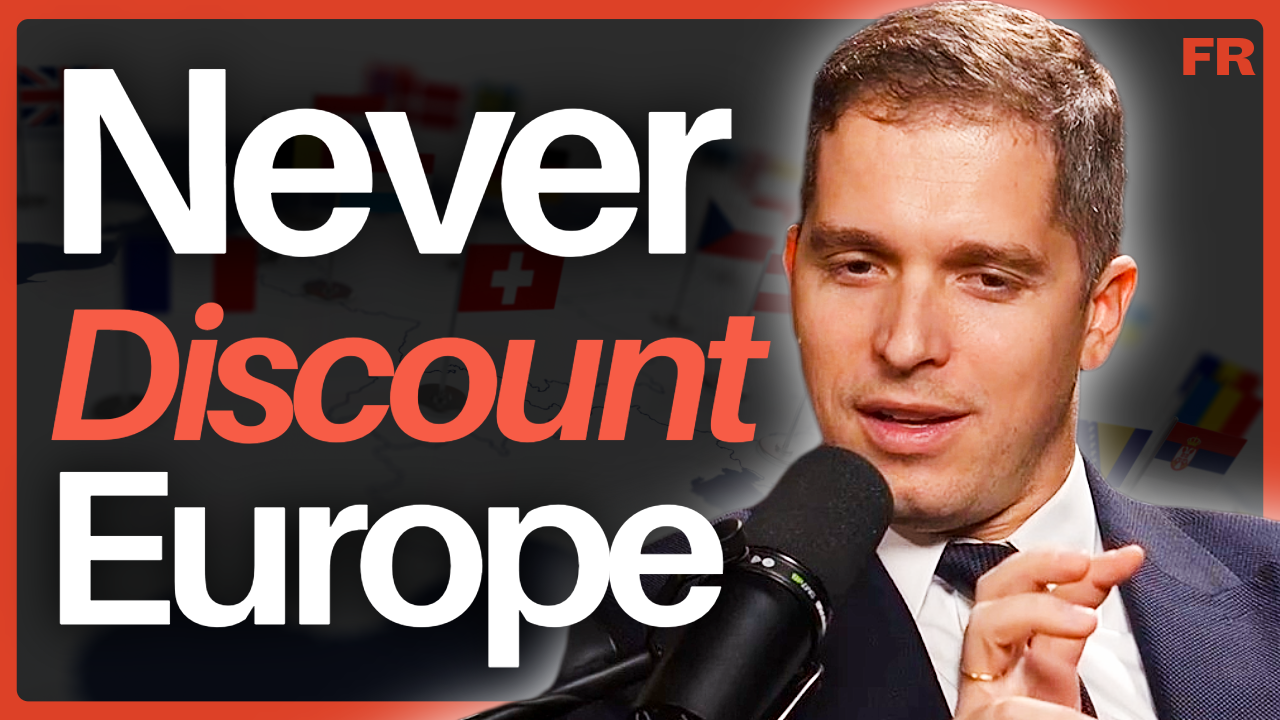
Dr. Mato Njavro is the Dean of Zagreb School of Economics and Management. Mato is also Professor at the Zagreb School of Economics and Management, the Luxembourg School of Business and a lecturer at the University of St.Gallen and at the Singapore Management University, where he teaches a course on Chinese Economy.
From 2016 to 2020, Mato was based in Singapore where he was a Senior Research Fellow at the St.Gallen Institute of Management in Asia (SGI-HSG).
CHAPTERS:
00:00 Introduction and Trailer
01:18 Croatia's Path to Europe
12:00 Defining European Identity
18:04 Migration and Social Cohesion
24:05 Ukraine Tests European Unity
30:06 Europe's Strategic Autonomy
33:39 Transatlantic Financial Integration
36:02 Economic Resilience Under Pressure
40:55 Confronting China's Rise
45:26 Europe-China Cooperation Potential
49:42 Competing in the Chinese Century
54:49 Broadening Asia-Europe Dialogue
57:38 Europe in a Multipolar World
01:01:29 Counsel for Future Leaders
Today I have with me Dean Njavro from the heart of Europe, from Croatia, joining me on today's podcast. We'll be talking about the future of Europe. What does it mean for Europe to thrive in a multipolar world? What can we actually learn from Europe and maybe some of the challenges facing Europe today? So it is with my great privilege that I get to welcome Dean Njavro on. Dean, welcome.
Mato 00:01:17
Hi Keith. Great to be here. Thank you for inviting me.
Keith 00:01:23
You're the Dean of the Zagreb School of Economics and you're in Croatia. You're the last member country to join the EU in 2013. Since then there's been no country that has joined. Croatia actually joined in what many people call the crisis years, the post-2008 financial crisis. There was a fallout then. I wanted to ask you what kept Croatia optimistic about the European project that they continued with the accession process.
Mato 00:01:47
Absolutely. Look, in 2013 Croatia officially joined the European Union. Last year we finished that integration—we joined Schengen and now we are also a member of the Eurozone.
The reason why we joined the European Union is quite simple actually. Almost all of these Central and Eastern European countries, whether it's Croatia, Poland, or the Czech Republic, all of them that became independent after the fall of the Berlin Wall were deeply European. The population felt deeply European and there was a sense that their destiny was as members of the European Union.
Unlike our friends in Poland and the Czech Republic, Croatia had pretty difficult years in the 1990s. The country has been independent only since the beginning of the 1990s, and unlike our friends in other parts of Central and Eastern Europe, we had to fight for our independence in a pretty brutal war. However, there was always a sense among our population and among our leadership that Croatia's destiny is inside of Europe.
Ever since the country became independent, the political elites together with the people were working hard to join the European Union. The point I want to make is the EU still has quite a lot of attraction for all these smaller countries such as Croatia, and even those that are not yet members of the European Union.
At the beginning of this year, Romania and Bulgaria joined Schengen. The European Commission put out this really nice video on their website showing how Europe is blue all the way from Lisbon, and you can drive 3,500 kilometres from Lisbon to Bucharest in Romania. It's all part of this Schengen zone.
Schengen zone, for our viewers who might not know, is basically one single area where if you're Croatian or Romanian now, or Polish, French, or Italian, when you go visit another country you don't need any documents. It's basically a borderless area.
However, to this day the European project has developed very well. It has integrated many countries—now we have 27 EU countries—but the integration has not finished. If you look at the video I was talking about by the EU Commission, Europe is blue all the way from Lisbon to Bucharest, then Greece. But in the middle of Europe, very close to my region, Croatia, there's still like a dark grey hole on this video—the countries that have not yet joined the EU. Bosnia, Serbia, Albania, Montenegro—they're all in the process.
The EU for a European country such as Croatia was instrumental. I remember well the days when I just started elementary school in the 1990s. The war was starting to break out. The 1990s were tough for Croatia. We ultimately became independent, and as we started the process of joining the EU, the country started changing a lot. The country started transforming.
The infrastructure—we built roads, beautiful road networks, we built airports, new ports. None of that would have been possible really without this integration with Europe. Today if you go to Croatia, you land at a beautiful airport in the city of Zagreb. If you want to go to the most famous city in Croatia, probably Dubrovnik, a jewel of the Adriatic, you rent a car in Zagreb, you drive 700 kilometres all the way down south on a beautiful road, then you cross a beautiful bridge before entering Dubrovnik.
My point is the country has transformed itself. Infrastructure has been significantly upgraded, the entrepreneurial ecosystem has developed, and without the EU membership it would have been difficult to envisage all of this transformation.
Keith 00:06:37
There's a contrast there because in ASEAN the challenge has always been—and this is something that Gita Wirjawan makes a critique of—that we shake a lot of hands, we smile a lot, but nothing really gets done in the sense that the poorer countries don't get the kind of lift from the richer countries or there is no developmental support.
Mato 00:06:56
ASEAN is much lighter, I would say less ambitious maybe, than the EU. The EU, if you want to understand it well, you need to go back to the beginnings. It started from the ashes of the Second World War in Europe. It was envisaged as first and foremost a peace project, a project that would economically connect Europe so that never again could we see the type of destruction that Europe brought on itself during the World Wars.
In that sense it was an extremely ambitious project. It evolved into something today that is a very unique animal. It's an entity that contains basically 27 countries. It's an entity that has made many successful projects such as Schengen, such as the fact that the euro as a currency has really become one of the leading reserve currencies of the world after the US dollar. Without the European Union there would be no euro. Without the euro, Europe would not be a united entity.
As the Dean of the Zagreb School of Economics and Management, all my students are very familiar with one of the most popular projects created as a result of the EU, which is the Erasmus project. This essentially enables any European student, wherever they study—whether it be in France, Italy, Spain, Croatia, or Poland—to spend a semester at any other European institution, at any other country, and that semester is financially supported by the European Commission.
It makes it easier for people to create their second identity. In Europe we all have at least two identities. Your first identity is your country, but the second identity that the Erasmus programme has helped build is this European identity. My students—they're Croatian, but when they go to Rome, Italy, when they go to Berlin or Paris, they feel almost like at home. That was the point of this Erasmus project. And it was a massively successful project.
But having said all that, yes, you're right. There are still many unfinished jobs. Europe is an unfinished project both in terms of integration—there are still countries that need to be integrated—and also there are many other challenges as the world is changing.
Keith 00:09:49
The follow-on question I had maybe has to do with the spirit or the core of it, which you alluded to earlier—that even as a Croatian before joining the EU, there is a strong affinity for this European identity. Where do you think that springs from?
Mato 00:10:08
It springs from our common history that we share. Croatia as an independent country exists only for the last 35 years. Before that we were part of various different countries or empires. First it was the former Yugoslavia, but before that, large parts of Croatia were part of the Austro-Hungarian Empire.
This sense that we share the common destiny with our European neighbours, whether it's Italy, Austria, Germany, or France, just stems from the fact that historically we have always been close to them. Geographically we are practically in the heart of Europe. If you look at Europe, we're in the heart of it.
But everything I say for Croatia, you can apply to any other Central European country. There's just a common sense of destiny that European countries share when it comes to their will to be part of the European Union.
There's a consensus among the population. There's nowhere else for us to go. We are simply Europe.
Keith 00:11:30
When you have 27 countries in a union, there's a lot of trade-offs that you have to make maybe at a governance level. A good example is one of the big challenges that I think Europe has faced in the past decade—the issue of immigration or the refugee crisis. When you have Schengen, different countries might have different policies, but because of this borderless approach towards managing human flows, you might face the spillover effects of another country's policies. How do you see that challenge creating tensions within the EU today?
Mato 00:12:13
Immigration was and certainly still is a massive issue, not just in Europe. I would say the genie is out of the bottle on that one. It's a big issue as we can see in the US, but in Europe also.
Look, Europe today, if you look at it as an entity, with all our challenges and issues, is still one of the most developed places in the world where the standard of living is the highest. EU countries are among the richest in the world in GDP per capita. If you look at the geography, on the south we have Africa, on the southeast the Middle East. There's simply hundreds of millions of people living in much poorer conditions than Europe, and for many of them Europe is the place where they want to go because it is where they see a better future for their families.
Croatia, obviously being part of the EU, has been one of these transit zones where many of the immigrants—for instance after the Arab Spring, after the troubles and after the ill-conceived attempts to destabilise countries in Northern Africa and the Middle East, whether it's Libya or Syria—there's been tremendous pressure of immigrants to Europe. Many of them were crossing through Croatia, but Croatia was not their final destination because they were set to go to other places such as Germany or Scandinavia.
It is a problem that no single country in Europe can solve. It is a problem that has to be solved at the level of the European Union, at the level of the EU Commission. And it is really a problem that if you want to be serious about it, you have to start basically at the source.
If you just think about it—look, Africa in 2050 will have almost 2.5 billion people. One in four people in the world will be African. I'm talking about the whole continent of Africa. Europe has around 450 million people. If Europe somehow doesn't engage itself with Africa and start developing Africa, starts building up on a massive scale or helping build Africa, there will be tremendous pressure of future immigrants from Africa to Europe.
Can Europe do it by itself? Probably not. Who is very active already doing these things in Africa? It's China. One of the ways to try to combat this future issue of immigration is to try to see what we can do as Europeans at the source and try to develop or help develop African countries so that there's more opportunity there so that they don't feel obliged to try to come to Europe.
The issue of immigration is huge. Every country in Europe has their own problems with it—some have more, some have less. Today, countries like Germany, France, there's a big pushback, UK big pushback on this type of illegal immigration. We're talking about illegal immigration, people coming from outside of Europe to Europe. We're not talking about intra-European movements, because if somebody moves from Croatia to Germany, that's not going to tilt the scale. That's not a problem.
But when a million refugees come from Syria and Libya, then that's a problem. There's a lot of pushback on that. This is the reason also why many political parties have been making a strong case, putting immigration at the centre, and this resonates with quite a lot of voters. In countries like Germany, in countries like France, you have very strong anti-establishment parties who are putting immigration at the core.
Keith 00:16:45
If you use the immigration issue as an example, the follow-on thinking or the consequence would be that people within Europe might be disillusioned with the EU project altogether because what you're experiencing at that level is a form of spillover effects. The financial crisis is another good example post-2008, where some countries might feel that I'm giving up a certain level of autonomy for integration. Then it's the trade-off, because in Southeast Asia it's the reverse—you keep all your autonomy but you have very little integration. My question to you is, do you think there is now greater disillusionment with the EU project in general or does it still remain strong and something that people are as optimistic as you are today?
Mato 00:17:32
I would say certainly the countries that have joined the EU towards the end, such as Croatia, Poland, the Czech Republic—those countries have benefited a lot over the last two decades, and those countries' populations still share a very pro-European sentiment. It is also those countries that have not suffered from huge amounts of illegal immigration because those countries were the transit countries. Generally, the illegal immigrants didn't end up in Poland or in Croatia—they went to Germany. Many of them went to France, some to Italy.
There is this Central and Eastern European bloc that is still very much pro-Europe. But I would argue that even the core European countries, the ones that were there from the start—Germany, Italy, France—even Italy, where currently in power we have Prime Minister Meloni who is on the right side of the political spectrum, even though she was the one who put the issue of immigration at the core of her political efforts to try to find a solution to that problem, once she became Prime Minister, she never questioned really Italy's role or place within the EU.
My sense is, especially given how the world is developing and we're going to some kind of a multipolar world, there is an understanding in Europe among almost all major European countries that there's no alternative to the EU. If we are divided, then in this world of big superpowers, any European country alone is almost irrelevant, even the strongest one—Germany or France. Only if we are together, united under the EU umbrella, do we have some chance of managing through these challenging times that we are having and that certainly in the future we're going to have more of.
My point is, look, there are many challenges and issues, immigration certainly being one of them, but whether people or our elites or our leadership is questioning whether the EU itself should exist—I think that is not the case. There's strong support for the EU because with all our challenges, so far the EU has been a success project, a stabiliser.
Now, could it have developed faster? Could it have done more to adjust to the new world realities? Certainly. But it's still been a major success project.
Keith 00:20:29
The whole Russia-Ukraine war—we're starting to see that within the EU there's been certain divergent modes of thinking. I wanted to ask maybe specifically on that question, which is, when you look at what's happening in Ukraine from your perspective as someone in the heart of Europe...
Mato 00:20:46
Most of the European leaders as well as the EU as a whole has wholeheartedly helped Ukraine as much as the EU could have done, both in terms of financial support, weapons, and in terms of opening up and making it easy for refugees from Ukraine to find a temporary home.
Some countries like Poland have taken a lot of Ukrainian refugees. Croatia has taken some. However, among the European leaders there's not a singular consensus on that. There are more and more voices—Hungary is an example, Slovakia is an example—where they are questioning the orthodoxy on this particular issue.
So there is no consensus in that sense, but most of the European leaders have wholeheartedly been helping Ukraine. But this is the biggest war in Europe since the Second World War. Before this war, the biggest war was in my neighbourhood—actually in my country and the neighbourhood, Bosnia. Now this is overshadowed by the massive Russian-Ukraine war.
It's obviously a huge problem for Europe actually, because while not directly—we're not directly in war—obviously it's the Ukrainians who are doing all the heavy lifting and fighting heroically. I mean, it's absolutely impressive what they have managed to achieve and how they have managed to defend themselves.
But indirectly, Europe is essentially supporting Ukraine, and it's a big problem for Europe actually because a lot of our efforts, a lot of our resources are going towards this war that does not seem to be ending. It just seems to be a kind of a long protracted war of attrition, and it's a huge problem for Europe.
I would say even in the countries where there is total support for Ukraine among the top elites, the parties, there are some political parties that are gaining more traction that war should be brought to an end at almost any cost. So it's a huge problem for Europe. Absolutely.
Keith 00:23:44
Because you're investing a lot. I mean, you're spending a lot of resources, right?
Mato 00:23:50
Absolutely. I mean, Europe is rearming. Brussels is in many ways preparing for war. So it's a situation unlike anything that I've seen in the last probably three decades.
Keith 00:24:09
Do you think that peace can be achieved?
Mato 00:24:09
As I started going into elementary school, I remembered we had to go at some point into the shelter—my city was being bombarded. I'm somebody who is old enough to be able to remember what war looks like.
Having that experience makes you sympathise obviously with the Ukrainians. But it's also something that makes you want to do anything you can to stop the war.
The war will eventually—I mean, all wars ultimately come to an end. It's just a matter of time and lives and energy that needs to be expended to bring it to the end. So eventually, yes, the war will end.
There is a certain sense of fatigue in Europe, probably also in Ukraine. There is great initiative by the current president of the US, Trump, that is trying his best to bring the war to an end. So we'll see what happens. Nobody really has a crystal ball, but there is a sense and the desire to help end this war as soon as possible.
Keith 00:25:30
Okay. So there's been a shift. At least in the past there wasn't that kind of end in sight, but now it's like increasingly more and more leaders are like we have to push for...
Mato 00:25:37
I would say so, yeah.
Keith 00:25:43
There's a point that you made earlier about President Trump, and this is where there's been some form of criticism I think in American media or Western media that the EU has been, or European leaders have kind of been engaging in some form of—this is from Susan Glasser from the New Yorker—she says that it's a strategic self-abasement. She was referring to I think Mark Rutte, the NATO Secretary General, when he called President Trump. And implicit I think in that critique is that the West has pretty much hitched its carriage too much on the horse of the US, meaning that maybe there was too much of an ideological convergence that Europeans didn't really act in much of their own interests. Do you think that's a fair criticism?
Mato 00:26:27
I think to a certain extent it's a fair criticism in the sense that Europe in many ways depended very much on the US. I could even say some parts of our—we outsourced our security almost to the US.
There is this famous video from the first Trump presidency when he's at the UN and talking about how European countries, in particular I think he was talking about Germany, how little they invest in defence, how they are fully dependent on Russian energy sources. There's a video—the German diplomats are laughing in this video—but he was right.
And I think President Trump, with his very brutal realpolitik style, offers an opportunity for Europe exactly to become more strategically autonomous. I hope our leaders will be able to take this opportunity and start making decisions and start making policies that put Europe first, because sometimes we share interests with our American partners, but many times our interests are not maybe aligned.
So the fact that President Trump is offering to disengage from many of the European matters might offer an opportunity for Europe to become more self-reliant, to become more strategically autonomous. This is something I hope that Europe and European leaders will be able to jump on and take this advantage.
Because yes, I agree with you that sometimes you look at some of our policies and you think, where's Europe in this? Does it really make sense?
Keith 00:28:27
What are some examples that in your mind in the past you feel like, hey, this wasn't really a Europe-first kind of policy?
Mato 00:28:40
One example is Europe is and has really been certainly a global leader in environmental and green technologies—not technologies, but the desire to be the cleanest, environmentally friendly adopter. So much so that the rules adopted by the EU Commission were so strict that it went against European industry many times without really acknowledging the fact that if you're really serious about environmental preservation, this is not a problem that any single country can solve itself. It's a problem that's a global issue that has to be solved at the multilateral level. You have to engage with the US but also China, India.
But in the case of the Commission, they really adopted such high standards that it put a lot of pressure on the industry, making it more difficult to be competitive. So this is one example.
Another example is generally our security arrangements with our neighbours. However this war ends in Ukraine, Russia is not going to go away. Geographically, it will stay there. So there's going to be—Europe will have to find some kind of equilibrium again with Russia.
Hopefully I think European leaders will be able to find that new equilibrium.
Keith 00:30:26
Yeah. So what you're saying is like, if you're a European leader, it's maybe not right to bash Russia all the time like the Americans do, for example, because they're your neighbour. So I mean, you need to take that into consideration.
Mato 00:30:37
They're not going to go away. We've imposed—I think Russia is currently the most sanctioned country in the world by far. These sanctions have not really brought, have not really done what the originators of the sanctions hoped they would. They have not collapsed Russia economically. Russia is—sometimes you just have to look at the map geographically. It's not going to go away. It's going to be there. So there's going to have to be some new equilibrium with Russia.
Now, the one key thing I'd like to—and I'm going to give you an example. In the 1990s there was a war not only in Croatia but there was a war in Bosnia, our neighbouring country. Initially Europe thought that, you know, this is our neighbourhood, Bosnia is a relatively small country, this is something that we will be able to deal with ourselves. So we don't—the thinking at the time among the European leaders was we don't need American help to deal with it.
Ultimately what happened is after a few years, Americans came in after Europe couldn't fix its own problems. Americans came in, brought the leaders of Bosnia to Dayton in the US, and they were the ones who brokered the Dayton peace agreement that was the basis of today's modern Bosnia, basically the constitution.
Why am I telling you this? Because if the same thing happens again, that means that Europe will not be at the table when the peace between Ukraine and Russia will be signed. We don't want the situation where other entities, other countries like the US are doing it again for Europeans. So it's much better for Europe that it takes part in this process than that the US brokers it without anyone from Europe sitting at a table, which is a true risk.
Keith 00:32:51
One might wonder, after the 2008 financial crisis, you look at the European countries that were the worst affected—a lot of them actually followed the US trend of deregulating the financial sector a lot more. I thought that would be the moment for Europeans to say, hey, you know, we should be much more autonomous. Do you think that's a fair criticism that people make, which is because you followed the West too much, you now had to a certain extent a huge contagion from the financial crisis that originated in the US?
Mato 00:33:36
Europe and the US both—our financial systems are intertwined and connected, unlike for instance at the time China, and still today. China's financial system is quite well, maybe isolated from the—China protects its own financial system, and therefore during the 2008 financial crisis was not so heavily affected and could act in a different way with the massive stimulus that they started.
But simply our systems—the financial systems between Europe and the US—were heavily intertwined, and therefore when the trouble started, it was almost inevitable that Europe would be affected.
One maybe thing that not many people today know is how the tables have turned. I remember 10, 12 years ago, so we're talking about 2012, there was this acronym somebody coined—PIGS: Portugal, Italy, Greece, Spain—as the countries that are the sick men of Europe. This was all because they were overleveraged, too much debt, and the global financial crisis hit them hard.
Fast forward 10 years after, actually it's many of these countries that are doing the best currently in the EU in terms of economic growth, in terms of employment. So one thing that gives me hope about Europe is Europe's ability to recognise the problem and then adapt. Maybe it doesn't happen very quickly, and it doesn't because of the structural limitations of Europe itself, because mind you, we always talk about Europe, Europe, Europe—I say Europe, EU—but we're talking about 27 countries that interact with European entities or bodies such as the European Parliament, European Commission, where certain levels of sovereignty have been delegated to. And these 27 countries together with the European bodies need to create a coherent economic or foreign policy.
So let's be kind to Europe because it's not—it's messy almost by design. But it's able to recognise—historically it was able to recognise historical moments. So in 2012, after the global financial crisis, many of the institutions like the European Stability Mechanism and some others, these new institutions were set up in order to avoid future issues or future global financial crises.
And today the system is much more stable, much more robust. The countries that were in trouble back then today are actually doing much better. I remember—and then on top of that you have these fast-growing economies of my country that has been growing quite fast, of Poland.
I'll give you a story. In 2008 I was in London working in a bank, and I remember at that time if you needed a plumber or an electrician in London, they were all Polish for some reason—they were all coming from Poland. I just spoke to a friend who lives in London recently and he told me all the Polish people have gone back to Poland. It's difficult to find a Polish plumber anymore in the UK because Poland has grown so much. Poland has transformed itself. It's become a kind of an economic tiger.
Whereas at the same time, the UK has left the EU through Brexit as we know, and I'm not sure how good it worked out for them. The jury is still out on that one.
Keith 00:37:38
Kishore was making a joke that the British have taken a holiday from the EU. So it's not an exit, it's a breakation.
Mato 00:37:52
Breakation. That's true because there's more now—the sentiment that they want to rejoin, even though we'll see what happens.
But to go back to your question, Europe has over time shown ability to recognise a problem and then react. And I hope that we are again in such a situation where there are many important issues—some of them we talked about: immigration, war in Ukraine, the whole green agenda, Green New Deal which the European Commission is strongly supporting. Let's see how Europe will now react in order to adjust and try to solve these issues.
Keith 00:38:32
What I'm picking out from you is that a good joke is like you can't underestimate how resilient the PIGS are, or Europe is in general. Like, don't underestimate the resilience of Europe.
Mato 00:38:44
Yeah, it's messy by default. It's almost unfair—Europe gets sometimes compared to these other big geopolitical giants, superpowers. China, which is super homogeneous—we're talking about 1.3 billion people, 90-95% ethnic Han. You have the US which is the world's number one superpower with all its issues, but still certainly strong and with the ability, historical ability, to reinnovate itself and this very dynamic economic system.
And then you have Europe, which is a peace project of 27 countries, which is idealistic certainly, which is super ambitious in its aim to integrate these countries into one coherent entity without infringing upon the identities or without fully giving the sovereignty to Brussels. So it's always at constant tension.
But again, I will repeat the point that historically it has shown the ability on many examples of how it can adapt. Now it's currently facing many challenges. So my hope is that it will be able to adapt again.
Keith 00:40:22
You've focused your efforts on understanding China as a European as well, which is something that not many people in Europe are very passionate about. You've earlier alluded to the fact that as part of trying to manage the immigration challenge from Africa, a huge part has to do with maybe redirecting or directing foreign direct investment into Africa, and China is a huge player. But at the same time, the rise of China has been very uncomfortable for a lot of Europeans. So this is where you have someone like the former Prime Minister of Estonia, Kaja Kallas. She was talking about Western leaders gathering in diplomacy and autocratic alliances seeking a fast track to a new world order, referring to Xi Jinping alongside the leaders of Russia, Iran, and North Korea in Beijing. My question to you is, do you think Europe as of today has acclimatised itself to the emergence of China?
Mato 00:41:19
Okay. So I'm familiar with that statement. I think it's an overly simplistic view of the world and of China. Sometimes Europe has this, or European politicians and leaders have this tendency to deliver lessons across the world of how they think things should work as opposed to really trying to put effort into understanding these different countries.
So the rise of China has certainly been one of the defining moments of not just China but all of Asia of this 21st century. And I would say to understand how Europe feels about it is not very easy because it's a complex issue.
Some countries in Europe have—to put it very bluntly—some countries are feeling more threatened or are exhibiting more scepticism about it. Other countries, including my own, has been more pragmatic about it, more realistic about it.
Croatia has several projects that are quite—I would say some flagship projects—where you could have seen great collaboration between Chinese companies and our own companies. One example is this famous bridge that was constructed that connects basically the south of Croatia, which was built by a Chinese company. One of the biggest renewable wind farms in my part of Europe is also built by China.
So in Croatia there are quite a few successful projects. The port of Piraeus in Greece—there's been many Chinese investments in Europe. What you have to keep in mind in Europe is that Kaja Kallas, she's from one of the European bodies, but Europe consists of 27 different countries, and each and every one of them have their own view. So to make an argument that all of Europe is feeling super uncomfortable about China would again be overly simplistic.
If we put that all aside and focus on the issues, there is hope that actually Europe, working together with China, can try to achieve many of its own interests. I told you the example about immigration—a big source of immigration is and will be Africa. It is only natural for Europe to collaborate with China in Africa in order to help develop Africa as best as we can, because this is in our own interest. We want a developed Africa. We don't want people there who are so hopeless that they will walk across the Sahara desert, swim across the Mediterranean Ocean just to come to Europe. This is not in Europe's interest. And only together, by working together with China who already has a strong foothold there, we can do something about it.
Another example is Europe's ambitions in green energy, in sustainability. I just came back from China some two weeks ago. I was at a global sustainability summit, and Europe can achieve it, but it can achieve it quicker, faster, and more efficiently if it collaborates with China.
So I think it is in our own interest to collaborate with China, to find, as in China they like to say, a win-win solution—something that's good for Europe, something that's good for China.
Keith 00:45:25
Do you think that thinking is mainstream now within the EU, especially among the political leaders or business leaders?
Mato 00:45:31
Not yet. And I'll tell you why. Maybe not yet. The current echelon of European leaders have all come from—if you look at their careers and how they developed, it was very Eurocentric. This whole Europe project, the EU project, took an extreme amount of energy. It was tough. It's not easy to make 27 countries with different languages, different histories, different customs, but all of them still sharing this one same European destiny work. It took a lot of effort to make it all work.
European leaders over the last maybe two decades were really involved and most of their resources were focused on making this Europe project work. As a result of that, maybe Europe turned inwards a little bit. It maybe even allowed itself—our elite, our leadership elite, was only focused on how do we make Europe work. And during that time they stopped thinking or educating themselves about the rest of the world.
So yes, I think there is currently in Europe a deficit of knowledge and understanding about the rest of the world, about Asia, about ASEAN, about China. And this is a problem. But there's a sense that this is a problem.
I will give you an example. Recently we had the opportunity to host at the Zagreb School of Economics and Management Gita Wirjawan, your former Minister of Foreign Affairs. We hosted him for two amazing sessions and we put the sessions online. They're quite popular—you can find them on YouTube. The sessions were quickly picked up by a leading Italian newspaper who then made a story about exactly what we talked about—how Europe needs a new generation of leaders who will not only understand Europe, but who will also better understand the rest of the world.
The reason why this journalist from Italy picked up on our talk with Mr. Wirjawan was because, as you well know, Mr. Wirjawan displayed an amazing understanding of our part of the world, of Europe, of the US. And when we think about it in Europe, maybe we had these types of leaders decades ago, but we need them again.
Keith 00:48:26
So what you're saying is that currently, because there's so much mental energy really focused on making the EU project work, in a certain sense they had to kind of—there's a trade-off that was being made.
Mato 00:48:38
I would say yeah, kind of, yeah. You can make that argument. Yeah. So much energy was expended on just making the EU work because it's not easy, it's messy, it's difficult, that our leaders ultimately ended up being experts on the EU. But not really understanding the rest of the world.
Keith 00:48:55
And then from a business point of view, if you look at industrial policy or trade policy, there's a lot of discomfort that now China's dominating in areas where European economies were traditional players or dominant players. You think about automobiles, you think about chips manufacturing, a lot of the high-end technology that was previously the European wheelhouse is now kind of been won over by China. So there's this discomfort. Do you see that in Europe—that people are like, hey, you know, China's really emerging and we should learn from them, or is it like, oh, you know, they're cheating, they're bad guys? What's been the thinking around this?
Mato 00:49:39
You're certainly right that there is—and I think the COVID years, during which travel to China stopped, people stopped going there, China isolated itself for a couple of years and then it reopened. Within those four years, when people from Europe started travelling back to China, they started seeing the electric vehicle markets in China and they were like, wow, what is this? These cars are state-of-the-art. This is as good if not better than what we have in Europe. We were always very proud of our car industry.
So there is this sense that China has really leapfrogged in some industries and taken advantage. Having said that, I would say Europe still has an ecosystem of research institutions, universities, innovative companies, ability to compete at the highest level, whether it's—one good example is the airline industry, Airbus, which has been doing extremely well, probably outperforming Boeing, the American Boeing. And it shows that Europe is still capable to produce super competitive products in very complicated industries.
So Europe is happy to compete. And one thing that every European leader will tell you when they talk about China is just that there has to be this kind of a symmetric relationship when it comes to market access. There was a sense that Europe opened itself up to China and Chinese products. But when Europeans wanted to go to China, then the markets were in certain areas quite protected.
So there is this sense of symmetry that needs to be achieved. But Mr. Wirjawan, when he was in Croatia, he said one interesting thing that stuck with me, which is, in certain industries where China has shown dominance, such as new energy vehicles or electric vehicles, maybe what Europe should do is do what China did when European car industries 20, 30 years ago were going into China—which is force them to open up joint ventures. And China did it because China wanted their companies to learn from these experiences. Maybe we should now try to get Chinese electric vehicle companies to open up JVs in Europe in order to get market access.
So there's—but I think this is now in the realms of negotiation for trade and trade deals between Europe and China. I think Europe has the ability to compete in certain sectors. China has done tremendously well for sure. And we'll have to find a way to define our relationship in such a way that it's again win-win.
Keith 00:53:06
It's quite fascinating as a Southeast Asian or Singaporean when you see how European leaders engage with China. It's like in Singapore when I speak to my friends who are diplomats and everything, it's like to them this is a no-no—some things you just don't say out loud. So it's interesting to see that learning curve happen in real time.
Mato 00:53:30
The learning curve in Europe maybe did not yet happen. I hope it will because you're right. I mean, some things that our leaders say when they go to China—it makes me blush a little bit. It's like faux pas, as the French would say. Like you just don't do certain things.
Maybe another thing I hope that our leaders will be able to do is show also some genuine intellectual curiosity and humility, and not just go and preach your posture.
Keith 00:54:05
That's the example that Kishore always points out—just you go there with the spirit of trying to understand the other part of the world a bit more so that you can enrich your part of the world a bit more.
Mato 00:54:17
Yeah, Europe had it. I mean, for centuries Europeans were going to China with open minds and trying to learn. So we just need to rediscover that.
Keith 00:54:25
From your perspective as someone who's in education, interacting with business leaders as well, do you think there's projects or initiatives at a policy level or at an EU level that can promote understanding between Europe and not just China but Singapore, Southeast Asia, our part of the world where it's a bit peripheral to them?
Mato 00:54:45
I think absolutely yes. I'll give you an example. One of the flagship EU projects is called Horizon Europe, which is our flagship research and innovation project. Initially it was created only to connect the research and innovation community within Europe, and it's a relatively sizable, big project—significant investment from the EU into the R&D ecosystem.
This Horizon project has been expanding. I think Singapore is currently negotiating to become a member in it. South Korea recently became a member in it. So Europe is showing—there are positive signs—that we are opening up our flagship research and innovation project to universities in Singapore, to universities in South Korea, enabling then collaboration among our scientists. So this is just one small sign, but it's a step in a good direction.
I hope more such projects can happen. At a personal level, I frequently have students who come to me, sometimes bachelor students, and they ask me, Dean, what do you think? Where should I spend an exchange semester? Because we really, as the Zagreb School of Economics and Management, we really encourage them to spend at least half a year or one year somewhere abroad because we believe it's good for them in many ways—not just learning a new language, but becoming more independent, prepares them better for entrepreneurship.
So what I tell my students is, look, maybe one semester you can spend somewhere else in Europe—you go to Italy, you go to France, Germany—but certainly one semester go to Asia, go to Singapore, go to China, go to Japan. And even those exchange programmes can be supported by the Erasmus programme which I told you earlier about, because we have for instance signed Erasmus bilateral agreements with universities in Singapore, with universities in China. So when our students go there, they get financial support.
Now, if we can do something at an EU-Singapore level or EU-China level where there is a much more concentrated effort to support this student exchange, I think that would be a good sign in the right direction.
Keith 00:57:22
Where do you see Europe in this new multipolar world? Is it going to be a new Europe where it's much more open, much more autonomous?
Mato 00:57:35
With its complexity, the new multipolar world—every challenging situation in life, whether at the personal level or at the national level, can be a challenge, but also it could be an opportunity. So yes, currently Europe is facing many challenges. We are in the process of redefining our relationship with our partners in the US, and also as we talked about, we're calibrating our relationship with China.
I am hopeful and I hope that Europe will be able to find its own European way that will enable us to keep collaborating with America, keep up collaboration with China, but where we will have a much more clearly defined European interest. Which, as we discussed earlier, was sometimes—over the last few years sometimes as a European you're watching some things and you're like, oh, this doesn't make a lot of sense. Why are we doing this to ourselves?
So this is my big hope—that some kind of strategic autonomy will result from this new multipolar world.
The issue with Europe—I think Henry Kissinger once said it, you know, if I need to call Europe, I don't know who do I call? Do I call Berlin, London, Paris? What is Europe?
But this is exactly why we need in Europe, why we need the European Union, why it's good to have these bodies like the European Commission, because it can coordinate policies among the European countries much better.
So my hope is that we'll emerge from this as a stronger, much more strategically autonomous Europe focused on our own interests and working with our partners.
Keith 00:59:41
What should ASEAN learn from Europe?
Mato 00:59:46
I'm not really sure I'm in a position to say it should learn anything because the reason why ASEAN was created and the reason why the European Union was created are two different reasons.
So maybe for ASEAN, certain elements of the European Union such as free movement of people is out of question, and I fully understand why this is the case. Imagine if Singapore now had open borders and tomorrow you'd have like 20 million people living here. So it's not really realistic that you have something like an ASEAN Schengen.
But for instance, again, one of my favourite European policies is the Erasmus policy, where at the European level there has been an effort to create this support, financial support, for students to actually spend part of their lives in a different EU country, and this helps create a European identity.
Maybe this is something that ASEAN could look into—create a kind of an ASEAN-type of Erasmus so that young Singaporean students would go and spend a semester somewhere. But I mean, I understand that Singaporeans would probably just want to go and study in the UK or in the US.
Keith 01:01:05
Yeah, but we should spend more time in Asia.
Mato 01:01:10
Yeah, but you should spend more time—ASEAN is your neighbourhood. You should try to understand it better. So something like Erasmus for ASEAN I think would be a pretty cool thing.
Keith 01:01:15
Okay, what do you think?
Mato 01:01:21
I actually think that's a good idea. I really think we should do more of that. I think there can be a case to be made that you have an exchange semester there and it's sponsored by—and obviously another thing is the free trade. Europe is a single—one of the biggest single markets in fact in the world.
Keith 01:01:35
So kind of free trade—but ASEAN is already trying to facilitate.
Mato 01:01:44
Yeah.
Keith 01:01:51
Last question. What's one piece of advice you would give to a graduating student entering into the working world given what you know?
Mato 01:01:57
I'll tell you what I tell them—not when they graduate, I tell you what I tell them before they, on the first day of their universities. I tell them, look, the world is changing fast. You need to understand it as best as you can, and the way to do it is to maximally take advantage of all the opportunities that they have in front of them, and especially these opportunities of these Erasmus programmes.
And I tell them to go study abroad, to spend a semester in Europe. I tell them to go to Asia, to try to understand China better, to try to understand ASEAN better, Southeast Asia. This is something that I really tell them. I tell them to move out of their comfort zones and not just stay in one place.
So these would be some of the key pieces of advice that I share with them.
Keith 01:02:50
Get out of your comfort zone.
Mato 01:02:50
Get out of your comfort zone, move, go to Asia, spend time in China, try to learn the language. Yeah, because ultimately I mean, my institution—we are trying to create the future leaders of Croatia and the neighbouring countries, people who will be taking on high-level roles in business, in politics. And it is exactly those—we were talking about what kind of leaders Europe needs. Europe needs a leader that can go to China and not embarrass themselves in a way, but still adequately represent our interest, which is possible. It's possible to fight for Europe while at the same time showing an understanding of a different country.
So this is the type of leaders I want to create, and this is why I tell my students you need to go there because sometimes it's a little bit difficult to understand this part of the world, understand Southeast Asia, understand Singapore, understand China just from being in Europe and reading the Economist or Financial Times. You don't really get the right picture of what this place is really like.
So I tell my students, look, you need to actually go there. You need to meet the people. You need to see the situation with your own eyes, see how it is on the ground. And this is why I really push them to get out of their comfort zones. And hopefully this is the type of leaders that Europe will need.
Keith 01:04:28
Well, on that hopeful note, Dean, I need to thank you for dressing up and thank you for coming on.
Mato 01:04:34
Thank you, Keith. Thank you for having me. It was a pleasure.