Lee Kuan Yew's Right-Hand Man : What Singapore's Founding Fathers Got Right
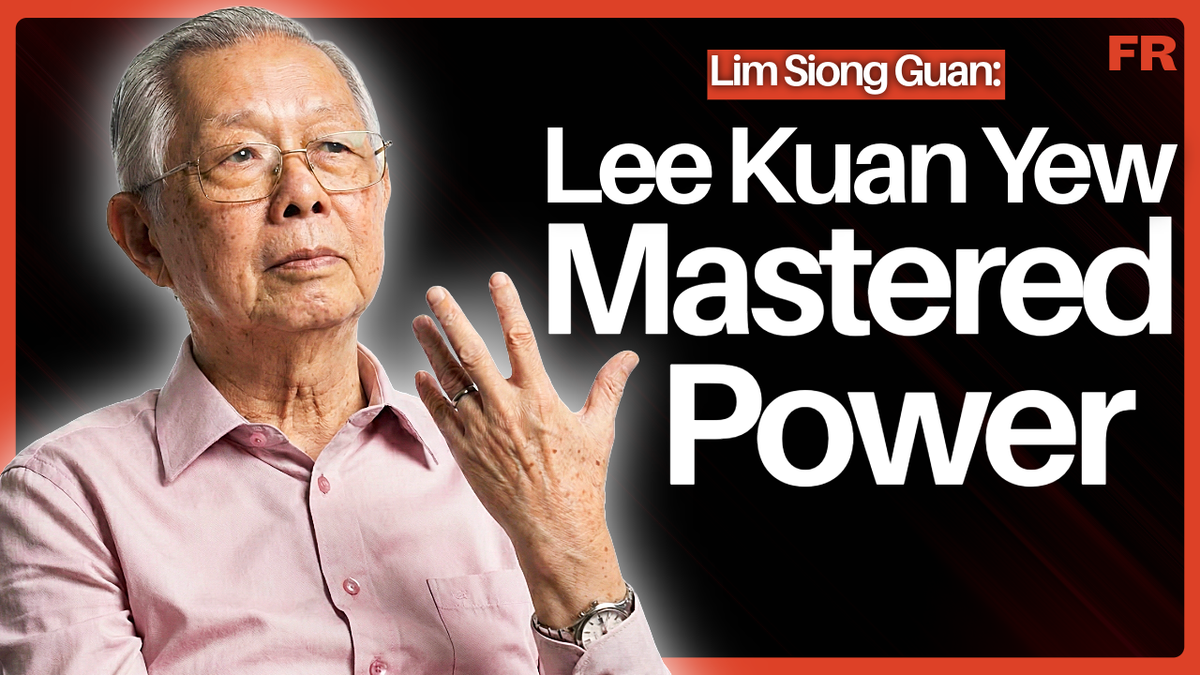
Lim Siong Guan is a Professor in the Lee Kuan Yew School of Public Policy, instructing on leadership and change management.
Siong Guan was the Head of the Singapore Civil Service from September 1999 to March 2005. He has been the Permanent Secretary of the Ministry of Defence (1981-1994), the Prime Minister’s Office (1994-1998), the Ministry of Education (1997-1999) and the Ministry of Finance (1998-2006).
Of note, he worked directly with Singapore's founding fathers to help Singapore transform itself into a modern economic hub of Southeast Asia.
He was also Lee Kuan Yew's first Principal Private Secretary.
In every appointment, he introduced innovative policies and practices which enhanced the drive, capacity, capability and performance of the organization. He has chaired the Inland Revenue Authority of Singapore (2004-2006), the Accounting and Corporate Regulatory Authority (2004-2006) and, the Central Provident Fund Board (1986-1994), and has been a board member of many companies including Temasek, the other sovereign wealth fund manager of Singapore.
CHAPTERS
00:00 Trailer & Intro
01:20 Early Days at Public Works Department
04:11 The Road Roller Story: Learning Government Systems
08:41 Philosophy of Problem-Solving: Think, Try, Switch
09:14 Joining Dr Goh Keng Swee's Team at MINDEF
10:30 Building the Junior Flying Club from Scratch
15:01 The Glider Experiment: Cutting Losses & Moving On
18:06 Starting the SAF: Culture of Curiosity & Discovery
18:50 Becoming Lee Kuan Yew's Principal Private Secretary
22:31 Understanding Power: Service Before Self-Interest
26:16 The Three Pillars of Trust: Care, Competence, Commitment
29:40 Building Modern Defence from Zero
35:47 Total Defence: Beyond Military Capability
40:05 Concentrating Talent Across the Public Service
46:55 Introduction to Scenario Planning for Government
49:37 Hotel Singapore & Home Divided Scenarios
53:59 The Unknown Unknowns Challenge
57:47 From Copy-and-Improve to Indigenous Innovation
01:02:31 Can Small Countries Lead in Innovation?
01:04:32 The Biggest Threat: Unwillingness to Try
01:08:04 The Mother's Challenge: Cultural Barriers to Startups
01:09:43 Defining Success 30 Years From Now
01:12:41 How Younger Generations Answer Differently
01:14:52 Advice For Fresh Graduates Today
Keith Yap 00:00:50
In the beginning in Singapore, there were the first generation leaders. One thinks of the legendary politicians Mr. Lee Kuan Yew, Dr. Goh Keng Swee, S. Rajaratnam. Well, alongside them, there needed to be a first generation civil service.
Today I'm joined by a legendary civil servant, someone who served under them and could say proudly that they helped Singapore transform from third world to first. It is my great privilege that I welcome Mr. Lim Siong Guan onto the podcast today. Mr. Lim, thank you for coming on.
Lim Siong Guan 00:01:15
Thanks very much for having me.
Keith Yap 00:01:20
I wanted to start at the beginning of your career where you were in the Public Works Department. Take us through what Singapore was like during that period in time, what you were working on, and what were the early lessons that you had, literally doing the dirty work that shaped your outlook on policy in the future.
Lim Siong Guan 00:01:38
I studied at the University of Adelaide from 1965 to 1969. Frankly, having been exposed to just studying in university, your thoughts about the future are things like whether you can go on to do a PhD. In fact, I had an offer of a PhD fellowship at Cambridge, but when I asked approval from the Public Service Commission, since you take a government scholarship and you have a bond to serve, they said no. Singapore desperately needs you, at least that's the feeling they conveyed.
So I came back to Singapore and you just wait a couple of months to see where you are posted. I got posted first to the Public Works Department. Since I graduated as a mechanical engineer, that made a lot of sense. But it was frankly only just a few weeks, and then I got posted first to the mechanical branch to look after all the mechanical equipment of the government. Then I got posted for a few weeks to the Sewerage Branch, which runs the sewerage system in Singapore, basically a job of civil engineers. But they still needed a few mechanical engineers to look after mechanical equipment in pumping stations that they had. I spent almost a year in the Sewerage Branch, so most of my experiences were there.
As to what conditions were like, I've always had an open mind. You go to a place and you say, what can I learn from here? What can I do which is useful here?
I need to describe to you the very first day I turned up for work at the branch, which at that time was at Paya Lebar Kim Chuan Sewage Treatment Works. As I entered the gate, I saw a couple of workers just painting up a road roller which was obviously rusted. They were painting it gray. I went in and asked why are the people painting that rusting road roller, and I was told, oh, because they're going to condemn it.
Condemnation is just a term that's used in government. If a piece of equipment is no longer working properly or is beyond economical repair, you need to condemn it as a piece of equipment which is not worth keeping. After you've been able to dispose of it with a condemnation certificate, then you can go buy a replacement piece of equipment.
They told me that the reason they were painting it up is because they needed to condemn the road roller to get a good replacement. That of course made it even more mystifying. If you are going to condemn a piece of equipment, why are you painting it?
They explained to me, well, you know, there's going to be a mechanical engineer sent in to inspect the piece of equipment and to certify that it is beyond economic repair. But if they come and see that road roller all rusted up, they will say that the reason is because you didn't look after the piece of equipment properly. So here are the men painting it up so that we won't be blamed for the condition of the road roller.
The thing that struck me here is, wow, we've got clever people. They think carefully about what needs to be done in order to get the approval that they need.
As I started work in the treatment works, my perspective was always about how can I be helpful to the people here. Here are mechanics and technicians working under me whose knowledge is way beyond anything that I can ever know for the equipment that they have to maintain. As a young engineer coming in, and here are the mechanics who are more than double my age, how do you make yourself useful?
The usefulness I found is because I go in as an engineer, and if you want to buy spare parts and so forth, you need the engineer to certify this is required. The mechanics cannot do the certification themselves. So that's where I came in useful, because I have to certify, and so I have to understand to a significant extent what they're trying to do. Basically, position yourself as helpful to the mechanics and technicians. You have to get the job done.
Let me describe to you another particular incident. At that time, Singapore was subject to flooding quite frequently, and there was this massive flood that happened in my time where the rivers overflowed. There was this pumping station we had at Kallang which became totally flooded and the pumps ceased to work. Before we could get the pumps going, we had to get the water out, because the pumps are located in a deep kind of well, deeper than most basements you find. They had these pumps working, but the pumps really couldn't do the job of pumping the water out of such a deep well.
I asked the workers to join the pumps together, one pump which feeds water into another similar pump so that there'll be greater suction power. The workers turned around to me and said, nobody has ever done this before, which set me back thinking about what I studied in my engineering at university. I reckoned, well, this is my reputation at stake in the minds of these workers.
I decided that yeah, I believe it will work and I believe it will be helpful. So I told them to do it, carry on and do it. If the engineer tells the workers, they'll do it. I'm sure I rose several notches up in their eyes that the system didn't break down and did show itself useful for purpose.
My approach in all this always is you think, you try, and if you try and something doesn't work, then be prepared to switch tracks. It's not a matter of pride, it's always a matter of getting the job done.
Keith Yap 00:09:02
Just from those two stories you recounted, the lesson or philosophy that started to develop back then was this idea of just being helpful and trying to solve the problem, trusting your expertise at the same time.
Fast forward, within a year you were then called up to be one of Dr. Goh's team, one of a young team of civil servants. Do you know how that actually transpired? Why did he choose, for example, younger folks like yourself who were just fresh out of university as opposed to maybe people who were much more seasoned and experienced?
Lim Siong Guan 00:09:32
I think Dr. Goh was being posted back to MINDEF for his second tour as Minister of Defense. He believed he needed a team of people to take a look at what's going on, people who, he said, start off with at least the mental capacity to do this.
I wasn't told, in fact. In the process of this latest book, The Best is Yet to Be, I read there one of the people who wrote notes on the past, Professor Lui Pao Chuen, who was the chief defense scientist of MINDEF. He said that he had a hand in choosing all the young engineers that were brought in. I didn't know that until he wrote that in the book.
All I knew at that time was Dr. Goh looked like he was given a free hand to choose whichever civil servants he wanted from the whole public service. He called me up to go to his office to be interviewed, which he did with a whole series of other people. I turned up in MINDEF together with people like Philip Yeo and Tan Chin Nam. There was a whole bunch of really young people who were there not because we understood all the technicalities, but people who at least looked like they had the energy and the mental capacity to learn new things fast and be prepared to try out stuff which nobody has ever done in Singapore before. We never had a defense ministry and we never had to build an armed forces before.
It immediately threw you into the deep end. I'm not terribly sure it's all that deep. The first appointment I got was as project director to get going what we called the Junior Flying Club, now called the Youth Flying Club. Dr. Goh's idea with the Junior Flying Club was to get young people interested in becoming fighter pilots for the air force.
We created this club and invited students from secondary school and the junior colleges. When they got to junior college, we would send them for flying training to get what is known as a private pilot's license. I set up the Junior Flying Club from scratch and worked on that.
Maybe a story there again. Dr. Goh, remember, as Minister for Finance, he was a man who was very careful about spending money. He just wanted to make sure you spend your money wisely and responsibly. He decided since we were going to have all these young people get flying training to get a private pilot's license, instead of the normal training which takes place on light aircraft, he said we should try to use gliders for this purpose. The point about the gliders is you get it into the air and then the plane just glides without an engine running. He decided that we should get gliders to do the private pilot license training, at least the initial training. He decided that we should buy powered gliders.
I went along with somebody who was going to be the chief pilot instructor for the Junior Flying Club. We bought eleven of these powered gliders, brought them back to Singapore, uncrated a number of them, started flying, and soon discovered that we couldn't use the gliders over Singapore. Gliders stay up in the air because of what are called thermals, convection currents. We discovered that you get very little of it over Singapore, probably because of our whole environment, the fact that we are an island and so forth.
We couldn't use the gliders. I got back to Dr. Goh and we decided just to abandon the project and go back to the normal way people train, which is to get people on the Cessnas and the light aircraft.
Just to add on to that story, once we discovered that powered gliders were no longer useful, one of the important things I learned from Dr. Goh is this point about, if you discover you try something and it doesn't work, just drop it and move on to get something that works.
I don't think we uncrated all the eleven powered gliders that we bought. But the few that we did, we discovered soon enough we couldn't use the powered gliders. So just dispose of the rest, even the ones that we hadn't even uncrated.
That was a very important lesson that I learned. Cut your losses and don't waste your time and don't waste your energies on something which you already know is not working, simply because you've taken the decision and you are fearful that somebody may come along and say that was a stupid idea. Why did you do a stupid decision? It was about just learning as you go and making sense out of what you do. What doesn't work, just cut it and move on.
Keith Yap 00:15:32
When one today thinks about starting, for example, an air force from scratch, many people think, oh, you've got to buy all this equipment, you have to get all this training, which is equally crucial. But no one really thinks, oh, you need to start a pipeline of talent earlier on, get people actually interested. This is one of the maybe more underrated components in the development of our air force.
Lim Siong Guan 00:15:57
Dr. Goh saw that when you talk about the SAF as a whole, Singapore does not have a military tradition. Many parents would not consider having their sons join the armed forces as a good career choice. Even more extreme, Dr. Goh felt that trying to get the future fighter pilots, which all had to be your own citizens, is something you have to first convince the public and convince the youth about the good sense, about something exciting for their future.
Here again, going back to Dr. Goh, we made a crucial decision. The question was, since at that time we never had any idea of having women as our fighter pilots, should we bring girls into the Junior Flying Club? Dr. Goh said yes, because these are going to be our future mothers. You want them to be supportive of their sons becoming fighter pilots.
That's how far-thinking and broad-thinking Dr. Goh was, to say you open the Junior Flying Club, bring the girls in right together with the boys.
Keith Yap 00:17:29
I've interviewed Madam Tan Siok Sun, who was his biographer, and I've interviewed Ooi Kee Beng who wrote his intellectual biography. They both added different elements of Dr. Goh's thinking, especially with regards to maybe his approach towards public policy as a whole, that he treats it very holistically. I wanted to ask you, as someone who worked with him to literally start our modern defense force in Singapore, what else do you see in him that you think more Singaporeans should know of?
Lim Siong Guan 00:18:00
Starting the SAF was a complete new thing. We never had to build a military defense capability ourselves before. Dr. Goh, in order to encourage us to try things, to think broadly, he had this saying which was plastered all over the SAF: the only way to avoid making mistakes is to not do anything, and that in the final analysis will be the ultimate mistake.
He was just encouraging us all. The key is about thinking, about trying, about discovering what works and what doesn't work so well. Therefore, knowing that the real problem is if you have people trying, and whether for reasons of pride or for reasons of not being able to recognize it, they just keep going on a path which doesn't work.
He wanted to encourage us to say that yes, be very questioning, ask all the good questions. But the most important thing is try and see whether it works or it doesn't work, and improve on what you can and move on when it doesn't work.
He introduced a frame of mind, a culture in the SAF which is about curiosity, about learning, about discovery.
Keith Yap 00:19:36
In the meantime, I wanted to ask you about another role that you had soon after your time in MINDEF, which was that you were Mr. Lee Kuan Yew's first Principal Private Secretary. For many of us who don't know, can you tell us what the PPS actually does at the start?
Lim Siong Guan 00:19:56
The PPS, that name is Principal Private Secretary. I actually went through a few discussions with him as to what we should call that appointment. Well, you're the Principal Private Secretary. You're the secretary, you're the assistant to Mr. Lee Kuan Yew as Prime Minister.
In many ways, what you do is totally dependent on what he tells you to do. In a surprising kind of way, a lot of people like to ask me the question, because Mr. Lee Kuan Yew's persona is somebody who's very strict and very demanding, and people are always wondering, how was it like to serve under Mr. Lee Kuan Yew for three years? My answer was, those were the freest years of my life.
It's because I was his secretary. I should only be dealing with what he tells me to deal with. Whereas in all my other appointments previously in the Public Works Department and MINDEF, and later on when I became Permanent Secretary, I'm in charge of organizations, I'm in charge of leading people to produce good results. Because I am in charge, I set the agenda. I can tell people, this is the strategy we want to adopt, these are the deadlines and so forth.
But for the three years under him, it's he who sets the kind of jobs and the jobs for me to undertake. So those became the freest years of my life in the sense that I got a lot of time to think of issues, a lot of time to read, a lot of time to just learn as we go. Particularly because Mr. Lee Kuan Yew was really, to my mind, an excellent teacher.
He got me to sit in every one of his meetings with officials, with other ministries, or with foreign leaders and so forth. He was very strict in keeping me out of all his political meetings within the People's Action Party. But other than that, he brought me into all the meetings, which was helpful to him because there were already records of the meetings and he left it to me to clear the records. But for me, it was an enormous learning opportunity.
Time was filled with learning, but the specific things to do and the deadlines and all that were set by him.
Keith Yap 00:22:31
One of the things that I saw in a lot of my readings of third-party accounts of him, and even in your book, was that many people kind of ascribe him to being a person who understood how power worked. Some call him the master of power dynamics. Understanding power dynamics, in your book you wrote that was one of the first few key lessons that you spoke about with him. Can you say more about what that actually meant?
Lim Siong Guan 00:23:00
Although people talk about he understood power, and very often you understand that kind of statement as meaning he uses power to bully people and so forth, but that was not what I found.
I found it totally remarkable that before Mr. Lee met any group of people, whether it was speaking to a Singapore audience on something or before he met foreign leaders, the most important question in his mind was about who am I speaking to? What are they concerned about? What can he do which will be helpful or will be beneficial for the people he's speaking to?
He was very clear, for example, that when he spoke to foreign leaders, he said it's important for Singapore that we don't go around with a begging bowl. But instead, you all the time present yourself as, we understand we have to look after ourselves. We have to do what we can for ourselves. But really asking, what's your concern? How can we understand what their concerns are? Because their concerns are what takes up their time and their energies.
I did find that very helpful, very significant.
There's another thing I want to say about Mr. Lee. I remember the very first day I reported for work under him, he said that in the course of your work, you are going to have to deal with foreign officials. He said, when you deal with foreign officials, you look them in the eye. You never look on the ground, because they need to respect you as a representative of the country.
That was such a remarkable statement for me, an instruction to say, as Singapore, we carry ourselves as Singaporeans proud of our country and proud of ourselves. We have a job to do and we are serious about getting it done. We are a serious people whom you can trust to deliver on our promises and you can trust to take ourselves seriously, so that whatever we say is something that we are going to carry through. In the same way, they are going to deal with us on the basis of we are going to take them seriously at what they speak about.
Keith Yap 00:26:16
To contextualize for the listeners, you were relatively young at this point in time, right?
Lim Siong Guan 00:26:22
I was thirty-one.
Keith Yap 00:26:28
I remember you were in your early thirties. I was wondering, was that actually intimidating for you to be in such a room, for example, where a lot of these figures seem larger than life and perhaps older and maybe they feel more seasoned, so therefore you felt intimidated? Did you ever feel that?
Lim Siong Guan 00:26:44
Not really, because first, I mean, if I go see them, they will know that I'm seeing them because Mr. Lee Kuan Yew has sent me to see them. So I'm obviously carrying a message, a message from Mr. Lee Kuan Yew. They take you as seriously simply because you are speaking in Mr. Lee Kuan Yew's name.
Keith Yap 00:27:13
What other things about him do you feel that maybe a Singaporean today tends to underappreciate that you think should carry on? Some of the values, some of the lessons that you learned that you think, if someone in 2030 is looking back at our early history and they want to learn something from Lee, this is something that they should definitely take away with.
Lim Siong Guan 00:27:31
Mr. Lee was very clear about the governance of a country. He said, you think about it, if you're running a company, you might think that to improve the performance of a company, you may want to remove your underperformers or your marginal performers. But Mr. Lee was very clear. He said, when you run a government, you cannot run it like you run a company. You have to look after everyone in the country.
That was quite striking to me. The whole essence of governance of a country, and after all, the most important asset for any government is the trust of its people first, and also of course the trust that you can build for other people or other countries to have in you. The most particular thing is the trust that you have in your people.
An integral part of trust is for people to recognize, for your own people, your public in Singapore, to recognize that they can trust you. We can say that there are three aspects of trust.
First, that you care about them. That your heart and your intentions are good.
Second, that you know what to do. That you are somebody who can solve problems and put the country on a good path.
And third, that you'll do what you say. That you're not just making empty promises, but you have to deliver.
Keith Yap 00:29:26
Care, competence, and commitment. That's a great way to phrase it.
You became PermSec and I had to also ask about literally you spending twenty-one years in the Ministry of Defense. For context, it's remarkable how Singapore actually went from zero military to a full-fledged modern armed forces that we have today. When people think about the military nowadays, they don't have a maybe a rosy view of the military, and they don't think of the military as a place of innovation fundamentally. A lot of people think of the military as maybe perhaps laggard adopters.
But I think in your time, especially when you were leading as the PermSec, you kind of saw the military as a place of testing new ideas. Later on, a lot of the ideas that you started when you were in MINDEF became greater public service initiatives as well.
I wanted to ask you this question about the military. What was it unique about building up a military from ground zero that you think most people actually tend to underappreciate?
Lim Siong Guan 00:30:38
A very important part of thinking about the military is really about thinking about the future. One must appreciate that the whole idea that we have about the military is to keep Singapore safe and to keep Singapore secure. The belief of the government is that we must have a military capability which is effective for deterrence. The whole point about deterrence is to maintain peace and security. You succeed if you are able to maintain the peace.
A lot of people think of the military in terms of going to fight and winning the battles. But in the case of Singapore, the idea is how do you develop a military so that you avoid getting to have to fight?
I want to say also that when you look at major pieces of military equipment, very often from the time you first conceive of the need for a piece of equipment to the time that it actually becomes operationally ready is easily ten years. Whether you talk in terms of building your armored units or you talk in terms of building the air force, anytime you think of a major piece of equipment, from the time you think about wanting to acquire it to the time you actually get it operationally ready is probably ten years.
Now you would say, how do you know what you need in ten years' time? This is the kind of thing which really drives you to say you have to, yes of course you have to take your chances, yes of course you have to dream of possibilities. But frankly, if you just see what you're trying to do is build a capability which will offer you the deterrence, you think of it differently because you are thinking of it from a defense perspective.
When I was in MINDEF as Permanent Secretary, one of the things that drove me was to introduce this concept of Total Defense. Total Defense at that time had just five components: military defense, civil defense, economic defense, social defense, and psychological defense.
The idea there was to say that it's not only about military defense, it's about the whole of nation being involved in building up that strength and that capability as a nation. The whole idea being, how do you maintain peace? How do you build up security for yourself?
Most particularly because we run a system which is very dependent on National Service and very dependent on the reserves as a major part of your army, what they call the army order of battle, the psychological part, the willingness of your own people to be defending Singapore becomes critical in this domain. That's why you talk about psychological defense, social defense being just the critical foundations of the defense of Singapore.
There is also the element of economic defense, which is about how you look after the economy so that your economy is stable and that you can rely upon it to operate even through crisis.
It's this kind of thinking that we are there to maintain peace and security for Singapore, and whatever we can do to enhance our capabilities to that end, that is what we should do.
Keith Yap 00:34:59
One of the through lines in your work as a public servant is that you've been a strong advocate of concentrating talent within the government as well. I think that stems or comes from the time in MINDEF, especially mainly because as you've pointed out earlier, Singapore when it first started didn't have the culture of wanting people to join the military as a good career. So then you need to solve that problem of how do you actually crowd in talent. That also later influenced your thinking in terms of the public service as a whole needs more talent.
What's your approach or the way you thought about talent management? How do you actually, in a sense, stack talent in your favor?
Lim Siong Guan 00:35:35
My approach when you're thinking about people is every person comes along with his particular talents and abilities. What we should be trying to do within our various public service organizations, and most particularly as a government as a whole for the country, should always be what can you do to help your people develop their talents and abilities and to be able to contribute their talents and abilities according to their capabilities.
To me, the talent issue really started with the idea about we really want to help every person realize, in the best way that we can, their talents and abilities.
Because you run many organizations through a hierarchical system, then obviously you have to pay particular attention to the people who can reach the higher levels, because they carry the bigger responsibility to develop all the people under them to be able, as an organization, to be the best it can possibly be.
Obviously then you pay particular attention to trying to spot your people who have the talent to reach the highest levels. You pay particular attention to try to spot this talent as early as possible, because the earlier you can spot the talent, the more and the earlier you can focus on developing them, and the earlier you can get value out of their capability.
That really was the idea of talent, a recognition that as you look for people at the higher levels, obviously there are fewer of such candidates. If we have a mechanism by which we are able to make the best assessment that we can, it is human assessment, so sometimes you make mistakes, but you try to make the best that you can to spot the people who can reach the highest levels. That's how you get the maximum value for the organization as a whole, not only for the individual person that you put in and that you try to bring on top.
This, particularly in the armed forces, became particularly critical, because in modern warfare, you're running military organizations which are highly mobile, where things change very fast. Basically, therefore, you need to have relatively young, energetic people, people with that energy and with that capability both mentally and physically to be in your senior positions and your top appointments.
Almost in MINDEF, therefore, you have this need to develop your commanders in compressed time, because you need to have commanders, you need to have senior staff officers with all that energy both mentally and physically. Therefore, the earlier you can spot them and the faster you can develop them, the more you are able to benefit from what they do, because there comes a time where physically it's not reasonable to expect it of them.
That's the reason for concentrating, for putting all that particular effort to try to recognize who can reach the highest levels. But as they run this, the system that we implemented in MINDEF was actually an attempt to see how we can best develop talents and abilities of people at every level. It was not simply a matter of just thinking of the people at the top.
Keith Yap 00:39:52
There's a more general lesson across the whole of public service as well, but perhaps it is felt the most acutely in the military.
Lim Siong Guan 00:39:57
Oh yeah.
Keith Yap 00:40:05
There is another strand to your thinking, which is that you are obsessed with the future. Part of it is this idea of scenario planning, especially when you're going back to what you said earlier, from where you start the conceptualization of, say, a certain asset to the point of its actual execution and implementation takes ten years. You're obsessed about the future and you took this idea of scenario planning, thinking about the future, into the much broader public service.
One of the conclusions you had was with regards to the future scenario of Singapore. The kind of possible threats to Singapore is that we either have a Home Divided or a Hotel Singapore.
Lim Siong Guan 00:40:45
The first set of national scenarios we developed, scenario planning was first developed in MINDEF for the SAF actually. The first set of scenarios were developed really for the SAF within MINDEF only. It's only when I got posted out of the Ministry of Defense to the Prime Minister's Office in the Public Service Division that I decided that this was really very critical for Singapore to be thinking about the future, and so brought the scenario planning framework there.
The first set of scenarios we produced, which was published I think in 1997, had two scenarios developed for the external environment and two for the internal environment. The two for the external environment, to be frank, I can't remember what they were. I don't think many people can, because this is virtually thirty years ago.
But the two internal scenarios, many people involved in scenarios can remember them even now across the civil service. These two scenarios were Hotel Singapore and Home Divided.
Hotel Singapore really posits that you could have a future in which Singaporeans stick around in Singapore only when things are nice and comfortable, and when things become uncomfortable, they run away from Singapore. That was the hotel thing. It's just like tourists. They come along when everything is peaceful and secure, but if there's trouble, they're going to stop coming. So that was the Hotel Singapore scenario.
The Home Divided scenario was like saying, you and I, we may be working in the same office, but in the evening I go home to my HDB flat and you go home to your condominium, and there's a brick wall between us. So Home Divided is really talking about divisions within society itself, which may be economic and may be social, but they are divisions within themselves.
These are two scenarios we developed. The whole idea of scenarios is very critical for us to understand. The scenarios are developed not as predictions about the future. They are developed as possibilities of how the future may be.
When we developed the first set of scenarios, we went around and talked to every member of Cabinet, including at that time Mr. Lee Kuan Yew and Mr. Goh Chok Tong, who had taken over from him as Prime Minister, and every minister, every Permanent Secretary, everyone whom we think can answer the question, what keeps you awake at night? How could things develop for Singapore?
We spoke to journalists, we spoke to both foreigners as well as Singaporeans, just to get these ideas. We put these ideas on how things may go wrong for Singapore. In order to make it easier for us to visualize that future, in order to make it easier for us to help people think about ways to mitigate these kinds of issues, we drew up scenarios about the future.
Scenarios, as I said, are not predictions. They are possibilities, and we are saying in order to think about the future for Singapore, you have to think in terms of possibilities.
I want to say one thing that developed interestingly at that time. Mr. Goh Chok Tong was then already Prime Minister. His office was having to prepare a speech for him at one of the graduation ceremonies in one of our IHLs, and he asked whether we had ideas. We sent the two scenarios, Hotel Singapore and Home Divided, to his office.
Mr. Goh Chok Tong went through it and said they are very interesting scenarios, but he says they are both negative. Can you think of a positive scenario?
Frankly, this is not normal scenario methodology. Scenarios normally are developed in terms of how things may go in the future and how things particularly may go wrong in the future, and therefore what can you do to prepare for it. But here's the Prime Minister asking, can you develop a positive scenario?
It was an interesting challenge. It is not in the normal way of scenario planning, but we just sat down and asked ourselves, what would we do in terms of policies and in terms of actions that could be taken to mitigate the effects or even minimize the probability of these scenarios happening? While all the time in all humility recognizing that these scenarios are all there, you are not undermining the validity of the scenarios by working out things to try to mitigate the effects or to minimize the possibility of scenarios.
We produced a scenario called Singapore 21, which contained ideas about things like how do we build resilience? How do you build racial and religious harmony in Singapore and things like that? We presented that to Mr. Goh Chok Tong, which he found very interesting and took up many of the ideas.
Quite frankly, we discovered something which we had not conceived of when we started scenario planning, which was with Singapore 21, we now could go to the ministries to say, this is the positive future that we can think about, and this serves as a kind of strategic framework for government policy going forward.
That's where scenario planning went, and that is why I moved on it.
Keith Yap 00:47:06
You were then, you also then had to kind of implement this idea of upgrading the public service for the twenty-first century. Part of the Singapore success story was that the civil service was professional, was meritocratic, and it really delivered a lot of public goods for the Singaporean citizen.
Why did you feel that need at that point in, say, 1995 to really go on this spree of, we need to modernize and try to upgrade the public service? And what were you looking to upgrade, actually?
Lim Siong Guan 00:47:37
You go to the civil service today and you talk about their values. The civil service today has just three values they talk about: integrity, service, and excellence.
Integrity as being that you are trustworthy and you are incorruptible and things like that. Service as a reminder to all civil servants that your job is to serve the people and to serve the private sector in Singapore where they depend on government for approvals and licenses and things like that. These are the people that you serve. This is why you exist as a government, to serve the people and various companies and so forth.
And third is about excellence, which is about being the best that you can be in everything that we undertake as a government. We need to be the best that we can be.
With that as a backdrop, what I wanted was to have a public service which imbibes these values, which really has to be the best that it can possibly be, has to try to do the best it can in whatever it undertakes. What this means is not simply doing today's job well. It's a matter of being innovative, about being willing to take in new ideas, being on a track where you are continuously improving.
That was the idea behind PS21, to create an awareness among people about service to the public, to talk in terms about a public service which is welcoming of change as a way by which you keep improving. We talk about the public service as aware of the future. You have to position the public service for the future. It's not good enough just to do a good job today. You have to ensure the sustainability of that success going into the future, and scenario planning was an important part of that exercise.
Really, PS21, which stood for Public Service for the Twenty-First Century, was a call, a whole exercise to bring the civil service to do a great job today and to position Singapore for success and for sustainability of the success and to enhance its survivability for the future.
Keith Yap 00:50:03
Earlier you spoke about the idea of being nimble, of being energetic and being willing to move fast and cut losses. Part of it was you were in the early phase of Singapore's nation building. You were also relatively young. But as civil services mature as well as governments mature, they tend to be more bureaucratic in nature.
One of the challenges that Singapore faces is that now you face a form of innovator's dilemma. What has allowed you to be innovative in the past could create new dogmas or doctrines that might not be relevant for the future.
Then the follow-on question is, how do you actually get the public service as a whole to be more open-minded to change or to actually be able to implement some of these initiatives that you've proposed, for example?
Lim Siong Guan 00:50:48
I can't speak about the public service today. I'm only speaking about the public service in my time.
What I can say about implementation, as I said, was that we had developed a scenario called Singapore 21, and that was a framework. I could talk to my Permanent Secretaries, because I was Head of Civil Service. I talked to Permanent Secretaries to say that's what we need to do, that's the transformation we want to make for the future.
Here I need to elaborate a bit further about scenario planning. Scenario planning is really about understanding what the driving forces are which can shape the future that any organization may face, because after all, scenario planning is something which is useful for organizations and is also useful for us as a country.
Scenario planning deals with recognizing the driving forces and knowing that there are two kinds of driving forces. One is the predetermined elements, the kind of things you know, things like population. MINDEF today can already have a fairly good idea five years from now how many national servicemen they can have available.
But there's also this other thing called critical uncertainties, where you acknowledge that we don't really know how the future can turn out, but we have to try to prepare ourselves no matter what future turns out.
Like one of the critical uncertainties is in geopolitical terms, the relationship between the US and China. Will they be more cooperative in the future? Will they be more combative in the future? What is it? But irrespective of how it turns out, you have to recognize this is a critical uncertainty which we have to be prepared for.
The point to recognize about scenario planning though is that obviously when we look at the driving forces, we're looking at factors which we can identify as factors important, which can have a heavy influence on Singapore in the future. It is what I would call you're dealing with what are called the known unknowns. You know what you do not know, and you create these scenarios on the basis of how things may turn out differently in the future. That is why you have several scenarios, because things may turn out differently. But you're dealing with known unknowns.
If you're dealing with the known knowns, it means you're dealing with a world where nothing changes. Then of course you work out your standard operating procedures. You know exactly what to do. You're not surprised by new things day by day. Some things can still be treated that way. But we also know that things are changing very fast in all kinds of different domains.
Then there's the known unknowns, where you know what you do not know.
But I think that we are now facing a situation where you have to ask yourself, how do you position yourself for the unknown unknowns?
Now the point about the unknown unknowns is you cannot use scenario planning for the unknown unknowns by definition. Trying to create a scenario based on what you do not know, when you don't know what you do not know, it is impossible. You can't run that scenario. That is, I think, a major challenge for Singapore as you think about the future.
Let me raise this point by thinking about the future, by bringing us back to 1965, or even when Singapore became independent, or even before that, 1959, when Singapore attained internal self-government while the British were still our colonial masters.
In 1965, when Singapore became independent, we were third world. You would say our natural ambition, of course, in economic and to some extent in social terms also, is to be first world.
Mr. Lee Kuan Yew, in a sense, as Prime Minister, when he travels, visits other countries, sees other things in the world, he sees something in Japan, he said, that's good for Singapore. He makes a point of telling his ministers and telling the civil servants, this is what is important for Singapore. Similarly, he sees stuff in Europe and he sees stuff in America, and you bring home the ideas. But we don't copy blindly, and that's one thing good about Singapore. We copy the ideas, but we improve along the way.
In that kind of scenario where you're copying other people who are definitely in technological civilizational terms already way ahead of Singapore, you copy, you improve on what you see. In a period of thirty to forty years, Singapore itself became first world.
Now here's the point. If our expertise or our competency that we developed most particularly was copy and improve, when you copy and improve somebody who is thirty, forty, maybe even fifty years ahead of you, in thirty to forty years, you yourself became first world.
If what we then now keep in Singapore, what's been very good is copy and improve, who are you copying today is a critical question. Because let's say we're talking about AI. Are we talking about AI today? I would say that if you are copying people in AI, maybe the leaders are only three years ahead of you.
Then we have to ask ourselves seriously, what does it mean to think about getting our way into the future by copying somebody who's three years ahead of you when we started copying somebody who's thirty, forty, or fifty years ahead of you?
Remember, when you're copying somebody thirty years ahead of you, there are certain things you have to change. You hope you can change through the homes, because the home has the biggest impact on the children growing up. The values, the ideas, what would make it possible for the children to be as successful as possible.
If the homes can deliver, that's nice. But if the homes cannot, then you will end up having to do it through the schools. Just think about the schools. If you count two years kindergarten, six years primary school, six years secondary school, two years NS, four years to get the first degree, that's twenty years.
If you want to try to change something and you can't and it wouldn't naturally come through the homes, you have to change it through the schools. That's a minimum twenty-year thing. In order to have clarity as to what you need to do for the twenty years, you need to have a strategic goal which is twenty-five to thirty years ahead.
Now this is the big challenge. In the days, in the early days from our independence and so forth, because you're copying somebody forty, fifty years ahead of you, maybe in thirty years you could become first world. In that time, of course, major changes took place in Singapore. Our sense of working hard, our sense of no one owes us a living, our sense of being able to consider a technical or engineering career, like happened to me, which was not the way we thought before when we were just a British colony. All these things could be brought together and copying from somebody else who's gone ahead, and we made good in one generation is fine.
But today, as we think about the future, the question is, is the future such that our homes will be able to bring us there in a way that gives hope and opportunity and a good future for the children? Or is it not good enough? That's a critical question.
I'm taking a long time to answer this question because it's quite complicated in a sense, but I want to give you a story. I went to Block 71 once and I met this girl who was doing a startup. She was really excited about her startup, and I asked her, what has been your biggest challenge for your startup?
She said, my mother.
I said, understand the mother. The mother is saying, you know, with the degree that you got from NUS and so forth, you can easily get a well-paying job outside and it's fairly stable. We don't even know whether this startup will still be alive six months from now.
Therefore, she said the biggest challenge is her mother, because her mother loves her, because her mother is protective of the children, because the mother wants the best future possible for the children.
But the message to my mind is what it means is that for what the startup is doing, all these things that we're trying to do in terms of creativity, in terms of innovativeness, just leaving it to the homes will not deliver what we need.
I believe as a country that if we see our future as needing a high level of innovativeness, a high level of creativity, a high level of, let's say, initiative and imagination, that is not something that's going to simply happen through our homes. It is not something that's simply going to happen on the basis of what we see other countries doing.
Because if the homes are not delivering it, we'll need to do it through the schools. For the schools to do it needs to be on a path which is to get to something which is twenty-five, thirty years into the future.
Now that's a completely different kind of challenge than the kind of formula we could use when we were following somebody who is three, four decades ahead of us.
Keith Yap 01:02:31
One of the big points in your answer just now is that Singapore now needs to move into this space where we become an indigenous innovator. The returns on imitation towards innovation is slightly decreasing or decreasing a lot more after we achieved a certain first world status.
I guess my question to you is, what do you think is needed? What are the ingredients needed to create the unlock for Singapore for us to really be at the forefront of innovation?
Lim Siong Guan 01:02:56
I think I need to be very careful about this. We are a small country. We are a small economy. We've got a small population. To be realistic about it, you are never going to be in the forefront in all these areas and so forth. To be able to imbibe an idea and go on the basis of what can I do with this technology, what can I do with this new development, that is where the innovativeness comes in.
It is not about, let me just copy what somebody else is doing. Because I think when you are talking about getting on a path that can get you to a good situation for the survivability and sustainability of Singapore twenty, thirty years from now, you can't get there simply by copying people.
I just want to be clear when I talk about innovativeness and imagination and so forth. It is not like you are going to be able to do everything and be right in front of everything. It is about a spirit which says, yes, I'm aware of what's going on in the world, but it is about a challenge to my imagination. What can I imagine myself being able to do with these things and not be constrained on the basis of, who else has done it? If nobody else has done it, then I think it's too risky to do it.
Rather, to go back to Dr. Goh's premise, he said the only way to avoid making mistakes is to not do anything. It's about saying, yeah, but the biggest threat, as it were, to your future is this unwillingness to try.
Things are changing so quickly. The only way you can actually know, and in many ways interestingly, the only way you can even be clear about the questions you need to ask, the questions you need to ask come to you only when you actually get on and try. It is not like you have all the answers before you try. The questions arise when you decide to try.
This is the challenge I believe. If you look in terms of Singapore and how do we make that way into the future so that you are able to imagine for yourself and you are willing to, yeah, just this whole attitude of trying and learning as you go and discovering the possibilities and being at par with the best in the world.
I want to tell you this thing. One time I was speaking to a Swiss professor who had been involved in giving various ideas for Singapore's future and things like that. I asked him a typical simple question, which is, what do you think we can do better in Singapore?
His answer to me, this is not the exact words, but this is the spirit of his answer, he says there's a problem with you guys in Singapore. You are world class. And now you have to think for yourself the way going forward. Don't always go on the basis of what other people are doing, and therefore what you should be following. It is a different way of thinking.
Keith Yap 01:06:30
Locally in Singapore, are there any kind of policies or kind of things that we can do to have that mindset shift?
Lim Siong Guan 01:06:42
Having a clarity of your strategic goal. For example, if you were to say that being highly innovative, highly creative is necessary for the survivability and sustainability of success for Singapore, then you're going to sit down and you're going to say, okay, what do we need to change? What do we need to change in terms of national attitudes? What do we need to change in terms of the way parents encourage or guide their children? What do you need to change in terms of the way we deliver lessons in school?
This is after all, innovative and so forth is a frame of mind, is an attitude, a perspective which says the worst mistake we can make is to not try. But trying is only for the purpose of keeping on improving as you go.
Keith Yap 01:07:39
I still struggle to fully conceptualize the full implications of it, mainly because I think there's a huge coordination problem. If everyone wants to be innovative, let's say within the government, you can't do that, for example.
Lim Siong Guan 01:07:58
I agree with you. This thing about being innovative, one of the big dangers we face in Singapore is that if you were to tell all our young people, be innovative, be creative, don't be bound by the past and all that, there could be some people who turn out and say, if that's the case, then I can say anything I like, even if some people get upset. It's okay.
What we've been trying to do, for example, in national education, whether it is in schools and so forth, you have to, it's very important, we may have to modify the way we teach. But national education becomes even more critical.
If we are moving strongly on this line of being innovative and creative, you need also to be able to move strongly on the point of saying, remember we are doing all these things because we believe the best thing we can do is to help every Singaporean be the best they can possibly be. But they can only be the best they can possibly be if they are able to maintain the racial harmony and religious harmony, if they are able to maintain peace and security and stability for Singapore.
All these things, the foundations and environment to allow you to move on this path, are totally dependent on your being able to keep things going. So national education becomes very important. This is why you have to think about it holistically.
But if I can take just a little bit more time to mention this. How do we decide what the strategic goal is when we are dealing with something which is the unknown unknowns?
My proposition is, for example, Keith, if I were to bring you and your friends, a group of people, and if I were to ask you, tell me how to describe the successful Singapore thirty years from now. How would you describe that successful Singapore?
Keith Yap 01:10:11
If you ask me, I think it'll be one that is economically vibrant, open, and inclusive.
Lim Siong Guan 01:10:19
Yes, yeah, all very good. Then I say, okay, now let's get down to the descriptors. You described it. So we go next level. And say, okay, now what are we talking about? What's the prevailing culture? Because at the end of the day, I believe it is the culture, what is regarded as the culture, the national characteristics which gives you this winning profile to have this wonderful economy and inclusiveness.
We have to discuss that. What do we need to shape the culture? You have to shape the culture. The attitudes of the people towards life, the attitudes of the people towards, let's say, innovation. What is their attitude?
My point is that if we now run a session that you talk to your friends and say, what is that future Singapore thirty years from now? The reason I say thirty years from now, remember, is because if we can have a sense in our mind what the strategic picture is like thirty years from now, we can then ask the question for each of the characteristics.
For example, you talk about the vibrant economy and all that. For each of the characteristics, we can then ask, what do we need to stop doing that we are currently doing? Because what we're doing today will not get us there. What do we need to start doing today which we are not doing but we need to do to get us there?
That's the kind of question we can begin to ask when you are clear where you're trying to go to.
Keith Yap 01:12:12
Makes sense.
Lim Siong Guan 01:12:20
Now I tell you the interesting thing. I do hold workshops where I talk to people who are just interested in these things, and I say thirty years from now, how would you describe the success of Singapore thirty years from now?
There are a good number of people who find it extremely difficult to answer that question, because they are more used to operating on the basis of reacting to a situation. In other words, if you tell me what the situation is thirty years from now, I can tell you the Singapore that is necessary to survive and to do well in that kind of situation. But since we're dealing with unknown unknowns, I can't tell you what the situation is like, and therefore I can't also give you an idea of what it is.
But on the other hand, I do find, and particularly the younger people in their twenties and thirties, I find that they can answer the question. Because I rather suspect they are not answering my question directly. My question is, how would you describe the successful Singapore thirty years from now? I believe they are not answering my question directly. What they're answering actually is the question, what would make Singapore a great place for my grandchildren? It's no longer their children, it's their grandchildren. What would make Singapore a great place for my grandchildren? And that is the answer that they are giving.
Which is still a good answer, because it really says, what will give us that sense of stability, that sense of direction to feed the hopes and aspirations of people not just for today but going into the future?
When I talk twenty to thirty years, it's deliberate for two reasons. One is because there are certain things, let's say about national characteristics and national competencies, which we need to use the school system to bring about, which takes you a minimum of twenty years.
But at the same time, talking twenty to thirty years also presents a challenge for anybody who says that idea is out of this world, is impossible. To which our question to them is, you mean we can't do it even if we have thirty years?
That's a kind of mental perspective which will make us think differently.
Keith Yap 01:14:52
The last question I have for you is, given all that you know now, what is one piece of advice you'd give to a fresh graduate entering the working world today?
Lim Siong Guan 01:15:05
I would say, chase the opportunity, don't chase the money.
When you chase the money, you are being paid for what you know today, what you have learned from your past and what you know today. When you chase opportunity, you are building your future so that you have the continuing ability to find, the continuing ability to build your life, to chase after your aspirations, to keep earning good money for your future.
But if you chase the money, you're only doing things for yourself today.
Keith Yap 01:15:42
With that, Professor Lim, thank you so much for your time and coming on.
Lim Siong Guan 01:15:49
Okay, my pleasure.
Keith Yap 01:15:49
Thank you for listening to today's episode. If you are watching this on YouTube, please consider subscribing and turning on notifications for whenever new episodes are out. If you're on Spotify or Apple, it would help us greatly if you could leave a five-star review on those platforms. Once again, thank you for tuning in to the Front Row Podcast