

The University Must Reinvent Itself — Or Become Irrelevant - Prof Lily Kong
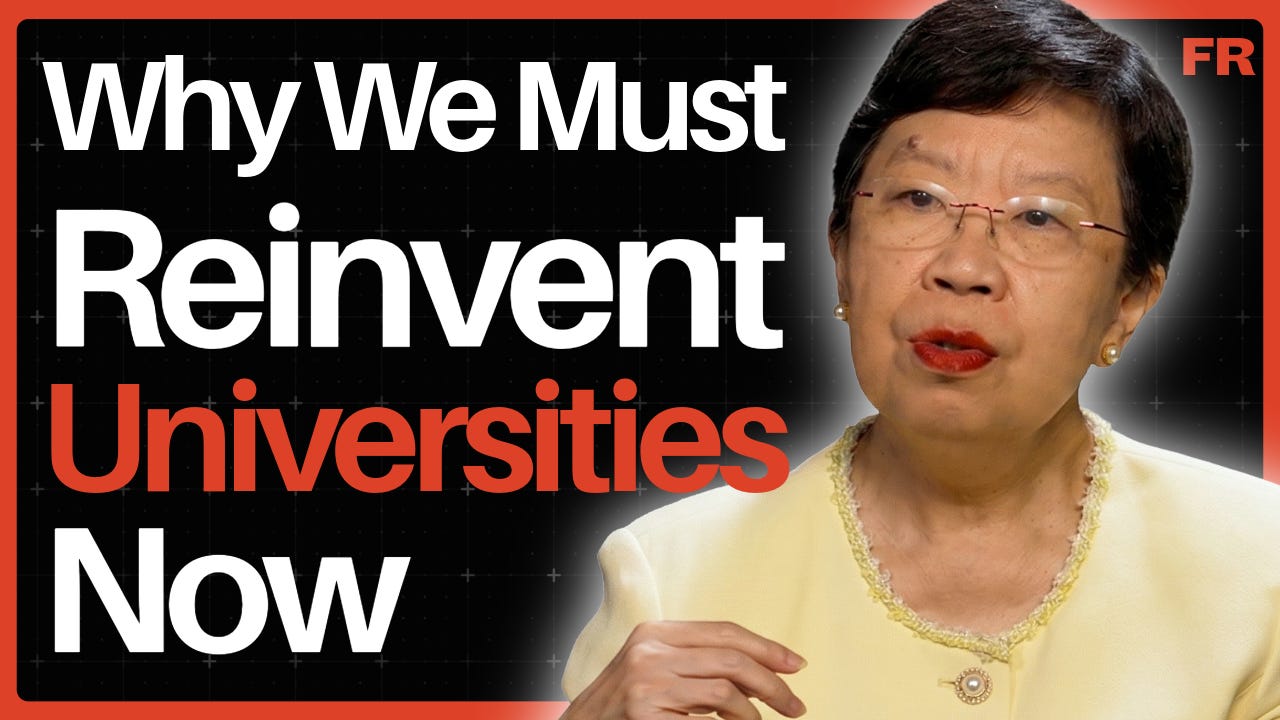
Professor Lily Kong is President of Singapore Management University (SMU) and one of Singapore's most distinguished geographers. A professor by training, she built her academic career studying the intersections of culture, religion, and urban space, with a body of work that spans both rigorous scholarship and practical policy relevance. She has published extensively and has, more recently, turned her attention to the future of higher education — producing a series of public lectures and a book that make the case for reimagining the university in an era of rapid technological and demographic change.
As SMU President, Kong leads an institution of some 13,000 to 14,000 students that has become known for its emphasis on entrepreneurship, interdisciplinarity, and applied learning.
TIMESTAMPS:
0:00 Introduction
0:26 The Geographer's Lens
3:21 Prisoners of Geography: Singapore's Hard Truths
7:29 Smallness as Strength and Constraint
8:52 Eastern vs Western Universities: Singapore's 50-Year Journey
12:49 Why Research and Innovation Are Under-Valued
15:48 Research That Changes Lives
18:15 Demographics Is Destiny: The Ageing Society
19:41 The 60-Year University
23:17 Rethinking How Universities Deliver
28:08 AI and the Accelerating Half-Life of Knowledge
29:21 What Universities Must Do in the Age of AI
35:51 Integrating Mind, Body, and Soul
36:37 Why Campus Life Matters More Than We Think
39:53 Reimagining the Humanities
43:35 Is the University a Scam?
48:31 SkillsFuture and the Lifelong Learning Challenge
51:46 What Lily Kong Is Telling Policymakers
53:46 Advice for Fresh Graduates
This is the 80th episode Of The Front Row Podcast
Keith 00:00:00
Today I am joined by one of Singapore's most iconic geographers, the President of Singapore Management University, and someone who has not only published a series of lectures online but also written a book about reimagining higher education in today's more turbulent world. With great privilege, I welcome Professor Lily Kong onto The Front Row Podcast.
Prof Lily Kong 00:00:23
Hello, Keith. It's a real pleasure to be here.
Keith 00:00:26
I'd like to start with the origins of the university. Perhaps it might be useful to first understand your background as a geographer. What is it about the lens of a geographer that would help you understand education differently from, say, a historian or an economist?
Prof Lily Kong 00:00:46
Geographers are very expansive in our approach to things. As an undergraduate, I studied geography and took courses in population geography, economic geography, transport geography, geomorphology, and hydrology. You can see immediately that it straddles the humanities, the social sciences, and the sciences. In that sense, it's very expansive and very integrative.
Critics will say that geographers are imperialistic — another word used is "adjectival." What they mean is: put a word in front of geography and the phenomenon becomes geography. Put "economic" or "urban" in front of it, and it becomes geography. The implication is that geography encroaches on many different disciplinary areas.
I take a different view — and other geographers do too — which is that this actually allows us to see things from very many different perspectives and to draw in insights from other disciplines. By nature of the discipline, we are integrative. We bring different perspectives to bear on a phenomenon. I think that is genuinely helpful today for two reasons.
First, as a scholar, we increasingly recognise that interdisciplinarity is so important, and geography has well prepared me for that. Second, it is actually very helpful for me as a university leader, allowing me to recognise the value of different disciplines and to intentionally — and the word is intentionally — bring different disciplines to bear on particular subject areas.
If we are interested in ageing or in sustainability, that is going to require multi- and interdisciplinary perspectives: climate science alongside climate history alongside sustainable and green finance. These are all different disciplines, but brought to bear on a particular phenomenon. As a university president, my geography background has really positioned me well to appreciate this integration and interdisciplinarity.
Keith 00:03:21
I'd like to press a little bit on this question. There is Tim Marshall's book about being prisoners of geography — the idea that geography, to a certain extent, influences policy behaviour. That's where the "geo" in geopolitics comes from. If geography does not dictate destiny, it influences it very seriously.
As a Singapore university leader, what are some hard geographic truths about Singapore that bear significantly on the way our education system is created?
Prof Lily Kong 00:04:02
That's a really good question. I've thought often about this notion of being prisoners of geography, and I think it's very real. Singapore's own existence could be framed within that context — the fact that we are a tiny island, bereft of natural resources, located in the heart of a predominantly Malay Muslim community. Those are geographical realities and imperatives. And just as they influence but do not determine Singapore's future and survival, so too do those factors influence how education, and higher education in particular, plays out.
As an example: the fact that we are heavily reliant on human capital — having no natural resources — means that Singapore's leaders have placed a great deal of emphasis on education. When Lee Kuan Yew first led a PAP-dominant Singapore, emphasis was placed on three things: housing, education, and healthcare. Education has always had very strong government support because of our geography.
Then there is the question of how geography influences how education is developed and defined. Here, our smallness has been both a constraint and a strength. A constraint in the sense that we always think: we are so small, we must plan. Some would say Singapore is a hyper-planned society — we plan to the last degree how many graduates we must have from which disciplines.
In that sense, we have succeeded in ensuring that our human capital responds to economic needs. But when we over-plan, driven by the view that we are small and must maximise our human resource, we over-plan. And in this day and age, where knowledge boundaries are much more fluid, it is very difficult to say we want this many civil engineers or this many lawyers, because of the fluidity of knowledge boundaries. So this geography that has influenced the ways in which we plan — and perhaps over-plan — is both a strength and a weakness at the same time.
Keith 00:07:29
There's an interesting parallel here. The beauty of being small is that you can scale up really fast. I was talking to some FinTech leaders previously, and some of them commented that if you look at the e-payment landscape a decade ago, Singapore was actually quite laggard in some regards — but the beauty of being small is that you can accelerate and catch up very quickly. Within a few years, you can leapfrog the rest, because you have the resources of a state but the size of a city. So it's a constraint, but also an amplifier.
Prof Lily Kong 00:08:01
Absolutely. Smallness is both a real strength and a setback. I think about that in the context of my own university: the fact that we are around 13,000 to 14,000 students, compared to universities of 30,000, 40,000, or 50,000. I see that as a real strength. That sense of community, that ability to bring everyone along together — it's a real parallel to Singapore. But at the same time, smallness can be a drawback, because you don't have that same pool of talent that you find in far larger societies. In any situation, the same fact can be a double-edged sword.
Keith 00:08:52
Another thing about Singapore is that we seem to synthesise really well both East and West. In your earlier lectures, you talked about the idea of Western universities versus Eastern universities — the European model of a self-governing institution, like a state within a state, versus more Chinese traditions of an imperial academy focused on training civil servants.
One of my past guests, Pak Gita Wirjawan, pointed out that if you look at modern university successes — in terms of generating a surplus of human capital — Singapore stands as a leading example. He said that within ASEAN, the Singapore education model is highly aspirational, because it was able to attract billions of dollars of FDI. I'd like you to comment on how Singapore universities succeeded over the past 50-plus years of independence, and perhaps some of the limitations or constraints we are facing now.
Prof Lily Kong 00:10:12
Lovely to hear Pak Gita's name — he is a friend of SMU and used to sit on one of our advisory boards.
Over the last 50 years, Singapore universities have evolved considerably. There was a time when we were a one-university town — much like a one-horse town. Everyone who was a graduate was a graduate from that one university. That was a period when a great deal of effort was put into developing human capital to feed economic needs.
When Singapore invested heavily in engineering and technology, the University of Singapore established an engineering school in direct response to what Singapore needed at the time. That is a very clear example of how the university responds to the needs of society by producing the kinds of human capital required at that moment. Things have changed significantly since then.
In the late 1990s and early 2000s, it became apparent that universities needed to contribute not just by producing workers, but by ensuring that new knowledge is produced. Research became really important, and research universities became the model for Singapore universities to strive after.
Then came a recognition that research in itself is not enough — that it is important to translate that research into usable ends, whether through innovation and entrepreneurship, or through research that informs public policy, business policy, and practice. The evolution over time is a reflection of the maturation of Singapore society and of the universities themselves.
Keith 00:12:49
It's interesting you say that, because I think in public discourse today — especially given the economic anxiety around jobs — the dominant frame seems to be centred on universities as a means of generating employment. We still seem somewhat under-indexed on their value in creating innovation, new research, and IP. Why do you think that's the case?
Prof Lily Kong 00:13:20
Keeping the balance is really important to me. There is a danger — as we have seen in many universities around the world — where research takes over and too little attention is paid to the educational endeavour. Something is lost when that happens. So at my own university, I am deeply committed to ensuring we keep the balance: education matters, but education not just in terms of producing workers — education for the whole person. That is one balance. The other is between education, research, and enterprise and innovation.
Now, why is it that people in Singapore do not necessarily think as much about research, innovation, and enterprise? I think it is a reflection of the history of universities. For the vast majority of people my age and older, the university was principally a means to a better career. When I went to university in the 1980s, only about 10 per cent of the population attended. People went because it was a ticket to a better job. So the framing and the connection were very much about employment.
It is only in more recent years that the government has recognised that investment in research — and in turning that research into IP — is important. As the government recognises this shift, the population usually follows behind, because societal change needs to happen, investments need to be made, and the value of research and entrepreneurship from universities needs time to demonstrate its effect. Then people begin to recognise it.
Keith 00:15:48
If you enjoy this show, please check if you're subscribed. Every subscription matters and really helps us grow this show to serve you. Thank you so much for the support. Now back to the show.
As an aside — SMU is known for its entrepreneurial students and stands as one of the leading universities in Asia-Pacific. Have you seen any research and innovation that has excited you in recent years?
Prof Lily Kong 00:16:15
There are two ways of responding to that. There is research that leads to new innovations, which then lead to new enterprises that create jobs and make life better for people. Examples of that would often be in the medical or tech space.
To cite cases beyond the Singapore context: the mRNA technologies that underpinned the COVID vaccines were worked on for some years before being turned to immediate, useful purpose. Or take the humble seatbelt — it emerged from research into accidents, into how to design interventions that prevent harm. These are innovations that came largely from the Western world, but they illustrate how lives get changed through research.
The other part of the answer is that it's not necessarily about new technologies or new medicines — it is also about research into entrepreneurship and innovation itself. I have a colleague doing a research project on what makes good entrepreneurs. Another is studying why there are so few women entrepreneurs. Those kinds of studies can help unlock entrepreneurial potential once we begin to understand what circumstances actually support and encourage it.
Keith 00:18:15
What comes to mind immediately is the significant public good that universities generate, which often goes unspoken. The seatbelt example is a good illustration: you needed researchers with an intellectual pursuit that had real-world applications, and the result generated enormous public benefit that no corporation alone would have taken on.
This brings me to a big question that's been forming in my mind. There are significant mega-trends reshaping the world as we speak. One of the more striking points you have raised — and one that doesn't get enough attention — is the ageing society. Our TFR has reached a new low at 0.87, and we are also living longer than ever before. That creates new economic constraints. If anything truly shapes our destiny, it may be demographics. Demographics truly is destiny.
How should we understand the extension of our lifespans in the context of higher education today?
Prof Lily Kong 00:19:41
I really appreciate that question — it is a subject close to my heart, and there are many dimensions to it.
With the advances in public hygiene, nutrition, and healthcare, people in Singapore and in several parts of the world are living longer. I have written about living a hundred-year life, and it is not that distant a reality. Two scholars at London Business School have made their calculations: if we are to maintain a reasonable standard of living after retirement, we will probably have to work until age 80.
If we are to work until 80, and we graduated at 22 or 24, that is another 55 to 60 years of working life. What makes us think that the knowledge and skills we acquired 50 years ago will last us that long? They will not. Universities therefore need to think of our roles in a 60-year relationship. I call it the 60-year university — walking 60 years with individuals, and rethinking how we deliver programmes and what we offer.
For someone in a four-year undergraduate degree, learning the foundationals and developing critical thinking skills is really important. Once you are in the workforce, you need skills and knowledge that allow you to pivot quickly. So what kinds of formats — bite-sized, short courses — should we be putting out? How regularly should people be coming back? Do we leave it to individuals to decide? Do we work with corporations to structure training for their employees? Do we offer alumni a subscription model, allowing them to return regularly?
The concept of the university and the format through which we deliver needs to be rethought radically. No university in the world has done that yet. We are having those conversations within my university right now. There was a recent article in Forbes about precisely this — it talks about university as a service. The university is not simply a place you attend for four years and then return to occasionally as an alumnus. The university remains a place of service to alumni for the next 60 years.
Keith 00:23:17
In terms of these preliminary conversations, how are you rethinking these concepts? For example, as our productive years extend, the half-life of our knowledge is decreasing — what we learned in the past becomes irrelevant at a faster rate.
Prof Lily Kong 00:23:41
These are all preliminary thoughts and still in discussion — we have not yet decided which way to go. But the collective wisdom of my colleagues — and I want to genuinely credit them — has been very generative.
One colleague, our incoming Vice President for Professional and Continuing Education, suggested thinking about it in the same way we think about medical check-ups. Up to a certain age, we all go for regular check-ups. Some areas call for a deep-dive review; others just need an annual blood test. A colonoscopy might be done every five or ten years. There are different kinds of check-ins for different needs.
His analogy was: should we have people come in for regular, periodic check-ins — to identify shortfalls, to assess new developments in their field that they want to avail themselves of? Can the university be the location for those check-ins, helping individuals understand where their strengths and gaps are, and then guiding further development?
A second idea concerns the people who are not currently re-skilling or upskilling, even though opportunities exist. Evidence suggests two barriers: they do not know what to do, or the imperatives of the workplace mean they simply do not have the time. How do we respond to both?
For those who do not know what to do, the regular check-in mechanism helps identify their gaps and guide them toward relevant programmes. For those who do not have the time, how do we work with employers to show that letting employees re-skill is a medium- to long-term gain, not a short-term loss?
One approach we are already using to some extent is to make training project-oriented rather than didactic. We have a pedagogical approach at SMU called SMUX — undergraduates and postgraduates work on real-world projects with partner organisations under faculty advisement. Why not extend this to continuing education, where the projects are drawn directly from the individual's own workplace? That way, when an employer asks who will cover the work during two weeks of training, the answer is: the employee is still doing the work, because the training project is the work project.
This SMUX-style pedagogy could be extended — and we have already started using it to good effect. The question is how to scale it.
Keith 00:28:08
I spoke to a number of people in the spin-off space, particularly those working in university spin-off labs, and that seems to be some of the inspiration behind that approach — pairing someone technical from the startup world with industry experts who can identify the right use case. That seems to be a very effective model for generating enterprise value.
On top of that, there is this idea that our knowledge half-life is not just depreciating — it's depreciating at an accelerating rate, because of AI. We think about generative AI today, which has generated significant economic anxiety. For younger people like myself, entry-level roles used to be the gateway to better training. But now that seems to be disappearing as organisations seek to leverage AI and downscale. In that landscape — where knowledge is no longer the key bottleneck — how do universities adapt?
Prof Lily Kong 00:29:21
I see university education in an expansive way. One thing worth noting is that the focus of universities has actually narrowed compared to schools. Schools tend to see whole-person development as quite important — character education, physical education, art, music. By the time we reach university, we have narrowed dramatically to cognitive learning: knowledge and thinking skills.
I think that needs to change. Especially because, as you say, information has become ubiquitous — though knowledge is not ubiquitous in the same way. You need to help young people learn how to turn information into knowledge: how to make sense of what you encounter online, through MOOCs, social media, or abundant material available digitally — and to apply it to a specific situation. That cognitive work cannot be taken for granted, even with AI.
Beyond that, whole-person development needs to come back to universities. Being more human — everyone says this when we talk about AI. But what are we actually doing about it in universities?
Building resilience is really important. Giving young people the creative room to explore and think out of the box is really important. What is AI? AI is trained on existing knowledge. What we need is new knowledge, new perspectives, new insights. Creativity, resilience, integrity, ethical judgement — all of these are outside the immediate domain of knowledge acquisition. The traditional classroom approach is very limited in cultivating these qualities.
So how do we create environments that stretch students in ways that ChatGPT or DeepSeek cannot simply answer? For example, creating environments where young people do the kind of work that first- or second-year lawyers used to do — because by the time they enter the workforce, AI can already handle that work. Why not create those environments within university, so students learn to do that work before moving on to the higher-order work?
I firmly believe that at this point in time, AI is benefiting people from my generation more than the younger generation. Why? Because we have had to go through the difficult work of reading and synthesising. We have the experience that gives us tacit knowledge — so when generative AI throws up an answer, I have a suspicion that something is not quite right. Younger people, who have not yet had that depth of experience, may not. How can we reasonably expect them to question AI when they have not yet built that foundation?
For me, therefore, the task is to create environments of deeper experience within a shorter time during university years.
There is also a second dimension. If we are going to live a hundred years, we do not want to spend 30 or 40 of those years in ill health and without friends. Cultivating in young people the ability to make and keep relationships is critically important — otherwise, we risk dying lonely.
And physical health: nutrition, healthy living, physical activity — none of this really appears in university. We tend to think that after primary or secondary school, physical education is a thing of the past. But it is not. I genuinely believe that universities are the place where we cultivate these habits. It is as much about forming habits through doing as it is about understanding why they matter. We should be running seminars and workshops for young people on these dimensions. When I was young, I took it for granted — and I now regret that.
Keith 00:35:51
It seems you are making the case that university is where we have the integration of mind, body, and soul. One could even argue this from a utilitarian perspective: if you are a state or a government, you are incentivised to invest in it because you can keep downstream costs low. I had a conversation earlier on with Minister Ong, who made the point about healthier ageing — that if you solve upstream problems, you save a great deal on mitigation and generate better health outcomes at a lower cost. And I think there is something to that: that your most formative years in university should be the time to invest in all of this.
Prof Lily Kong 00:36:37
Absolutely. Investing at the younger age, so that we understand why this matters and develop habits that we carry forward. The other thing — and I feel passionately about this — is the question of why our TFR is so low. We are not getting enough marriages, and when people do marry, they do not necessarily have children.
Part of the answer lies in cultivating the right context for young people to meet one another and form relationships. I am an advocate for the position that when we fund a university, it is not just about classrooms. It is about the sports field. It is about the dance hall. It is about student residences. All the things that make for healthy ageing, positive relationships, and a healthy marriage rate come from those contexts — not just from the lecture theatre.
We are short-sighted and wrong if we say we will only invest in lecture theatres and seminar rooms.
Keith 00:37:58
Hey guys — I've been building this podcast for about a year and a half, and I thought it would be useful to share the exact playbook I used to build it from zero to one. In this playbook, I share what it takes to set up your podcast, how to create a world-class experience for your guests, and how to pitch to guests even when you are just starting out. If you are a business owner, an investor, or even an institution, I think this playbook will help you build your podcast better.
And I'm not putting it behind a paywall — I'm giving the entire thing away for free, with the great help of our friends at Podster. Go to singapore.podster.com/zerotopro or click the link in the description to access and download the playbook. I hope this helps you on your podcasting journey. Now back to the show.
It is almost ironic that until the age of 18 there is an obsessive focus on physical health, and then once you enter university it becomes a free-for-all — a huge drop-off that seems quite paradoxical.
There is also another paradox you touched on with AI. Beyond what you earlier described — the difficulty of articulating tacit knowledge — there is the Moravec paradox: the idea that AI cannot act in the real world, and there remains a fundamental limit to what artificial intelligence can do. You are essentially making the case that we should invest in being more human. What does a new model of humanities education actually look like in this day and age?
Prof Lily Kong 00:39:53
I was hugely encouraged about ten years ago when I joined SMU. I noticed that the business school capstone was centred on the humanities, and I thought — how did that happen? One of the professors explained to me that he believed many leadership lessons, including business leadership lessons, can actually be observed in the classics. He wanted his students in the capstone to draw on classes in leadership and team-building, ethical business, literature or history, and then say: what lessons have you learned, and how do you apply them in business?
In the humanities, there is a great deal of applicability that we are not tapping sufficiently. Studying literature is not just about practical criticism — though I think it is one of the most useful skills I learned in junior college. You learn to deeply read a text, to take apart its meaning. Those skills are transferable to any job. But beyond utility, studying the humanities is about understanding humanity. And humanity needs to be understood whatever field you are in. If you are a business leader and need to read your competitor, that is part of it. If you are a political leader reading Sun Tzu or Machiavelli — these are texts from the humanities that help shape the human individual each of us is.
I think drawing those lessons to light makes people recognise the value of the humanities in living their lives.
Keith 00:42:25
It's interesting you say that, because I was a humanities student, and one thing I realised as I explored history and economics was that you develop a deep capacity to empathise with a person's or character's motivations — and it is surprising how often that plays out in real life. There is a reason people say that life sometimes models itself after fiction.
Prof Lily Kong 00:42:50
It shapes our values in ways we may not realise at the time. For me, one of the classics that has really stayed with me is To Kill a Mockingbird. Atticus Finch's idea of climbing into other people's shoes and walking around in them — that is empathy. That phrase has stayed with me and my friends for the best part of four decades, and it shapes how we think about who we are and how we respond to situations.
Keith 00:43:35
So far we have had a broadly optimistic reading of where universities could take us. But there is an idea that has been gaining traction in recent years — that universities are, in some sense, a scam. I mean that with some hyperbole, but the argument is essentially about the sheepskin effect: that much of it is signalling — demonstrating compliance — rather than genuine capability formation.
Layer on the economic anxieties of today — geopolitical instability, US-China decoupling, increased competition for high-value jobs — and you have middle-class aspirations across the world that looked to universities as a ticket to a better job, and are no longer seeing that delivered. Singapore does not suffer from the tuition inflation that we see in the West. But the anxiety exists here too. And this year, 74.4 per cent of our graduates were able to find full-time employment within six months — a decline. How are you thinking about how universities should adapt to ensure this uncertainty does not become disillusionment?
Prof Lily Kong 00:45:09
Maintaining trust in universities is really important. We have seen it decline in the United States. Pew Center polling shows that trust in institutions has fallen broadly, and trust in universities has declined alongside it — for several reasons. One, because of growing graduate debt. Two, because people feel they got a degree and still could not find a job. Three, because of the extreme ideological positions taken on some campuses.
Closer to home, in Taiwan and China, youth unemployment is higher than the general average — and that speaks to how well education is preparing people for the workforce. Trust declines accordingly.
In Singapore, employment rates are still good for graduates and polytechnic graduates combined, which accounts for a significant majority of each cohort. Whether this year's decline is the start of a long-term trend or a reflection of a difficult period — time will tell.
What must universities do? It is imperative, critical, that universities pay attention to the value they provide. That value must operate on two levels: immediate employability, and lifelong relevance.
On immediate employability: as AI makes entry-level roles redundant, how do we prepare young people to enter at what was previously the third- or fourth-year level of a career? That shift needs to happen in our curriculum and pedagogy.
On lifelong relevance: if someone graduates ten years later, faces a block in their career, and does not know where to pivot — and if the university steps in to help, and they see genuine value in that help and successfully make the pivot — then trust in universities will lift. The relationship is no longer just about the point of employment. It is about value across the longer arc of a life.
Keith 00:48:31
When you talked earlier about the university-as-subscription idea, it resonated with me. In Singapore, the government is already doing a great deal to promote lifelong learning through SkillsFuture credits. But the challenge is that the sheer volume of choices can be overwhelming, and quality control is inconsistent. I think if SkillsFuture credits were channelled more directly to universities, people would feel more reassured — they would know the quality, and they would feel supported. But another challenge is that people find it hard to step away from the intensity of the marketplace. How else should universities be reaching out to actively engage people to return and continue their education?
Prof Lily Kong 00:49:36
We have made a start and seen some progress, but I think we need to think harder about how to accelerate it.
One thing we have done is open up career advisory to alumni — permanently. The career office in a university should not be only for graduating students. We have expanded that service and put in more resources for alumni to return. And that connects to the check-in idea I mentioned earlier: you come back, you speak to the career office — which should be scanning the changing landscape, understanding shifting skills needs and emerging opportunities — and it can offer advice tailored to your existing experience, identify your gaps, and recommend relevant training programmes. Even if we don't have those programmes, we should be honest enough to say: for this, you need to go to another university.
Those regular check-ins should be paired with advisories for training. And then the last piece is placement — and that is the most difficult, because universities are not really placement agencies. We need to work with bodies like Workforce Singapore or with professional placement firms. That whole loop needs to be closed, and universities can play a significant part in it.
Keith 00:51:46
What are some of the ideas you are surfacing to policymakers — the things you are saying we should do more of?
Prof Lily Kong 00:51:57
I am making a bid for more residential space — and I dislike the word hostel. It is not just a roof over people's heads. It is a residence, a residential college, where community is built. That is one bid.
A second is continued support for lifelong learning. In the same way that undergraduates receive subsidies to attend university, SkillsFuture has been supporting working adults coming back — and my bid is that we must continue and expand that.
A third bid — and this is less about employability and workforce than about something I care about deeply — is upliftment and enrichment for older people for its own sake. I wrote about this in a recent op-ed. When my late mother received a letter informing her she had $500 in SkillsFuture credits — she was about 89 years old — she was delighted. She said she could learn how to cut hair. She was never going to become a hairdresser. But the joy on her face told me something important: we cannot put an expiry date on curiosity and learning. If there is some way to support older people in continuing to learn — for upliftment, for a sense of self-respect and value — we also go a long way, in a very utilitarian sense, towards keeping older people healthy.
Keith 00:53:46
One last question. Knowing everything you know, sitting where you are — what is one piece of advice you would give to a fresh graduate entering the working world today?
Prof Lily Kong 00:53:56
Don't panic — because the human qualities are going to stand you in very good stead, even in the face of AI. And use your university years to cultivate your humanity.
Keith 00:54:17
With that, Professor Kong, thank you so much for coming on. Thank you for listening to today's episode. If you are watching this on YouTube, please consider subscribing and turning on notifications for whenever new episodes are out. If you're on Spotify or Apple, it would help us greatly if you could leave a five-star review on those platforms. Once again, thank you for tuning in to The Front Row Podcast.
Prof Lily Kong 00:54:19
Thank you so much, Keith.