Kishore Mahbubani On The Future Of Global Order
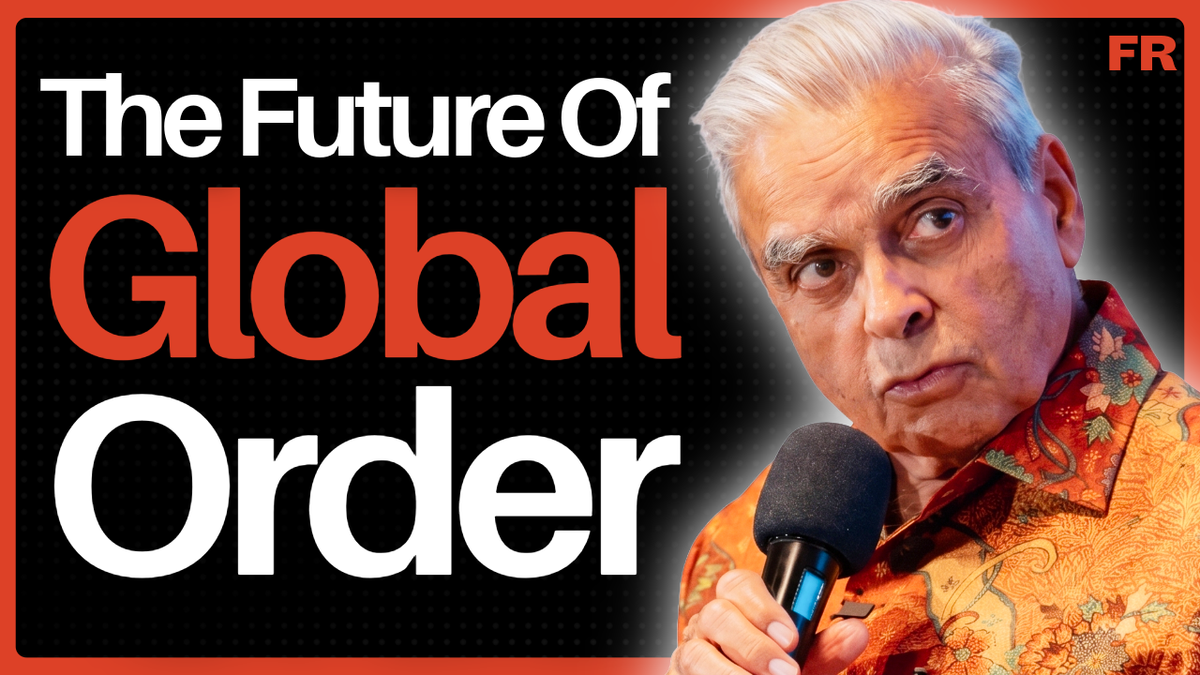
Kishore Mahbubani is one of Asia's most prominent public intellectuals, a former diplomat, academic, and author whose career spans decades at the intersection of geopolitics, philosophy, and statecraft.
He served as Singapore's Permanent Representative to the United Nations on two occasions and as President of the UN Security Council, before becoming the founding Dean of the Lee Kuan Yew School of Public Policy at the National University of Singapore, a position he held for over a decade.
He is the author of several widely read books on the shifting global order, most recently Has China Won?, which examines the structural logic of US-China competition and has been read and cited by senior officials on both sides of that contest.
In this conversation — filmed live in front of an audience of young leaders curated with the National Youth Council — Mahbubani ranges across the Iran-Israel war and the misreading of Persian civilisational logic, the structural weaknesses of multilateral institutions and who is actually responsible for them, the enduring miracle of ASEAN in the world's most diverse region, and the iron law of geopolitics that makes the US-China contest essentially mechanical.
He closes with a characteristically optimistic verdict on Singapore's place in history and what the next generation of leaders must understand to navigate the crossfire that is coming.
TIMESTAMPS:
0:00 Trailer
1:08 Introduction
1:42 Singapore's Sixty Years of Peace
3:05 The MacDonald House Incident
5:00 How Singapore Repaired Relations With Indonesia
7:46 The Iran-Israel War
8:48 How Israel Sold Trump a Quick War
11:27 Why Iran Didn't Surrender
12:26 The Strait of Hormuz as a Weapon
14:38 Gaza and the Two-State Solution
16:00 How Gaza Damaged the West's Standing
18:26 Israel's Military Dominance Won't Last Forever
21:09 How Young Singaporeans Should Read the Crisis
21:42 Don't Get Emotional — Get Rational
23:24 Who Actually Weakened the UN
24:09 The Hypocrisy of Western Complaints About the UN
29:30 How Singapore Can Use Multilateral Platforms
31:56 The Iron Law of US-China Competition
33:57 How China Found Its Weapon
36:02 ASEAN's Imperfections — and Why That's Fine
39:37 ASEAN Outgrew the EU
42:09 Q&A
43:17 The Case for the UN Veto
45:15 Why the UK Should Give Its Seat to India
47:30 Sunrise vs Sunset Organisations — BRICS and the G7
52:15 ASEAN's Limits — and Its Quiet Power
56:02 The Long-Term Fallout From the Iran War
58:20 Is International Law a Sunrise or Sunset Trend?
1:02:46 Singapore's Founding Realist Principle
1:04:32 The Malacca Toll, the UAE, and the GCC
1:09:32 One Piece of Advice for Young Leaders
1:10:04 The Singapore Miracle in World History
1:13:00 Prepare for the Crossfire
1:13:51 Closing
This is the 84th episode Of The Front Row Podcast
Keith 01:08:00
To help us make sense of the coming chaos, we have a man who has helped build Singapore as a trustworthy and reliable partner in the world. He is a diplomat, scholar, and one of the most clear-eyed strategic thinkers Asia has ever produced. Some have called him the muse of the Asian century. This conversation that I'm about to share with you was filmed live in front of an audience of young leaders, curated together with the National Youth Council. We're glad we can share it with you online today.
Kishore 01:42:00
First of all, thank you very much for having me here, and thank you for spending an evening with me. I hope you don't find your time wasted.
On geopolitics and where we are in the world today, one thing I want to emphasise is that many Singaporeans don't understand that the almost sixty years of peace and prosperity Singapore has enjoyed makes this country very unique. In 1965, when Singapore became independent, the British left behind multiracial colonies in every corner of the world. If you travel to South America, you have Guyana — a multiracial colony left behind by the British. You have several in Africa. You had Sri Lanka in South Asia. You had Cyprus in Europe. You have Fiji in the South Pacific.
Go and check every country I've mentioned — every single one has experienced some kind of trauma, either internal or external, as part of its history. The thing that surprises me is that Singaporeans are not even aware of how unique and how remarkable our record is.
A couple of years before we became independent, during Konfrontasi, a bomb went off a few doors away at MacDonald House. That bomb had a very important impact on Singapore's history. As you know, we caught the two Indonesian marines responsible. Singapore, believing in the rule of law, put them on trial and determined they should hang. President Suharto asked for clemency. We said no. The Singapore embassy was burnt. As a result, relations between Singapore and Indonesia started off on a very sour note.
I mention that because the logical consequence of that incident could have been what you see today between India and Pakistan, between Israel and its neighbours, between Japan and China — all those kinds of enduring hostilities. But why didn't relations between Singapore and Indonesia go in that direction?
The answer is that our founding leaders were geniuses. Absolute geniuses. I say this with some confidence because I've actually met many world leaders. I can say with great confidence that our founding leaders were far superior to most world leaders in their ability to make tough decisions for Singapore.
Going back to the MacDonald House incident — we could have had decades of suspicion with Indonesia. But fortunately, we had a very smart ambassador there, Lee Koon Choy. He told Mr Lee Kuan Yew there was a very simple way of resolving this. Follow Javanese tradition: go to the graves of the two marines who were hanged in Singapore, sprinkle flowers, and their souls will rest in peace.
Something as simple as that, brilliantly done at the right time, closed a very painful chapter and allowed us to build and transform that relationship. Today, you live in a world where countries cannot even say sorry to each other or talk to each other. That is why you have this incredible amount of discord in the world.
The reason you have had these exceptional decades is because brilliant minds worked very hard to plant the right seeds for Singapore. Because they planted the right seeds, the right plants emerged. We have deep roots today. There are invisible trees above us that are actually protecting Singapore.
One simple example: when was the last time our region saw a major war? 1979 — that's 47 years ago. Why? Because there is an umbrella called ASEAN that was created, built over decades and decades. That's why you are enjoying the peace.
I mention this because many Singaporeans are not even aware of ASEAN, and those who are aware of it read what The Economist says, what the Financial Times says, and rubbish it. Because the Anglo-Saxon media rubbish ASEAN, Singaporeans rubbish ASEAN. In doing so, they are shooting holes in the umbrella that is protecting them. We must find out what is giving us this peace, and then cherish it, protect it, and nurture it.
Keith 07:46:00
The last time we spoke, about a year ago, the world was surprisingly less turbulent — which is ironic, because at that time I thought Liberation Day and the tariffs represented the worst things could get. Apparently, you can always sink to a new low.
I want to bring us to a current theatre of conflict: the Iran war. As we understand it now, the war is in a fragile pause. Large-scale airstrikes have eased, but the ceasefire is shaky, and in some cases has already been violated. The Strait of Hormuz remains a critical pressure point that Iran is using as leverage. Negotiations remain unresolved.
One of the points you've made in previous interviews is that the US has fundamentally misread Persian civilisational logic. I'd like you to explain what that actually means.
Kishore 08:48:00
On Iran — I call it the Israel war, because the conflict is fundamentally between Iran and Israel. Israel, as is well known, has significant influence on the United States and has been able to bring the US along with it. I hope some of you may have read the article in the Straits Times today by their London correspondent Jonathan Eyal, which is worth reading. For the first time, it argues, public opinion in the United States is turning against Israel. That would be one of the more self-defeating things Israel has done — alienating its strongest constituency.
In this war, both sides have made strategic mistakes. In Israel's case, for example, there is a very detailed New York Times account of a meeting — one nobody has challenged — that took place a few weeks before the conflict started. Prime Minister Netanyahu went to Washington, gave President Trump a briefing, and said this would be quick and easy: decapitate the Iranian leadership, the regime will collapse, we declare victory and go home. That is almost exactly what he said.
He told President Trump they had to move fast because there would be a day when all the top leaders would be gathered in the open at a particular venue. And sure enough, Israeli intelligence performed remarkably. They knew exactly where each nuclear scientist would be, at what hour, so they could eliminate him at the precise time and place. Mossad's performance was extraordinary.
So President Trump believed what Netanyahu said. This would be an easy war — a quick, short engagement, which is what Trump prefers. He does not like long wars. And then he discovered that Iran is not Venezuela.
The reason Iran is not Venezuela is because Iran represents one of the oldest, strongest civilisations in human history — Persian civilisation. The Persians have been fighting wars for three thousand years. They have had many near-death experiences from invading hordes, seen the country destroyed, and revived. It is a very hardened civilisation.
The decapitation strike, rather than weakening Iran, gave it a powerful burst of energy. Iran said: now I will respond. And they responded by closing the Strait of Hormuz — something they had long wanted to do, and which has caused the entire global economy to suffer.
What has helped Iran enormously is that President Trump's main concern is the November midterm elections. If oil prices remain high, if inflation increases, if food prices go up in the US, Republicans under Trump will suffer enormously. The Iranians are sophisticated enough to understand that very well.
Even though the Iranians took a severe military beating — the Israelis and Americans could bomb any part of Iran and Iran couldn't stop them — most countries in that position would have found the temptation to surrender very strong. Iranians didn't surrender. Instead, they were able to retaliate very effectively.
I think both sides have underestimated each other. There is now a recalibration going on as both sides try to understand exactly where they stand. Nobody can tell you what will happen in the next few days, because President Trump will surprise us — and at times will surprise himself. He will do things he would never consider doing today. He is a very difficult man to predict. You could go in either direction: escalation, or a declaration that the war is over. Nobody knows which way it will go.
Keith 14:38:00
It feels like reality is becoming a reality show.
The other thread I thought was worth exploring — partly because of our relationships with both the US and Israel — is the question of Gaza. The World Bank has estimated that Gaza needs approximately $71.4 billion over the next decade to recover from two years of war, and that seems to be the floor, not the ceiling. As the war continues, that bill will only grow.
When I was reading the book on Singapore's fifty years of relations with Israel, former Foreign Minister George Yeo pointed out that Henry Kissinger always argued that grand solutions were not possible, and that one should take small steps that open up possibilities and let history find its course gradually. That was in reference to the two-state solution, which Singapore has consistently advocated for. But the paradox to me is that as time has passed, that solution seems further and further away — almost to the point of structural impossibility. Is that diagnosis too grim?
Kishore 16:00:00
You want me to make the crowd even sadder? Even before we talk about reconstruction, the living conditions of the millions of people in Gaza is absolutely awful. They don't have shelter. Forget schools, forget hospitals — they don't have shelter, and they often have difficulty finding food. They are among the most miserable people on the planet.
What happened in Gaza has damaged the standing of Western countries in the eyes of the rest of the world, because those countries always said they oppose violations of human rights, they oppose genocide. But when Gaza came along, they kept absolutely quiet. That has damaged them enormously.
I want to emphasise that none of this condones the terrible attacks Hamas made on 7 October when they killed so many people. That was wrong. We condemned it. But you still have to respond proportionately and in accordance with international humanitarian law. Most of that law has been violated in Gaza. And the European countries that used to lecture Singapore about human rights kept absolutely quiet — as did many of the leading human rights advocates in the United States. That is the impact Gaza has had.
As for the two-state solution: the current Israeli government no longer believes in it. They are pursuing what amounts to a one-state solution, and that will not work. There is no way to remove five or six million Palestinians. A solution must be found for them.
The tragedy is that none of Israel's friends have given it honest advice about how to manage its future. Israel is today, without question, the most powerful military force in the Middle East — its capabilities are stunning, given a population of only five to seven million citizens. Even Egypt, with a population of eighty to ninety million, would lose a war with Israel tomorrow.
But because they have these capabilities today, they assume they can remain militarily dominant forever. In that belief, they have not studied history. No power remains dominant forever. There are 1.4 to 1.5 billion Muslims in the world who have become very angry. Right now they are weak and cannot exert themselves — but that will change at some point.
It is wiser for Israel to make peace while it is incredibly powerful, when it can secure the best possible terms, rather than to drag this out and wait for a day when things may have changed. As a friend of Israel, I am advising them: stop walking towards a cliff. Turn around and find a peaceful solution.
Keith 21:09:00
If you ask the average Singaporean — and I speak to my friends, my Muslim friends tend to be more aggravated, but even friends who are not particularly religious feel this is a humanitarian crisis at the very least. In that context, as a young Singaporean, many don't even see the possibility of viewing Israelis as partners, for example. What would your advice be to them — how to read the situation without being too emotionally stirred?
Kishore 21:42:00
The one big lesson I learned from Lee Kuan Yew, Goh Keng Swee, and Rajaratnam is this: when it comes to geopolitics, if you have a contest between someone who is rational, cool, and calm, and someone who is emotional, the rational, calm person always wins. So when it comes to geopolitics, do not become emotional. Calculate everything in a very cool, calm, rational fashion.
The world will remain a mess in many parts. We cannot fix all of it. We have to accept what is happening, live with it, try to manage it, and be thoughtful where we can. I am glad Singapore has sent humanitarian supplies to the Palestinians. I think we should send more — that is something concrete we can do.
Beyond that, we are far too small to fix a problem like Israel and Palestine. I find it helpful to have private conversations with Israeli friends and Palestinian friends and share my thinking on how they might find peace. But we cannot become too starkly involved. And that principle applies not just to Israel and Palestine — it applies to any conflict in our region. The Philippines and China, India and Pakistan: those are not our fights. We have to let them figure it out.
Keith 23:24:00
One of your theses is that when Singapore cannot affect change directly, it uses and leverages multilateral institutions. But over the past two or three years, those institutions — the WTO, the World Health Organization, the UN — have only become weaker. There seems to be a structural decline under way.
Where do you think the future of the UN lies? I know you are an optimist, but from the way things appear, it seems increasingly pessimistic for multilateral organisations. I'm happy for you to give us a hopeful note, though.
Kishore 24:09:00
This is a perfect example of Singaporeans having their minds captured by the Anglo-Saxon media. The media rubbishes the UN, so we rubbish the UN too — forgetting that small states survive because of something called the United Nations.
Before 1945, it was perfectly acceptable for a powerful state to conquer its neighbour. The UN Charter changed everything. It said: from now on, any state that invades and occupies a neighbouring state pays the price, with the international community saying no, that is wrong. That fundamental turn in human history has benefited Singapore enormously.
You should also understand why the UN is performing badly. Not because something is wrong with the organisation itself. It's because the great powers want to weaken it. Even at the height of the Cold War, when the United States and the Soviet Union disagreed on everything, they agreed on one thing: the UN must be kept going. But the one criterion both applied when selecting a Secretary-General was that he must be spineless. When an organisation is forced to pick spineless leaders, of course it will be weak. But who made it weak? The great powers made it weak.
One of the most interesting exchanges I personally witnessed was in the mid-1980s. Our then-Foreign Minister Mr Dhanabalan was speaking with US Secretary of State George Shultz. Shultz was complaining: look at the UN, it's so weak, badly managed, wasting money. Dhanabalan said, "I agree with you. The UN is very weak. Why don't we now pick a very dynamic, entrepreneurial person with courage and integrity to run it?" And Shultz blushed. He knew. It was the United States that had been picking these weak Secretaries-General.
It's not like the Catholic Church. When the Catholic Church selects its leader, they look for the strongest individual, someone with high integrity and moral courage — and that person becomes Pope. For the UN, if you have integrity and moral courage, you are disqualified. I mean, this is absurd. The Western countries weaken the UN, then they complain the UN is weak.
And remember: the UN is a voluntary organisation. You don't have to join. You can quit any time. Tell me — how many countries have quit the United Nations? Why hasn't any country walked out? Why hasn't the United States? Clearly there is something very valuable and precious in it. So why are we Singaporeans rubbishing it when it is clearly not in our national interest to do so?
We should expose the hypocrisy: these countries weaken the UN and then protest that it is weak. This is just one area of what I would call a very profitable hobby of mine — collecting examples of Western hypocrisy. If you know of some good ones, please email me. I'll put them in my next book.
Keith 29:30:00
I think you've helpfully distinguished between the diagnosis and the cause. The UN is weak — but the cause is clear. Given what is at stake, though, and given that Singapore is a price-taker when great powers decide who leads these institutions, I'd like you to show us how Singapore can actually use these platforms to help create a better world.
Kishore 30:21:00
We should be like Dhanabalan. He said directly to George Shultz: why don't you pick a strong Secretary-General? We should be able to say that clearly and directly to the Americans, to the Russians, to everyone, because those are simply the facts.
At the end of the day, the nature of world history did change in 1945. Yes, countries have been invaded since then — Vietnam invaded Cambodia, the US invaded Iraq. International law has been broken. But just as in domestic law — in Singapore, murder is banned, yet murders still happen — what matters is how violations are handled. And the fact is, most countries overall still respect the principles of the UN Charter. That is something we should celebrate.
Keith 31:30:00
So it goes back to your earlier point about ASEAN — that sometimes you don't appreciate how good things are until you see how bad things can become. Even then, we tend to underappreciate the value these institutions bring. Do you see an off-ramp coming, or do you think this is just a pause and things will get worse in the near and medium term?
Kishore 31:56:00
The US-China relationship is complicated, which is why I wrote an entire book on it — Has China Won? I'm very glad that fairly senior people from both China and the United States have read it and called it a fair and balanced account, because it tries to explain both perspectives.
There is no question that the US-China contest will accelerate over the medium term. That's a given. Because of that iron law of geopolitics — going back 2,000 years — the world's number one power will always push down the world's number one emerging power. It's mechanical. So when you listen to American officials, they are determined to stop China. Determined.
And if they're determined to stop China, what should China do? Say it won't grow? The Chinese can't do that. They have to keep growing their economy, growing their middle class. This contest is locked in.
Nobody anticipated what happened this year. When the United States raised tariffs on China to 145%, the Chinese found a weapon to retaliate with. They cut off the supply of rare earths and magnets. The US discovered very quickly that its economy cannot function without them. And this is an example of Trump being very pragmatic — he said, OK, I can't push them down on this one, I have to compromise. Trump lowered the tariffs. China restored supplies of rare earths and magnets. And so you have a détente — a brief détente, but a very brief one. This is temporary. Both sides will still find ways to gain advantage.
The contest will carry on. If they can avoid the worst-case scenario of a direct war, that is all we need. We should work to ensure they don't go to all-out war. I think that can be prevented.
That is also one reason I wrote Has China Won — because many people fall into a kind of passivity: we can't do anything about it. But if you write something reasonable and people read it, you can actually influence policy. The Trump administration read the book and responded well to it. Don't just say you can't do anything about it.
Keith 36:02:00
I read The ASEAN Miracle. I think the miracle dimension is undeniable. But there are two familiar critiques. First, that ASEAN member economies often compete for the same foreign investment rather than complementing each other — so you don't get the kind of regional development that comes with genuine integration. Second, that ASEAN countries have not really helped develop one another. As Parjit Agarwal from Indonesia has pointed out, only two of the ten ASEAN member states have reached developed status — Singapore and Brunei — with Malaysia catching up.
A less-discussed point, which I think you've raised, is that ASEAN countries tend to be too silent and polite in the face of great-power rivalry, when in fact they should be doing more to de-escalate — because China is a geopolitical reality we have to live with, and if the US wants to leave, it can.
My question is: how do you strengthen ASEAN to be better equipped to maintain competition without confrontation?
Kishore 37:28:00
ASEAN is a very imperfect organisation — incredibly imperfect. But when you measure organisations, who do you compare ASEAN with? The only fair comparison is with other regional organisations among developing countries. And a very simple question: name me one organisation of developing countries doing a better job than ASEAN.
Go to Latin America — Mercosur: Brazil, Argentina, Uruguay. In ASEAN, leaders meet every year and talk to each other. In Mercosur, the leaders of Brazil and Argentina don't talk to each other. What is going on in Africa? The Gulf Cooperation Council? Look at the internal divisions there. South Asia? The South Asian Association for Regional Cooperation hasn't met in ten years. And then there's the European Union — which is supposed to be the gold standard for regional cooperation, and in some ways is, because there is zero prospect of war between EU member states. But if you want to meet the most depressed young people in the world, go to Europe. Europe is becoming a wonderful museum for the world. ASEAN is not a museum. ASEAN is growing.
In the decade from 2010 to 2020, these poor developing countries in ASEAN contributed more to global economic growth than the entire European Union. No other region can match ASEAN's growth. So when you try to turn this imperfect body into a perfect one, you'll destroy it. Don't try to make it perfect. Leave it as it is. ASEAN is like a crab — two steps forward, one step back, one step sideways. That's how ASEAN moves. Because if you try to take an imperfect organisation and force it to be perfect, you'll destroy it.
Enjoy the imperfect regional organisation you have — because all of you can sit here tonight without worrying about a bomb coming through those windows. That is because of ASEAN.
And I want to be serious when I say this: every morning I wake up, I worship ASEAN. This organisation has been so brilliant in taking the most diverse region on planet Earth and keeping the peace. There are 700 million people in ASEAN — 250 million Muslims, 150 million Buddhists, 150 million Christians, Mahayana Buddhists, Theravada Buddhists, Chinese, Communists. Tell me one place in the world where you have Hindus, Muslims, Buddhists, and Christians all living in peace with each other. So what ASEAN has done — taking this hugely diverse region and delivering peace and prosperity — is an act of miracle.
Do we thank ASEAN for this miracle? No. We join The Economist and we rubbish it. That's what Singaporeans do.
Keith 42:09:00
On that note, I'd like to move to questions. Although we rubbish it, I think we see it for its imperfections — and the Singaporean in us always strives for perfection. They always joke: when you get 90 on the exam, your mum asks, why not 91? Why not 92? It's in that spirit — not rubbishing, but hoping for a better future. And the lesson I take away is: don't try to turn a crab into a tiger.
I'd like to start with the top-voted question from the audience. And if you have questions, please raise your hand so we can get the mic to you.
Audience Member 1 42:46:00
Thank you for the candid conversation. I have a slightly contrary view on the United Nations. First, there's a structural problem with the Security Council veto — the ability to block resolutions. And second, who or what serves as the policeman for the world? Is that the direction of travel you think the UN could move towards to be more effective?
Kishore 43:17:00
Two good questions — one on the veto, one on being the policeman.
On the veto: the politically correct answer is that vetoes are bad. In theory, in any country, we believe every citizen should have one vote. If one citizen could veto the entire country's decisions, we would never allow that. So internationally, we should also say all countries are equal.
But the founders of the UN were much more brilliant than we are. They saw clearly what happened to the UN's predecessor, the League of Nations. Why did the League of Nations die? Because its most powerful member, the United States, left. So the founders asked: how do we anchor the great powers in the UN? Make sure they don't quit? Because if they quit, the UN becomes useless. The founding fathers gave the veto precisely as a mechanism to ground the great powers and keep them inside the tent.
The veto also serves to ensure that the UN does not make decisions to enforce sanctions on the United States, for example. You cannot fight the United States directly — the UN would die. So the veto was a brilliant structural solution.
The only mistake the founders made was that it was designed for the great powers of 1945. This is 2026. Those are no longer the great powers of the world. And that is why I wrote a column — which I was surprised the Financial Times published — arguing it is time for the UK to gracefully hand its seat to India. The reason is straightforward: in the year 2000, the British economy was 3.5 times larger than India's. Today, India is larger than the UK, and by 2050 India will be four times bigger. Strictly speaking, the UK should give up its seat to India. I'm surprised no Indian leader is calling for this — I'm trying to help them out.
So the veto should remain, but it must be transferred to the great powers of today. That is the change that needs to happen.
On the policeman: when the great powers collaborate, the UN does a brilliant job. In the 1990s, after the Soviet Union collapsed, there was a brief period when Russia, the US, and China were getting along reasonably well in the Security Council. Suddenly, all kinds of long-standing conflicts disappeared — including the Cambodian conflict. So when the UN doesn't function, it doesn't mean something is wrong with the UN. It means great-power relations are bad. If tomorrow — improbably — the United States and China fell in love with each other, the UN would come roaring back. Everything would happen at the UN again. It all depends on the great powers.
Keith 47:30:00
This next question is about Singapore joining BRICS, and I want to link it to a broader question about sacred cows. When you become as successful as Singapore has, certain precepts become doctrinal truths. You've argued that Singapore should take a fresh look at BRICS and find ways to participate in it. But Donald Trump — and many American leaders — see BRICS as a rival to US-led institutions. How does one make that shift in a multipolar world? Could we see Singapore embedded in BRICS in the future?
Kishore 48:20:00
In this world, there are sunrise organisations and sunset organisations. It is clearly in Singapore's interest to join sunrise organisations and not sunset ones.
The G7 is a sunset organisation. When it was started, it genuinely represented the most powerful economies in the world — a meeting of peers, where the Europeans could speak to the United States on a level playing field. Today, a G7 meeting is like a meeting of Snow White and the Seven Dwarfs. The Dwarfs have no say. The Europeans have become dwarfs — I'm not exaggerating. They can have no real impact on what G7 does. And the G7's share of global GNP, decade by decade, is going down. They're not growing.
BRICS's share of global GNP is rising. BRICS is clearly a sunrise organisation. It has got lots of challenges — most significantly, its two biggest members, India and China, don't get along very well. That is a problem. But they have found ways of getting along well enough to keep BRICS going.
I'm not advocating that Singapore join BRICS outright — we are too small and it would be complicated — but we can find ways of working with BRICS. There is also the OECD, which represents mostly Western states: there is no reason why Singapore can't join the OECD while also working with BRICS. We should look for multiple options, and do so slowly and carefully.
The critical point is this: the countries of the world are mostly operating peacefully and trying to find peaceful ways of growing and developing. We should increase our connections with as many countries as possible, not focus only on Western countries.
Audience Member 2 50:58:00
Thank you for your sharing. My name is Clarence. I was previously a trade negotiator for ASEAN, so I can relate to the energy of working within that structure.
My question is on ASEAN. Given the Thailand-Cambodia conflict and Trump's positioning as a kind of go-between, do you feel that ASEAN was in any way derelict in the job it should have been doing? My second question: with the US tariffs, we saw ASEAN countries coming together in one sense, but ultimately negotiating individually with the United States. Is that a sign that when the stakes are truly high, each country will defend its own interests without regard for the collective organisation?
Kishore 52:15:00
I am glad you experienced the imperfections of ASEAN as a trade negotiator. It's important to remember that when Singapore first started trade negotiations, our Permanent Secretary at the Ministry of Finance was Mr Ng Tong Dao — a very impatient man. He went to Indonesia thinking he could get something done within 24 hours. He realised very quickly that in ASEAN, you wait a few years. The answer will be yes eventually, but don't rush.
You've identified two imperfections, and you're right on both counts. On the Thailand-Cambodia dispute: ASEAN didn't intervene in the latest round. But in the previous dispute, the Indonesian Foreign Minister Marty Natalegawa did go in and try to help Thailand and Cambodia find a resolution. We didn't do that this time around, and I'm glad President Trump intervened. Any leader who pushes for peace is doing the right thing.
But here is the thing about ASEAN's imperfection in that case: if ASEAN had not existed, the war between Thailand and Cambodia could have escalated very quickly — more troops deployed, more soldiers killed. Instead it was brief and restrained. Why? Because there was very strong informal peer pressure from ASEAN countries — private phone calls, quiet appeals to please stop. That peer pressure helped restrain the conflict. Now, can you imagine doing the same with Iran and Israel? There is no such peer pressure. They don't belong to any common organisation. That is the difference.
On ASEAN countries negotiating individually with the United States on tariffs: there is no choice. Our economies are very different. We cannot agree on one common package to present to Washington because our needs are different. It is actually good that all of us are finding our own solutions, as long as those solutions don't damage our neighbours — and they don't, because all of us are simply trying to get the best possible deal from the United States.
But please also remember: take the long view. We have had administrations in the past that paid less attention to ASEAN and ASEAN relations went down. Then they were replaced by administrations that valued ASEAN — like Barack Obama, who grew up as a child in Indonesia and speaks Bahasa Indonesia. He knew where ASEAN was. So you have to learn patience. Don't get frazzled if one or two years are difficult. Things will change.
Keith 56:02:00
There's a question about the precedents being set by the Iran-Israel war. If we zoom out — the blockading of the Strait of Hormuz, the fighting in the Middle East — what are the longer-term fallouts that you foresee? Developments that will reshape the world in ways that many people are not paying enough attention to?
Kishore 56:31:00
The closure of the Strait of Hormuz is a clear violation of international law under the UNCLOS convention, and Singapore's position stating this is correct. But at the same time, if you want Iran to behave as a responsible stakeholder in the global system and observe international law, you also have to be willing to say that the attack by the United States and Israel on Iran is a violation of international law. You can't tell one side to respect international law and tell the other side it's perfectly fine to violate it. The merciless bombing is itself a massive violation. So we must call on all parties to respect international law if we want to find a solution.
Keith 57:57:00
Is this going to be a world where international law is increasingly disregarded, treated as secondary to national interest? Because historically, great powers have never really let international law constrain them when they feel their interests are at stake. Do we see that spreading — not just among great powers, but any state that decides it can pursue its interests regardless of international law?
Kishore 58:20:00
My answer to that — forgive me if I sound repetitive — is to ask a simple question: is international law a sunrise trend or a sunset trend?
Let me put it to a vote. How many of you think international law is a sunrise trend? Raise your hands.
[Audience response]
OK, how many say it's sunset?
[Audience response]
Clearly a vast majority. I belong to the minority — I say it's sunrise. And I say it's sunrise for a very simple reason. Watch decade by decade: are most countries complying more or less with international law? This is a factual question, a measurable one.
The first and most fundamental violation of international law is invading your neighbour. That trend, over the long term, is going down. There are 193 countries in the world. How many are complying with international law? How many are violating it? The good news is the vast majority of 193 nations are complying. It is by far a sunrise tendency, because most countries do so for sensible reasons — it is in their interest to respect international law because it keeps them at peace.
Of course, there will be massive violations from time to time, and it is always the great powers who violate international law. So it is up to the rest of us — the non-great powers — to tell them: please behave yourselves and respect international law.
On the long-term trend, the world is actually becoming a better place, partly because policymakers around the world are becoming more educated and more aware of the costs and benefits of going to war. All the recent wars have again reminded us of the futility and stupidity of war. One of my life missions is to increase the forces that delegitimise war. Small states should speak out more strongly on this. That is why I launched the Asian Peace Programme. And yes, some of my Singaporean friends said to me, Kishore, why are you wasting your time? But if you have that cynical attitude, you will never improve the world.
Audience Member 3 1:02:25:00
There's a real chance that US security deterrence in Asia is weakening. Iran is a middle-sized power — but what are the implications for Asia if the US is now the biggest disruptor of the global system rather than its guarantor?
Kishore 1:02:46:00
The one thing I learned from our founding fathers is that they were realists of the highest order. If you are powerful, we will deal with you.
In the Cold War, we were much closer to the United States. But even then, we were never anti-Soviet Union. I personally accompanied Mr Rajaratnam to Moscow in 1976 — exactly fifty years ago — and we met with the legendary Soviet Foreign Minister Andrei Gromyko. Mr Rajaratnam told Gromyko: we are anti-communist at home — and it's true, Singapore is anti-communist domestically, we jailed communists — but we are not anti-communist in our foreign policy. We welcome American naval vessels in Singapore. We welcome Soviet naval vessels in Singapore. We don't take sides.
The same principle applies between the US and China today. We will be friends with the US and friends with China. We will not take sides. This is not our fight.
And fortunately, we don't have to make this decision alone. We are in ASEAN. All ten ASEAN countries broadly agree: we want to be friends with both the US and China. We are not going to choose. All ten of us agreeing makes it a reasonable, defensible position. That is one of the protections we have in this geopolitical context. It is what our founding fathers would have done, and it is what we are doing.
Audience Member 4 1:04:32:00
Earlier this week, the Indonesian Finance Minister raised the idea of imposing a toll on the Strait of Malacca — we've seen the situation with the Strait of Hormuz, and there was pushback from Singapore. What were your immediate thoughts? The Indonesian Finance Minister also suggested the revenue could be split three ways between Singapore, Malaysia, and Indonesia. Is this a viable solution?
And a related question: how do you compare Singapore's position to that of the UAE in the current situation, given that US alignment is making some Gulf states vulnerable? And how is the GCC reacting to what Iran is doing?
Keith 1:05:15:00
Let's gather those three questions together and then we'll take the answers.
Kishore 1:06:21:00
Three questions: the Indonesian Finance Minister's toll proposal, whether Singapore is like the UAE in some ways, and how the GCC is responding to Iran.
The Indonesian Finance Minister — that is easy to answer. He has withdrawn the proposal. The matter is closed. I am not even sure whether it was serious or a trial balloon. But it is a very good example of how countries like Indonesia, Malaysia, and Singapore respect international law, and why it is in their interest to do so. Indonesia is a huge archipelagic country. It is very much in Indonesia's interest to see the archipelagic principles embedded in international law protected and not weakened. So Indonesia has enormous vested interests in upholding international law.
On Singapore versus the UAE: I would say our positions are quite different, because we are not directly involved in any bilateral conflict. Iran explained its strikes on US bases as a response to attacks on Iran, but to be completely candid, they went beyond that. When a country is fighting for survival, you have to expect it to do desperate things.
Which brings me to the GCC. The genius of ASEAN is that it maintains good relations with all its big neighbours — India, China, Japan, South Korea, Australia. We have good relations with all of them. The GCC must copy ASEAN on this. You must have good relations with all your neighbours, whether you like them or not. That is irrelevant. They are your neighbours. You have to live with them.
There is only one fact I can guarantee you with certainty: Iran will be a neighbour of the GCC not for the next ten years, not for the next hundred years, but for the next thousand years. If you have a thousand-year neighbour, learn to get along with it.
Keith 1:09:32:00
On that note, I have one last question as we wrap up. People call you the muse of the Asian century — not a title I gave you, but one that has been given to you. You've been influential not just in the public space, but in rooms where decisions are actually being made. Today we're in a room full of young, striving leaders trying to make their way in the world. If there is one piece of advice you would give them, or one bet you think they should be making today, what is it?
Kishore 1:10:04:00
One piece of advice is very difficult, but I would say this: despite everything I've said, be optimistic.
I am actually optimistic about the future. The reason I try to analyse every flaw in the international system is to identify what needs to be fixed. At the end of the day, consider what Singapore has achieved. When I grew up in the 1960s, our per capita income was $500. Now it's $94,000.
And I want to emphasise something to all of you, just in case you didn't know: no other country anywhere in the world, at any point in human history, has grown as fast and as comprehensively as Singapore has, in the years that Singapore has done it. We are number one in world history. We should be celebrating that fact.
Singaporeans are not even aware of this. It's stunning. You are living in a country that, by any millennial standard of human achievement, has done something miraculous. And yet we wake up every morning mourning all kinds of small things that don't work, fixating on all kinds of problems. Which is bizarre.
I have lived in Cambodia when it was being shelled every day. I have lived through war, I have lived through poverty, I have seen the other side. So I can see clearly what we have achieved — because I've been there, I've crossed over to the other side. And so I understand what a miracle we have today.
Every miracle is the result of amazing hard work and amazing genius. If we hadn't had our founding fathers — Lee Kuan Yew, Goh Keng Swee, Rajaratnam — I can tell you, they were real geniuses. And the proof is simple: why hasn't any other country done what Singapore has done? No other country has. We must understand that special contribution — understand what it was about the genius that created this Singapore — and ensure we capture it, preserve it, and let it survive another sixty years.
Keith 1:13:00:00
So what is that one thing we should capture in a bottle and carry with us wherever we go? I already know "worship ASEAN" is one answer, and the Singapore miracle is another. But what is the one thing you hope will stay with us as we go forward in the world today?
Kishore 1:13:16:00
I guarantee you that the geopolitical tensions in our neighbourhood will grow, because the US-China contest will accelerate and Southeast Asia will become an arena in this great-power competition. We will be caught in the crossfire. That is a given. The question is: how do you start preparing now to protect yourself from that crossfire? Because it's coming.
So life won't be boring.
Keith 1:13:51:00
On that note, thank you Professor Mahbubani for making the time for us.
Thank you for listening to today's episode. If you are watching this on YouTube, please consider subscribing and turning on notifications for whenever new episodes are out. If you're on Spotify or Apple, it would help us greatly if you could leave a five-star review. Once again, thank you for tuning in to The Front Row Podcast.