The Harsh Truths of Singapore's Independence - Janadas Devan
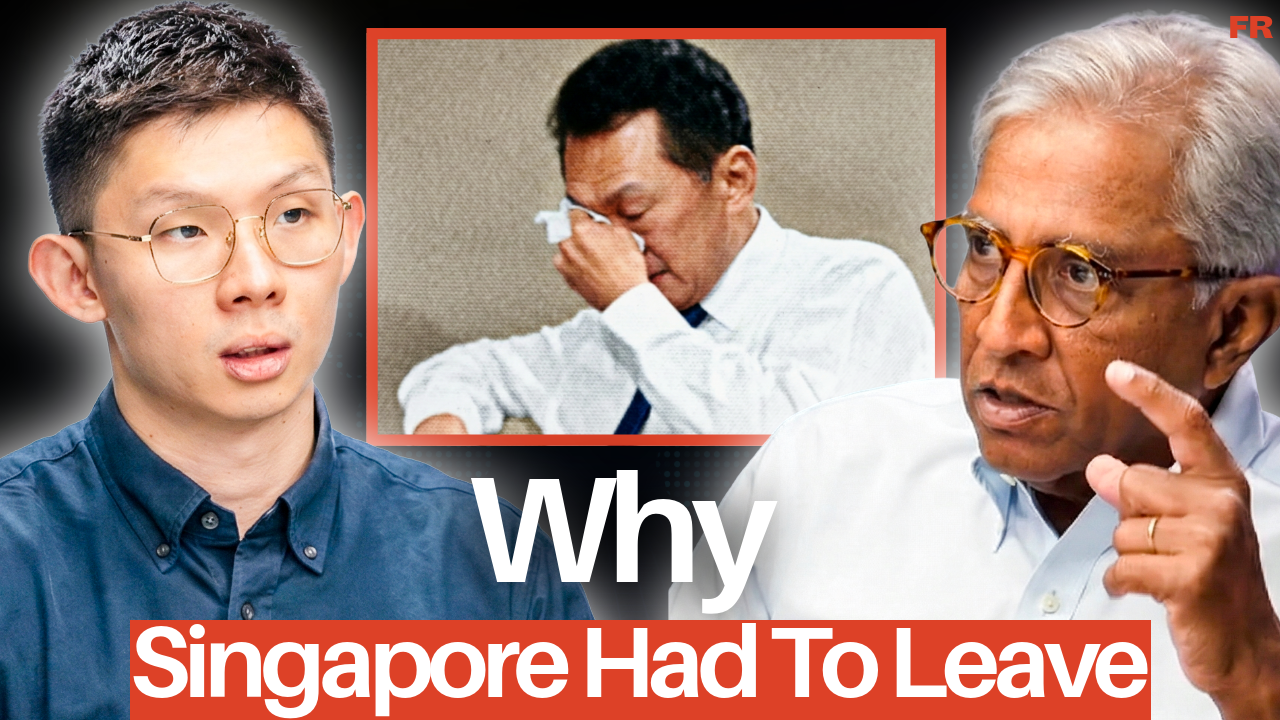
Thank you for checking out my interview with Janadas Devan.
Janadas Devan is the Senior Adviser at the Ministry of Digital Development and Information and current Deputy Secretary at the Prime Minister's Office of Singapore
Mr Devan coordinated The Albatross File: Inside Separation, the authoritative 488-page volume documenting Singapore's path to independence, co-published by Straits Times Press and the National Archives of Singapore.
Here is more context on The Albatross File:
The troubled 1963 merger with Malaysia began with fundamental disagreements and was further strained by the 1964 race riots.
Finance Minister Dr Goh Keng Swee maintained a secret file code-named "Albatross"—referencing Coleridge's poem about burden and consequence—containing Cabinet memos, negotiation records, and his handwritten notes from meetings with Malaysian leaders.
TIMESTAMPS:
00:00 Trailer
00:51 Subscribe!
01:19 Did We Take Merger For Granted?
05:25 The 1945 Split: Singapore's First Separation
09:44 Battle for Merger
12:48 What Tunku Actually Wanted
16:20 Ten Months: From Victory to Riots In Singapore
19:08 September 1963: PAP's Big Malay Win
26:30 Misreading Malaysian Politics
28:33 The Counter-Offensive Gamble
38:29 LKY's Strategy Works Too Well
42:35 The Idealists Who Opposed Separation
46:30 Ideological Divide in Singapore's Cabinet
49:49 How Real Was The Risk to Lee Kuan Yew?
52:53 How LKY Rattled UMNO
57:16 LKY's International Reputation
59:16 Why Secrecy Was Essential
01:04:21 Tunku's Decision: "Singapore as Gangrene"
01:07:17 Dr Goh's Masterstroke
01:11:28 Understanding Separation In Context
01:15:30 Three Lessons for Singapore
This is the 72nd episode Of The Front Row Podcast
Keith 00:01:13
We take it for granted that Singapore's merger with Malaysia was almost inevitable, at least for the lay public like me. But if we look early on in our history, we see that even in the time of someone like David Marshall in 1955, there was this idea that he wanted a merger with Malaysia. But back then, the Tunku was already lukewarm. He was not convinced. So the idea that we would eventually head towards merger between Singapore and Malaysia seemed at least not inevitable. At the very least, it seems very historically contingent.
Janadas 00:01:41
The people who wanted merger were all Singaporean. It was an article of faith for the founding generation, both within the PAP and outside the PAP. As you mentioned, David Marshall, chief minister in 1955, was the first to broach merger with the Tunku. It was the Malaysian leadership, in particular the Tunku, who was resistant to the idea of Malaysia.
Almost the first article of the PAP's manifesto when it was formed in 1954 was merger. This was not just the left or the right, but everyone. There is a Malayan Communist Party, there is no Singapore Communist Party. They took it as an article of faith that Singapore should belong to Malaya, the peninsula.
You must remember at that time it was inconceivable for a city state, for a city to be independent, to exist on its own. Even now, besides Singapore, how many city states are there? Actually, it's only Monaco and Vatican City. That's it. So it wasn't obvious that Singapore could survive on its own as an independent country.
We forget this, but for a very long part of Singapore's history, in fact for most of its existence as a British possession, we were part of Malaya. We were part of the Straits Settlements, which included Malacca and Penang and Singapore. Singapore was the central city of the Straits Settlements.
After the war, the British decided they would propose the Malayan Union, and very early they decided to keep Singapore out of the Malayan Union. Why? Because they knew that a Malayan Union with Singapore as part of the Malayan Union would be rejected. Malaya by itself, excluding Singapore, had about 1.9 million Chinese, 2.1 million Malays, and about 600,000 Indians. This was in 1945-46.
To have included Singapore would have meant that the Chinese would have overwhelmed the Malays. Even then, with a bare plurality of 2.1 compared to 1.9, the Malay leadership rejected the Malayan Union. Why? Because it had proposed liberal rules for citizenship. Almost all the Chinese then in Malaya would have been accepted as citizens. UMNO was formed to object to the Malayan Union. They put in place far more restrictive requirements for citizenship. You had to understand Malay and so on. The vast majority of the Chinese population was not given citizenship in the Federation of Malaya.
Singapore was hived off as a separate Crown Colony only in 1945. You might actually call that the first separation. The British were the ones who decided to put Singapore out of Malaya.
After that, it was an article of faith by everyone that Singapore could not be independent other than as a part of Malaya. This was an almost universal sentiment.
Keith 00:05:23
You go back to this idea of the article of faith, and it's not clear to me as a reader whether this was actually a consensus view.
Janadas 00:05:29
They were all in favour of merger for a variety of different reasons. Nobody really believed that Singapore could succeed economically by itself. The best case against an independent Singapore was made by the PAP's founding leaders. As Rajaratnam says in oral history, after 1965 they had to spend the rest of their life proving themselves wrong because they were the ones who made the case that Singapore could not survive on its own. Everyone, without exception.
Keith 00:06:07
So within the party itself, they already agreed that for economic reasons we needed to merge.
Janadas 00:06:13
Economic reasons, security reasons, and for political reasons too. The PAP leadership at that time felt that if they were part of Malaysia, the federal authority would take action against the communists or the extreme left. That was another reason why they wanted merger.
Keith 00:06:38
Can you say more about the security reasons? When I read about the political angle of maybe a merger as a way to guarantee PAP survival and to a certain extent protect itself from the communist insurgency.
Janadas 00:06:52
When we read about, for example, Operation Coldstore. Operation Coldstore took place before we joined Malaysia, but certainly the decision on Operation Coldstore was made by the Internal Security Council, in which Malaya had a decisive vote. It couldn't have happened otherwise. If the British and the Singaporeans had disagreed, the breaking vote, the casting vote, was held by Malaya.
For the Malayans, the British persuaded them, and they accepted and realized that if Singapore were to go communist, for example, you would have a so-called Cuba at the feet of Malaya. So from their point of view, they could see that Singapore's security was inextricably a part of their security, internal security as well as external security.
Singapore was a major British base and had been for a very long time. It was part of the defence structure for both Malaysia, Malaya, the peninsula, as well as all the other British possessions in Southeast Asia. The reason why the British built a naval base in Singapore from the 1920s onwards was actually not to defend Singapore, but to defend the approaches to India, which was their major possession, and of course to ensure the sea lanes between Britain, India, and then their other possessions, Australia, part of the Dominion, Australia and New Zealand. So it was part of a global security structure.
At that point, Britain was still a major power, just gone through the war. They all saw Singapore as very much a part of the security and economic structure that they were trying to put in place post-war.
Keith 00:08:59
So you couldn't... For Lee Kuan Yew and the PAP, I think the public articulation of the way they appeal to investors has always been this idea of, one, the common market, and two, this idea of a Malaysian Malaysia, right? But the security aspect also played a part, both internal as well as external, but it's not been more publicly discussed back then.
Janadas 00:09:21
No, it was. You look at Mr Lee's Battle for Merger talks in the lead-up to the referendum. He was very explicit in arguing that Singapore could not survive by itself. The very idea of Singapore as an independent country was absurd. He said that it would be to commit national suicide if we didn't merge. Everyone, all of them, felt that way.
Keith 00:09:53
The road to merger, and you alluded to the Battle for Merger. There was this huge contestation for how and on what terms Singapore should merge with Malaysia. I think both David Marshall's Workers' Party and Barisan Sosialis opposed the PAP's view of merger in parliament explicitly. I wanted to ask, do you think there was any credence to their view as to why Singapore should merge on different terms than the PAP proposed?
Janadas 00:10:17
Both Barisan and David Marshall objected to the terms of Malaysia as set out by the Singapore leadership, the PAP. They had a referendum, and the PAP alternative got substantial support, more than 70%. And so we went through. But by that time, David Marshall had accepted that the terms the PAP had negotiated were adequate.
He had objected to the initial terms because he felt that Singapore citizens would become second-class citizens in Malaya. So he objected. But when he was chief minister, he himself mooted merger, didn't get his way with the Tunku. Then, on the eve of the referendum, there was a famous debate between him and Mr Lee, and he accepted at that debate that the terms that they had negotiated on citizenship were fair. So that actually played a part in assuring a portion of the Singapore population that the terms the PAP had negotiated were adequate.
But he was not the decisive figure. The decisive players were the Barisan on one side and then the PAP. The Barisan actually miscalculated. They had argued in favour of joining Malaysia on the same terms as all the other states in Malaya. What they didn't realise, and they couldn't repair the damage once it was pointed out to them, that if we had joined Malaysia on the same terms as the other states in Peninsula Malaya, a sizable portion of Singapore's Chinese population would have been disenfranchised. So which is why that argument lost.
It is very important to realise that none of them, either Barisan or David Marshall, argued against merger as such. It was an argument about the terms of merger, not whether Singapore should merge. As I said, it was an article of faith by almost everybody in Singapore that there was no alternative to merger.
Keith 00:12:44
What are the terms that the PAP set as we went into merger?
Janadas 00:12:49
Actually, as it turned out, it would have been better if Singapore had merged with Malaysia on the terms the Tunku initially conceived. The Tunku wanted Singapore to be part of Malaysia as an autonomous territory. You take care of all your affairs, and Kuala Lumpur will take charge only of foreign policy and defence. In other words, he saw Kuala Lumpur as taking the place of the British.
When Singapore became self-governing in 1959, it had full internal self-government except for foreign policy and defence, which remained with the British. And then, of course, internal security became a shared responsibility with Malaya, the federation, having a decisive voice.
We had the police under Singapore between 59 and 63. We had a minister for home affairs. Mr Ong Pang Boon was minister of home affairs. When we joined Malaysia, we no longer had a minister of home affairs.
Unfortunately, the Malaysian finance minister, Tun Tan Siew Sin, objected to giving Singapore that much autonomy, especially authority over finance and taxation and revenue. So he insisted on a greater federal role, oversight over Singapore. In the end, Singapore only had autonomy in labour and education. It had some autonomy in health, provision of health services. It had autonomy in broadcasting, but everything else was a federal responsibility.
As a result, Tunku himself said Singapore felt it had to interfere in Malaysian politics in order to safeguard its interests. So the Tunku was a man of considerable insight and foresight. Unfortunately, he didn't get his way. At Tan Siew Sin's insistence, the federal government played a bigger role in Singapore than the Tunku had initially conceived.
You can read the oral histories. The one thing they all united on is, both Tunku as well as Singapore leadership, they were all united in blaming Tan Siew Sin for a lot of things that went wrong. It was unfortunate. I mean, I think if we had different terms, I don't know whether Malaysia would have succeeded, but certainly the relations might not have become as fraught as soon as they did.
My own view is that the contradictions between the two societies were such, the social, the political contradictions were such, that inevitably the merger would have failed. It would have failed for the same reason Singapore was never a part of the Malayan Union. You can't change demography.
Keith 00:16:17
In 1962, Lee Kuan Yew was actually giving a broadcast when he was getting students, getting everyone in Singapore, to actually support merger. And he had this view that in a decade or 15 to 20 years' time, any political party had to eventually embrace multiculturalism.
Janadas 00:16:36
That it was the nature, as time passed and people became citizens, they would eventually have to take a view that you had to be multicultural.
Keith 00:16:45
So in the final analysis, was he right or wrong?
Janadas 00:16:50
He was obviously wrong. As late as June 1965, his famous speech, 5 June 1965, the first Malaysian Solidarity Convention rally here at the National Theatre. There is a clip we show in the exhibition. He said, "History is on our side. We will all become Malaysian."
Well, no. I suppose they were idealist. They underestimated the pull of sectarian identity. It was not a lesson they forgot once we became independent. Which is why you have in place all these safeguards in Singapore. The first thing that we did after we became independent, the first major constitutional change, was to provide for the Presidential Council for Minority Rights that had the power to veto legislation that affected minorities in Singapore adversely. And then, of course, later, you know, MRHA and all the rest.
But I think, looking back, all of them, Mr Lee included, underestimated the pull of sectarian identity, race and religion. Which is why they were shocked when the riots occurred. He knew things were heating up. He suspected something was going to explode. But they were shocked that communities that had lived at peace with each other for decades were suddenly at each other's throats. It was a searing experience for all of them.
We never had those kinds of riots before. And you have to consider, I mean, look at this. 1963, September 1963, Singapore's general election. It took place a few days after merger. There were at that time three Malay majority constituencies in Singapore. In all three Malay majority constituencies, the PAP Malay candidates defeated the UMNO Malay candidates.
This shocked the Malaysians, including the Tunku, who had come down to campaign on behalf of the UMNO candidates and the Alliance candidates. They were defeated. They lost all the seats they contested. Both the Malaysian Chinese Association candidates as well as the UMNO candidates, they lost everything. And they were shocked, in particular, the loss of the three Malay majority constituencies, which they had won in the 59 general election.
So here you have a multiracial party defeated UMNO in the Malay majority constituencies that September. July 1964, you have riots. Ten months. That's all it took. Within ten months, racial sentiments have been riled up, racial suspicions have been triggered, fostered, instigated. And you had riots.
And I think all of them, I mean you can read all the histories, they expressed their shock.
Keith 00:20:35
21 September, when there was this Singapore general election, I guess the aftermath of it within the PAP was that they were confident that this multicultural ideal could actually...
Janadas 00:20:48
No, I mean, not confident, but they underestimated the resistance. They underestimated... I mean, perhaps they didn't understand Malaysian politics. They didn't understand how race was not merely a factor but was central to Malaysian politics.
Their political experience was different. They grew up in a more cosmopolitan city state. Many of them were educated overseas. And just look at the leadership composition. It was multiracial from the beginning.
I remember Viku recounting his experiences meeting Tunku in London in their earlier years. Many of them were educated here. Razak was educated here. He was a classmate, or rather a college mate, of Singapore leaders. Eddie Barker and him were friends from Raffles College. They used to play hockey together. And then, of course, they met up again in Malaya.
So their association and their knowledge was with the Malay professional and upper middle class. They were exposed to political elites within Malaysia.
Keith 00:22:09
Why would they get it so wrong?
Janadas 00:22:09
You must remember also quite a few of our Singapore leaders were Baba or Peranakan. Mr Lee was Peranakan. So he spoke Malay very fluently. Dr Goh was Peranakan. So they were familiar with Malay culture, with Malay language. They had dealings and interactions with Malays, English-educated Malays. But they were comfortable with a certain type of Malay, so to speak. They had little knowledge of the kampong, simply because they were living in urban Singapore.
Keith 00:22:53
Going back to the general election in September 1963, the question I had was, if there was a tacit agreement between UMNO and PAP back then, it doesn't seem apparent to me why immediately after merger... It was literally a few days after merger when Lee Kuan Yew was proclaiming that we were going to be like brothers to Malaysia and this was not going to be a master-servant relationship. So there was this view that we're just going to run Singapore on our own and then UMNO can run Malaysia. But immediately after, there's this... It doesn't seem that the tacit agreement was actually in place.
Janadas 00:23:25
Well, yeah, because I think Mr Lee and the PAP leaders thought that the Tunku would not interfere in our politics. But the Tunku and the other Malaysian leaders did. They came down to campaign on behalf of the Alliance, the coalition, in the Singapore general election. And that is why when it came time for the Malaysia general election in April 64, people like Dr Toh Chin Chye, who was chairman of the party at that time, PAP, and Mr Rajaratnam and Mr Ong Pang Boon felt that they should contest in their elections.
It was a fateful decision, as Mr Lee said, because when they decided to contest in their elections, Mr Lee especially attracted huge crowds in Malaysia. The rallies were so huge that they all felt that they would probably win all the nine seats they contested. As it so happened, they only won one seat. But it rattled the Malaysian leadership.
And then April 64, they ramped up their agitation in Singapore. Ja'afar Albar came down to Singapore, agitated, made a huge number of, many incendiary speeches. And in July 64, three months later, you had race riots.
Keith 00:24:58
You look at the way things play out between 21 September 63 and 25 April 64. It seems to me like the classic example of game theory, right? Like if one defects, your counterparty will automatically defect. So if you come and contest in my elections, I'll go up and do it to you as well.
Janadas 00:25:15
But in this case, the PAP's strategy towards Malaysia was actually quite well calibrated from the onset. Meaning that they didn't directly contest a seat. Mr Lee was so nuanced, nobody in Malaysia understood it. You know, we are not opposing the Tunku, where we are not contesting, please support the Tunku. And so people took him at his word and they decided not to vote for him. I think some of the PAP candidates lost their deposits in Malaysia.
And it was so nuanced that nobody quite got it. But nevertheless, it made such an impact. And they were huge. The crowds were huge. They'd never seen crowds like that in Malaysia. I mean, the politics always was a bit subdued. It was more gentle, more low-key. Whereas here, the PAP brought the intensity of politics from Singapore. They had gone through a period of fierce contestation with the Barisan Socialists, winning hearts and minds. So we are used to a different style of politics, much more intense, and it came as a shock to the Malaysians.
Keith 00:26:29
But if you came away from that campaign and they only won one Bangsar seat, wouldn't the analysis be like, actually, this is not a huge political threat?
Janadas 00:26:34
Yes, logically, yes. But nevertheless, they were emotionally affected. And they could see the potential.
And also, it was not just extra-parliamentary, was also in parliament, because you had these intense debates in parliament. Remember, as I said just now, you had in place terms of merger that had the central government interfering to an extent that the Tunku didn't want in domestic affairs, Singapore affairs. And therefore, in response, in reaction, we had to take a... The Singapore leadership had to take a strong position whenever it came to budgetary issues and finance and taxes and so on. And so there were these intense debates in parliament.
And the British high commissioner at that point in Malaysia, Anthony Head, noted that whenever there was an argument in parliament, the PAP ministers clearly had the better of the argument. And so all this rattled them. And they responded in kind, responded by trying to intimidate the Singapore leadership.
The race riots was an act of intimidation. There is little doubt that it was engineered by elements in Malaysia, not the Tunku, but others. And this is... Everyone who commented and who was privy to information at that point, the Australians, the New Zealand diplomats, the British, the Americans, all concluded that the race riots was instigated.
Keith 00:28:16
We kind of take it for granted that in Singapore now you're much more multicultural, much more multiracial. But you're someone that lived through the period, witnessed that history. Do you have... Can you give us a sense or at least paint a portrait of what was it like to see those riots?
Janadas 00:28:29
Mustn't underestimate the impact of the race riots. They had an overwhelming impact, and I don't think Singapore recovered for decades from those race riots.
A whole host of things resulted from the race riots. The suspicion of Malay dominance arose from the race riots. Mr Lee says in his oral history they had a difficult time containing anti-Malay feelings among their supporters because they were affected. You know, they could see that the federal police was in federal hands, and they felt that the police was not evenhanded. Whether it's true or not, probably not true, but they felt that way. And it took a long time to recover.
There was part of Mr Lee's oral history where he conducted his oral history in 81-82, where he noted that whenever he visited the Housing Board, HDB flats, even then, 81, 15 years, 16 years after separation, he noted that Malay families tended to congregate, if not on the same floor, the same block. Why? Well, he had this theory. He said that they were fearful that if another race riot were to occur, they didn't want to be amongst non-Malays. I see. So they tended to congregate.
So he felt, and I don't think he's wrong, because you are a majority when we were part of Malaysia, suddenly you are a minority. So it took a long time, and I think a few generations, to arrive at where we are now. Which is why someone of my generation, I'm surprised the extent to which people of your generation don't regard race as a coercive factor.
We were much more conscious, my generation, of race differences. Why? Well, because of the race riots. It took a long time to recover.
I mean, deliberate conscious effort was required. A whole host of factors came in. Where in those days you used to have vernacular schools. About 30, 40% of Chinese Singaporeans went to Chinese schools. There were Malay schools. There were even Tamil schools. Now everyone goes to the same kind of school. Everyone, the main language of instruction is English. Your Malay, Chinese, Tamil, it's the second language. But it took years.
Keith 00:31:48
So it seems to me that the racial differences were more pronounced then also because you had all the social institutions also organised on the basis of race, which is very different now.
Janadas 00:31:54
Yeah. So I think to a certain extent it was this race riot that really sharpened the impact of having race-based organisations being too explicit in everyone's life.
They still exist, but I mean, I don't think you should assume you have arrived. But certainly we're far better off than we were. And it took a long time to recover. You don't recover overnight from cataclysmic events like that. They were... There were two race riots, by the way. July 1964.
Keith 00:32:27
Right. Yeah. So the fact they came quite in close succession to each other definitely weighed heavily on the minds of the leaders.
Janadas 00:32:34
Yes. And at the same time, the economic union wasn't coming into...
Keith 00:32:40
No. I mean, that's the reason why Dr Goh got fed up. The primary reason, as he says somewhere in his oral history, he says he had had enough of Malaysia, which is why he proposed going our separate ways. And he says, I just wanted to get out. I could see no future in it. And the political cause was dreadful, and the economic benefits, well, didn't exist.
In those days, there was something called pioneer certificates for new industries. In the two years we were in Malaysia, we only got two pioneer certificates approved by Kuala Lumpur, and one came with so many conditions you might as well not have given it. So our industrialisation was stymied. Our economy didn't do well. Well, also because of confrontation with Indonesia. So the common market didn't come to fruition.
So as Dr Goh says, what economic benefits? None. And the political cause, as far as he was concerned, were dreadful.
Keith 00:33:43
In the year before, literally in less than ten months before you won this seat where your Malay candidate won against UMNO, then you had race riots. And then within ten months you had racial riots.
Janadas 00:33:53
That's right. There's no common... I mean, the PAP won in Geylang Serai, which became the locus of the race riots ten months later. So this reversal of fortunes so drastically that they were very shocked by.
Keith 00:34:11
So then we go on to the events that led to separation, right? So I think there's this idea of hiving off that was surfaced three months after the second riot. There was 15 December 64. And then within, I think, for PM Lee back then, he was thinking about outlining the possible constitutional rearrangements. What were the permutations that were available at the table?
Janadas 00:34:36
Well, as you can read in the oral history, both Dr Goh's oral history and Mr Lee's oral history, Mr Lee in particular had determined on a counter-offensive following the race riots. If they were going to turn on and off this racial switch, race riot switch, as Dr Goh put it, then we need to organise ourselves in Malaysia up and down the peninsula. We had to become a party beyond Singapore. PAP had to become a party beyond Singapore in order to put pressure on them, whether in parliament or outside parliament.
So that was the genesis of the Malaysian Solidarity Convention, which was really an alliance of five non-communal parties that included not only Singapore PAP, but also political parties in Peninsula Malaysia as well as political parties from Sabah and Sarawak.
And so they determined on a strategy: I will campaign, I will put pressure on you, I will increase the political pain. So you start race riots here, you cannot be sure that there won't be an explosion throughout Malaya. So that was the strategy that he had adopted. It was a counter-offensive.
And actually, the counter-offensive began bearing fruit almost immediately. That is why the Tunku himself, in December 1964, raised the possibility of a looser federation. It was he called it hiving off. Then later it became confederation. It became the Ulster model. All sorts of things. But the general idea was to get Singapore out of the Malaysian parliament.
Those negotiations failed by March 1965. They had failed. Why? Because one, the Malaysians couldn't quite figure out what exactly they wanted because they kept flip-flopping. But more importantly, it failed because the British learned about it and put a stop to it.
The British were adamant that Singapore should continue to be represented in the Malaysian parliament. They didn't want their international position to be undermined by the perception that Malaysia was breaking up. And as they said, you know, we can't be defending you at the frontier against Indonesia and then the rear disintegrates. That's how they saw it.
So as a result of British intervention, that whole idea of a looser federation failed by March 1965, had unraveled. It didn't mean that the political struggle ended. In fact, it became more intense. There were calls to arrest Mr Lee Kuan Yew. Calls that actually the Tunku himself took seriously and considered, albeit briefly.
The Malays, the PAP side, the Singapore side, ramped up the political pressure. By May 65, the Malaysian Solidarity Convention had been formed. June 1965, you had the first rally in Singapore, massively successful. And then also debates in parliament. Famous debate in May, thanking the Yang di-Pertuan Agong for his speech opening parliament. And Mr Lee made his famous intervention, 27 May, when he spoke in Malay. Speech had a tremendous impact in Malaysia, and it rattled again the Malaysian leadership.
The Tunku is on record saying that that was the last straw, 27 May speech.
Keith 00:38:31
The first question I had is, why couldn't they go back to the Tunku's original proposal?
Janadas 00:38:36
Well, that remained a possibility. It remained a possibility, ironically, in Mr Lee's mind. In fact, his preference, as he makes it plain in his oral history, was not separation. He wanted to bring pressure, counter-offensive. He embarked on his counter-offensive with the aim of getting the Malaysian leadership to agree to measures that would allow Singapore to be more autonomous. That was his first preference. Failing which, separation.
So up to the eve of separation, his penultimate meeting with Tunku on 7 August, he asked Tunku, can we go back? By which time the Tunku had got fed up. The Tunku had decided by then, Singapore out. And it was the Tunku who said to Mr Lee, no, it's finished.
Keith 00:39:30
So did the counter-offensive work too well, is that what you're saying?
Janadas 00:39:36
I think the Tunku couldn't see any other way out. And I personally don't think the Tunku was wrong. If somehow or other we had failed to accomplish separation 9 August, the contradictions between the two societies were such that you couldn't postpone the inevitable for that long. In fact, separation may well have occurred under violent conditions. So it is a miracle. But very fortunately, we separated on amicable terms.
It wasn't the first partition, if you like, in postcolonial societies. The first cataclysmic partition took place on the subcontinent, India. And the partition of India and Pakistan was incredibly violent. More than a million people died.
So I suppose, looking back, we should be grateful to leaders on both sides, Singapore as well as Malaysia, that we effected this separation peacefully.
Keith 00:40:54
And even the reverberations of the partition still echo today. Very real, tangible ramifications. There's still, well, in effect, state of war still exists.
The other question I had was on this counter-offensive strategy, right? Like, Lee Kuan Yew was clearly seen as the main catalyst.
Janadas 00:41:12
But he was not alone. The others in the PAP leadership, for different reasons, were central to that counter-offensive. Dr Toh Chin Chye and Mr Rajaratnam and Mr Ong Pang Boon were the people who decided to contest the Malaysian general election. They also were the decisive figures in the formation of the Malaysian Solidarity Convention.
But Mr Lee was the leading figure, the leading voice. You know, they embarked on this with a different end in mind. I don't think Dr Toh and Raja Ratnam were ever expecting separation to be the outcome of their decision to fight on and fight on fiercely. But that was the result.
Keith 00:42:06
But when I was reading the different memos, it was very interesting to see the memos from both Rajaratnam and Prime Minister Lee, because you could see that there was a very clear... I won't say ideological difference, but they had a very different point of view, right? So I think for Raja Ratnam, he really believed that there was going to be a Malaysian Malaysia if only we persisted.
Janadas 00:42:28
Yeah. I don't think even after separation, Mr Rajaratnam gave up on that idea. In fact, quite a few months after separation, he's still on record saying that remerger is inevitable. So there were lots of people who felt that way. I suspect Dr Toh felt the same way for many months.
I mean, his letter to the Tunku accepting separation spoke about succeeding generations succeeding where they had failed. He said, although lasting unification of Singapore and Malaya have not been achieved this time, nevertheless it is my profound belief that future generations will succeed where we fail.
Keith 00:43:22
That's right. Yeah. And that was to the letter that Tunku sent.
Janadas 00:43:27
That's right. I was quite shocked by that because I thought it's like someone literally tells you to break up, right? Sure, so revisit this.
And I know many, most people in Singapore today can't understand this, especially the younger generation. They find it inconceivable that Singapore should not exist as an independent sovereign state. But for that generation, that was never in their wildest dream a possibility until it was forced upon them.
Keith 00:43:59
Why would someone like EW Barker and someone like S Rajaratnam... They're so different in their outlook. Like, what explains that difference?
Janadas 00:44:12
Well, first of all, as I said, Dr Goh was very much in favour of merger. He was one of the architects of merger. He was actually the lead negotiator when he was... He was the lead negotiator in entry into Malaysia, and he was the lead negotiator in now getting out of Malaysia.
Mr Barker was not involved in merger. He only came into parliament, the legislative assembly, following the 63 general elections. Then he became minister for law. So he wasn't involved in the earlier part.
They were all individuals. They had different beliefs, and they argued ferociously, as the record indicates. But fortunately, they held together. And I suspect that one reason why they held together, despite the profound differences, is they had gone through an earlier period of intense struggle against the extreme left and the communist. It was in many ways a more dangerous struggle and more dangerous period. In some ways, not in many ways, but in some ways, more dangerous than the period we had gone through in Malaysia. And it was a struggle that lasted for many years, almost from the beginning, even before the PAP was formed in 54.
They got into an alliance with the extreme left, the communist. And then, of course, they broke up. And they held on by just one seat for two years. And it was a very intense period. And I think the team gelled together then. They learned to trust each other. And therefore, when this test came, despite the fierce arguments, despite the disagreements, Rajaratnam, Toh Chin Chye, Ong Pang Boon almost didn't sign the separation agreement.
When they were persuaded to do so, well, by the Tunku.
Keith 00:46:15
It was like they literally were trauma-bonded. They were bonded by their trauma, I think.
Janadas 00:46:21
Yeah. And yeah, I mean, it's fortunate because... And Mr Lee feared the PAP splitting up.
Keith 00:46:30
Because they already split up under...
Janadas 00:46:35
No, I mean, this core leadership splitting up. It was a concern. We quote him expressing his concern, not only to the British and the Australian diplomats reporting him, you know, expressing his concern quite frankly in conversations with them. And following the negotiated agreement between Singapore and Malaysia, 6 August, 7 August, early morning, well, he had to manage his cabinet, in particular, three individuals.
The three being Dr Toh, chairman of the party, Mr Rajaratnam, and Mr Ong Pang Boon. These were the three Malayan-born... The others were Malayan-born. Dr Goh was Malayan-born. But these were the three figures who were most intimately involved in organising across the peninsula.
Keith 00:47:35
I wanted to get you to maybe elaborate on the dangerous strategy that he took. So he raised the political pressure throughout 65. He talked about the formation of the Malaysian Solidarity Convention, the parliamentary speeches, right? And you talk about it rattling the UMNO leadership. Can you elaborate a little more about what was the risk?
Janadas 00:47:52
Dr Goh says this. Mr Lee decided on this strategy, supported no doubt by others in the PAP, at considerable risk to himself. There was a very real possibility that he might have been arrested.
In fact, the Tunku came close to deciding to arrest Mr Lee. Even the Tunku, moderate figure. We quote British documents. British High Commissioner to Malaysia, Anthony Head, went to see the Tunku on 1 June 1965, three days after Mr Lee's famous speech in the Malaysian parliament, 27 May. And Anthony Head asked the Tunku, we understand that, here, rumours that a case is being made up for Mr Lee's arrest. And Tunku confirms it. Says, yeah. And then he tells the British, don't interfere. This is domestic.
And Anthony Head says, look, if you were to do that, Britain, the United Kingdom, would have to reconsider its relations with Malaysia. In other words, he was hinting, we can't be defending you. We might not be able to defend you against Indonesia.
And the Tunku says, well, in which case, I'll make peace with Sukarno. This is 1 June.
And then Anthony Head, immediately after that meeting, sees Mr Lee Kuan Yew and says, well, tells Mr Lee, they're thinking of arresting you. And the Singapore leadership had heard it also. And Mr Lee says, too late. I says, we can't backtrack. We must persist. We must continue to keep up the pressure.
That was at best. That was the risk. He was going to be arrested. And not only him, because, you know, they arrest him, it's not as though Toh Chin Chye and the rest would keep quiet. They will continue to agitate. They will continue to organise. And how can you be sure that arresting Mr Lee in itself will be enough? So very real possibility others also might be arrested.
That was at one end. At worst, he would have been killed off. And he expressed his worry. I don't think he thought that the Tunku would order it, but somebody else might.
Keith 00:50:44
The ultras.
Janadas 00:50:44
Yeah. Yeah. And he, there was a genuine fear. And he was not the only one who genuinely feared this. The British feared it. The Australian diplomats also feared it as a possibility. Because they knew who was behind the race riots.
And when the Tunku wrote to Toh Chin Chye on 7 August, telling him, look, I'm no longer in as strong a position. I'm no longer in a position to prevent bloodshed. What was that? What does that mean? It means that I'm not in full command of all the forces in Malaya.
So if separation were not to occur, I cannot guarantee that there is no bloodshed. And that is what compelled or persuaded Dr Toh and Mr Rajaratnam and ultimately Ong Pang Boon to sign.
Keith 00:51:51
And that was... Even with that, it's like you have to consider that actually the riot just happened less than a year before, right? So it's... This could be way worse than the traumatic event that happened the year before.
Janadas 00:52:03
So the arrest was a real possibility. The actual case was made. The British, as a result of British pressure, and I think ultimately the Tunku is not a bloody-minded person. You know, and he's a wise man in many ways. I think he realised that arresting would not have solved anything.
Keith 00:52:29
So then if we look at the parliamentary speech of Lee Kuan Yew in 1965, there was this part where you said he was speaking in Malay, he was speaking very fluently. I wanted to get you to maybe elaborate a little bit more on that. Like, in what way was it actually going to be increasing the political pressure?
Janadas 00:52:48
Well, as Rajaratnam put it, among others says, here you have someone whom you are trying to portray as a Chinese chauvinist, and here he is speaking in fluent Malay, meaning, unlike you, he's in a position to address not only the English-educated as well as the Chinese-educated, he's also in a position to address your ground, the Malays.
And don't forget, barely a year earlier, 1963, September, the PAP, led by Mr Lee Kuan Yew, won in all the three Malay majority constituencies. In other words, they have a capacity to organise among, at least what they used to call, progressive Malays. Right?
So there was no guarantee that you could confine the PAP leadership and Mr Lee in particular to just the Chinese ground. Right? So there was a possibility, and they felt threatened that he could expand beyond not only the Chinese ground in Malaysia and not only the Malay ground in Singapore, but also the Malay ground, at least in the urban centres. So that was the threat.
Right. And so they must have done their calculations, and they could not be sure that his influence would grow over time.
Keith 00:54:28
So in other words, in 15, 20 years' time, if like he got... Maybe even less.
Janadas 00:54:34
He could have. Yeah, he could have won the urban seats. I mean, I don't think, looking back, I don't think it would have been as simple as that. But they felt that way. Right?
And also, you must also remember that Mr Lee, by that time, had acquired... Mr Lee in particular, but also the Singapore leadership in general, had acquired quite a considerable international reputation. And in fact, the Tunku, after separation, writes to Harold Wilson, British prime minister, and says, well, you know, if not separation, I considered, could have considered, repressive measures. But I decided not to take repressive measures because there would have been an international repercussion.
Mr Lee had, quote-unquote, insinuated himself to foreign leaders, especially in Asia. Actually, he meant not only Asia but also Britain, Australia, and much of the Commonwealth.
Mr Lee undertook a famous, well-known journey through Africa at the request of the Tunku, December-January, December 63, January 64. And he spent 35 days visiting many African countries. Egypt, Algeria, meeting all the major figures of the anti-colonial struggle period. Nkrumah, Kenneth Kaunda, Nyerere, Nasser, Ben Bella, all these people who were big names in those days. And they all came to admire and have a high regard for him. And every time they met other Malaysian leaders, Razak, Tunku, they would say good things about Mr Lee.
More importantly, Mr Lee had established close relations with the British Labour Party leadership, whom he knew, in particular Harold Wilson, Dennis Healey, and others in the British Labour Party. And as luck would have it, the British Labour Party won the general elections in Britain in 64.
If it had been the Tories in charge, may have been different. Douglas-Home, the prime minister at that time, the Tory leader, was an aristocrat, may have been a bit more comfortable with Tunku. Whereas the Labour Party chaps were all grammar school boys. They were not aristocrats, and they were intellectuals, and they got along with the Singapore leadership.
And Mr Lee says in his memoir somewhere that that was the most fortunate meeting he had with the British Labour Party on the eve of the election victory. Harold Wilson had invited him to address the Labour Party conference. So he went and addressed the Labour Party conference.
So, and then, of course, he had a relationship with Robert Menzies, the Australian prime minister, who was a major figure. He was a war leader. He was Australian prime minister during the war. So he was a tremendous figure in those days.
And so he had this... The Tunku was aware of this. Not only the domestic pressure, but the possible international pressure.
Keith 00:58:12
Tangibly, what would those international pressures amount to?
Janadas 00:58:18
Commonwealth. Right? Many of these countries were members of the Commonwealth. And in effect, Harold Wilson says that he told the Tunku, look, if you were to arrest Lee Kuan Yew, please don't come to the Commonwealth Prime Minister's Conference. And the Commonwealth Prime Minister's Conference was in June 1965.
So anyway, Tunku went there, and then as a result of, I suppose, all the pressure and so on he was feeling, developed shingles and ended up in hospital. And there is, somewhere or other, he says in his memoirs he was tossing and turning in the London clinic, unable to decide which was causing him more pain, the thought of Lee Kuan Yew or the shingles.
But anyway, I think all these things... Both the domestic pressure, the tremendous political pressure that the Singapore leadership had brought to bear, both in parliament and outside parliament, and their growing international stature. And the fact that he didn't feel that he would have carried British, Australian opinion if he had decided to take coercive or repressive measures.
And finally, I think we need to acknowledge that we are fortunate that Tunku was the prime minister in Malaysia at that point. Because Tunku was fundamentally a decent man.
Keith 00:59:57
I'm trying to put myself on the other side, right? Which is... And I don't think a lot of people talk about this, but it's just like, I can't imagine being in Tunku's shoes because he had so much pressure on from everywhere, right? So everyone is putting pressure on him.
Janadas 01:00:09
I mean, the Tunku... I mean, Mr Lee acknowledges in his order of history. He says, he said at one point, I suppose I should be grateful to Tunku that he wasn't a bloody-minded person.
Keith 01:00:16
I think now was a good time to talk a little bit more about the process of separation. So as one reads through the different memos and one goes through the book and even goes through the exhibition, I think one thing that stands out for me was just how secretive it all was. Right?
Janadas 01:00:33
Yeah. For example, EW Barker was typing out the separation agreement himself.
Keith 01:00:40
No, no, he got the cabinet secretary.
Janadas 01:00:40
Oh, the cabinet...
Keith 01:00:46
But at the start, at the start, was just, you know, he did all the research himself. He didn't... No staff assistance.
Janadas 01:00:51
Yes. You know, didn't even consult the attorney general. Yes. Did his research himself, went to the university library, called for certain books, and, you know, read them and drafted the thing.
And the only other person he showed the agreements to, the draft to, was Mr Lee and, of course, Dr Goh. And Mr Lee showed it to Mrs Lee. And Eddie Barker's wife didn't know. Nobody knew. She only knew, I think, when Lee Kuan Yew, when separation actually occurred or just before, the day before.
So it had to be kept to a very small circle. Number of reasons. Number one, they had gone through this period, remember, December 64 to February-March 65, when they were trying to negotiate a looser federation or even possibly a confederation. It collapsed because the British learned about it. And the British were very, very ingenious, very skillful. They took it apart piece by piece. So it didn't happen.
So both Mr Lee and Dr Goh in particular were obsessed about keeping it secret from the British. And so they had to repeatedly tell the Malaysian leadership, please don't tell the British. And fortunately, they didn't. When the British did discover on the eve, Anthony Head tried to put a stop to it. And by that time it was too late. That's number one reason.
Number two reason. If it had been more open, more people had known about it, both within Singapore and their leadership, it may not have occurred. Because Toh Chin Chye, Rajaratnam, would have objected. They objected to a looser federation. They would probably have objected to this.
Same on their side, right? I mean, the ultras would have objected. People like Ja'afar Albar didn't accept separation. In fact, he resigned as UMNO secretary-general in the wake of separation. Mahathir Mohamad was at that time just MP, but very articulate MP, very strong in his views. He objected to separation.
So if more people had been involved, I think it may not have occurred. In fact, I'm quite sure it would not have occurred at that point. And Mr Lee had to manage his own cabinet, and he had to make sure that they held together. And they may not have held together if it had become, if it had been more public.
Keith 01:03:47
So it's literally do it first and then maybe ask for forgiveness later.
Janadas 01:03:47
Right. Yeah, yeah. The whole process of negotiation had to start... So if we were to discuss the process of negotiation, we have to start with Dr Goh, right? Because I think he was, like, what you said, the lead negotiator was fundamental.
Keith 01:04:09
He was fundamental to the discussion of Singapore's eventual separation. And as one read through the book, he immediately entertained the option of separation.
Janadas 01:04:19
Yeah. But we should not now assume that separation occurred only because of Dr Goh.
Keith 01:04:26
No. Separation would not have occurred if the Tunku had not decided on it.
Janadas 01:04:32
Yes. Tunku was the decisive figure. If he had changed his mind as late as 7 August, it wouldn't have happened.
He had decided Singapore had better hive off by 1 July. He was in the London clinic, tossing and turning, as I said, unable to decide whether shingles or Mr Lee was more painful. And then he decided, Singapore, gangrene, cut it off. And he writes to that effect to Tun Razak, 1 July.
Dr Goh, in June, was away in Germany, medical treatment. He comes back early July. The Malaysians try one last time to check whether or not, to test whether or not, the PAP has support in Singapore. So they probably engineered a by-election. There was a by-election in Hong Lim, 10 July.
Fortunately, the PAP candidate won in an area where they had lost twice before in a row. By-election 61, and then again in 63, they lost. And this time they won.
15 July. Razak asked Goh Keng Swee to come and see him. And it was at this meeting on 15 July, when Razak, probably desperate, and by which time he had already received Tunku's letter saying cut off Singapore, asked Dr Goh, do you have any suggestions?
Dr Goh and the Singapore leadership didn't know at that point that the Tunku had written to this effect to Razak. That only became obvious when the Tunku published his memoirs in 1977. Looking back many years later.
And at this meeting, Dr Goh says, let's go our separate ways.
Razak, taken aback, says, are you sure? Would Mr Lee agree?
And Dr Goh says, if we do it fast and we do it secretly, yes, I think so.
Then Razak says, go and ask Lee Kuan Yew.
So Dr Goh comes back, tells Mr Lee Kuan Yew. He tells Mr Lee they are thinking of getting us off, hiving off. He didn't tell Mr Lee that he had proposed it. And then Mr Lee says, okay, but tells Dr Goh, try for a looser federation.
Dr Goh goes and sees Razak again, 20 July, and says, Mr Lee would go for it. But he didn't say the... But he didn't say looser federation.
Third meeting, 26 July. By this time, Razak got cold feet. Says, you know, how about going back to the earlier arrangement? It was Razak who raises it. He says, you know, you become independent. What if you establish relations with China? This, that, and the other.
And so... And Dr Goh, and here is where I think Dr Goh is the decisive figure. He says, anything you want. He didn't play along. He says, anything you want, we are comfortable. You want us to remain looser federation, we are comfortable. You want us out, we are comfortable. Whatever the case, our position is going to be strengthened day by day. We will win greater confidence internationally. The British are already favouring us.
And Tunku had to acknowledge that. Razak had to acknowledge that might be so. And domestically, our position will grow, will strengthen.
And then Razak groans and acknowledges as much.
Fourth meeting, 3 August. By which time Razak had got clear instructions from Tunku: go ahead, settle the terms, convene parliament. Parliament was going to convene on 9 August in any case, the Malaysian parliament. And everything was settled. He looks at the agreement that Eddie Barker had drafted by then, Razak. And he makes a few points, he changes some things on defence and so on in there, but he accepts.
And then 6 August meeting stretches into 7 August. They finalise the separation agreement.
So number one, separation would not have occurred if the Tunku had not decided. He was the decisive figure. Why was he compelled to come to the decision? Well, it was the counter-offensive from Mr Lee and the others in the PAP, held by others in the PAP. Here they were, contesting fiercely for both public opinion within Malaysia as well as public opinion internationally. And then, of course, you just won the by-election in Hong Lim.
So you try and arrest Lee Kuan Yew, you try and use repressive measures. How can you be sure that the Singapore population will not revolt? And what is more, how can you be sure that the revolt will not spread? Because they've now got support in the entire peninsula, not only Singapore, and also possibly Sabah and Sarawak. So they decided, Tunku, let him go. He says, better give Singapore to Lee Kuan Yew. That's what he says.
Number three. If it had not been Dr Goh leading the negotiations, it would have gone haywire. If you had had someone in the position... Razak says, how about looser federation? He says, okay, let's try and talk about it. So then the negotiations would have gone astray, and you would have considered this, and you would have delayed, and you may not have had a settlement by 9 August.
Why did we have 9 August? Well, nobody consulted an astrologer. It was just because parliament was convening 9 August, and Dr Goh said, 9 August, let's do it then. And they agreed. They were at that point as desperate to get us out, Tunku in particular, and possibly Razak also, as Dr Goh was desperate to get out.
Keith 01:11:18
I remember it's a much more complicated story than either getting booted out against our wishes or clever Singaporeans, they plotted our way out.
Janadas 01:11:30
Yeah. I think the story of a divorce is always... You always have to revisit why they got a divorce in the first place. And I think even Dr Goh mentioned that he said that Razak was dithering a lot.
Keith 01:11:35
Yes, he... That's why he kept changing.
Janadas 01:11:42
I mean, the Tunku was a much more decisive figure. He decides... Even Mr Lee gave up, 7 August. He says, you know, there was a decisive quality about the Tunku. It was quite clear when he had decided, there was no changing his mind.
There's this very memorable scene where Mr Lee says, look, Chin Chye and Raja don't want to sign. Can you write to them? And he goes and writes a letter to them, and he gives the letter. He writes a letter to Toh Chin Chye, and he gives the letter to Mr Lee, and he says, it's over.
Keith 01:12:17
In Irene's biography, and again in the Albatross, it's like you have a sense that they were really the idealists, and they were holding out. It took them a whole half a day just to sign.
Janadas 01:12:28
No, they believed in a Malaysian Malaysia. They were... There were quite a few others in Singapore who believed that Singapore was an inextricable part of the peninsula.
There were few in the cabinet. By that time, Dr Goh had come to this view. People like EW Barker felt that, you know, I don't understand why they wanted to merge in the first place. The other people like Lim Kim San had decided that merger will not succeed. We are better off by ourselves.
And Mr Lee himself was completely torn. He was the one person in the cabinet who was completely torn. He was genuinely torn, and he felt responsible for the people they had mobilised in Malaya. And he felt that he was abandoning them. And I think that's the reason why he broke down. The people he had mobilised, Malaysian Solidarity Convention, felt responsible for. Probably Sabah and Sarawak, bundled into Malaysia, well, largely because of Singapore.
Keith 01:13:48
The big question I had was just... I think you answered it. Why was he so upset? And to a certain extent, like, what you say, he felt like he was abandoning people.
Janadas 01:13:54
He had spent so much of his life at that point fighting for Malaysia. In fact, Tunku himself acknowledges it when he sends his memoirs, 1977 memoir, Looking Back, to Mr Lee. He inscribed it to Mr Lee: my friend who worked hardest to form Malaysia and hardest still to break up Malaysia.
Well, the second part is not so accurate, but the first part is accurate. Not only fighting for merger in Singapore, but also helping to persuade the British and others to allow Sabah and Sarawak to amalgamate into this larger federation, and winning international recognition for Singapore and Malaysia. 35-day tour of Africa, Afro-Asian countries, and so on.
Keith 01:15:03
I wanted to kind of draw some lessons for us as younger Singaporeans. If we look back at this history, I think the first immediate lesson that one should draw is that we don't should not take our multiculturalism, multiracialism for granted, because that came out of a desire to build institutions to safeguard us from the very traumas that created it. What other lessons for you, like, personally, remember?
Janadas 01:15:28
Don't take all this for granted. I mean, as I said, ten months. That's all it took for race relations to fracture to an extent that Malays and Chinese in Singapore were killing each other. That's all it took. Ten months.
If the Singaporeans had not remained united, if the PAP had lost in Hong Lim in 1965, 10 July, less than about one month before separation, the Malaysians would have decided, okay, this government doesn't have the support of Singaporeans. We arrest Mr Lee Kuan Yew and a few others in the PAP. There won't be a revolt.
The fact that the PAP won in July 65 probably stayed the hands of the ultras on the other side. The whole by-election was engineered. Then we are quite sure of it. The Singapore leaders at that time expressed, contemporaneously, their suspicions that this was a deliberate test. You arranged for the previous incumbent to resign, force a by-election, knowing full well that the PAP had lost in this area twice. By-election 61, where the PAP candidate only got 25%. And then again in 63 elections.
So that's number two. Very important lesson. If you have a weak government, there is no reason why your neighbours, near and far, need to take this government seriously. That's number two.
Number three. Related to this. Remember I said it was not only the counter-offensive that Mr Lee and his comrades decided to mount within Malaysia to bring pressure to bear on the Malaysian government. It was also his reputation, Singapore's reputation, internationally that played a crucial role. Those are things that matter.
The way how the rest of the world conceives Singapore as a useful player, as a useful partner, trusted partner, credible partner, is pertinent to Singapore's ability to survive.
You may ask yourself now, Singapore is not a G20 country, but prime ministers of Singapore, previous prime minister as well as the current prime minister, they are invited to attend every G20 meeting. We're not the world's largest economy. Why? Because of the credibility that you have gained, the way you conduct yourself, the way you position yourself internationally, and the brand, if you like, that you've established as a trusted government, a trusted entity, a trusted society.
All this matters.
Keith 01:19:08
The three lessons, if I quickly sum it up, is one, don't take our multiracialism, multiculturalism for granted. Two, if you have a weak government, your relations with countries near and far would be that much more bedevilled. And the third one is about retaining that position of the Singapore principle as a trusted partner, as a country and a government and a society that means something to the rest of the world. And that's something that all Singaporeans should continue striving towards.