How China Came To Dominate The Global Economy - Arthur Kroeber
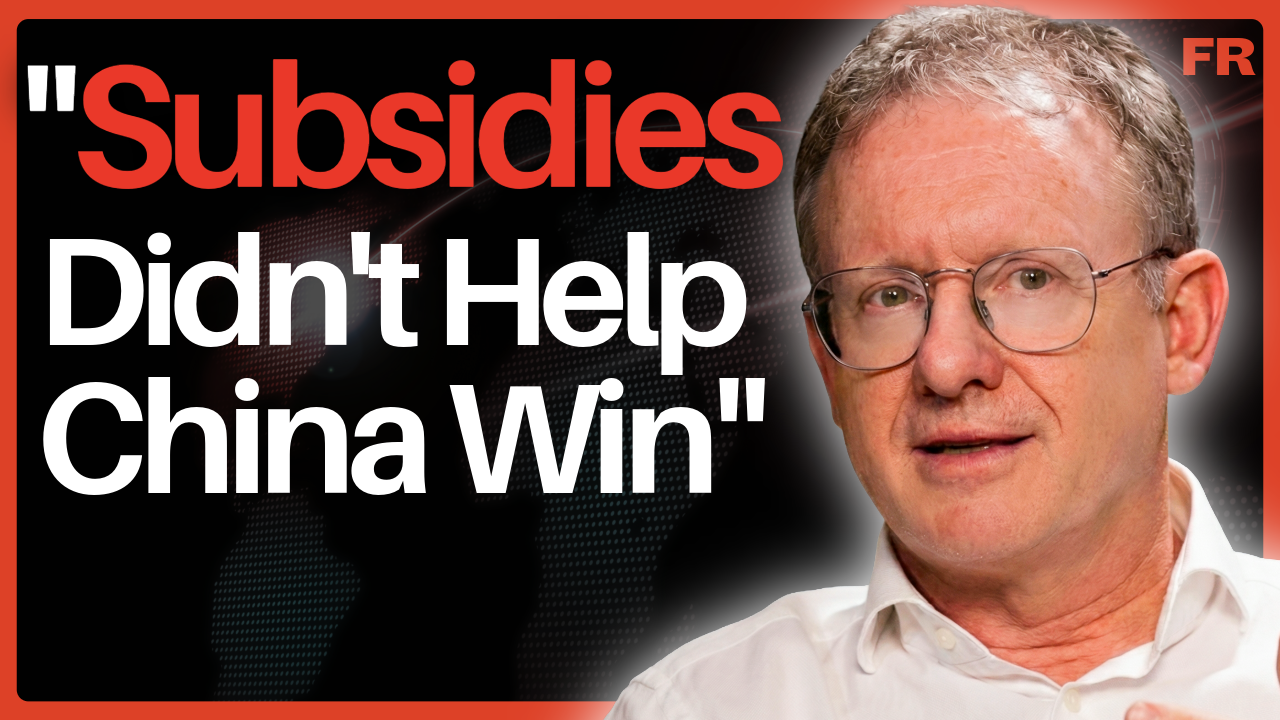
Arthur Kroeber has spent more than three decades trying to make sense of Asia’s most important economies — and helping the rest of the world understand them too.
In 2002, he co-founded Dragonomics in Beijing, a research firm born out of his deep intellectual curiosity about China’s economic transformation.
He went on to edit its flagship publication, China Economic Quarterly, for 15 years.
When Dragonomics merged with Gavekal in 2011, Arthur became head of research, continuing the work he’s best known for: clear, rigorous analysis of China’s economy at a time when the world needed it most.
Before moving into research, Arthur spent 15 years as a journalist travelling across Asia — reporting from China, India, Pakistan and beyond. Those years on the ground shaped the way he thinks about policy, people and the forces that drive economic change.
Today, he teaches as an Adjunct Professor of Economics at NYU’s Stern School of Business, and contributes to global conversations as a member of the Council on Foreign Relations and the National Committee on US-China Relations.
He is also a senior non-resident fellow at the Brookings-Tsinghua Center in Beijing.
His book, China’s Economy: What Everyone Needs to Know, published by Oxford University Press and now in its second edition, is widely used in classrooms around the world (and is a personal reference book I use to better understand China)
TIMESTAMPS:
00:00 Trailer & Intro
01:18 China’s New Five-Year Plan
03:32 Was "Made in China 2025" Successful?
07:04 Why The US Prioritizes Financial Efficiency
12:47 Can the US Reshore Manufacturing?
16:24 How China Mastered Technology Transfer
23:03 Why Are Cars The Key Consumer Product
26:46 Behind The Real "Catfish Effect": Tesla in China
33:07 China’s "Hunger Games" Industrial Policy
42:11 China's Chronic Problem with Industrial Overcapacity
51:27 China’s Confidence Paradox
55:49 The Fight For Supply Chains
58:48 What to Expect from The Remainder of Trump 2.0
01:08:55 Semiconductor Bans vs. Rare Earth Control
01:15:33 The Future of US-China Relations
01:21:00 Advice for A Fresh Graduate
This is the 64th episode of The Front Row Podcast
Keith 00:01:20
Yeah, so we have the 15th Five-Year Plan coming up. The plan period is going to start next year and run through 2030. What we have now is basically the first suggestions of what might be in it. There will be an outline released later, and then the general plan will be subject to approval by the National People's Congress next March. So what we have now is just some suggestions of what they're thinking about.
To be frank, from what we've seen so far, there's not a lot that is super new. I think a big question for a lot of people was the government has for a long time had a very investment-centric economic policy where they focus on investments in high-tech manufacturing and infrastructure. They have not had such a strong focus on consumption. I think there were some people hoping that there would be an indication of a shift towards a more consumption-focused development model. I don't think we're going to see that.
I think basically what you're seeing is a reiteration, an elaboration of the development program that Xi Jinping has been working on for the last several years with some adjustments around the margin to take account of the fact that they do have some structural economic problems that they need to deal with. That will require some tweaking, and they're dealing with a more difficult global environment because of the increased tensions with the United States. But fundamentally, as best I can tell, and of course there's a lot we don't know and we'll have to wait for the full outline, but I think as best we can tell, it's kind of a stay-the-course document reaffirming the general direction that they've been on for several years.
Keith 00:03:32
It's been 12 years since Xi's presidency came to power. At the same time, it's also been 10 years since they announced Made in China 2025. What's your appraisal of China's ability to actually bring to pass Made in China 2025?
Arthur 00:03:55
I think the best way to read Made in China 2025 is as a general set of aspirations. There were some documents that came out at that time which put more precise numbers on their goals in terms of the market share of Chinese companies in various sectors, both in the China market and globally. I think we probably don't want to read those too literally because they're also subject to definitional questions like what is the market for X, how do you define that. You can slide around that quite a bit.
But broadly speaking, the aims of Made in China 2025 were number one, to promote the use of information technology and other kinds of technologies throughout the entire manufacturing sector, so upgrade the quality of production across the board. Number two, in a number of priority technology sectors such as semiconductors, new energy and so forth, they wanted to increase production quite a lot and increase China's share of the global market. And then number three, they wanted broadly to decrease their reliance on imported technology inputs and increase Chinese companies' control of what they would call core or foundational technologies.
So I think on all three of those dimensions they did pretty well. They unquestionably now have the largest and most effective manufacturing ecosystem in the world. They account for about 30% of global manufacturing by value, and they have a very broad palette of sectors where they're a major global producer of goods. The technology inputs into their manufacturing sector have gotten a lot better. The manufacturing processes have improved. There's a lot more use of artificial intelligence, robotics and other kinds of systems to make manufacturing more efficient. They've made marked progress in things like green energy technology, some progress in semiconductors, but broadly speaking across a range of technology sectors, they've increased their capacity to compete globally. And they're a lot less dependent on foreign inputs than they were before. So broadly speaking, I think the program was a success.
Now the other thing you have to ask is at what cost did this success come, and the answer there was the cost was pretty high. They invested huge amounts of money through various channels. A lot of this money was wasted or stolen. So it wasn't the most efficient way to upgrade their manufacturing, their technology, but it was very effective.
Keith 00:06:57
What would have been the most efficient way?
Arthur 00:07:02
Well, I guess the question is what is your goal? Could they have reached the level of success that they have now if they had pursued it in a more efficient way? Maybe not, right? So the goal in China has never been to maximize the marginal efficiency of each dollar of investment. The goal in China has always been to build effective systems. And they have built a very effective manufacturing system. And I think their point of view would be okay, so there was some money wasted along the way. Maybe we could have done it a little bit better, but at the end of the day, we got to where we wanted to get to and that's fine.
Keith 00:07:42
Yeah, so it's just about if we have this end goal, as long as we get there, it's fine. What's a few billion?
Arthur 00:07:48
Yeah. And I think the contrast that a lot of people in China would make, and is increasingly being made in the US, is in the United States, which until 15 years ago was the world's largest manufacturing economy, now it's number two behind China and the gap is very large. The US has moved a lot of its manufacturing production outside of the US to China or other parts of Asia. And the US has been driven overwhelmingly by maximizing financial efficiency.
And you could make an argument that this has been very bad for a lot of the leaders in US manufacturing. So if you look at a company like General Electric or Intel or Boeing, these are all companies that used to be absolutely at the global peak of their sectors. General Electric is a shadow of its former self. Intel is struggling for survival. Boeing, because of the nature of the aircraft industry, is still pretty important, but they've really struggled to maintain quality.
And I think you can make an argument that the emphasis on financial efficiency has made it difficult for the US to maintain the kind of manufacturing capacity that it now decides that it wants to have back. Whereas China, less obsessed with financial efficiency, more preoccupied with simply building the systems, I think the outcome there is pretty clear that efficiency is not necessarily the be-all and end-all if what you're trying to do is just build a large and successful physical production system.
Keith 00:09:42
So this obsession with financial efficiency creates, I guess, a perverse incentive to not continually improve their production processes. Is that the dynamic actually happening?
Arthur 00:09:54
Well, no, it's not quite like that. I think what it has done is that it has led US companies to focus on the areas where they are marginally the best and to remove from the United States activities where it was not maximally efficient to do it. So for example, Apple started out as a manufacturing company. It basically over time turned into a design company, but it supervised and controlled and basically created the manufacturing processes in China that enabled its growth. So they didn't stop paying attention to manufacturing processes, but they just moved them out of the United States to China because they felt that they couldn't financially justify doing them in a high-cost location like the United States anymore. And you look at a company like Nvidia or the chip designers, they've become very good at what they do.
So I think we need to be a little bit careful about saying that the path that the US took was wrong or incorrect. It had certain consequences that elites in the US now regret. So they now regret that they don't have the big manufacturing base. Now there are plenty of economists who would say doesn't matter, the United States has the biggest economy in the world. In fact, for the last three years it's been growing faster than China in nominal US dollar terms. So China peaked three years ago at about 75% of US economy in total size. It's now smaller than that.
So the US is by any measure an incredibly successful economy that has generated a lot of technological progress, some of the biggest and best companies in the world. But the one fly in the ointment is that the manufacturing ecosystem has shriveled and a lot of that has moved to China and people think that's a problem. So there's an interesting conversation to be had about how big a problem is that and what's the right way to address that. But I think we want to be careful about saying that the US is a disaster, a failure. No, it's actually a spectacular success, but that success has come at a certain price just in terms of the manufacturing production ecosystem.
Keith 00:12:32
Yes. I spoke to Patrick McGee and I think when you were talking about Apple, he fleshes out that story in full.
Arthur 00:12:39
Yes, that was a terrific book. I recommend everyone read it.
Keith 00:12:45
Yeah, I read it. It was fantastic. And he pointed out that now because of this arrangement that Apple had with Foxconn in China, you are essentially trapped in a geopolitical dilemma. So that's perhaps one of the huge costs. And the other point I think he made was that Tim Cook or Steve Jobs had no choice but to really outsource it because Apple wasn't financially doing well when Steve Jobs was coming back to the helm. There's no real other alternative. I guess then my question would be, if you look at the companies like the Apples of the world or the Intels of the world, is the right move to try to shift manufacturing back, or do we just stay the course of what we're doing?
Arthur 00:13:36
Well, I think you have to distinguish between what the right thing for a company is and what a right thing is for the state. If you are Apple, I think in fact Tim Cook has made it pretty clear where he's taking Apple, and where he's taking Apple is they're still going to produce a lot of stuff in China. In fact, he's recently intimated additional investment plans here. It's a big market. It's very efficient. It's very hard to substitute for what China does anywhere else in the world. But they've also been moving some production to India because they have to hedge their geopolitical risk and that's the obvious place to do it.
It is very difficult for them to move a substantial part of their physical production back to the US because the cost structure and the availability of labor just isn't there. So I think the direction that they're moving is very clear. And if you look at electronics production generally, very hard to see large amounts of this coming back to the United States because the factories of production simply don't exist.
So I think lots of those decisions are the right ones for any individual company. They just have to go where they can maximize their efficiencies of production and manage the political risks.
For the United States as a country, it's a somewhat more complicated problem. I think the consensus now in Washington is that the US has let too much of its industrial infrastructure slip away. We need to get back some of that. I think policymakers are struggling to figure out which pieces can you actually bring back, what costs is it reasonable to incur to do that, and how do you keep them there. You had one set of policies in the Biden administration which was somewhat coherent but I think also had some problems, another set of policies under the Trump administration which I frankly think is completely incoherent and not really well thought through. So I think there's still a lot of work to be done on figuring out which pieces of industry is it really important to bring back to the US, which pieces is important to not have in China but maybe it doesn't have to be in the US, it can be somewhere else. And which pieces is it okay if it happens somewhere else. Those are hard problems to solve. So it's going to take a while to figure it out.
Keith 00:16:20
One of the things that I found fascinating was when Made in China 2025, that plan first came out, I don't think there was this optimism, maybe not within China or even around the world, that China could actually pull this off. Because I think for so long, China was seen as the world's factory but in the lower end, low quality manufactured goods.
And there were attempts I think in earlier iterations of industrial policy like your JVs where, you know, for you to set up a factory or an automobile factory in China, you have to trade technology for market access. That didn't turn out too well. So I wanted to get a sense of how do we get here, how did China actually arrive at where they are today. Maybe let's start with the JV piece of the story. What were the limits of that joint venture model that the Chinese tried?
Arthur 00:17:20
So the idea was that you have multinational companies come to China, they do joint ventures with local companies, usually state-owned ones, and through the joint venture there's some kind of technology transfer whereby the Chinese partner learns how to do things, and then ultimately you create national champions.
And broadly speaking, there was some variation in how this worked, but in a lot of instances, what happened was that the JVs wound up being vehicles for the multinationals. They brought in most of the IP, most of the know-how, and the domestic partner sometimes just didn't have an incentive other than to sit around and collect the profits from the joint venture, really. And most notably in the auto sector, the companies, the state-owned companies that participated in these joint ventures, never really were successful at creating their own brands or their own technology. They remained captive of these joint ventures which were essentially profit engines for the multinationals. And multinationals, because they were only owned 50%, basically they had to hand over 50% of their profits to the state-owned partners, but they were making so much money it was kind of okay.
So the problem was that the incentive structure in the joint ventures did not really permit the kind of direct technology transfer that the Chinese leaders were hoping for when they set that up.
Now there were some spillover benefits. So often what happened was that you have a joint venture doing various things and people who worked for that joint venture would go off and set up their own company. Sometimes the Chinese joint venture partner would do that deliberately and they would set up a competing factory next door, as it were, to the joint venture. But I think the more important phenomenon was that you had a lot of informal spillover of know-how from the joint ventures into the private sector.
But it turned out to be somewhat limited in terms of the technology transfer. I think what was more important was that the Chinese state invested in ecosystems of infrastructure that enabled over time pretty rapid development of new companies, startups. So they invested a lot in logistics infrastructure. They invested a lot in internet infrastructure very early on to make data flows easier. They invested a lot in power infrastructure. All these kinds of things.
And then the other thing that they did is that, like other countries in East Asia since the end of World War II, they had a very export-oriented strategy. And I would argue that the export orientation was probably more important than the joint venture model as a mechanism of technology transfer for the same reason that it was successful in Japan, South Korea, and Taiwan.
So if you look at where China's growth in technology came from in the consumer electronics zone, it came from companies that were acting as original equipment manufacturers for the big brands outside of China. They learned how to create components. They learned how to put together systems. They learned a lot of manufacturing process knowledge, so that every time their customer demanded something new, they had to figure out how do we make this new thing. So this constant process of working with overseas customers to keep upgrading their technology to meet foreign demand, that was probably the biggest single driver of Chinese technological development.
And then a third piece was, and this is very visible in new energy, the government decided to get in very early to industries that the rest of the world was basically ignoring. So they got into electric vehicles, they got into batteries, they got into solar, they got into wind. And they placed much bigger bets on these new industries than other governments around the world were willing to do, and they stuck with those bets even when they seemed to be very costly and losing money. And that in the end turned out very well because they had correctly identified a few technologies that were going to wind up being very important and they got kind of a head start on everyone else.
So joint venture model was somewhat helpful. I think the export orientation was more helpful, and the willingness to commit national resources on a handful of really important sunrise industries was also a big part of the story.
Keith 00:23:00
If you look at automotives, I've always wondered why is that figured so heavily in all kinds of economic discourse. Even today when you talk about Chinese dominance in technology, EVs come to mind. Why is automotive seen as the first key consumer product that people talk about?
Arthur 00:23:26
Yeah, I mean this is true, this has been true of all industrial economies for the last 100 years. The big industrial economies, it centers around automotive. Why is that? Well, I think one reason is that it's kind of a central transport and logistics good that everyone needs to have. So it's something that you can mass-produce, has an enormous market. It has a very long component supply chain. So there are all of these different pieces that have to go into it. So you can create a very large industrial cluster around not just assembling the autos but making all of the individual components for it because it's quite complicated.
To make an automobile requires you to learn all kinds of production coordination skills. So you have to manage all these supplier networks and then figure out how to put the thing together. It is both an industrial product and a consumer product. So it has to meet pretty high engineering specifications, but it also needs to be something that consumers like to buy. So it breeds both engineering competence and consumer marketing competence. So it really combines a lot of domains and enables you to build up comprehensive industrial clusters that then create a lot of side benefits for the rest of the economy. So it really kind of is a natural starting point for any kind of large-scale industrialization.
And what's interesting in China is that, if you look at the history of East Asia, Japan wound up being very successful in the auto industry. Korea followed, also very successful. China said, "Oh well, we'll do the same thing. We'll just do what Toyota and Honda and Hyundai did." And they failed. They did not succeed in building a really globally competitive traditional auto industry, basically because of problems in the joint venture model and various other things. I think also because that industry had become so mature that displacing the incumbents was much more difficult when China came along than it was when Toyota came along.
So the Chinese looked at this in the early 2000s. They said, "This is really not working. What can we do?" Well, the answer was, "Well, we can try electric vehicles because no one else is making those. We'll get in on the ground floor. There are no incumbents to get in our way." And this will be our route to success. And after a very long period of trial and error, it did become that.
Keith 00:26:19
Yeah. I remember in 2013, I think it was a CNBC interview where Elon Musk was asked about BYD and he just dismissed it. And the question would be then, they went in so early but you have a first mover advantage, you should be able to gain market share. But why didn't that happen for so long, and we could only see maybe the emergence of Chinese dominance in this space perhaps only in the last five years?
Arthur 00:26:43
Yeah. So there was a combination of factors there. So one is the internal combustion engine car is a very good product. It's been very successful for well over 100 years. And it had gotten refined to a very high art, and so it was not easy to dislodge that.
If you want to replace it with electric cars, there are a lot of requirements that you have. First of all, you had to make huge advances in battery technology because the initial batteries were gigantic, very heavy. It was very difficult to get the cars to work properly. So you had to work on battery technology to make the batteries smaller, more efficient, and to operate under wide range of operating conditions. So that was a non-trivial technological hurdle that you had to get across.
And then in terms of adoption, you needed to build out infrastructure in charging stations, because who's going to buy electric vehicle if they can't charge it? And so there's just a very long lead time to getting up to the amount of infrastructure.
And then the final hurdle was really interesting. So by 2019, the technology problems had been largely addressed. So they made big improvements in battery technology and so you got decent range and pretty good reliability in the batteries. So at the technical level they were able to make pretty decent electric vehicles. They'd begun to build out the charging infrastructure. So at least in some cities, it was not that problematic to own an EV.
But they had not solved the consumer acceptance problem. And so people in China didn't think of EVs as a car that they wanted to own. It was not, cars are kind of a status symbol. All of the foreign cars, the Audis, the Volkswagens, the Mercedes, the Toyotas, the Hondas, at different levels of income were all viewed as status markers. They were well-designed cars. They were attractive consumer goods that people were used to buying, and people weren't used to buying EVs, and they were seen as kind of gadgets.
So that flipped when Tesla was allowed to open up its wholly owned plant in Shanghai in 2019 and they started turning out these cars which by the standards at the time were very attractive. So Tesla was really the first company to make an electric car into an attractive consumer good, not just a gadget for hobbyists. And it took off in China and people said, "Oh, this is really exciting." It became the new status symbol to have a Tesla, and that completely flipped the consumer perceptions of what an EV was. Not just some weird thing but an attractive consumer good that conferred a certain kind of status.
So the initial impact of Tesla for the domestic EV makers was disastrous. BYD had a huge fall in sales in the year or two after Tesla entered the market and they realized that technically their cars were fine, but they couldn't compete with Tesla in terms of the consumer appeal.
So basically, as I understand it, they went out and hired a lot of designers from established firms, for example in Germany, to figure out how to design new models that could compete in the consumer market with Tesla. And what is stunning is how quickly they were able to do that and how quickly they, not just BYD but a whole host of Chinese electric vehicle makers, were able to flip and create the right packaging. And then they had a huge advantage because they had the technology down and they were so used to operating in this cutthroat Chinese market that they knew how to keep their costs down. So they were able in the end to create very attractive cars that performed basically as well as Teslas, if not better, at significantly lower cost. And then that is what flipped things.
And it still kind of astonishes me how quickly that transformation occurred. And I'm not sure I fully understand why it was so fast, but it was very impressive.
Keith 00:31:26
So you're arguing that Tesla's entry into China in 2019, it was really just the ability to drive consumer adoption that normalized the EV. That seems to be the main thing that Tesla achieved. Okay. Because I think there are also arguments like someone like Patrick McGee would say it's like Tesla also created that catfish effect, where you have this foreign EV company that came in and it forced everyone to improve their competitive capability.
Arthur 00:32:06
Right. But I think the point I would make is that if the Chinese EVs had been technically bad when Tesla came in, they would not have been able to recover so quickly. So I think what the history shows us, the timeline shows us is that at a technical level, the Chinese companies by the time Tesla came to market, they were fine. They had mastered all of the technical stuff that they needed to do. But the catfish effect, if you will, was that Tesla forced them to figure out how to make them attractive consumer products.
And then because they didn't have to solve any technological problems and you could basically buy design talent, they could make the shift very quickly. Whereas if they had actually had to overcome a technological barrier, they would have had the incentive to compete, but it would have taken them a lot longer.
Keith 00:33:05
So if we were to recap the upgrading of China's technology evolution, some of the things that you've pointed out was first its heavy investment in infrastructure, two its export orientation that forces it to improve processes for a larger market. The third point that you made was actually investments into areas of technologies that were ignored for a very long time. I guess the question would be, when we talk about investments in China, it will be seen as essentially subsidies because the state is primarily the main capital allocator. I guess the question would then be, when people think about subsidies, people have this mental model of it's some cumbersome SOE, the government just pumps a lot of money in. What's different about the way China subsidizes or invests that would break that kind of mental model?
Arthur 00:34:08
Well, I guess the way I think of this is influenced by my basic premise that if you look historically, all successful industrializing countries started out as exporters. And the reason that it was important to be exporters is if you're selling only into your domestic market, you have probably both the incentive and the ability to try and influence government policy to kind of rig the market in your favor. And this is the problem with so-called import substitution strategies historically, such as you saw in Latin America in the '60s and '70s, India. You create these protected markets, the companies manufacture but they only manufacture for a domestic audience, and so therefore they basically create a kind of cartel where they don't really have an incentive to improve their technology very quickly, and they just keep selling the same things over and over again and they rely on government protection to keep them in business.
And if you're an export-oriented economy, you can't do that because you can't rig the global market. The only way that you can stay competitive globally over a long period of time is to improve your technology. If you try to compete just on being the cheapest, you can survive for a while, but you don't last very long because probably someone else is going to figure out how to be cheaper. So the way you stay in business is you improve your technology. So exports are a proven way of transferring technology from advanced markets to developing markets because the exporters from the developing markets have to invest in that technology and figure it out one way or another.
And so what China, I think, basically did was figure out how to create a domestic equivalent to the export market. So the domestic market for all kinds of consumer stuff in China is notoriously competitive. It was not actually that protected because international companies actually had very large presences here. And so the scale of the Chinese domestic market and the intense degree of competition meant that in order to survive and thrive, you had to figure out how to improve your technology or improve your manufacturing efficiency so that you could lower costs.
And so the subsidy mechanism worked both because you had a lot of emphasis in many industries on export production, and because you had a domestic market that was sufficiently large, open and competitive that it was kind of a second export market almost, which is unusual.
I'm thinking here, it's not exactly related to manufacturing production but I think it's very relevant. Kai-Fu Lee a number of years ago published a book, so he's a Chinese venture capitalist, used to run Google's operation in China, very astute observer of the Chinese technological scene. He wrote a book called AI Superpowers which made some I think rather questionable claims about the likely development of artificial intelligence. But in that book he describes in great detail the internet ecosystem in China and he compares it specifically to the Silicon Valley ecosystem. And his basic point, which I think is totally true, is that the Chinese system was way more competitive and cutthroat than Silicon Valley. And because of this intensely competitive environment, you wound up having intensely excellent firms like Tencent and Alibaba that had figured out how to just become incredibly efficient in this environment.
And that logic applies also I think to the manufacturing sector, that the degree of competition was what culled out the less fit and left you with these ultra-fit champions at the end of the day.
The problem with industrial policy, people often say, well, you shouldn't do industrial policy and you shouldn't do subsidies because the state can't pick winners. And I think that's completely false. I think the history of industrial policy in many countries shows that it's perfectly possible to pick winners, particularly if you're picking a sector rather than individual company. It is not rocket science to figure out what are going to be the next wave of key industries.
What you have to have is a mechanism for getting rid of the losers. And that's where things often fail. You keep supporting companies even if they aren't doing the right thing. You need to have a mechanism for weeding out the weaker players. That's what export orientation does. You export, you win. You fail to export, sorry, you go out of business, you don't get any more subsidies.
And similarly, the Chinese approach has been to subsidize sectors, have this Hunger Games-style competition, and then gradually over time it becomes clear who the most efficient players are, and then you start withdrawing the subsidy support gradually and letting the winners win and the losers lose. And it takes a long time in China but it does happen. And I think that really is the key to why it works.
Keith 00:40:05
A lot of the Western critiques of China's ecosystem back then was just to see them as copycats. And actually what I think Kai-Fu was pointing out was that the copycat culture created a gladiator culture. Because everyone's okay with copycatting, you have to really figure out how do you actually stand out in the competition.
Arthur 00:40:25
That's right. And then what happens is that the copycatting gives way to a culture of real innovation. And we've seen that frankly if you go back to descriptions of Japan in the 1920s, they said the same things about Japan then that they were saying about China 80 or 90 years later, that they just copied, they didn't know how to make their own thing. And then by the 1970s, everyone was saying, well actually they can make their own thing. Korea similarly started out basically copying the Japanese and then they wound up being very successful in their own way.
So I think the other flaw in the analysis is that people don't realize that in the right policy circumstances, which are consistently available in Asia, in East Asia, copycatting becomes a pathway to incremental innovation and climbing up the technology chain. China is just the latest country that did it and they did it on a far grander scale than the other countries because they're bigger.
Keith 00:41:26
Yeah. BYD says he calls it when scale meets scale. Yeah, so I think that's the perfect phrase.
Arthur 00:41:34
Yeah, that's right.
Keith 00:41:34
I have a question on this involution or overcapacity depending on where you're standing. So if you're in China, it'll probably be involution, but if you're from Southeast Asia, maybe that's an overcapacity problem. You talked about the fact that at some point when the government wins, all subsidies, there is a kind of natural direction or convergence towards consolidation, but we haven't really seen that. In fact, in the recent plenum they were talking about consolidation and cutting excess competition. Why did that phenomenon actually emerge?
Arthur 00:42:11
Yeah, well this is a persistent issue in China. And the basic issue is just it takes a really long time. And it takes a really long time because the subsidy mechanism in China is very uncoordinated. So the central government generally will indicate a broad direction and they will mobilize certain amounts of finance for it. But then it's basically up to local governments to do a lot of the support, which they do extremely enthusiastically.
And the problem is that local governments have a lot of incentives to keep the subsidy support flowing beyond its useful expiry date. And the basic issue is that they have a lot of different ways that they could support companies, not just through direct subsidies. They can do it by leaning on the local bank branches to provide preferential loans. They can do it by giving people free land or reduced electricity rates. And all these things do not necessarily affect the budget of the local government. They don't have to spend budgetary funds to support local enterprises. I mean, they may, but even if they don't spend budgetary funds, they have a hundred different ways of providing support and enabling these companies to stay in business even if they're not very profitable.
Now, why would they do that? Two reasons. One is that these companies provide employment and it is absolutely part of the KPIs of local governments to maintain social stability and they view, how do you maintain social stability? Make sure everyone has some kind of a job. And then even if a company is not very profitable, under the Chinese tax structure the local government will get a nice cut of the VAT that the company has to pay when it produces stuff. So it's effectively a production tax. So they can give a lot of support that does not require them to make budgetary expenditures.
And then on the other side they get employment and they get tax revenues. And it is very difficult, given that incentive structure, it is very difficult to stop them from supporting marginal producers. There's also, they probably also in some product categories they have the ability to keep companies in business by saying well if you want to buy product X in this province, it has to be from the company within the province, not the company from outside the province. So local protectionism, creating guaranteed local markets, is another way to do this.
So all of this is very difficult for the central government to police. The local governments are not thinking about how do we get three national champions to produce electric cars. They're thinking about how do I keep my electric car company in business regardless of what BYD and Xpeng are doing somewhere else. So it is very difficult for this structure of industrial support to be withdrawn.
And we've seen this time and time again across a whole range of industries in China over the last 25, 30 years. This is a constant problem. And what it means is eventually over a long period of time industries do consolidate. So if you look for example at TV manufacturing, 15, 20 years ago it was incredibly fragmented, there were all of these producers everywhere. Now there's a handful of TV manufacturers that has consolidated. And you could look at whole bunch of traditional consumer durables industries and the story is the same. It took a really long time but in the end the big guys won out.
I think the problem is worse now because of the extraordinary level of support that the central government gave to technology manufacturing starting in about 2019 or 2020. And between 2019 and 2023, a span of four years, annual new loans to manufacturing rose from 500 billion renminbi a year to three trillion. So they rose by sixfold in just four years. This was an enormous fire hose of cash going into all kinds of, if you could claim that you were doing some kind of technology manufacturing, you could get a loan. So this led to an explosion of capacity, a lot of copycatism, and people just scooping up this money and setting up production. Local governments were very happy to see this happen.
And because you've created this unusually large swath of excess production across a very wide range of sectors, it's correspondingly going to, I think, take a bit longer for the consolidation to occur. So it does happen eventually, but it takes a really long time because it's not a centrally controlled process. It's a very diffuse process.
Keith 00:47:32
Yeah. So just given how chronic it is, now the government's trying to cut this excess competition. And in your view do you think that's actually possible, to kind of accelerate the timeline, or is it just by definition or by nature of China's economy, it's really hard?
Arthur 00:47:52
It's really hard. I think in cases where they have been somewhat successful at reducing capacity, it's because the industry was a little bit more concentrated to start with or there was a larger number of state players or there was some leverage that could be employed to make it work. But there are a lot of cases where the state has tried to consolidate by force and it hasn't worked that well.
And I think the problem is now it's many industries. It's not just two or three. And in each of these industries you have dozens or hundreds or thousands of competitors. So the problem is just incredibly complex. So I'm a little bit skeptical that they will be able to achieve quick results by this top-down consolidation.
I do think, however, that basically the banks are running out of the both the ability and the willingness to finance this. So I mentioned that you had this enormous expansion of bank loans to industry. In the last two years that's now fallen in half, both because a lot of these companies are struggling and because the banks are saying, why should we lend more to these companies which might fail and then we're going to have a bad loan on our books and we're not making that much profit anyway in general, so let's just pull back.
So I think what is likely to happen is that the ability of the system to just keep shoveling finance into marginal producers is already shrinking, and over the next few years that will lead to more and more of these companies exiting the market. Less because the government is saying you must consolidate and more just because the funding is going to drop. So the capital is just going to run dry.
Keith 00:49:53
Basically. I think in certain industries it is probably the case that enforced consolidation can kind of accelerate that process and they've picked out a few. Notably they're looking at the solar supply chain and they're starting with the polysilicon producers and saying maybe we can consolidate these raw material suppliers just into a handful, enforce some price discipline there. And then if you can raise the prices of the raw materials, then the downstream guys who can't afford to pay those higher prices, they go out of business and you can have a cascade effect. That will be a very interesting test case to see can they really orchestrate this or not. And maybe, maybe. But bottom line is it is likely to happen but it is also likely to take a really long time.
Arthur 00:50:42
Yeah. But at the same time, now China is kind of seen as, within like I guess a decade since the plan was first announced, it's really established itself as a leading technology superpower in the world. But the paradox is that within China itself, the consumer confidence isn't on par with that kind of perception that people have. I mean, if I put myself in a typical Singaporean's shoes, if we're producing all these world-beating companies, I would expect the Singaporean citizens to have a rosier expectation of the future. That doesn't seem to be the case now. I'm not sure why.
Keith 00:51:24
Yeah. Well, yeah. So I started thinking about this a few years ago when it became very clear that Xi Jinping was pushing a developmental strategy which was not about growth, economic growth. It was about technological upgrading. And if you read some of the documents, industrial policy documents that started coming out as early as 2017, they state very clearly, we think that technology-intensive manufacturing is going to produce all of the productivity growth of the future. All job creation, all income growth basically is going to come from these technology-intensive investments.
And so the concern I had, which endures because of the problems that we're seeing now, is that you'd wind up with an economy which, because it was focusing all of its resources into technology-intensive production, you'd wind up with an economy that was very good at those things. Very good at making renewable energy equipment and nuclear power plants and electric vehicles and semiconductors and industrial robots. And you look at all those sectors, very good in terms of their ability to produce those things.
But an economy as a whole that was struggling because the reality is most people do not work in those industries. The vast majority of people in China work in service industries that might have a tangential connection to these high-tech industries, but many of them have none at all. And it's not at all clear and remains unclear to me, you get really good at producing semiconductors and industrial robots, how does that help raise wages and productivity throughout the rest of the economy? And the Chinese government seems to assume that this will just naturally happen and it's not clear that it will.
So the likely trajectory that I thought China was headed towards a few years ago was a lot of technological success in an economy that was growing slower and slower because they were, frankly, all they were interested in doing was increasing the supply of high-tech goods and they were not paying attention to the demand side of the economy. And that seems to be more or less where we're heading.
And I think in an economy as large and as complicated as China, that can go on for quite a long time. We're not talking about pure stagnation the way Japan stagnated in the 1990s. It's not that bad. But the direction of travel seems to be towards a technologically competent economy that's just not growing very fast overall because you have this sort of archipelago of islands of success in an otherwise very stagnant sea. And that's basically the conundrum that they have right now.
Keith 00:54:29
So they kind of have a techno, I don't know whether it's techno-optimism or some, I'd go techno-fetishism.
Arthur 00:54:41
Yeah. Yeah. It's not just optimism. It's just like idolatry and this very single-minded view that technology will solve all your problems, which I think just ignores a lot of the complexities and realities of how a modern economy works, which is mainly not about gadgetry. It's about a web of service activity.
Keith 00:55:02
Yeah, which is quite similar to I think a lot of the AGI proponents in the US as well, which is like you arrive at this AGI. Probably shouldn't go too deeply into that.
Arthur 00:55:09
But yeah, I would broadly agree that that's a similar type of thinking.
Keith 00:55:14
I guess the question would be, if you were in the shoes of the Chinese policymaker, a huge part of Made in China 2025 was to reduce reliance on foreign technology, and also in part because they kind of expected that the US-China relations were going to take a turn for the worse. So it was kind of, I guess I won't say existential, but a necessary kind of step that you had to take in order to secure your future. Is that the right view to understand?
Arthur 00:55:48
Well, that's certainly what they thought. I mean, I think this explosion of investment in high-tech, I mean, they were clearly increasing, they were on an increasing trajectory, but they really ramped it up. And why did they do that? Well, basically because they faced the first trade war from Trump where the US moved from being basically supportive of China to much more confrontational. And then starting under Trump and then really accelerating under Biden, you got a lot of export controls to try and choke off supply of high-end technology to China.
And they said, "Wow, if we really want to develop technologically, we're going to have to do it on our own. We can't get the stuff from the US. We have to double down and do it all ourselves. And because we are in this contest with the US, we have to reduce our vulnerabilities to the US. So we have to de-Americanize our supply chains, get rid of US components, and to the extent possible create domestic substitutes for everything."
So yeah, it was absolutely in response to this perception that the US was committed to a policy of constraining their growth in very damaging ways. And I think that's quite understandable that they had that point of view. I think they then overdid it with the level of support. It was just kind of crazy. But, you know, again, that is a time-honored history. In China, if you go back to 2008, global financial crisis, huge hit to their export industry, they did this massive infrastructure stimulus, which then led to a lot of problems in future years, local government debt, overbuilding, blah blah blah.
This is how things tend to work. They perceive a problem. They mobilize massive resources to deal with it, and then they wind up with a rather extended period of indigestion afterwards.
Keith 00:57:48
It seems that we're entering into the second round of the US-China trade war, especially under President Trump. It's like the second iteration. And the way you've mapped out the sequence of events, it's like they have talks, US and China have talks and they seem to be making progress, and then suddenly President Trump makes some announcement to throw more tariffs or ramp up export controls, and then China retaliates, this time in a much more, and I quote a friend, a very clinical, a very directed way. And then he threatens revenge, the markets respond, and then he backs down and then he claims victory. And then we keep seeing this play happen again and again.
My first immediate question was just, with President Trump's second time coming in, what has he normalized in terms of American policy towards China?
Arthur 00:58:47
Well that's actually a very interesting question. Because if you dial back to the first Trump administration, what he inherited was a very long-standing policy that was called constructive engagement where the US had some issues with China but broadly speaking was trying to help China sort of incorporate into the global system. And the broad view was that China's rise was in US interest.
And Trump basically ended that policy. Under him, the US said no, China is a strategic rival, it's an adversary, it's a problem, we need to compete with them. And that would have happened anyway. It was in fact, the Chinese I think initially were happy that Trump got elected, not Hillary Clinton, because they thought Hillary Clinton would be much more hawkish. But he crystallized a development that was already ready to be crystallized, that the US was going to change its perspective. And that was a very big shift.
And then the Biden administration came in and they basically doubled down on that. So all the tariffs that Trump had, they left them in place. They didn't remove any of them. And they started to work much more extensively on the export controls that he had started to slow them down technologically.
So now Trump is in for the second time and what's interesting is that he seems to be now having some second thoughts about that whole idea. So yeah, he's had this very aggressive trade dispute with China this year, which involved all of this tariffing and so forth. But I think what we're headed for later this week is a kind of a de-escalation, a truce. And Trump is signaling that he is basically less concerned about China as a national security threat and he wants to do more business with China.
So we might be winding up in a situation where Trump, having changed the consensus once to a more hostile view towards China, wants to change it again back to a less hostile view. Now, he's got to override a lot of people in the national security establishment in Washington who are very committed to the China-as-adversary point of view. But he could do that.
So I think what you draw from this is Trump is this unusual figure who has certain impulses and certain broadly strongly held beliefs, but he's not super ideological and he is not sort of hawkish in the traditional sense. He's much more transactional and he's much more open to these ideas that, oh, we can just have a business relationship with China and it'll be fine.
So I think what's going to happen in the short run is, basically I think what happened this year was that Trump decided to whack China with big tariffs and he was surprised that they hit back. The White House in the spring thought that the Chinese would just cave and immediately do a deal. Now they had a lot of smart people telling them, no, that is not going to happen. China is much better prepared than they were for the first trade war. They've been insulating themselves. They're powerful. They're not going to cave.
And so I think he was surprised when they retaliated and matched him tariff for tariff. And then he got mad and we got into this escalation mode. And I think basically the conclusion that he has come to is that China cannot be bullied, that this is a fight that he actually doesn't want to have. And so it's better to just do a tactical retreat, declare victory, and move on.
So it sounds like what we're going to get this week is an agreement to get rid of a lot of the escalatory things that the different sides had done and basically punt everything until after the midterm elections in the US next year. So because from Trump's political standpoint, he does not want to be in a very tight legislative election next year. He does not want to be running a very controversial, potentially very damaging trade confrontation with China. He wants to be basking in the victory that he achieved last year.
So I think basically what happens is they make this truce. They agree to suspend export controls and the Chinese agree to buy more soybeans and whatnot. Trump makes a visit to China next spring, it goes well, and he can say, "Look, I was tough with China and I got all these great things." And equally, I think it's in China's interest to go along with that because they have a lot of domestic economic problems. Getting some stability in this relationship would be a real benefit for them.
And then what happens after the midterm elections, who knows? Does Trump decide that it's in his interest to become more confrontational with China? Maybe. Does he say, no, actually now we need to open the doors to more Chinese investment? Maybe. Who knows. It could go a lot of different ways.
Keith 01:04:43
But you kind of showed that Trump's tariffs is kind of like a paper tiger, where China is still very competitive in its exports. So from my point of view, China has leverage and there is another point which is that they also have control over the rare earths. So why is it really in their incentive to settle for a truce?
Arthur 01:05:17
Basically because, okay, so I think you have to think about what's the hierarchy of needs for the Chinese government. I think the top priority for them is having a stable global economic environment in which to operate and expand their influence, because I think the basic view in Beijing would be as long as we have global stability, we are in great shape because we are super competitive, we have an excellent technology industrial strategy. If the world is stable, we can compete and we can win.
So the number one goal that they would have out of any negotiation with the United States is can we get to a place where things are fixed and stable and we can predictably move. And the problem they have with dealing with Trump is he hates stability. He always likes to keep people off balance. And so if they can get him to not be unstable for a year or two, that's a big win. So I would say that's their top priority.
The next set of priorities relates to technology controls. So in their ideal world, they would like to have an agreement with the US where the US relaxes some of the very tight controls it has on exports of semiconductor chips, semiconductor fabricating equipment, various other kinds of technology. But they know that that's harder to get because that's not just Trump's decision. That's, there's a whole national security apparatus in Washington that is fully committed to that export control regime. So they would like to get that and the rare earth controls do actually give them some leverage. So that's maybe achievable, but I think that is something where it's possible to play a longer game.
And then the third in the hierarchy of needs would be reducing the tariffs. And I put it third because the reality is they faced very high tariffs this year from the US and their exports have done fine because they found other markets. They're able to trans-ship through other countries to the US, etc. And so I think their view is yeah, the tariffs are really high and they're really annoying and we'd rather they didn't exist. But the reality is if we have to live with them, we can manage.
So I think what you have now is they're being offered a deal where they get stability. Okay, good. Number one priority is achieved. And their third one, which is tariffs, probably will be reduced in exchange for tightening up the fentanyl controls on their part. So that's pretty good. And yeah, we know that the technology export controls, that's tougher. That'll take longer. So we can take a pass on that stuff because we have these other two things that we want.
Keith 01:08:13
The longer-term game seems to me that it's at least from the US side, it's trying to escape the Chinese chokehold on rare earth minerals or rare earth materials. And then for the Chinese side is to kind of have their own indigenous chips where they don't need to be relying on your Nvidia. And that seems to be the longer-term thing. What is actually the best option for both sides in the medium term? How would they actually, I guess, escape their weakness or their interdependence in those areas?
Arthur 01:08:50
Okay. Well, I want to deal with the question at two levels. So I'll deal with the question you asked directly and then I think there's a question that lies behind that that I want to talk about.
So the direct question is yeah, basically you now seem to have a balance of terror in supply chains where the US has a pretty strong grasp on many elements of the semiconductor supply chain and China has a very strong grasp on the rare earth supply chain. And the two are connected actually because some semiconductor production depends on rare earth inputs. So China has kind of an upstream jiu-jitsu hold on the semiconductor supply chain as well.
I think both of these are very durable advantages. The semiconductor technology stack is incredibly complicated. China has invested many billions of dollars over many years. They have made some fairly impressive progress in some areas, but they're very far from being able to produce the highest-end chips. They're very far from being able to replicate the kind of fabricating equipment that you can only get from ASML and some of these other producers. So they have a long way to go before they can sort of be independent in the semiconductor supply chain.
Similarly, they have a real lock on the rare earth supply chain and the magnets that come from it. They do a lot of the extraction, the ore extraction, particularly of the heavy rare earths that are important for magnets. You can't really get those anywhere other than China. They own most of the processing technology. They have the most skilled personnel. And experience has shown that it is very difficult to build an alternative rare earth supply chain. The Japanese have been working on that for 15 years and they have succeeded somewhat but not that much actually. And for the US to do it, I think, would be under today's conditions would be even harder.
So each side has a pretty strong weapon. And the Chinese weapon is particularly powerful because a lot of the rare earths and magnets are really indispensable for a lot of weaponry in the US defense supply chain. So China really has some ability to create large problems for the US defense department to arm itself the way it would like. So that's a very uncomfortable position for the US to be in.
I think the way this plays out in the short term is each side has shown its weapon. The Chinese will probably agree to suspend application of their rare earth export controls for a period of time while the US suspends application of some of its new export controls. And then both sides will work like crazy to try and fill out their vulnerabilities. And for both sides it will take a really long time. So there's kind of a balance of power there for a while, and I'd see that being the case for a number of years.
I think the bigger question that lies behind this is frankly more a question on the US side. And this is about what is it that as a nation we want our relationship with the other country to be.
I think China has a pretty clear strategic view on this. So Xi Jinping wants China to become a bigger power in the world, a major power, exert a lot more influence than it has in the past, but he wants to get there without getting into an armed conflict with the United States. So he wants to do it forcefully but peacefully. And so I think the advantage that China has is that it's operating from kind of a weaker position where it has a very clear goal, which is to expand its power and influence through increasing its economic linkages with the rest of the world.
The US is in an intrinsically more difficult position because it is the established superpower. It has commitments all over the world and it wants to kind of retain its position, which means both somehow coming up with a way of dealing with China but also dealing with all of the other things it deals with around the rest of the world. So China has a more focused objective, the US has more diffuse objectives.
And what the US basically has to figure out is China is not going away. This is not a Cold War situation where the system is going to collapse like the Soviet Union did. The US has to figure out how to coexist with a China that is much larger, much more capable, and technologically much more advanced than the Soviet Union ever was and much more of a pure competitor. And the US doesn't really have a good way of thinking about that problem and it has not developed a coherent strategy for how to coexist with China.
They did previously under constructive engagement, but that has fallen apart. It doesn't seem that for the last 10 years they'd flirted with, well, let's turn it into a new Cold War, and that's not working. So what do you do? And I think that is really, the rare earths, these semiconductor export controls, these are all instruments in a larger sort of competition or relationship. And the bigger issue is how are we going to define the contours of that relationship. And a lot of the responsibility for figuring that out naturally sits with the United States because it's the incumbent power. And it's taking a long time to figure out what that relationship should be.
Keith 01:15:24
From your point of view, what could that alternative vision look like? So if it's not a new Cold War, it's not Pax Americana, what would that be like for America?
Arthur 01:15:41
Yeah, that is the $64,000 question. And I don't think anyone really has a terrific answer for that. And most of the answers that have been suggested, I think, are implausible.
So new Cold War doesn't work because China is much more integrated in the global economy than the Soviet Union is by just orders of magnitude, and technologically just much more competent across a wider range of sectors. So instead of blocks like you had in the Cold War, you have competing economic networks, one with China as the hub, one with the US as the hub, and most countries belong to both. So it's like two networks that are overlapping and interlocking. So Cold War doesn't work.
People say, "Oh, it's going to be the Chinese century." I don't know what that means. That is implausible because there are a lot of constraints on China. They've chosen a path which is going to lead them, I think, to much slower economic growth. So the US will continue to be the world's largest economy. And from a values basis, America, despite its many problems, is a lot more attractive to many people than China ever will be. So that doesn't really make a lot of sense.
So I don't think really anyone has a terrific idea about what this new world looks like. And I'm also a little skeptical. I think now, particularly Trump is in office, people say, "Oh well, the old world is just disintegrating and the US is retreating and abandoning everything." It's like, yes rhetorically, but in reality the resilience of these alliance and patronage networks that the US has set up over the last 80 years is quite strong. And I think it takes more than four years of Trump to fully pull them apart.
So frankly, I don't know. I mean, we are in terra incognita here. We've never had a situation of this type where you have two highly competent global powers that in some dimensions are kind of at near parity, highly interconnected with one another and very difficult to dislodge. I have not solved that problem. And I think it's going to be some time before smarter people than me figure out how to solve the problem.
Keith 01:18:07
Yeah. In Southeast Asia, it seems like it's just like we'll just go with whatever suits our interest now in whatever sector. So you take a piecemeal approach and then we'll figure it out along the way. So Singapore is the prime example. It's like the defense partner is the US, but then you're China's largest source of FDI, America's like our largest source of FDI. So you just figure out which are the domains that we can cooperate or partner with and then we just go with that in the meantime.
Arthur 01:18:30
Yeah. And I think that's an okay place to be. It's always a little bit nerve-wracking to be squeezed between two giant gorillas that are swatting at each other. The risk of collateral damage is pretty high. But I think the geographical reality is Southeast Asia is right next to China. So economically, a lot of the eggs here are going to be in the China basket. That is just unavoidable.
But a lot of the Southeast Asian economies are very open. They're very export-oriented. So they are connected to the rest of the world including the United States in very important ways. They are part of globalized supply chains with a lot of American or American-aligned partners. So the economics is very complicated.
And then from a security standpoint, clearly it's in the interest of many of the countries in the region to have some counterweight to Chinese political power. So yeah, I mean, I think it is inevitable that there's going to be a lot of balancing going on here. Some countries do this a little bit more deftly than others. But again, I tend to view this as a very enduring, long-standing state of affairs that there's going to be this competition between the US and China. Neither side is going away.
People keep saying, well, the US is going to retreat to the Western Hemisphere. It's going to be new Monroe Doctrine. They'll leave Asia to China. This is not going to happen. I think the belief that the US is just going to abandon its global commitments and all of the prestige and power and influence that comes with that, no, that is not going to happen. So we've got an uneasy, sort of shifting situation that has not found any kind of obvious equilibrium, and I think that's the world we're going to be living in for many years to come.
Keith 01:20:46
With that, I come to my last question I ask every guest. If there's one piece of advice you would burn into every fresh graduate entering the working world today, what would that advice be?
Arthur 01:21:05
Keep an open mind and whenever you start thinking negative thoughts, try and figure out a way around them. I think there is excessive negativity now. There's a lot of catastrophism. People, younger people, particularly in the United States, I think in many cases have the view that we are living in particularly bad times. I don't really think it's true. I mean, there are a lot of problems. It's very complicated. We have climate change. We have this superpower rivalry and so forth. We're also living at by far the richest point in human history. A lot more people in the world have been included in this wealth over the last 30 or 40 years than were previously.
Individual societies are suffering from distribution problems. But the world as a whole, I think, is more inclusive and more people in more places have more opportunities to do things than has ever been the case before. So don't give into catastrophism. Get a little bit of perspective, travel, see the world around you, and then think about ways that you can make it a better place.
Keith 01:22:15
With that, Arthur, thank you so much for coming on.
Arthur 01:22:17
Okay. Thank you. It was a pleasure.