Expert Perspectives on AI
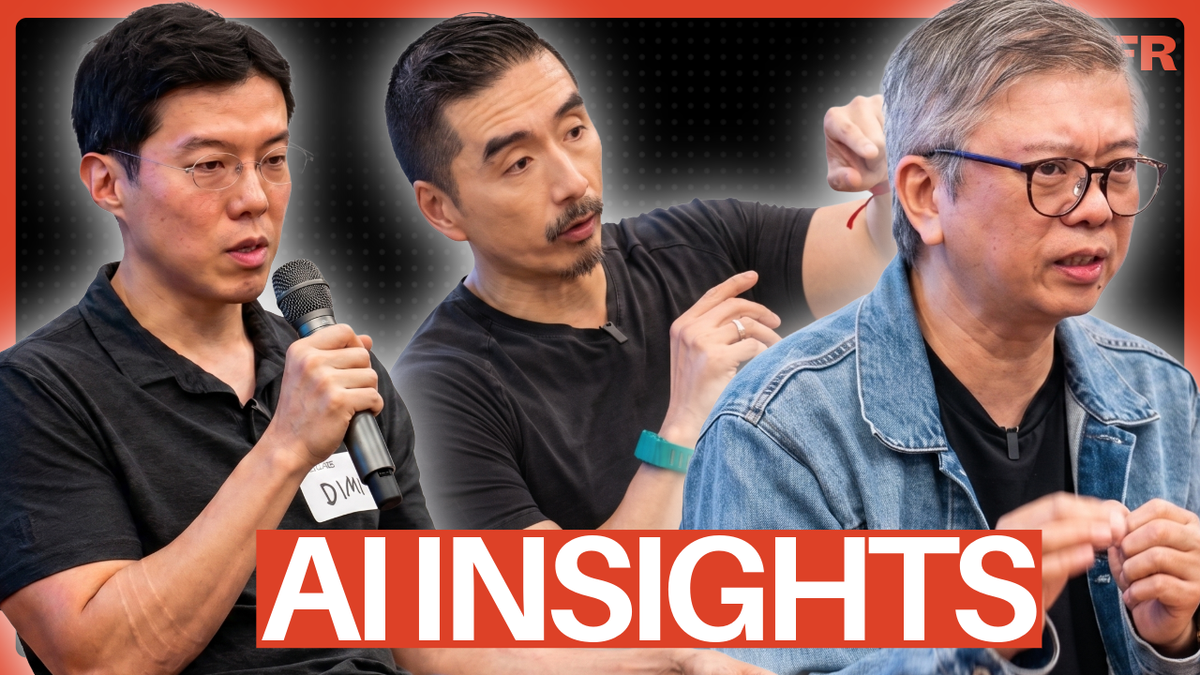
The following is a series of transcripts from an interview series I did at a SuperAI event.
I hope you find the transcripts useful :)
Dr. Dean Ho is currently Provost’s Chair Professor and Head of the Department of Biomedical Engineering in the College of Design and Engineering, Director of The Institute for Digital Medicine (WisDM) at the Yong Loo Lin School of Medicine, and Director of The N.1 Institute for Health (N.1) at the National University of Singapore.
His central argument is that medicine has always been built on population averages — and that this is no longer sufficient. With AI and digital twins, he believes we now have the tools to treat every patient as a sample size of one.
The conversation spans three registers: oncology (a blood cancer patient who entered the trial at eighty and is still thriving four and a half years later); commercialised drug combination design (Kyan's 91% predictivity vs a competitor's 52%); and personal healthspan
(Dean ran an IRB-approved trial on himself tracking sleep, gut, metabolism, and supplementation).
The through-line is a simple but radical idea: a single annual health snapshot tells you almost nothing. Dynamics — how your body changes hour to hour, day to day — is where the signal lives.
DEAN HO
Keith 00:00:00
One of the biggest innovations in AI today is the ability to collect our own personal data and translate that into actionable insights that can actually improve our healthspan and longevity. Let me give you an example with cancer. What if I told you that many patients who don't respond to treatment aren't actually non-responders — that the truth is the dose was wrong, and not personalised to them? And that with artificial intelligence, they could actually receive proper dosages based on their body's specific response to a drug?
Would that change the way you think about medicine today? This is the problem that my guest, Professor Dean Ho, has been trying to solve. Professor Dean Ho is a researcher at NUS, where he heads up the N-1 Institute and is building a platform called Q8.ai. He is essentially asking the question: what if we stopped treating patients based on population averages and started treating them as a sample size of one — could we then truly personalise healthcare?
If you want a peek into how the artificial intelligence revolution could change the way we think about health today, and possibly tomorrow, this conversation is for you. My conversation with Dean took place at a community event jointly organised by SuperAI, CARTA, Singapore Global Network, and myself. I hope you enjoy this conversation as much as I did.
Prof Dean Ho 00:01:31
I want to give a short talk about what we are doing to use data for real-world applications. We used to focus exclusively on oncology, but we have since moved into longevity, healthspan, and what many know as biohacking.
When we talk about living well, I go back to the very beginning. An overarching ethos of our work is that we are stories, not snapshots. Everyone in this room has probably been to a physical exam once a year. Your doctor hands you a PDF — a bunch of numbers, some of it essentially GPT'd back to you — and then you don't look at that PDF ever again until another one arrives a year later. In conventional medicine, we define "longitudinal" as one of these PDFs once a year for ten years. But as I'll show you shortly, our biology changes far faster than that. The best dose of a drug for you today could be very different even a few hours or a week later. If we only get one PDF per year, we miss all of that. We are stories, not snapshots.
On AI: in any AI panel or keynote you attend, you can do a drinking game. Every time you hear "garbage in, garbage out," take a shot. But I think we owe ourselves more depth than that. If you collect a single data point from a billion people — vertical scale, enormous breadth — but I've just told you that we change over time, then no AI can tell you the story that moves forward. It cannot capture that acute change. We have to think more deeply.
If we are indeed stories, then we must remember that terms like "optimal," "precise," and "personalised" describe dynamic processes. They are not static. No regimen can truly be optimal and remain so indefinitely.
Let me give you a real-world use case. A patient came to us with a rare blood cancer — maybe one case in Singapore every three to five years. We hear a great deal about digital twins. We do develop them for patients, but contrary to how most people think about AI and big data, we use only that patient's own data. Nobody else's data influences any other patient. Once we build this curve — this twin — we can adjust doses dynamically.
In oncology, the standard approach is this: you give every patient the highest possible dose until they stop responding. If a patient doesn't respond, you switch them to something else, and you keep going until they exhaust all options and move to end of life. For this particular patient, whenever he received the maximum dose, his cancer markers worsened. Before switching him to a new drug, our clinical trial allowed us to test different doses and track how his markers changed — which is how we build the curve.
As part of the trial, we were permitted to recommend a lower dose, but we were lowering the dose not for toxicity — which is common in cancer treatment — but for efficacy. We were the first to do this in the world. Fifteen years ago, when I proposed this to oncologists, I was shown the door. They told me it would be illegal, that it was wrong. Now, some of those same oncologists have to read about how to do this in their societies' annual education materials. It took fifteen years, but whenever we dropped the dose for this patient, the efficacy returned. High dose — no response. Lower dose — response.
This study was planned for twelve months. The patient entered the trial at around eighty years old, already quite frail. As of last September, he had been with us for four and a half years. He is still with us, and not only is he doing well — he is thriving. He is around eighty-four and a half years old. His cancer markers are the lowest they have ever been over the entire course of the trial. The patient himself has asked to remain on it.
Healthy people are very efficient at becoming unhealthy. We told ourselves we would keep helping cancer patients — that has not stopped, we have about ten clinical trials running. But healthy people accelerating toward illness is a separate and urgent problem. So we launched a trial where I became the test subject.
What is unique about this trial is that it is double IRB-approved. If you run a trial, you can either document things casually and post on social media, or you can submit to an ethics board. This required two ethics board protocols and additional MOH approval, because it had never been done here before. I believe it is the first human trial in history where the professor is the test subject in an interventional study — meaning the trial involved algorithms driving supplementation, fasting, sleep, fitness, the whole picture.
I never intended this to be the outcome. People often say that the only reason it worked for me is that I have some superhuman level of discipline. My parents would totally disagree with that. And if I truly had that discipline, the "before" photo would not have existed in the first place.
On the question of stories over snapshots: the chart showing my metabolism over the course of a single day illustrates the point. In the Delta trial last year, I did fifty-two blood draws — not one per week, but clustered: sometimes four in a week, sometimes none. I pricked my finger about a thousand times. I tracked markers that you cannot get from a standard clinical lab. This is ethics-regulated, deep phenotyping — well beyond what you typically see on social media.
On sleep: I was at Brian Johnson's home about two years ago. He is a friend — a genuinely kind person. We did discuss sleep. I used to sleep at one in the morning. Now I sleep at around nine-thirty. It took time to re-engineer that. Sleep is probably one of the hardest habits to change, but our team specialises in helping people see their dynamics. When you can see the immediate benefits of a single good night's sleep, it is far easier to sustain better habits than when you are waiting a year for a PDF.
On gut health: I ran twenty-four gut tests last year. There is a marker called Fusobacteria. It is linked to colon cancer, obesity, type 2 diabetes, and fatty liver disease. It is quite prevalent in the population. You do not need zero — but you do not want too much. After twenty-four tests, Fuso has never shown up in my results, not even at trace levels. We are trying to understand why. I do not know yet, but too many people are sharing gut test results on social media without understanding that their Fusobacteria may be elevated — and that they need to do something about it.
I published a paper on myself a couple of years ago, and the full Delta trial — sleep, gut, deep metabolics — is currently in peer review. Stay tuned.
One final acknowledgement: why is longevity personal to me? Some of you may know my wife. She is a two-time tumour survivor — brain and spine — and her illness came after we moved to Singapore. It was during her recovery that I found myself going in the other direction. I was staring at the ceiling one morning thinking: if I stay on this trajectory, my kids may not live as long as they could — one parent with serious health challenges, another becoming seriously unhealthy. People ask me all the time: your study is an N of one — what does that mean for the rest of us? The Delta workflow is designed for a much broader population. Everyone has their own Delta. That is why we named it that way.
Something that moved me: after I shifted my sleep to nine-thirty, my kids started sleeping at around the same time — earlier, in fact. Their friends, aged eleven and thirteen, are messaging them at three or four in the morning. Those messages are muted now. When you can see your habits helping other people, and then see them benefitting, your own adherence improves. It is a communal effort.
And yes — I did eat those ice cream cones. Balance matters. But when you can see your data in action, remarkable things can happen, especially when you move beyond looking at one snapshot of your health once a year.
Keith 00:13:25
We have some time before the next session, and I thought it would be useful to pick up on a few threads from Dean's talk. You will have noticed that Dean does not have a Singaporean accent — and that is intentional context. When people think about biomedical R&D, they tend to think Boston, or they think China. Singapore has quietly carved out a niche in advancing medical innovation. So I want to start by asking: what is it about Singapore's medical ecosystem that enables this kind of N-equals-one research — research that is perhaps less common elsewhere?
Prof Dean Ho 00:14:07
I am originally from LA, so when I start saying "dude" during the Q&A, you will know for sure.
What matters right now in the AI and digital medicine space is defining what impact actually means. I got to know Singapore well before I moved here in 2018 — I had been flying in regularly for five or six years before that. What I found is that you can collaborate with clinicians anywhere in the world, but when you combine exceptional clinicians who also carry a much higher patient load and who have a genuine tolerance for trying things differently — and then you add a regulatory agency that is ten minutes away and able to meet five days after you reach out — that is unprecedented. The accessibility of the key stakeholders who can bridge an idea all the way to patient benefit is, I think, going to save lives. That is why I am here.
Keith 00:15:23
You mentioned regulation. Can you elaborate on that specifically in the context of AI healthcare? What were some of the friction points you experienced in the US versus what you found in Singapore?
Prof Dean Ho 00:15:40
The most ironic example: about two and a half years ago, I was in a four-hour face-to-face meeting with Rob Califf — who was FDA Commissioner at the time. About six months after that, I was doing a fireside with his predecessor. The irony is that I had to move to Singapore to actually meet two FDA commissioners — and my colleagues back in the US do not even know the current commissioner's name. That is the bottom line.
Being at the leading edge of regulation, being in a place where the ecosystem is built to attract people from around the world who can help it thrive — that is what I mean. That is unprecedented.
Keith 00:16:22
Another thread I want to pull on: we have been conditioned to trust the randomised controlled trial. We optimise for the population average. Your thesis is that combining AI with digital twins allows us to personalise medicine down to an N of one. What is actually broken about the old system — what is so insufficient about it — that demands this kind of intervention?
Prof Dean Ho 00:16:51
Medicine is built on averages. That is the whole concept, and there is nothing wrong with it. The randomised controlled trial is designed to let you determine, with certainty, what a good dose is on average for a population. It is a robust, well-established system.
But at the time it was designed, we did not have the ability to track dynamics. We could not understand how people evolve during treatment the way we can now. You do not have to scan someone ten times a day — there are better ways to assess change.
Here is the problem: if you recruit patients into a trial, one patient gets a low dose, another a middle dose, another the maximum. But we have demonstrated that some patients respond better at lower doses. If the patient on the maximum dose does not respond, they are out of the trial — and you will never know whether a lower dose would have worked for them, because you never tried it. An average approach is suitable, but it is imperfect. It tells you nothing about what happens to that individual person tomorrow, or the day after. We have to do better.
Keith 00:18:12
If we take what you are doing now — N-equals-one personalised treatment — what are the actual bottlenecks to scaling it to a thousand people, or a hundred thousand? What are the structural barriers in the medical system?
Prof Dean Ho 00:18:28
I do not think the bottleneck is the medical system. It is not the doctors, it is not the nurses, it is not the infrastructure. It is people — meaning mindset.
Ten years ago, when I would describe this approach to doctors, the response was: "That's a case report." A case report, for those unfamiliar, is a technical term for a one-off. Someone comes into an emergency room, they have run out of standard options, they try something unconventional, it works. It may never happen again in human history. N-equals-one is different — it is systematic, it is calibrated.
But here is the contradiction: ask any of those same doctors whether they want medicine to be personalised, and every single one will say yes. Then ask them about N-equals-one and they say it is a one-off. At some point, you have to decide — are we going to truly personalise medicine, as we say we will? Or are we going to use the word performatively and stop short of the potential we actually have?
It is not the technology. We are our own biggest barrier. But we are getting there. It has taken a decade, and we are getting there.
Keith 00:19:48
My pushback — as someone on the street — is that these are highly trained people. They have been through medical school, they understand health outcomes. What explains the inertia if the use case is this compelling?
Prof Dean Ho 00:20:04
I think doctors, at heart, know there is probably a better way. I asked one of the doctors collaborating with us why he joined our trial. His answer: the doses I give are based on data from twenty or thirty years ago. He had seen patients do better at lower doses and could not explain it. His attitude was simply: if you can guide us toward something better, help us — help us help the patients.
Keith 00:20:40
You have given us the patient example. You are running multiple trials. Can you give us a sense of the economics — is it expensive to scale this? And roughly how many patients have come through the programme?
Prof Dean Ho 00:20:54
For the dosing algorithm, we have treated several hundred patients. For the combination design — where the algorithm recommends which drug combinations to use — it is several hundred more, with exceptional outcomes.
For the patient on screen, we saved him approximately $10,000 per month on his treatment, because for that particular drug, using less means spending less. We have not fully costed the approach itself, but the trajectory is clear: this will save both the healthcare system and patients money.
Keith 00:21:30
Can you give us a sense of the other live use cases — beyond that one patient, what other cases are you seeing where this kind of treatment has made a meaningful difference?
Prof Dean Ho 00:21:44
Part of this is now commercialised. Full disclosure: I am a shareholder in the company — Kyan — which is the combination design platform. We have treated hundreds of patients across Singapore, Malaysia, Indonesia, Vietnam, and now the US.
To put the numbers plainly: the positive predictivity of our drug recommender for blood cancers is around 91%. When we say a drug will work, it works 91% of the time. Our negative predictivity — arguably even more important — is also 91%: when we say a drug will not work, that prediction holds 91% of the time. Our nearest competitor, who has treated roughly half the number of patients we have, sits at around 52% on both metrics.
There are patients who have exhausted seven lines of therapy — patients who, by every conventional measure, should not still be with us. For some of them, finding the right combination means identifying one option out of a trillion possibilities. We have had patients who were a week from hospice care who are now back home. Some are in full remission. Some made it to transplant. It is not a one-off. This is commercialised, and it is helping people.
Keith 00:23:20
I want to bring it back to the personal, because I want to wrap this segment by speaking to the majority of people here — those who are healthy, trying to figure out how to engage with longevity. Not everyone is going to prick their fingers every day, not everyone is going to run a trial on themselves. The only other doctor I know who experimented on himself was Dr Octopus from Spider-Man, and I hope your outcome is rather more positive.
Prof Dean Ho 00:23:47
There you go — I appreciate that.
Keith 00:23:49
For the rest of us, not in that experimental space — what practical advice can you give on how the average person can take more ownership of their healthspan and longevity?
Prof Dean Ho 00:24:08
First: even having collected as much data on myself as I have, I believe there is genuine merit in not over-quantifying your life. I do not collect data on myself to the same degree I did last year. But there are meaningful signals you can track without great difficulty.
Many of you wear a wearable. In the Delta trial, I wore three simultaneously. One of the simplest and most revealing markers was resting heart rate first thing in the morning, as a function of the previous night's sleep. Sleep well for one night and your resting heart rate goes down. Sleep badly and it goes up. It flips with remarkable consistency. It is one of the easiest indicators of how you are actually doing.
Sleep is one of the hardest things to improve, and there is a persistent tug-of-war in the medical community about it. My doctor friends will sometimes say: "Dean, it is too late for me — my resting heart rate is already too high to sleep earlier." But the causal arrow runs the other way: good sleep is causative of a lower resting heart rate. It is rare to find a correlation-causation pair that clean. I tell my friends — kindly, because they are my friends — do not use the resting heart rate argument as a reason why it is too late. That is confirmation bias working against you. And if a patient asks you about sleeping earlier, what will you tell them if you will not do it yourself?
A hundred years of behavioural science data tells us that healthier doctors have healthier patients, healthier parents have healthier children, and healthier leaders have healthier teams. When you think about the simple things that will move the needle for you, remember that other people are watching. For the grandparents in the room — there is even a looser but real connection: healthier grandparents tend to have healthier grandchildren.
I had lunch with a friend last week — a very healthy sixty-three-year-old. He brought his medical records for me to look at. I said: you are in excellent shape, I'll bet your grandchild is too. He thought about it. His granddaughter, he told me, sees him eating fish — so she only eats fish. She sees him cycling every day, so she just asked for a trampoline. When he made that connection, his eyes lit up. And what mattered beyond the granddaughter was what that realisation did for him — the reinforcement it gave his own habits.
Technology is important, but if you want to improve the health of a million people, you do not have to put technology in the hands of a million people. You may only need to reach fifty to a hundred thousand. If they can stick with it, and if you can quantify and amplify the ripple effect, good things can happen.
Keith 00:27:49
Let me give you the final word. If everyone goes home tonight and tries to sleep ten minutes earlier — which may be ambitious given that we are still here — what is the one piece of practical advice you would leave them with?
Prof Dean Ho 00:27:55
We are probably going to be here until nine, so the timing is a little optimistic.
Keith 00:27:58
Fair enough. But if you had one thing to tell them — one concrete action they can take charge of — what would it be?
Prof Dean Ho 00:28:06
Just one. If you already sleep well — great, we will find something else to work on. But for those who genuinely struggle with sleep: move your sleep time earlier by ten minutes. Ten minutes, seven days, try it.
There are published studies — plenty of them — showing that even one week of micro-adjustment to sleep timing will improve your health markers. For some people, resting heart rate drops noticeably in seven days. For others, total sleep duration actually lengthens when they micro-adjust by ten minutes. The shift is small enough to not feel disruptive, but meaningful enough to be measurable.
I'll leave you with one finding. A study was conducted on a small group of healthy twenty-five-year-old males. They were sleep-deprived for seven days — meaning five hours of sleep per night. After seven days, their testosterone had dropped by 25%. That is a larger decline than the average reduction over an entire lifetime. The researchers chose that demographic specifically because the marker would rebound. But it illustrates what is happening when you are pushing through on four or five hours.
Watch your Netflix. Just move it ten minutes earlier. Give it a go. And when you feel slightly better, move it another ten. You owe it to yourselves.
Keith 00:30:00
With that — let us all sleep ten minutes earlier. Thank you, Dean.
Sau Sheong Chang is the Chief Technology Officer of GovTech Singapore, the government agency responsible for Singapore's national technology infrastructure and digital public services. In this role, he oversees the development and maintenance of platforms that underpin daily life for millions of Singaporeans — from SingPass, the national digital identity system, to Parents Gateway, CDC vouchers, and the Culture Pass.
Sau Sheong brings an unusual combination of deep private-sector experience and long public-service commitment to his work. He began his technology career at the National Computer Board in 1997, left in 1999 to found his first startup, and spent the intervening decades in startups and large technology companies before returning to public service — first as one of the earliest Smart Nation Fellows, and subsequently as a full-time GovTechie.
In this conversation, recorded at a community event co-organised by SuperAI, Carta, and Singapore Global Network, Sau Sheong speaks candidly about Singapore's 40-year arc of digital transformation, the buy-versus-build dilemma at the heart of government technology strategy, GovTech's adoption of AI tools including Claude Code for classified systems, and what the AI disruption actually looks like from inside one of the world's most advanced digital governments.
Keith 00:00:00
Singapore is one of the most digitally advanced societies in the world. When you use government services — whether paying your taxes, registering a company for your first startup, or applying for grants — the process is surprisingly painless. If you are a Singaporean in the know, your mind will immediately think of SingPass. This humble little app is what we use to verify our identity on almost all the important transactions we make.
But what doesn't get talked about is the army of public servants building and maintaining all of these services at the backend. I had the chance to speak to Sau Sheong. He is the CTO of GovTech Singapore and the man in charge of developing our national tech stack. He also happens to be one of the leading practitioners of AI in government and product building.
If you want to get a sense of what AI governance in Singapore actually looks like from the inside — from a practitioner's perspective — this is the conversation for you. The following conversation took place at a community event that SuperAI, Carta, Singapore Global Network, and myself jointly organised.
I hope you enjoy this. I managed to speak to this gentleman called Mehran Gu — I'm not sure if you've heard of him — he has this book called The New Geography of Innovation. His central thesis is that if you look at different countries across the world, there are distinct clusters that promote technological innovation in unique ways, and Singapore was one of his examples. He argued that in Singapore, the public service is leading in digital innovation — and that this is actually quite uncommon globally.
So I wanted to ask you, from your experience at the frontline: what makes Singapore unique in its ability to deliver public services at scale through digital means, efficiently and with excellence?
Sau Sheong 00:01:58
Hi everyone. First of all, very high praise from Keith — I'm not sure I actually live up to it. It's really a team effort. I'm not personally responsible for all the CDC vouchers you receive. And every time you can't log in to SingPass, please don't call me. Though SingPass does have 99.99% reliability, so I think we're doing pretty well.
To answer your question — it might take a little while — let me start with some background about myself. I joined GovTech about three years ago, but I've actually been part of this tech journey since long before GovTech existed. I was with the National Computer Board back in 1997, so some of the people in this room were probably not yet born at that point.
Believe it or not, Singapore's journey in digital transformation — what was called computerisation at the time — started in 1981, through an agency called the National Computer Board. That organisation evolved into the Infocomm Development Authority, and then, about ten years ago, became GovTech Singapore.
I was part of the NCB team working on computerisation for the Singapore Sports Council, which was then embedded within the old National Stadium. I mention this because Singapore started very early. It wasn't a fluke that we became good at technology. The computerisation project launched in 1981 and continued through different phases over the decades.
The very DNA of the Singapore government has technology built in — and I think that is one of the core reasons we perform better than many other countries. When I interact with my peers in other governments, the difference becomes clear. In most countries, technology is provided by external suppliers and vendors. In Singapore, we literally have government agencies in charge of technology. We have more than one — in fact, we have three: NCB was the oldest, then D-Star, and more recently, HGX. For the healthcare cluster, there is also Synapxe. So we are genuinely serious about technology and how it underpins our operations — and that seriousness isn't new.
Keith 00:05:45
There's another part of the secret sauce that I've come to realise from speaking to friends in government and overseas. One of the distinctive things about Singapore is that talented people — especially in technology — actually choose to work in government. Someone like yourself is a good example. You don't see this very often elsewhere in the world. I've spoken to friends in the US who say that, given a choice, they would never seriously consider being a civil servant as a software engineer.
Whereas in Singapore, GovTech is hiring world-class software engineers. Can you help me understand that a little more — how does the government position itself as an employer of choice for top tech talent?
Sau Sheong 00:06:33
We have a very good marketing team and a very good recruitment team — none of that is my doing. But we do go beyond our shores. We actively seek out Singaporeans who have worked abroad and try to bring them back to contribute to this effort.
I myself left NCB in 1999 to do my first startup. I spent many years doing startups and working in big tech companies, and I came back to public service because I felt a genuine pull to serve the nation. That is something we actively sell to candidates. When they see what we have built, when Singaporeans see our successes, many of them want to be part of that. They want to contribute to real impact.
If you've spent years doing commercial work, very often your contribution ultimately translates to one thing: revenue, shareholder value. In the Singapore government, you're contributing to the country itself. You live here, your family is here — this is your home. That strikes a chord in a lot of people.
We're also open to different forms of contribution. People can join at all levels, and we have a programme called Smart Nation Fellows for more senior practitioners who want to contribute for a defined period, in areas that match their expertise, without a long-term commitment. The Smart Nation Fellowship is a tool we use to encourage broader participation.
I was actually the second Smart Nation Fellow when the programme started. And many Smart Nation Fellows do eventually join GovTech as full-time staff, because they find — as I did — that building something with real value for the country carries a very different meaning from building something to increase shareholder returns. That, I think, is the real secret.
Keith 00:09:44
Can you give me an example of a project you were particularly proud of — something that felt like a genuine feat, and where you had to overcome real obstacles to get there?
Sau Sheong 00:09:54
There are many I could talk about. You mentioned SingPass earlier — it's actually quite an old product. Last year was its 20th anniversary. It started as a common login application for government systems and evolved into what it is today. The road was bumpy, but it has become something many Singaporeans are genuinely proud of. When I get introduced as someone who worked on SingPass, I see people light up — Singaporeans abroad especially seem to identify with it.
Beyond SingPass, if any of you have children in school, you've likely used Parents Gateway — an MOE system that is actually developed by GovTech. The government paid leave system is another. CDC vouchers, the recently launched Culture Pass — all GovTech. Many of the systems that underpin daily life in Singapore were built by GovTech or by GovTech teams embedded within the agencies.
Of course, none of these came without challenges. Developing the product is one thing — getting it rolled out is never straightforward. But that's part and parcel of any serious project.
The real satisfaction is putting something into the hands of citizens that makes a tangible difference to their everyday lives. That's the thing that is genuinely valuable.
Keith 00:12:32
You wrote an essay — a 37-minute read on Medium — that I'd recommend everyone here read. It explores the buy-versus-build dilemma that governments face: do you purchase software from external vendors, or do you build it yourself? And you tied this to the AI moment, specifically how large language models have dramatically lowered the cost of building and iterating on products.
I'd like you to elaborate a little on this. How does GovTech's AI strategy inform the way you decide what to build versus what to buy?
Sau Sheong 00:13:20
This is genuinely complex, and to explain it properly would take days. But let me try.
Government overall has more than 2,000 systems. Within GovTech itself, we run around 70 systems — most of them platforms, like SingPass, that power many other systems. We build a lot, but it is impossible for us to build everything for the whole of government. Inevitably, some systems are bought as commercial off-the-shelf products, and others are commissioned from system integrators.
For a long period — during the NCB and IDA era — outsourcing was the norm, as it was across the industry broadly. You reduced your own manpower requirements, you stimulated the external technology industry to grow, and there were real benefits to that approach. But over time, serious problems emerged. Government started losing its own capabilities. When the systems you've outsourced are peripheral, you can cope. But when they become core to what it means to operate as a government agency — to deliver the services the government exists to provide — losing that capability is a serious problem.
Part of the reason GovTech was established was to rebuild those internal capabilities and recover that ownership. There has since been a significant push towards modernisation and capability-building.
So is the answer simply "build"? No — because we will never have the manpower to build everything. The real question is: what is the strategy for deciding what to build versus what to buy? You need to capture the systems that matter most. But what counts as "most important" shifts over time as operations evolve.
Our response has been a platform strategy. We control the core layers of the most critical systems, and we engage suppliers to build applications on top of those platforms. We also push for standardisation so that suppliers work to common standards, making it easier to switch between them if needed.
As for AI — it is true that AI has made it substantially easier to build. But that doesn't mean we're going to rebuild SAP or Oracle. Systems that are deeply embedded and carry decades of institutional functionality are not candidates for replacement. The targets are the systems that were simply built on top of whatever was available at the time — those are the ones we want to change, to build properly on our own platforms, in ways that allow both our internal teams and our vendors to move quickly.
Keith 00:18:39
Can you talk more about AI adoption within GovTech specifically — the considerations you and the organisation have when adopting AI? I assume the calculus is quite different from the private sector. You probably place a much higher premium on security and on ownership. So how does that shape the way you integrate AI into your workflows?
Sau Sheong 00:19:05
It's not a trivial question, because what AI is capable of is changing almost daily. Just last night, Anthropic announced Claude and also announced managed agents. Many assumptions we held about what we should or shouldn't be doing have shifted as a result. When Manus was announced and shown to be capable of identifying vulnerabilities in systems years old, a lot of people in cybersecurity suddenly woke up.
So I'll offer this disclaimer: I don't want to give the impression that what I say here is authoritative or definitive, because it may not be true tomorrow.
That said, within government, many of the considerations around AI adoption are not so different from the private sector. There is significant pressure — coming from the Prime Minister's office — to drive adoption across agencies, and GovTech is expected to be at the forefront of delivery, and to deliver fast.
For me, and for GovTech, the most critical application is AI in software development. We've had a developer productivity programme running for about two years, providing AI tools to our engineers. Our earliest tool was GitHub Copilot. We subsequently added Codeium — which became Windsurf — and GitLab Duo, which is popular because we're heavy GitLab users.
Over the past year, the landscape has shifted considerably. Claude Code has become the dominant tool for software development, with Cursor also widely used and OpenAI's Codex entering the picture. Yesterday, in fact, we officially launched the use of Claude Code for classified systems. For unclassified systems, developers already had access to a range of tools. For classified systems, yesterday we issued credits to all our developers to use Claude Code up to a defined token threshold — with the ability to request more if justified. We're monitoring uptake, and it is ramping up well.
The next question, of course, is whether the investment is actually delivering. I've interviewed several teams who are early adopters, and the results are striking. Three separate teams reported productivity multiples — five times, ten times, one person even said thirty times. I'm not entirely sure how to interpret the thirty-times figure, but the direction is clear.
What's happening beyond software development is also significant. The Ministry of Education, for example, has been rolling out AI tools for teachers, students, and general productivity — tools to help teachers mark more efficiently, tools to help students learn mother tongue languages. Other agencies are adopting AI across their operations as well. There's quite a bit happening.
Keith 00:24:54
We're approaching the end of our time together. There are real trade-offs to be made — GovTech has a finite pool of talent and many ministries to serve. How does GovTech prioritise where to deploy that talent, so that the benefits of AI adoption are felt broadly across government?
Sau Sheong 00:25:15
We look at it across a few dimensions.
The first is scale: how many agencies need the same thing? Case management is a good example. It's one of the most common use cases across government — many agencies process cases and need a system to manage them. Rather than build the same thing repeatedly, we build a common platform and engage suppliers to build applications on top of it, adapted to each use case. So the first parameter is breadth: how many agencies and use cases does this address?
The second parameter — and this one is less obvious — is agency willingness to work with us. It sounds ironic, but some agencies prefer to commission their own external developers rather than work through GovTech. That's not optimal, because you end up with the same application replicated multiple times, which is a poor use of public funds. So we have to bring agencies on board, engage them, and get them to collaborate. Without that cooperation, we can't build centrally and deploy broadly.
The third parameter is value. The scale parameter captures breadth, but sometimes a use case has limited reach yet enormous value. Even one agency, one use case, can justify significant investment if the underlying impact is large enough.
In fact, there is a system we work on that processes around a trillion dollars of value annually for Singapore. That is clearly worth participating in, regardless of how many agencies are involved.
Keith 00:28:35
I have one final question for you. There are a lot of younger people in this room, and there's a lot of AI anxiety out there. My sense is that part of what's driving it is that knowledge work is being disrupted in a way many people haven't experienced before. As someone who leads a technology organisation and has been through multiple waves of disruption — in both the public and private sectors — how would you advise younger people to think about AI and their careers?
Sau Sheong 00:29:06
It's a question I get often. And I'll be honest: the real answer is that I don't know, because all of this is genuinely new. But I do have a sense of what's happening, because I engage with it every day.
The anxiety is real, and you are right to feel it. This technology is disruptive — not in the sense that it destroys things, but in the sense that it can multiply individual productivity so significantly that fewer people are needed to do the same work.
I speak primarily to the software industry, which I've been part of for 31 years. But I see this playing out across many industries. I have a close friend who is a legal officer in the public sector, and the legal industry is being disrupted just as profoundly — except that many in that field may not yet fully appreciate it. Software engineers understand it because they face it every day.
How do you deal with it? The industry's response has actually given me a lot of comfort. Rather than collapsing, I've seen it adapting — sometimes going down wrong paths, but ultimately moving in the right direction.
There's also an important asymmetry between senior and junior engineers that people often miss. The assumption is that senior engineers benefit most from AI because they know the technology deeply, and AI amplifies their existing capabilities. That is true. But senior engineers can also become fixated on the processes and workflows they've used their entire careers. They use AI to do the same things faster — which is impressive — but they don't always question whether those things need to be done at all.
Junior engineers, by contrast, often don't carry that baggage. They look at a problem and ask: why am I doing any of this the old way? And they find entirely different approaches that turn out to be far more efficient.
I'll give you a concrete example. I spoke to a team of senior engineers who had adopted AI tools and were getting ten times productivity improvements — genuinely impressive. Then I spoke to two junior data scientists, aged 25 and 28. They are data scientists, not even software engineers. They told me their productivity was roughly thirty times what it was before. They had simply skipped entire categories of assumptions about how the work should be done.
So my message to junior people is: don't despair. You have an edge that is not obvious. And to senior people: the edge is real, but only if you're willing to question the foundations of how you work, not just accelerate what you already do.
I'm actually quite comforted by what I see in the tech industry. My worry, honestly, is for the other industries — the lawyers, the people whose training doesn't naturally equip them to understand and adapt to what's happening. Whether they'll navigate this as well, I genuinely don't know.
Keith 00:34:13
With that — thank you, Sau Sheong.
Sau Sheong 00:34:16
Thanks, Keith.
Dimitra Taslim is seasoned tech investor and currently, serves as a Venture Partner at Granite Asia.
Before Granite Asia’s spinout and rebrand from GGV Capital Asia, Dimitra was part of the investment team at GGV Capital, where he helped source and support investments across emerging Asian markets. His work at Granite Asia reflects the firm’s broader thesis of supporting ambitious Asian founders through long-term capital, operational support, and access to cross-border networks.
Dimitra brings a blend of investor and operator experience. Prior to venture capital, he worked in private equity and growth investing in London, and also founded a digital wealth startup. His background gives him a strong focus on execution, operational scale, and founder-market fit — especially in businesses solving infrastructure and productivity challenges in Asia.
One of the biggest lessons VCs have learned in the past five years is that Southeast Asia is far more fragmented than anyone wished it was in the 2010s.
Today I'm speaking with Dimitra Taslim, a venture partner at Granite Asia, one of Singapore's and the region's leading venture funds. He has been investing across Southeast Asia and greater Asia long enough to know how to separate signal from noise.
In the context of the coming AI revolution, how should we make sense of Singapore's place? Where are the new opportunities for us to grow? I think you'll get a better sense of that after my conversation with Dimitra.
The following conversation took place at a community event that SuperAI, Kata Singapore Global Network, and myself jointly organised. I hope you enjoy it.
Keith 00:00:56
I wanted to start with the AI thesis and the geopolitical positioning of investments. If we use Jensen Huang's famous five-layer cake of AI to explain who comes out on top globally — you have the US and China competing at different layers — where does Singapore fit in? I'd like to get your view on where Singapore sits in this global contest for AI supremacy, and where we can truly make a difference in our startup ecosystem. Maybe you can start by explaining what the five-layer cake is.
Dimitra Taslim 00:01:27
The five-layer cake was made very famous by Jensen Huang. He said that AI is like a five-layer cake, and the layers are: energy, chips and hardware, infrastructure, models, and eventually applications.
Let me go layer by layer.
At the energy level, China is leading by far. China installs and produces more solar panels than the rest of the world combined. They make the best wind turbines in the world and have some of the best technology for harnessing and optimising renewable energy. So China is well ahead in terms of a sustainable future for AI.
On chips, the Taiwanese and Americans are probably a few generations ahead. They want to believe they are ten to fifteen years ahead of China, but I actually believe that with 1.4 billion people rowing the boat in the same direction, it's quite extraordinary. I'd say the Chinese are sub-ten years behind, and they'll reach two-to-four nanometre hopefully sooner than the Americans expect.
Infrastructure is interesting — it covers everything surrounding a data centre, not just the racks, but also energy efficiency and location. In the future of inference, you need data centres that are smaller and closer to the grid, possibly in city centres where latency is critical. For pre-training, you can use a data centre further away, somewhere cheaper. Singapore may play a small role here.
The foundation model layer is a different matter. If you're not at the bleeding edge — which really means the US and China — it's very hard to compete there.
Then you have applications. But what's emerging now is an interesting sixth layer sitting between foundation models and applications: agents. And I think Singapore should look closely at this. Our strengths — location, ports, logistics, warehousing, banking — create a significant orchestration opportunity. In an agentic future where situational intelligence and contextual knowledge matter, building things for specific verticals is where Singapore may have a real role to play.
Keith 00:03:56
I'd like you to elaborate a bit more on that sixth layer. If you think about Singapore's inherent advantages — even something like the Iran conflict makes you realise, as a Singaporean, how fortunate we are to have a certain level of energy sufficiency despite having zero natural resources. Can you say more about why Singapore has a unique advantage in that intermediate layer?
Dimitra Taslim 00:04:28
Firstly, thank you to the first generation of leaders for giving Singapore Inc. such a good name — people still want to do business with us and provide us energy to this day, when some countries are struggling.
To answer your question directly: we have to amplify our strengths. As our dear mentor George always says, Singapore's biggest arbitrage is cultural arbitrage.
Here's a quick example. Asia is the factory of the world, and Singapore is quite advanced in manufacturing and robotics. If you wanted to build an operating system for the factory floor, you could leave all the agent-building to the Americans and the Chinese. The Americans might be very good at building CRM and ERP agents. The Chinese might be very good at building inventory management and warehouse management agents. If you then wanted to build an agentic orchestration layer for the factory floor, which country is better placed to get the APIs from the Americans, get the APIs from the Chinese, and put it all together into one layer that has the best of both East and West? I don't think there's a better country than Singapore to do that.
The Americans might build incredible agents on certain things. The Chinese might build incredible agents on other things. But who is the middle layer that orchestrates the best American agents with the best Chinese agents? I don't think the Americans are as good at IMS or WMS as the Chinese are, and I don't think the Chinese are as good at CRM or ERP agents as the Americans. But somebody needs to be in the middle to orchestrate all of this together, especially when the APIs are closed.
Our advantage is never going to be in pure innovation. It's going to be in orchestration, arbitrage, integration, and the translation layer between East and West. That's what we have to do.
Keith 00:06:34
There was an analogy I was thinking through with a friend: if you think about all the different frontier labs, Singapore looks closest to something like Perplexity — you're able to plug into different models and still be a very valuable player in the industry, even if you're not one of the big frontier labs. Does that resonate?
Dimitra Taslim 00:06:53
Exactly.
Keith 00:06:58
The flip side of this is something many of us in this ecosystem have come to realise. Singapore has traditionally positioned itself as the gateway to Southeast Asia. For the past decade, there's been a thesis that if you have a market of 750 million Southeast Asians in one of the fastest-growing regions in the world, you could approximate it to a common market — perhaps not at the same magnitude as the US, but with some form of parity. That explained a lot of the large influx of venture capital in the past decade.
You're someone unique in that you were doing VC in the US before coming back to Singapore. I'd like you to help me understand some of the hard lessons you've learned deploying capital in two different markets. What has the past ten years taught us about Singapore and Southeast Asia, sometimes the hard way?
Dimitra Taslim 00:08:06
Let's start with a bit of venture capital history 101. Does anyone know how venture capital was invented?
It was invented off the coast of Nantucket, when captains of ships would visit coffee shops in Massachusetts and say, "Look, I'm putting together a crew. I'm going to go out and hunt a big whale. The seas are stormy, the waves are massive, my boat could capsize at any time. But if I don't die and I catch a whale, I could feed an entire village for a year — the flesh, the blubber for soap, the skin for leather." When they came back with a whale, they'd make investors rich and say, "But I need some operating expenditure while I'm out at sea, and when I return, you can have 80% of my profit."
The first firm to take that whaling model and apply it to company building was actually KKR. They said hunting for a good company is like whaling. They took that two-and-twenty model from the coffee shops of Massachusetts and applied it to building companies. So inherently, the economics of venture are whaling economics: you need big outcomes.
But here's the problem: whales only swim in big bodies of water. The body of water here seems large, but it's really about ten different ponds. And the whale can't jump from pond to pond. Each pond has a different culture, different race, different consumer preferences. The old adage that Southeast Asia is one monolithic, homogeneous market is very untrue. It doesn't lend itself as well to whale hunting. You do get some whales, but not at the frequency you'd see in China or the US.
So one of the things I've had to adapt coming back is understanding how to operate in a far more fragmented market.
The second thing is deal flow quality. In the US, the quality of deals at the top of the funnel is generally very high. If you and ten other friends across the top venture firms are all looking at the same deal, it becomes incredibly competitive at the bottom of the funnel — a really strong founder might get ten term sheets from big-name firms and has to pick one. It's a founder's market. In Southeast Asia, you may not see the same density of highly compelling deals at the top of the funnel, but if you're a good-quality name, your chances of winning at the bottom of the funnel are very high. Unlike the US, where there are firms that have been around for thirty to forty years with original founders' names still on the door and very strong brands.
Then there's exits. In the US, the old saying "buy high, sell higher" really works because the secondary market is so liquid. In fact, in the US, the biggest risk-taker is arguably the first-to-third joiner at a company, because the secondary market is so liquid that founders can sell their shares to the next investor even without a primary round — they derisk very fast. In a market that liquid, with an IPO market that's mostly open, it's great for investors. You don't have that here. So adapting to that — thinking carefully about exit paths, focusing on fundamentals far more than narrative — has been one of the big challenges.
Keith 00:12:42
Can you give an example of what that pivot towards fundamentals looks like? When you're looking at founders you'd put money into, what are the filters?
Dimitra Taslim 00:12:54
The US and China are just so deep. If I meet someone in New York working on something — say a vertical-specific e-commerce play — after two weeks of work, I'll find two more teams doing something similar in San Francisco, three in the Midwest, two more in New York. The same in China: if I speak to someone in Shanghai, there's probably someone doing it in Beijing, Chongqing, Wuhan, somewhere else. The market is so deep that when you analyse companies and think about competitive-adjusted returns, it's a very different calculation.
Here, if I meet a strong founder in Jakarta and do my work for two weeks, I'm unlikely to find anyone else doing something similar in Bandung or Sumatra. So when you find something really great here, you have to act fast. Very likely there are very few competitors. But that can cut both ways — in the US, you never really miss the boat, because there's almost always a second mover. If you missed Uber, you got into Lyft. If you missed Meta, there was Snapchat and others. Here, you don't have that option. If you have conviction, you have to move.
So there's a sense of urgency, a focus on fundamentals, and a rigorous check for fraud — which is far more prevalent here than in the US. You have to do the work that other people don't want to do.
I'll give you an example. I was looking at a coffee company once. They claimed to be selling a certain number of cups per day. So I sent two of my friends' kids — a sixteen-year-old and an eighteen-year-old — to their busiest location. One counted cups from 8am to 2pm; the other from 2pm to 8pm. When I extrapolated that count across the number of stores they claimed to have, the actual figure was 30% below what they'd stated.
You probably won't need to do things like that in the US, but here you simply cannot take claims at face value. You have to do the work.
I'll give you another example. When I was looking at e-commerce in Southeast Asia in the early days, there was a lot of what they call GMV fraud. One type is triangular fraud. Say Keith is on Shopee and picks something from page one. I'm the merchant on page one, but I'm actually sourcing the item from a merchant on page ten and drop-shipping it to Keith, who never reaches page ten. In the worst case, that single transaction can be counted three times. That's triangular GMV fraud. You don't get that kind of thing in the US. I don't know whether it's inherently a higher-integrity market or just a reflection of socioeconomic maturity. But there's a lot of fraud here, and you have to do your due diligence.
Keith 00:16:40
We have to come to the topic of AI. One of the challenges in Southeast Asia when it comes to AI adoption is that the cost of labour is still relatively low compared to the cost of technology. In the US, the economics make sense because labour is expensive — you can make the case that using something like Cursor or Perplexity could save you headcount cost. But in our region, it's harder. So it seems like Southeast Asia is naturally going to be a late adopter. Where do you see the real opportunities in this AI revolution for our region?
Dimitra Taslim 00:17:28
It really depends. We're not at a stage yet where our blue-collar workers are particularly well paid, so if there's any labour replacement happening, it's probably going to be on the white-collar side first.
But here's an interesting example. I recently went to Shenzhen and met a company making Level 4.5 autonomous vans — the kind you see delivering packages here. Almost fully autonomous, with LiDAR and camera technology. They're selling these vans at around 40,000 RMB, which is roughly 6,000 to 7,000 US dollars. A van driver in China earns about 1,000 US dollars a month. So if you're a logistics operator, you break even on the driver's salary cost in seven months. This thing doesn't take holidays, doesn't need insurance, never complains about too much work, and operates 24/7.
The Chinese government has stepped in to throttle the rollout because they're worried about job security, but it's a completely different story in the US, where both white-collar and eventually blue-collar jobs are getting disrupted.
What I find most remarkable is the cost of tokens. The cost curve is unlike anything I've seen before. Two years ago, per million tokens was maybe around fifty cents. Today it's around seven cents. Going back three or four years, it was even higher. That's a 100x fall. You can compare it to the cost curve of solar, or the internet, or the steam engine, or mobile — there's nothing quite like it. At some point, it may be cheap enough to change the equation entirely for our region.
Keith 00:19:54
Going back to Singapore and Southeast Asia — if you look at the map, only two countries in the region have reached developed-world status: Singapore and Brunei. The rest are still developing, with per-capita income under 10,000 US dollars and electrification and cost-of-living still catching up. So the downstream implication might be that AI won't be a transformative force for most of the region for quite some time. Do you agree with that? And if so, should investors based in Singapore simply be looking to deploy capital in the US and China instead?
Dimitra Taslim 00:20:41
I think the framework is fairly simple. Break it into white collar and blue collar.
White-collar workers in Southeast Asia's metro cities — Manila, Jakarta, Singapore, Bangkok — are pretty highly paid. When you adjust the cost of AI against human cost inclusive of insurance, PTO, and parental leave, AI is definitely in the game in terms of competitiveness.
On the blue-collar side, this is where the cost curve of industrial robots — and eventually humanoids — really comes into play. That's the physical manifestation of AI. If you can make industrial robots at scale, cheap enough, powered by AI, and model the total cost of a blue-collar worker including guaranteed bonuses, insurance, sick days, accuracy rate, and performance rate, you may well be in the money. It'll probably start with higher-value-add manufacturing rather than agriculture, but it will come. At some point the Chinese will manufacture robots cheaply enough that leasing one becomes more palatable for a factory than hiring a worker.
Keith 00:22:25
So from a venture investing perspective, you'd deploy capital into those frontier technologies and do so in the US?
Dimitra Taslim 00:22:30
Absolutely.
Keith 00:22:36
There's a related question — and it does sound like a somewhat doomer scenario. You're painting a picture of massive disruption across the board. As someone who's been in this industry for ten to fifteen years, how are you thinking about the changes happening within the venture industry itself? How are firms reconfiguring their teams? And what advice would you give to someone entering the space today?
Dimitra Taslim 00:23:07
I don't know if I'm the right person to give advice, honestly — I think I'm probably guilty of part of what makes this hard.
Sometimes I ask an analyst or associate to do something, and the work comes back below the standard I expected. I might make an offhand comment like, "Maybe I'll just do this on AI." And you can see them spring into action: "No no, don't worry, I'll do it, I'll do it better." So I can sense the anxiety.
I graduated post the Global Financial Crisis, and the biggest challenge I faced was entering the labour market at that moment — I ended up doing a master's just to delay it. I really feel for young people today. It's scary and exciting at the same time. Scary because there are so many variables that it's hard to focus on what really matters. Exciting because the future is literally in the palm of your hand.
Here's how I'd frame it. Say you're in charge of CRM data entry on a sales team. You spend hours every day going through Slack, Salesforce, and WhatsApp messages trying to eliminate duplicate entries. It's consuming your time. You come to me one day and say, "Dimitra, I spent the weekend on Claude Code and found a way to automate most of my job. I now have 50% more time." There are only two outcomes: I fire you and cut your salary by 50%, or I say, "Well done — here are more important responsibilities." Which do you think is more likely? If I'm a good boss, I'm going to think: I have to keep this person. I have to give them more to do.
So the fear of using these tools — the worry that they'll replace you — is, to me, utterly irrational, especially if you figure out how to use them well. Lean into it. Don't fear it. Get ahead of it. If you can do something genuinely impressive and you're open about it, any good boss will keep you and give you more.
Keith 00:25:58
Let's open the floor to questions. Feel free to raise your hand.
Audience Member 00:26:15
There's a lot of talk about AI and how quickly it's moving. From an investor's perspective, how do you tell if a company is going to be durable versus just something that's riding the current models — given that AI has that risk of disrupting itself?
Dimitra Taslim 00:26:34
That's such a good question, and it's genuinely hard.
If you look at past platform shifts — from the steam engine to mainframe to PCs, the internet, desktop to mobile, and on-premise to cloud — they've all had meaningful friction. Moving to cloud required extra cybersecurity work, data privacy consultants, and integration costs. Moving to mobile meant buying iPads and handheld devices. There was always an adoption cost, an integration cost.
This one is different. This is an API-based platform shift. If I'm a brand and I get an engineer to pipe ChatGPT into my Zendesk, I can have automated customer service in two days and probably let go of a few outsourced agents in the Philippines. In software terms, the time-to-value is extremely fast.
But that same quality — the very low friction — also means it's highly democratic. Every brand can do it. Which means the competitive moat from adoption alone is thin.
There's another dynamic too. Unlike past platform shifts, it feels like every big tech CEO today has a copy of Clayton Christensen's The Innovator's Dilemma on their desk. They missed desktop to mobile. Some missed on-premise to cloud. This time, they're saying: I cannot be disrupted. I have to disrupt myself. I have to move faster. So not only is adoption happening bottom-up — everyone is using these tools to build more efficient companies — but top-down, the incumbents are more nimble than they've ever been. They're watching for ants that might grow big and looking to acquire them early, like what Meta is doing.
Where that leaves the balance between durable startups and those that get acquired or crushed, I genuinely don't know. But my best guess is that acquisitions will happen younger and faster than in previous cycles.
Keith 00:29:39
I'd like to come back to the Singapore and Asian advantage. You travel extensively across the region — what cultural patterns do you observe in how different markets are adopting AI?
Dimitra Taslim 00:30:14
Something interesting has happened in the past year. The Chinese started out very loudly positioned as an open-source ecosystem — "we are open, we share everything." But recently, look at Qwen and Zhipu AI: they've gone closed-source. Why? Because you have to pay the bills. Open source is great for building community and distillation, but if you can't monetise through the model layer, you close it.
Previously you had this polarised dynamic: the West was closed-source, frontier, "we're the best, we don't do distillation." The East was open-source and collaborative. Now the Chinese who were doing distillation are closing up too, because they have to monetise. So I think at the model layer, at least, you're seeing convergence.
At the application layer, though, the cultures are still very different. Let me give an example. In the US, if you're Zoom and I'm Slack, we might say: "I do video, you do messaging. Let's be frenemies — we open our APIs to each other, you don't come on my turf, I don't go on yours, we each do what we do best." In China, if you have one foot in my communications layer, I will destroy you. I will build up and down, left and right, and do everything until you're gone. That very gladiatorial, vertically integrated mindset — build the complete stack — is very Chinese. It's very different from the American approach of connecting through APIs. Very different cultures.
To return to your broader question about Singapore's role: I'm not sure it's entirely a choice. Going back to Jensen's five-layer cake — where else can Singapore play? Can we do energy at scale? Can we build leading-edge chips at two nanometres? Infrastructure, potentially — floating data centres, maybe data centres in space at some point. Foundation models? You'd need to throw a hundred billion dollars at it. Applications? Possibly, but I don't think we have the scale of market to win there.
So I don't think it's out of choice. I think the only layer where Singapore can genuinely play is orchestration — taking the best of East and West and putting it together into a workflow operating system for the verticals we're strong in: ports, banking, warehousing, logistics. I don't see any other layer where it's remotely possible to be at the bleeding edge alongside China and the US. The money is just too large.
Audience Member 00:33:48
Given the pace of AI and assuming Moore's Law continues, which frameworks or ways of thinking do you find most useful?
Dimitra Taslim 00:34:08
I've been thinking a lot about this.
When Google came out, their stated vision was to organise the world's information in a way that is universally accessible and useful. When Google got really good at it, there was a step-function reduction in the value of human ability to gather information.
With AI, and assuming Moore's Law continues, I think the curve is more like a massive decay — where the marginal value of human textbook intelligence asymptotes to zero. In that reality, what matters more? Human intuition. Commercial judgment. Empathy. Resilience. Adaptability. Those traits become far more important.
The consensus view — and I want to be clear this is a consensus, not a contrarian position — is that AI will amplify capitalists and technocrats at the bleeding edge in China and the US, while labour in the Marxist sense gets hyper-compressed. I don't know exactly what happens to labour in the short to medium term. In the long term, I hope for a Jevons Paradox: that this abundance actually causes people to do more, take on more, create more.
But I do think it's making building startups far easier. So people should try to be builders.
One framework I found really useful was recently put out by Jack Dorsey and Roelof Botha from Sequoia. After Dorsey let go of a large number of people, they co-wrote a piece arguing that in the future, companies will have essentially three types of people: individual contributors who own a specific part of the operating system; problem solvers who are given a challenge and go solve it; and what they call player-managers — people who can build things but are also managing across systems. Very different from today's hierarchical structure. A lot of middle management in the future could be replaced, because today the middle manager's value is that they hold information from above and below and act as a gateway. In the future, you can build systems that do that. If your only value is being an information conduit, that role is at risk. I'd strongly recommend reading their article — it's a useful lens for thinking about what role you want to build for yourself.
Audience Member 00:37:20
Where do you see Europe in this dynamic between China and the US?
Dimitra Taslim 00:37:34
My view is that Germany actually has more in common with China than most people would expect.
Look at monetary policy. The West is currently telling China to print more money — there's deflation, you're dumping cheap goods on us. But China looks at Western money printing and thinks: if I solve all my problems by printing money and people get addicted to that, I don't want to end up there. It's very much like post-war Germany, where there was a deep belief in industrial economics, scientific rigour, and a focus on patents. Post-war Germany generated more patents than any other country until Japan caught up. China is focused on the same model.
So there are real parallels. And I think China has more in common with Europe, on certain dimensions, than it does with the US.
Europe's situation is going to be very interesting. I think Europe has a chance to play a role more like Singapore's — but it's stuck between ideology and pragmatism. The pragmatic side says work with Chinese supply chains, because that's the only way your auto industry and others survive. But your ideological alignment is with the Anglo-Saxon world. How Europe navigates that tension will be, I think, the defining question of this decade for the continent. I hope Europe does well, because I love Europe.
Keith 00:39:49
There's an economist called Keyu Jin who wrote a book called The New China Playbook. Her central point was that China has always looked towards Germany in its developmental path — including how students are trained, the heavy emphasis on science and technology. That resonance is not coincidental.
And actually, the former Foreign Minister George Yeo, who I interviewed recently, was alluding to this same point about geopolitical multipolarity. In that same vein, hopefully Europe starts to carve out its own path. He had a very interesting conversation — I recommend checking it out — with the then-president of STG, Alexander Stubb, where the core thesis was: how could Europe better understand China? What are the misunderstandings Europeans hold? He pointed to a deep historical connection between Europe and China, and his favourite example was Matteo Ricci. I'd encourage you to look that interview up.
On that note, I'd like to thank Dimitra for sharing his perspectives today. Thank you so much for coming down and giving your time.
Dimitra Taslim 00:41:25
Thank you.